Spin Again Sunday: New Adventures of Gilligan Game (1974)

gilligan box

Today’s Game: The New Adventures of Gilligan Game

Manufactured by: Milton Bradley

Copyright Date: 1974

Game Box: Eye-catching in lime green, with all the characters represented in cartoon form. I don’t know what made cartoon Ginger’s hair go white, but I imagine life with Gilligan includes many shocking experiences.

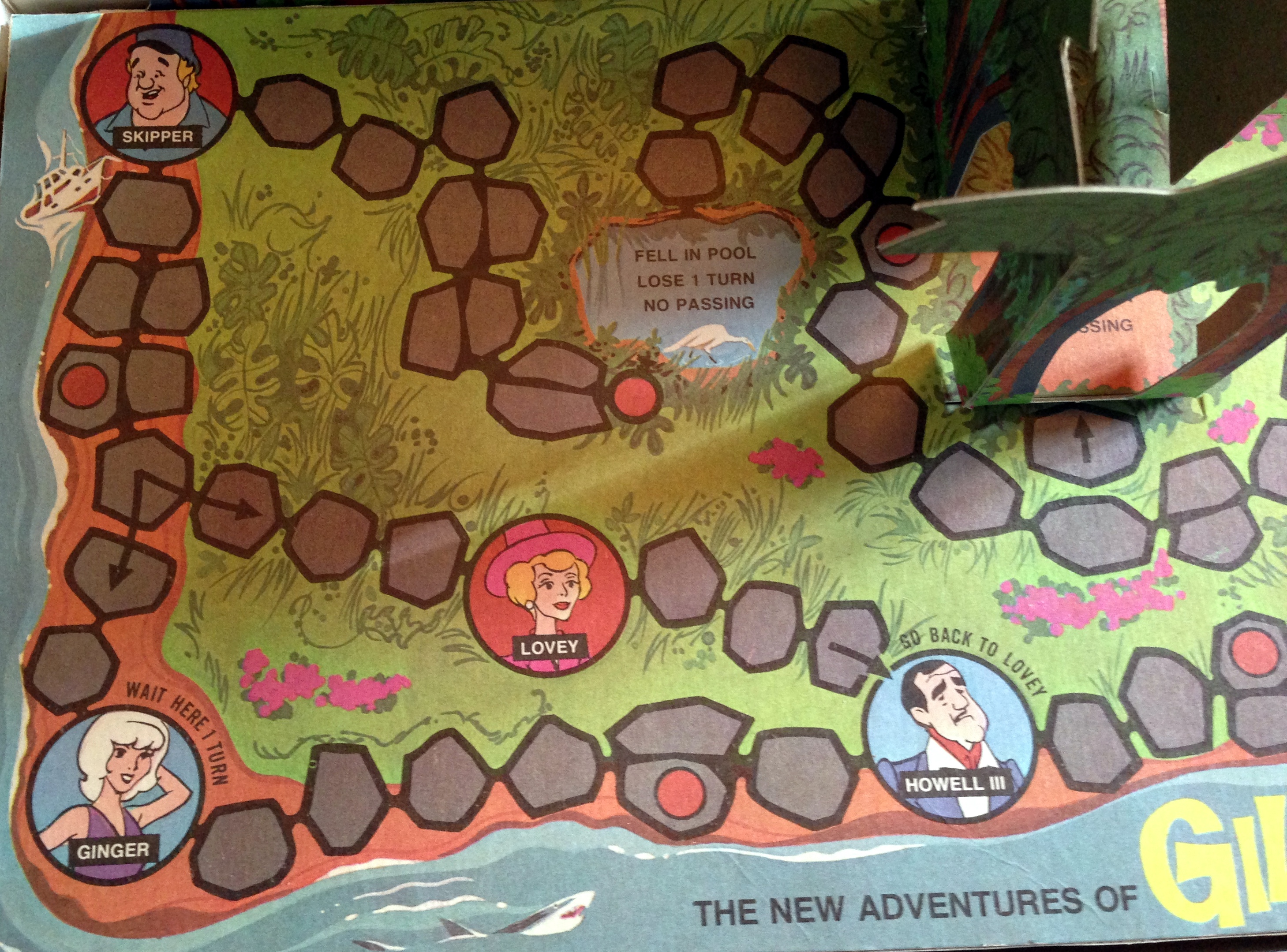
gilligan boardGame Board: Milton Bradley called this a “set-up and play” game. It doesn’t have a board, per se; a cardboard box insert serves that function. Some of the island’s topographical features fit into the insert, giving the game a 3-D look. This adds a bit of visual interest to what is a very basic game.

Recommended Ages: The box says 6 to 12, but I can’t imagine any over 8 enjoying this—or the cartoon, for that matter.

Object: Be first back to the hut.

Game Pieces: Standard plastic pawns.

gilligan board closeupGame Play: You just move your pawn around the “island,” according to your roll of the die. If you roll a six or land on a red space, you take a yellow card and follow its rhyming instructions—for example, “My-o My-o Me/You Can Go Ahead 3.”

Background: This game was not based upon the classic 1960s sitcom but upon the less-than-classic 1970s Filmation cartoon. This cartoon’s only real virtue was that it featured voices from five of the original sitcom cast members.

Other Spin Again Sunday posts you might enjoy:

Planet of the Apes Game

The Muppet Show Game

H.R. Pufnstuf Game

Spin Again Sunday: The Partridge Family Game (1971)

partridge family box

This Week’s Game: The Partridge Family Game, 1971

Manufactured By: Milton Bradley

Object: Being the first to reach the bus after a concert.

Recommended Ages: 7 to 12.

Game Box: A picture of the family, with everyone looking deliriously happy, except Danny. Maybe he’s wondering why they set up to play right outside their bus. The colorful Partridge logo also appears prominently.

Game Board: The same photo appears here, surrounded by a multicolored track.

partridge family board

Game Pieces: Character photos make these much cooler than ordinary plastic pawns. They aren’t durable, though–notice the damage done to Laurie. Keith, oddly, is pristine. Someone must have liked him.

They made these from the photo on the box, so Danny has that same dazed look on his face.

They made these from the photo on the box, so Danny has that same dazed look on his face.

Game Play: The instructions explain it in this ungrammatical fashion: “As on TV, many happenings occur to the Partridge family, this game describes one of them. They have finished playing at local arena and must hurry from there to their BUS to get traveling again. On the way they may have some delays.” (I guess BUS is important, since they put it in caps.)

Players advance along the track by rolling the dice. When they land on a partridge space, they take a card. The cards send them forward or backward, according to whether a particular family member has a good or bad experience. One feature adds a little excitement: If you land on an occupied space, the person who was there has to move backward to your starting point.

Most of these cards make sense, but look at this Laurie card: "Laurie belongs to the 'now generation.' Lose 1 turn."

Most of these cards make sense, but look at this Laurie card: “Laurie belongs to the ‘now generation.’ Lose 1 turn.”

My Thoughts: I paid about 50 cents for this very damaged game. I liked the colorful game board and figured I could do something crafty with it. Five years later, I still haven’t figured out what that will be yet.

Though the game play is boring, I’m sure I would have loved this game as child, and my Partridge pawns would have ended up in even worse shape than these.

Other Spin Again Sunday Posts You Might Enjoy:

The Game of Dragnet

The Waltons

Addams Family Card Game

Family Affair Friday (Not!): Season 2, Episode 12, “Our Friend Stanley,” 12/4/1967 (with vintage toy bonus)

Written by: Henry Garson and Edmund Beloin. Directed by: Charles Barton.

This week’s episode begins with French hustling the twins off to school.

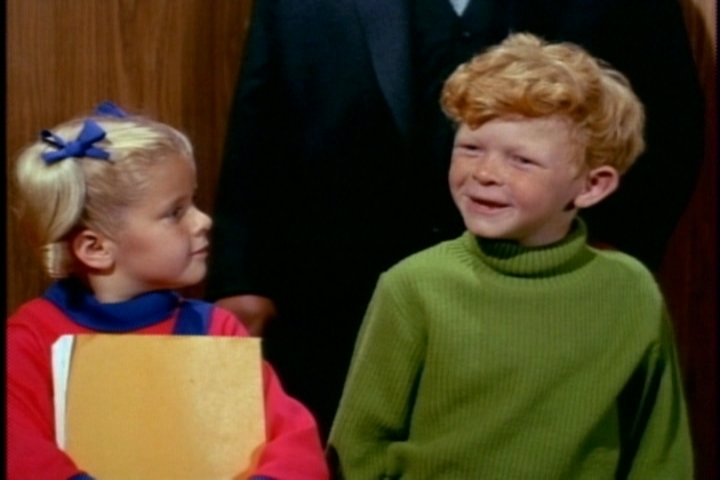
In the elevator, they encounter a sad-looking boy clutched protectively by his mother.

In the elevator, they encounter a sad-looking boy clutched protectively by his mother.

Buffy and Jody, firing off a series of questions that embarrass French, learn that Stanley is new to the building and getting ready to attend his first day at their school. They are pleased to learn that Stanley, like them, is in second grade. (Whew! We’ve emerged safely from last week’s time warp.)

They can’t understand, however, why Stanley and his mother are planning to take a taxi to school, rather than walking.

The light finally dawns when they see Stanley walk out of the elevator.

The light begins to dawn on them when they see Stanley walk out of the elevator.

French explains to them that Stanley has a brace on his leg and encourages them to be friendly and helpful to the boy at school.

(Leg braces always intrigued me when I was a kid. I saw them a lot on TV kids but never on any real ones. Apparently, they were frequently used by victims of polio, which was no longer an issue during my childhood–or Buffy’s and Jody’s.)
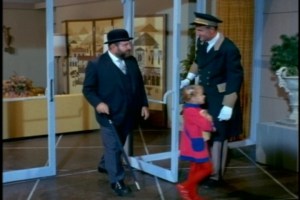
Oh, and one more thing before we get to the kids' school--we get a Scotty sighting in this episode!

Oh, and one more thing before we get to the kids’ school–we get a Scotty sighting in this episode!

At recess, Buffy notices that Stanley is sitting by himself and tells Jody that they should help him. Jody invites Stanley to play marbles with his multi-racial band of friends, but by the time he convinces Stanley to play, the other boys have moved on to leap-frog. Jody still encourages Stanley to join them.”If you fall, you fall,” he says, noting that all the boys fall sometimes.
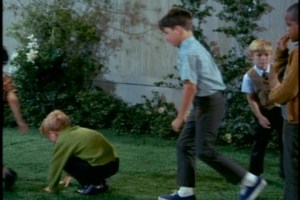
I have a bad feeling about this.

I have a bad feeling about this.

With exquisitely bad timing, Stanley’s mother picks this moment to show up at school with Stanley’s sweater.

Now I've got a really bad feeling about this.

Now I’ve got a really bad feeling about this.

Sure enough, Stanley hits the grass, and his mother doesn’t take it well.
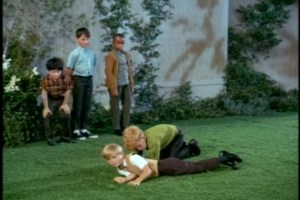
She bans Buffy and Jody from playing with Stanley again.

She bans Buffy and Jody from playing with Stanley again.

Well, that’s going to be awkward because meanwhile, back at the apartment building…

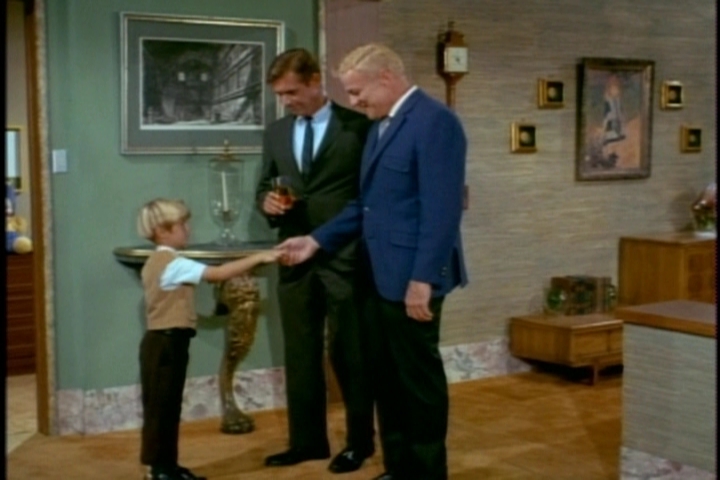
...Bill meets up with one of his many, many old friends in the lobby--and this old friend happens to be Stanley's father. (Incidentally, Bill smokes like a chimney throughout this episode.)

…Bill meets up with one of his many, many old friends–and this old friend happens to be Stanley’s father. (Incidentally, Bill smokes like a chimney throughout this episode.)

Doug invites Bill to stop by later to catch up with him and his wife Estelle. Bill’s visit is marked by pained glances between Doug and Estelle when the subject of children comes up. Sheesh, their kid has a leg brace, not that “elephant man” disease! Eventually, Stanley himself appears, and Bill notices how protective Estelle is of her son.
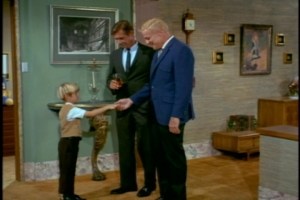
Stanley's apartment has lots of Family Affair green...and what is that table/shelf thing protruding from the wall?

Stanley’s apartment has lots of Family Affair green…and what is that table/shelf thing protruding from the wall?

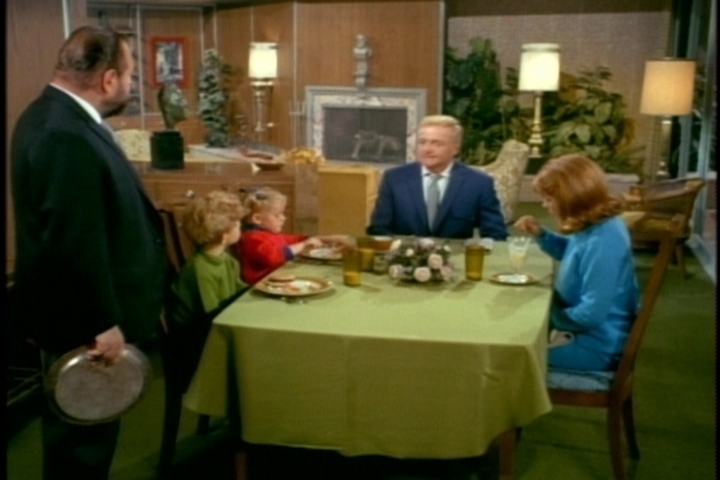
When he returns to his own apartment for dinner, Bill learns that Estelle has forbidden Stanley to play with Buffy and Jody.

A worried Bill tells French that this situation is bad for the twins as well as for Stanley--in the future, Buffy and Jody might try to avoid people with handicaps.

A worried Bill tells French that this situation is bad for the twins as well as for Stanley–in the future, Buffy and Jody might try to avoid people with handicaps.

He decides to have a man-to-man, smoker-to-smoker talk with Doug.

Doug agrees that Estelle is overprotective, but he is reluctant to intervene.

Doug agrees that Estelle is overprotective, but he is reluctant to intervene.

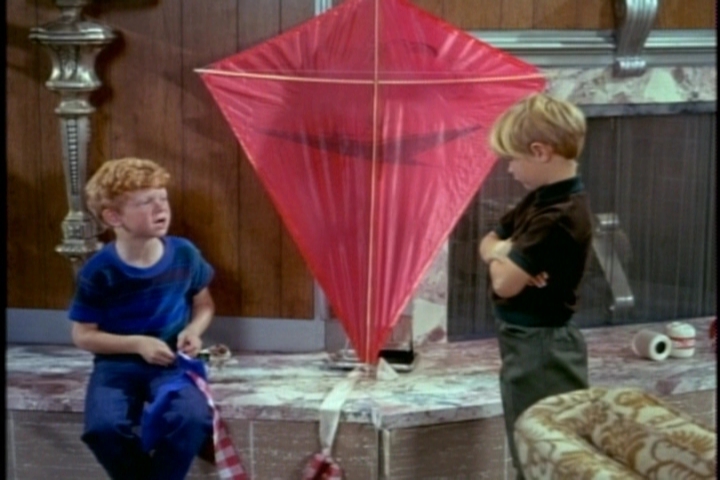
Eventually, however, he agrees to let Bill take Jody and Stanley to the park for some kite-flying.

Bill couldn't have come up with an activity that doesn't require running?

Bill couldn’t have come up with an activity that doesn’t require running?

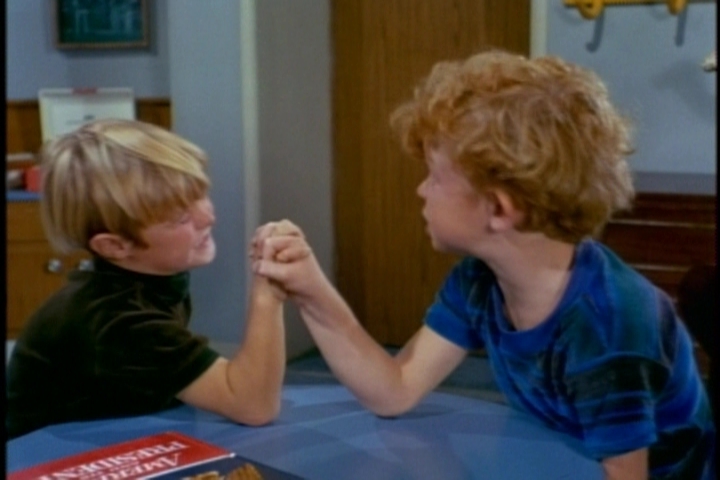
Even before they leave for the park, the situation deteriorates. Stanley has some kind of male-ego chip on his shoulder, and he challenges Jody to a fight. Our sweet-natured Jody has no interest in fighting, but Bill encourages the boys to settle their differences through “Indian wrestling.”

We called it arm wrestling when I was a kid, and not for any PC reasons, I'm sure. We weren't very PC about Native Americans back then.

We called it arm wrestling when I was a kid, and not for any PC reasons, I’m sure. We weren’t very PC about Native Americans back then.

Showing her usual flair for timing, Estelle barges in, having learned about the kite-flying outing and wanting to nip it in the bud.
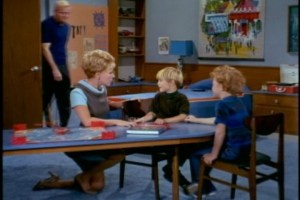
As it turns out, Stanley is an arm-wrestling wizard. When Estelle sees how proud he is to have beaten Jody, she realizes that he needs normal boy experiences.

As it turns out, Stanley is an arm-wrestling wizard. When Estelle sees how proud he is to have beaten Jody, she realizes that he needs normal boy experiences.

Soon, the boys are flying their kites in Central Park.

Buffy, who apparently prefers to sit with Mrs. Beasley, Bill, and Bill's second-hand smoke, expresses her admiration about the way Bill handled the Stanley situation.

Buffy, who prefers to sit with Mrs. Beasley, Bill, and Bill’s second-hand smoke, expresses her admiration about the way Bill handled the Stanley situation.

“I guess you just like kids,” she says.
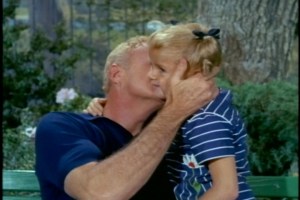
Awww.

Awww.

Commentary

This is a nice episode, one of many in which Buffy and Jody meet a child who is different from them in some way. Uncle Bill’s opinion, that it’s as important for twins to experience friendship with Stanley as it is for Stanley himself, seems rather progressive.
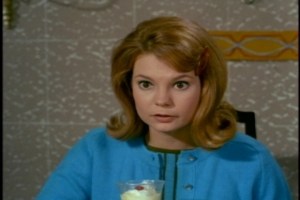
Another episode highlight: Buffy and Jody teasing Cissy about her latest boyfriend.

Another episode highlight: Buffy and Jody teasing Cissy about her latest boyfriend, Harold, a “tall, skinny guy whose bow tie wiggles up and down when he talks.”

Guest Cast

Stanley: Michael Freeman. Miss Jerome: Ila Britton. Eddie: Gary Dubin. Estelle: Sally Forrest. Scotty: Karl Lukas. Doug: John Lupton.

Michael Freeman was a cutie and an okay child actor, so it’s surprising he didn’t get more work. His most interesting credit is “The Boy Pusher” in the 1973 TV movie Go Ask Alice. (I see the whole movie is available on Youtube. That’s got to be good for some laughs.)

Dubin was Punky Lazaar in several Partridge Family episodes.Recent titles in his filmography suggest that his career has gone in, um, a different direction lately.

Lupton starred in a 1950s Western series called Broken Arrow and a short-lived 1960s daytime soap called Never Too Young. He played Tommy Horton on Days of Our Lives from 1967 to 1980. He appeared in an episode of the Sebastian Cabot series Checkmate and in the 1972 film Napolean and Samantha with Johnnie Whitaker.

John Lupton

John Lupton

Forrest found modest film success in movies directed by Ida Lupino (who would guest star on two Family Affair episodes herself); the first of these was Not Wanted in 1949.
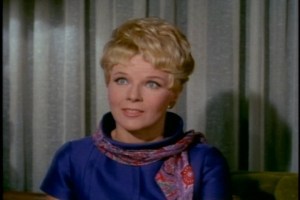
Sally Forrest

Sally Forrest

Inconsistency Alert

The length of Buffy’s pigtails varies from scene to scene–see below and note the length in relation to her ears. They are shorter in her scenes with Uncle Bill; Brian Keith’s abbreviated shooting schedule undoubtedly led to these scenes being shot at a time far removed from the episode’s other scenes.

VTS_01_8.VOB_000104603VTS_01_7.VOB_000622452

Less easy to explain is the way her hair bows change color from red to blue in between leaving the Davis apartment and entering the elevator. Freaky!
VTS_01_7.VOB_000557847VTS_01_7.VOB_000632615

Notable Quotes

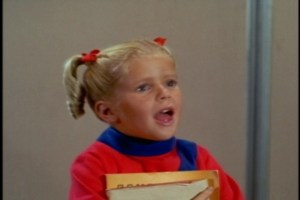
“Once in a while, she just stands there and looks at us and says, ‘Why didn’t I become an airline hostess?”–Buffy, describing her teacher.

This Week’s Bonus Feature

I know I’ve been stingy with bonus features lately, but my husband bought me something yesterday that I just had to share.

Family Affair Colorforms, from 1970!

Family Affair Colorforms, from 1970!

This is one of the few Family Affair toys I didn’t have and one that I particularly wanted–I love Jody’s ridiculous expression on the box. Note also that Mrs. Beasley is wearing a red dress, and Cissy appears to be a 35-year-old woman.

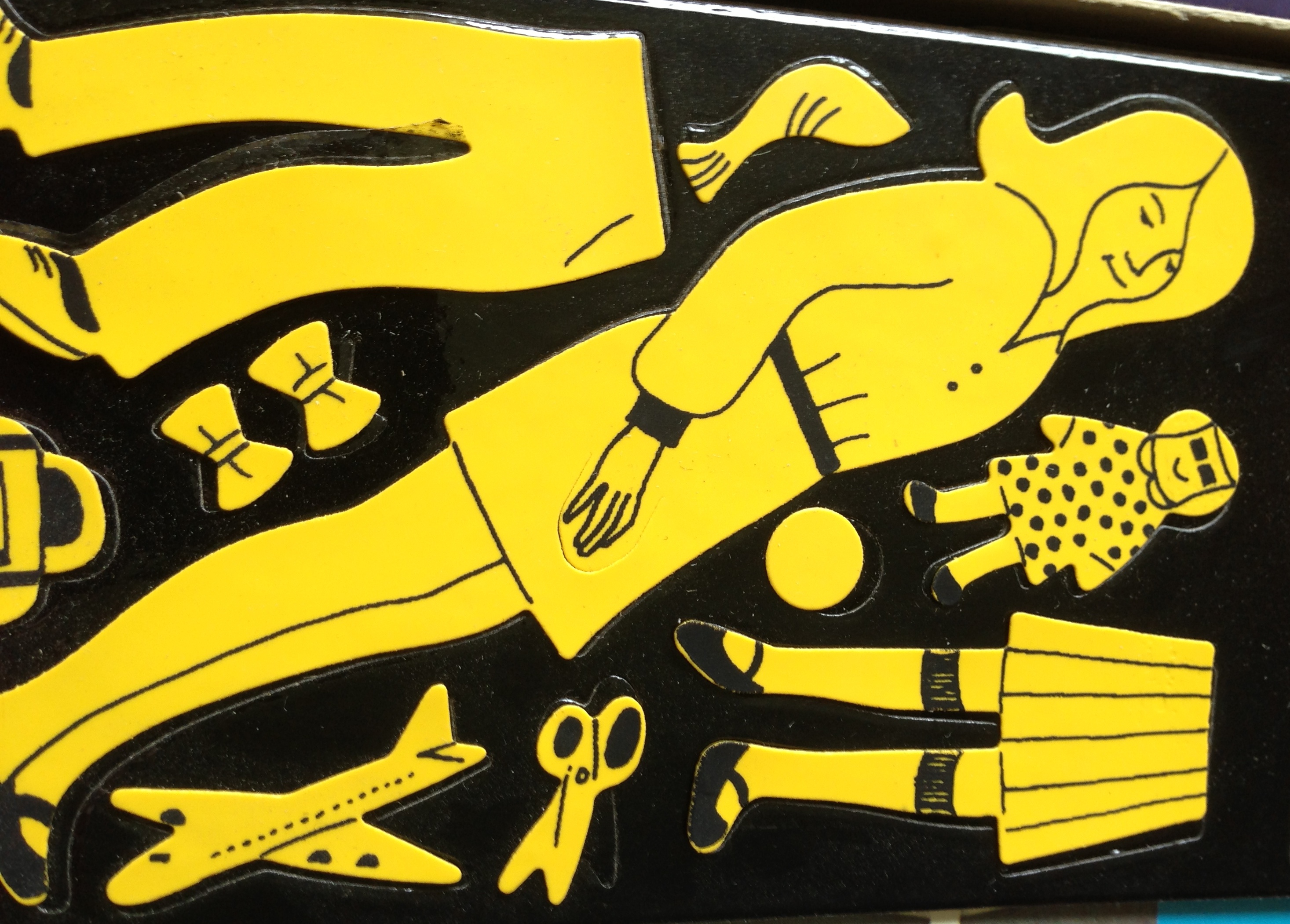
On the inside, the likenesses are even worse.

On the inside, the likenesses are even worse.

All the characters except Cissy have separate top and bottom halves, as well as separate arms.

Wiseacre kids must have had fun with this feature, such as by giving Jody a skirt, Bill a weight problem, and French some tiny legs.

Wiseacre kids must have had fun with this feature, such as by giving Jody a skirt, Bill a weight problem, and French some tiny legs.

I actually prefer the Colorforms version of the Davis apartment to the real one.

And Colorforms Buffy and Jody are lucky--they get a dog.

And Colorforms Buffy and Jody are lucky–they get a dog.

Weird Words of Wisdom: A Swing in Your Walk and a Gleam in Your Eye Edition

“Trouble with you thinker types is you are always so SURE people will act the way you think they should logically act. I gather you aren’t really in favor of teen-age hanky-panky, but you believe the boy must exercise as much restraint as the girl. I agree: This would be just peachy keeno, but life isn’t like that. Males are the conquerors and females, the limit setters. I doubt you moderns can ever eliminate this double standard, and if you do, Heaven help the men! When they are no longer the aggressors, they may become slaves, for many women won’t stop at ‘equality.’”

This girl NEEDS help. A creepy guy is following her around and staring at her. (I think he's trying to figure out her hairstyle.)

This girl NEEDS help. A creepy guy is following her around and staring at her. (I think he’s trying to figure out her hairstyle.)

Helen Help Us by Helen Bottel, 1970

About this Book and Its Author: If mid-century advice columnists were colas, Abby and Ann would be Coke and Pepsi. Helen Bottel? She was RC. Her syndicated column, “Helen Help Us,” ran for 25 years in about 200 papers that were apparently too cheap to spring for one of the bigger names.

Bottel entered the advice game on a dare from husband and began writing a column in her local Oregon paper in 1958. Not lacking chutzpah, Bottel sent her work to King Features Syndicate within three weeks of starting her column. Remarkably, they snapped her up.

Her column wasn’t specifically aimed at teens, but she acknowledged that they were her most frequent correspondents. In this 1970 collection, the letters are exclusively from teens and young adults, and Bottel concerns herself mainly with helping them resist the society’s growing sexual licentiousness. Judging from the letters, it’s an uphill battle; most of them seem to be from girls who “gave in” and regretted it.

Actually, the letters are weirder than most of the advice Bottel gives, and the predicaments the writers find themselves in disabuse one of the notion that they date from a more innocent time. Correspondents include a 16-year-old who’s seeking a divorce from her abusive husband; a high school girl who’s dating an alcoholic 13 years older than she; a girl whose 15-year-old friend “ran away to be with the hippies” and ended up pregnant and with a case of VD; and a 19-year-old guy who’s attracted to a 14-year-old girl (“I’m not going to tell you she is mature in looks and mind because she isn’t, but I feel she has the basic personality traits I look for in a girl.”)

Bottel’s own background was troubled, according to a 1986 People magazine article. Her father deserted the family when she was two, and her mentally ill mother died when Bottel was 15. A caring foster mother put her on the road toward success.

She sometimes used the slangy, quip-heavy style that Ann and Abby relied upon in their early years. Generally, she seemed sincere in her efforts to help, however. All those who wrote in—more than 3,500 per year–received a personal response in the mail.

She gave up her column in 1983, explaining, “I was tired of being the third person in a two-person market.” At around the same time, she attracted the attention of the Japanese newspaper Yomiuri Shimbun, which gave her a fresh outlet for her advice and whose readers relished her American perspective.

Bottel died in 1999.

A Note About My Edition: This 75-cent Tempo paperback wasn’t bound with great care. From page 56, it skips to page 89. Then, after page 114, it goes back to page 89 and starts from there again. I’m missing 33 pages of potentially weird wisdom!

When Weird Words of Wisdom Worlds Collide: Bottel recommends a book by Evelyn Duvall.

Extreme Weirdness Alert: Bottel’s book includes a bizarre letter from a girl who befriended a male TV star’s daughter. When the girls returned home 15 minutes past curfew due to a flat tire, the TV star was angry and got into an argument with the letter-writer, who ended up throwing a hairbrush at him. He, then, took the hairbrush and gave her “a real hard spanking.” This letter doesn’t entirely ring true, unless the TV star was Pat Boone.
Quotes from Helen Help Us

“You can’t turn a boy on and expect him not to catch on fire.”

“With immaturity, poverty, jealousy, distrust, an overdose of ‘family,’ and a slight case of mental illness against it, this marriage has as much of a chance for success as the Penguin against Batman.”

“You kids and a ‘real formal’ adult ball would go together like the Monkees and a minuet.”

“One girl’s wet blanket is another girl’s comforter.”

To an 18-year-old male whose parents won’t let him date: “Nothing will solve your problem faster than the draft. The Army may not be the easiest way to cut apron-strings, but it’s the most effective.”

“If a girl doesn’t stand on ‘Three slaps and you’re out,’ she may REALLY strike out on the fourth pitch.”

“Work on your looks and personality so that fellows will see the sparkle first and discover the sympathy as an added dividend. Change that ‘anxious-to-please’ smile to a friendly grin. Put a swing in your walk and a gleam in your eye. Let men know you’re a female-type girl. That’s all it takes.”

“…males being males, and females being forever feminine, ‘equal rights’ will always be shot full of loopholes.”

“Wild parties make you ‘in,’ all right—TROUBLE!”

“Nice girls don’t advertise—they wait to be discovered.”

“This ‘Pill for All’ bit is something like letting girls visit in men’s dormitory rooms. Much drumbeating, but where it’s allowed, who visits? Almost no one.”

“A kiss shouldn’t make promises a girl doesn’t plan to keep, and if it’s lacking in ‘technique,’ so much the better. As I’ve said before, a kiss is like a salesman’s spiel: If it’s too perfect, you suspect he’s had so much practice he couldn’t possibly be sincere.”

Other Weird Words of Wisdom Posts You Might Enjoy:

“Take It on the Chin, Gal” Edition

Swearing, Shouting, and Backslapping Edition

Twin Sister Smackdown Edition

Spin Again Sunday: The All in the Family Game (1972)

af boxHonesty, I have mixed feelings about the TV series All in the Family, probably because my family let me watch it at much too young an age. On a regular basis, the show assaulted my sensibilities with such concepts as cross burning and attempted rape. I can’t imagine letting my 10-year-old listen as a stream of racial epithets pour forth from the TV–but, thankfully, she doesn’t live in a world where she hears those words on a regular basis from relatives, as I did. Along with my parents’ guidance, All in the Family did reinforce to me how ridiculous racism was, and for that, I’m grateful.

Though most of the show’s characters creeped me out to varying degrees, I always loved Edith. She reminded me a lot of my beloved maternal grandmother–naive, confused, but kind-hearted. As a child, I was shocked when I first heard Jean Stapleton interviewed and realized she didn’t talk like Edith. It produced an early epiphany about how convincing acting can be.

I’m featuring this game in Jean Stapleton’s honor.

af answer

This Week’s Game: The All in the Family Game, Milton Bradley

Copyright Date: 1972

Recommended Ages: 10 to Adult

Object: “Guess Archie’s Answers”

Game Play: One person acts as “the MC” and asks questions from the game booklet. Players write their answers down on slips of paper and pass them to the MC. When the responses are read aloud, players earn points by guessing which player gave each answer. The MC also reads Archie’s answer to each question (or, in some cases, Edith’s answer). Players who matched that answer get an extra point.

af question

“Clever or unexpected responses often throw the party into peals of laughter,” the game box assures us. I can imagine that might be true, but the “official” answers from Archie and Edith aren’t exactly uproarious. Some examples:

How do you feel about being a sex symbol?

Archie: If the shoe fits–why take it off?

With my background, I should be a…

Archie: Boss over something.

What’s with hips?

Archie: They should be watched.

What do you think of Bangladesh?

Edith: I never played that game.

Spin Again Sunday: What Shall I Be? (1972)

what shall i be box

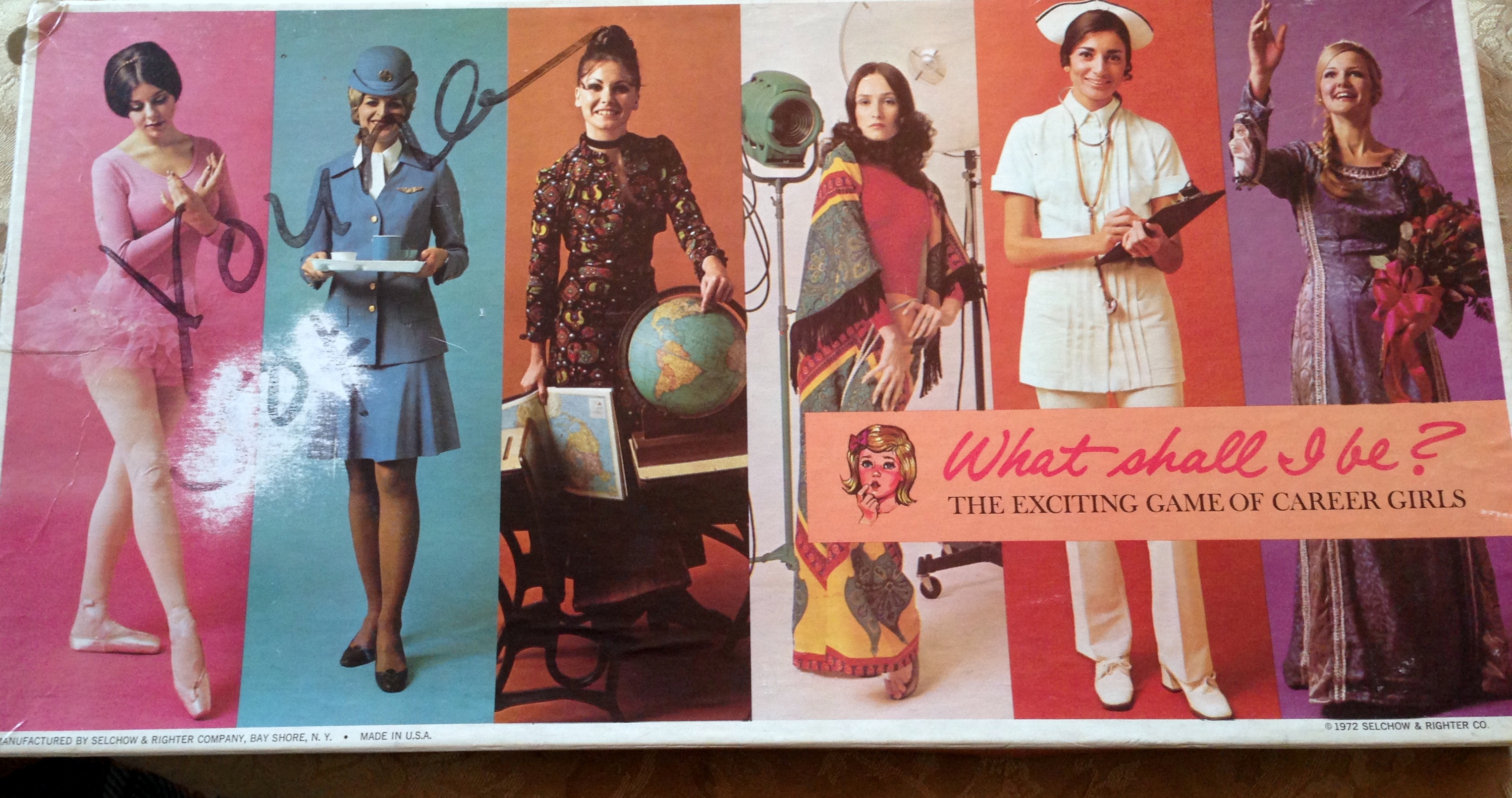
Spin Again Sunday is back! After a long hiatus–for which I apologize–I return with a game that explores the full gamut of careers available to women–ballerina, airline stewardess, teacher, model, nurse, and actress.

Actually, by 1972, even the good people at Selchow and Righter (who also brought us The Bride Game and The Emily Post Popularity Game) realized that their game was slightly retrograde. They could have opted to redesign the whole the game, but that probably would have cost a lot of money. Instead, they reissued their 1966 game board but added this disclaimer to the inside lid:

what shall i be disclaimer

I suppose they figured that would keep Gloria Steinem off their backs.

This Week’s Game: What Shall I Be? The Exciting Game of Career Girls

Manufactured: 1972, Selchow & Righter

Recommended For: Girls ages 8-13

Game Board: Drawings on the board–copyright 1966–show somewhat more conservative versions of the career girls than the full color photos on the 1972 box.

what shall i be board

Game Pieces: The pawns are your basic colored plastic items. The game also involves three kinds of cards. School Cards represent the formal training needed for each career.

what shall i be cards

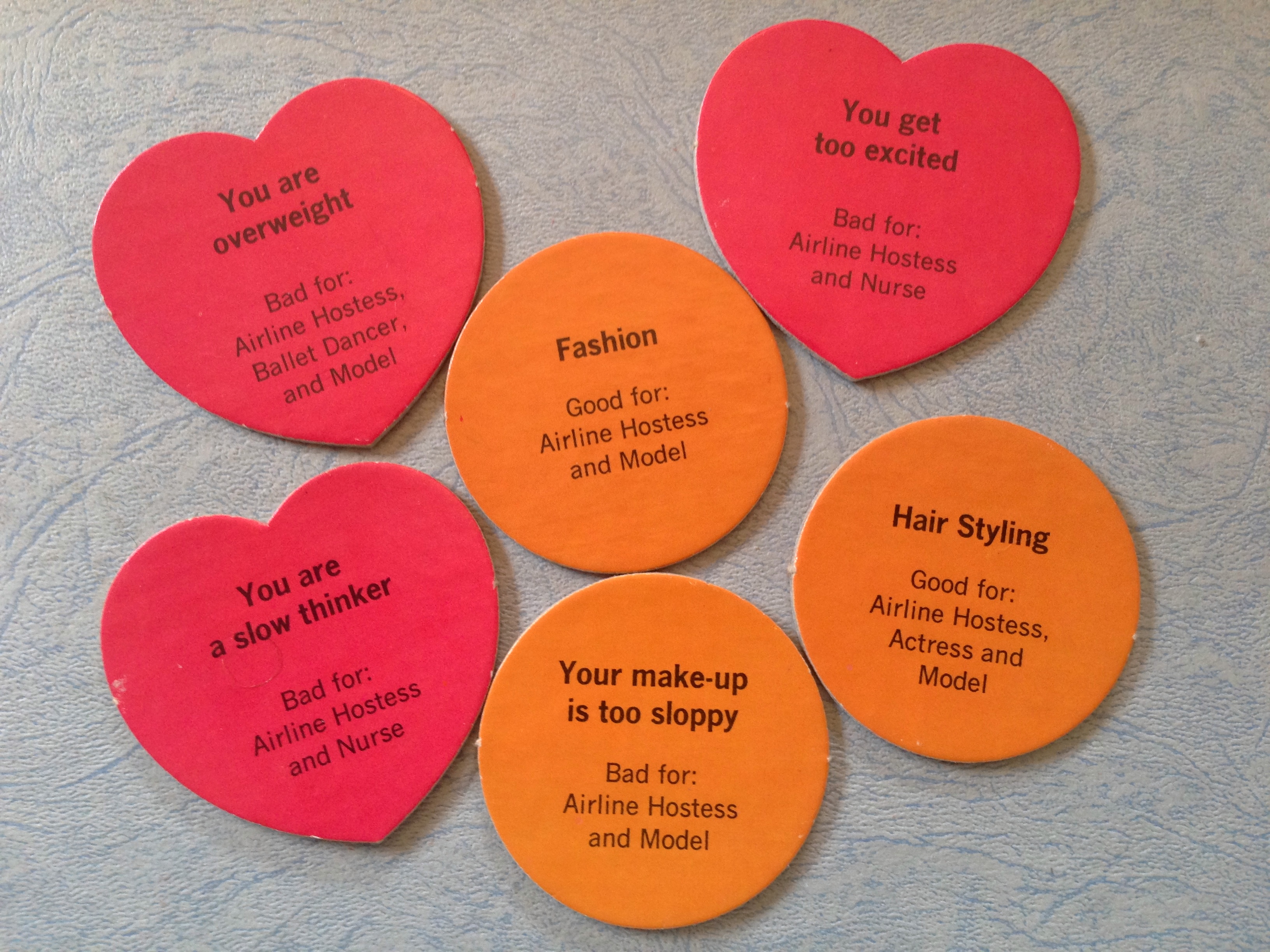
Players also need to collect round Subject Cards and heart-shaped Personality Cards that support their career ambitions. (As you can see, cards can also work against success in certain careers. No fat chicks need apply for stewardess!)

what shall i be cards 2Game Play: Players move around the board and collect cards according to the spaces on which they land. The first player who collects four school cards for one profession, plus two Subject Cards and two Personality Cards that support that profession wins.

My Verdict: As silly as it seems now, this game would have appealed to me when I was 8 or so. Remember those cheap toy doctor’s and nurse’s kits that you could buy anywhere? My mom was always trying to raise my consciousness by buying me the doctor one, but I always wanted the nurse version.

Other Spin Again Sunday posts you might enjoy

The Waltons

Barbie Miss Lively Livin’

Patty Duke Game

Weird Words of Wisdom: Swearing, Shouting, and Back-Slapping Edition

teenager

“My prime concern is that, back at the childhood stage, parents and schools not encourage girls to be competitive with males if that is going to make them dissatisfied with raising children, their most creative job in adulthood, whether or not they go to work too.”

A Teenager’s Guide to Life and Love, 1970
By Dr. Benjamin Spock

Dr. Benjamin Spock

Dr. Benjamin Spock

About the author: Dr. Benjamin Spock was one of the most influential authors of the 20th century. His Baby and Child Care, first published in 1946, had sold more than 50 million copies by the time of Spock’s death in 1998.

Marking a shift from authoritarian parenting models, Spock’s book encouraged parents to trust their instincts and treat their children as individuals.

By the time Spock published this book for teenagers, he had attracted controversy for his protests against the war in Vietnam. In 1972, he would run for president on the People’s Party ticket, advocating for legalized abortion and marijuana and socialist economic policies. Unsurprisingly, he became a lightning rod for criticism from the right, which blamed his “permissive” parenting model for causing societal ills. (Recently, on a true crime message board I follow, one poster even blamed Spock’s influence for the Newtown, Connecticut, school shootings.)

In this book for teens, Spock doesn’t advocate any permissiveness. He makes the usual admonitions against smoking, drinking, marijuana use, and teenage sex.

When it comes to gender roles, he’s downright old-fashioned. He labels any female interest in non-baby-oriented achievements as signs of “rivalry” or “aggressiveness.” By 1970, many women were openly expressing dissatisfaction with being forced into a housewife role. Spock blames their feelings on parents and schools who have treated women in too egalitarian a fashion.

Spock’s reliance on Freudian theories of sexual development explains some of his weirder statements in this book, including the total WTF-ery that is this passage:

“I’d like to take this occasion to warn boys who earn money as sitters that a girl in the three-to-six-year-old period can become very seductive if for instance she gets excited in rough-h0using, just because she is at the early-childhood sexual-romantic stage, yet hardly knows what she’s doing. A youth with strong sexual feelings of his own may find it difficult to resist such as disarming temptation to sex play unless he’s somewhat prepared.”

Within a year after this book was published, Spock spoke at the National Women’s Political Conference and got an earful from Gloria Steinem and other feminists about sexism in Baby and Child Care. To his credit, he listened and learned from that experience, revising future editions of his work to eliminate sexist language.

Quotes from A Teenager’s Guide to Life and Love

“I think that treating the two sexes alike pits them against each other to some degree and increases the rivalry due to other causes. Women in America during the past 50 years have increasingly been wearing clothes and doing their hair like men. Some of them now drink, shout, backslap, use obscenities and tell dirty stories like men. In these respects I think they have been motivated more by rivalry than by natural inclination.”

“…the thing that I’m concerned about is that quite a few women nowadays, especially some of those who have gone to college, find the life of taking care of their babies and children all day boring and frustrating…I think that the main reason so many mothers are bored is that their upbringing and their education have made them somehow expect to get their satisfaction and their pride as adults from the same occupations outside the home as men.”

“One big trouble is that schools and colleges don’t teach about the tremendous contribution that women make to any society in raising the children and inspiring them to do great things. Schools and colleges hold up for admiration the statesmen, generals, inventors, scientists, writers, composers and industrialists. So these are the careers that bright girls as well as bright boys dream of. When young women find themselves instead taking care of their children all day, some of them feel they aren’t using their education, aren’t being fulfilled…I would say it is much more creative to rear and shape the personality of a fine live child than it is to work in an office or even to carve a statue.”

“When a significant portion of the women in a society become more rivalrous and aggressive, over several generations, they can push a proportion of the males into a more submissive role.”

“Another way in which some men have lost considerable sense of pride and masterfulness is by no longer being the only breadwinner in many families.”

“I believe that if a girl is raised at home and taught in school to have pride in the creativity of motherhood, joy in being a woman, a sense of fulfillment through her ability to understand and help people, she will be happier as a wife and mother. And then if she has an outside career in addition, whatever it is, she will bring her womanliness to it…In other words, she won’t feel that the main satisfaction of any career is to compete with the men at their own game.”

“What about the insensitive boy who persists in making advances—even forcibly—despite a girl’s sincere resistance? She has to be ready to fight and scream if necessary. But this possibility raises the question whether a girl really has to get into a situation in which she is at the mercy of a boy whose crudeness she is not aware of. The answer generally is no.”

“…boys and men on the prowl take it for granted that a girl who accepts rides from semi-strangers is probably looking for excitement.”

Other Weird Word of Wisdom posts you might enjoy:

Mugging, Smooching, and Flinging the Woo Edition

Embracing Our Nature and Destiny Edition

Big Splendid Manhood Edition