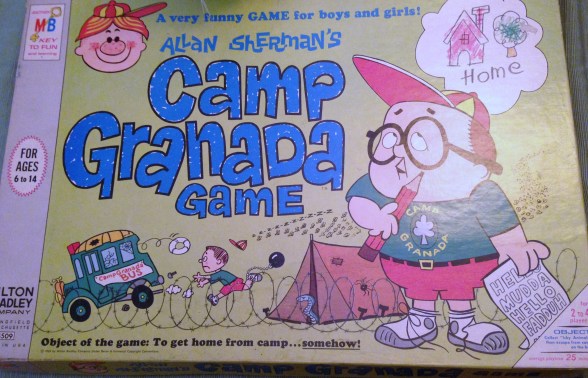
Spin Again Sunday: Allan Sherman’s Camp Granada Game, 1965

I’d like to wish a happy Chanukah to everyone who is celebrating it. I’m part of an interfaith family; my husband gives me presents at Christmas, and I give him presents for Chanukah. Last night, he opened this vintage board game.

My husband’s a big fan of Allan Sherman’s song parodies, so as soon I learned that this game existed I knew I would get it for him someday. It’s based on Sherman’s biggest hit, “Hello Muddah, Hello Fadduh,” and, like the song, it explores the perils of summer camp.

This Week’s Game: Allan Sherman’s Camp Granada Game, 1965, Milton Bradley.

The Box: Large and lime green, the box features cute cartoon illustrations and crayon-style lettering.

The Board: The board introduces you to all of Camp Granada’s “attractions,” from Cruddy Creek to Quicksand Beach to the Bawl Park.

Each player sets up a bunk house near the board.

The Object: “To be the first player to collect 3 icky animals and go home by driving the bus out the exit gate.”

Game Play: For once, I have someone to help me explain:

Players set up the game by placing an icky animal on each red space. You start the game with 3 icky animal cards. Bus cards direct you where to go on the board, and you collect whatever icky animal is waiting for you. You can only drive the bus home after you’ve collected the specific animals on your cards. You hide your cards and your animals in your bunk house, so other players don’t know what you’re looking for. In certain situations, players can steal each other’s animals. If the bus’ radiator falls out during a player’s turn, that turn is over.

Fatal Flaw: My daughter loved the sticky rubber animals in this game, and she couldn’t wait play. We had fun, but the bus is a huge pain—it’s almost impossible to keep the radiator from popping out every two seconds. The manufacturers knew this was a problem: The rules include “Special Advice from Allan Sherman” about keeping the wheels straight. The rules also allow for beginning players to have 2 or 3 “free” breakdowns in each turn.

My Thoughts: This is a clever game with lots of cute details. It’s too bad the bus doesn’t work well, but we found ways to work around the problem.

Other Spin Again Sunday posts you might enjoy:

Barbie Miss Lively Livin’, 1970

Addams Family Card Game, 1965

Dr. Kildare Game, 1962

Family Affair Friday(ish): Episode 13, The Thursday Man, 12/12/1966

I apologize for the lateness of this week’s entry in my Family Affair series.

Episode 13, “The Thursday Man,” 12/12/1966

Written by: Edmund Hartmann (the show’s executive producer). Directed by: William D. Russell.

Synopsis

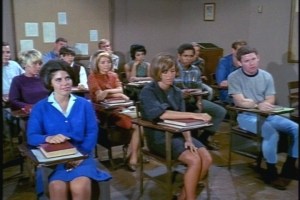
Cissy’s attempt at a composition about Mr. French leads her to the conclusion that people are truly unknowable (rather a pessimistic thought for a TV teen).

At least Cissy's classmates find her composition interesting.Well, maybe that one in the front left does.

At least Cissy’s classmates find her composition interesting.
Well, maybe that one in the front left does.

Her teacher challenges her to find out more about Mr. French, and Cissy begins a great deal of snooping.

withers

All she gets from French’s frenemy Withers is a description of French as “opinionated, stubborn, aloof, difficult, and stiff-necked.” Oh, and apparently French becomes unhinged if you mention “Old Bertie.”

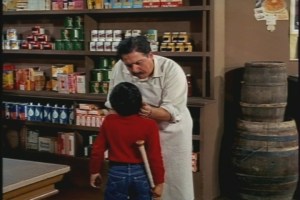
So what does Cissy do next? Confront Mr. French about Old Bertie, of course.

French's reaction is painful to behold. You'd think this might stop Cissy, but no...

French’s reaction is painful to behold. You’d think this might stop Cissy, but no…

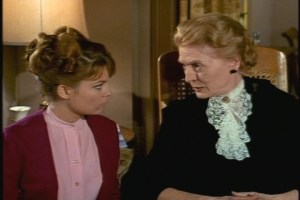
She really crosses the line by pretending to check his credit references with an old lady he secretly visits every Thursday. When Cissy confesses her true identity, Mrs. Allenby tells her the sad truth: Mr. French was once in love with a girl who died in the London blitz.

And “Old Bertie,” a name that provokes a strong reaction in French? It’s a stuffed dog he won for his girl and the only trace of her he found after the blitz. Cissy vows to keep the secret and refrain from violating the privacy of others.

Old Bertie

Old Bertie

Commentary

It’s painful to watch Cissy nosing around in the life of someone who so clearly values privacy (and what kind of teacher would turn a student into a junior Kitty Kelly?).

The teacher in question. Between her and the teacher we'll meet next week, I'm wondering if public school was such a good idea.

The teacher in question. Between her and the teacher we’ll meet next week, I’m wondering if public school was such a good idea.

Sebastian Cabot does a wonderful job conveying hurt and indignation when Cissy confronts him with the name “Old Bertie.” Cissy really goes over the line by pumping Mrs. Allenby for information, but watching her realize that she really would rather not have known the sad truth is gratifying.

Cissy and Mrs. Allenby.

Cissy and Mrs. Allenby

It’s wonderful to get some back-story on Mr. French, and a scene between him and Old Bertie and Buffy and Mrs. Beasley is sweet.

Guest Cast

Mrs. Allenby: Kathryn Givney. Freddy: Eugene Martin. Withers: Richard Peel. Mrs. Mariani: Lillian Adams. Miss Elliot: Ila Britton. Miss Faversham: Heather Angel.

Fun Facts

Mr. French was born in the West End of London. His father and grandfather were both butlers. He has worked for Uncle Bill for nine years–they met when Uncle Bill was working on a project in London. Mr. French’s first name is Giles, and his day off is Thursday.

Notable Quotes

Cissy: “It kind of scares me…I mean, trying to get personal with Mr. French.”

Cissy: “Maybe men aren’t as inquisitive as women.” Uncle Bill: “Maybe we respect each other’s privacy, too.”

Today’s Bonus Feature

An article about Sebastian Cabot from Photoplay, October 1967.

Old-Time Radio Playlist: Christmas, Part 3

draft_lens18469959module153045563photo_1315359699JollyI’ve been sick the past two days, which has put me behind on my blogging schedule. This is the third part of my Christmas OTR playlist.

This week, Family Affair Friday will appear on Saturday.

Read part one and part two of my Christmas playlist.

“First Song—Let it Snow”

Dinah Shore Chevrolet Show, December 22, 1954

“First Song—Sleigh Ride”

Dinah Shore Chevrolet Show, December 24, 1954

“Even though the snow may be artificial out here in Hollywood, the sentiment isn’t at all.”

About the Dinah Shore Chevrolet Show: Popular singer Dinah Shore was a fixture on radio throughout the 1940s; according to the Digital Deli Too, she headlined six different shows. The television era brought her even greater fame. The Dinah Shore Show, sponsored by Chevrolet, premiered in 1951 as a 15-minute, twice-a-week program and became an instant hit. From 1953 to 1955, the Dinah Shore Chevrolet Show also aired on radio.
Musical Notes: Songs on the first show include “Let it Snow,” a Rodgers and Hammerstein song called “Happy Christmas, Little Friend,” and the pop standard “Teach Me Tonight.” The second show is all Christmas—besides “Sleigh Ride,” it includes “Silver Bells” and a medley of religious Christmas carols. (I wonder if Shore, who was Jewish, felt strange singing those.
My Verdict: I like the 15-minute length of these—it allows for several songs but limits the cheesy variety show comedy banter.

“’Twas the Night Before Christmas”

The Great Gildersleeve, December 24, 1944

“The only excuse for the kind of suffering that’s going on, all over the world, is if we can make sure it never happens again…Let’s sing the way we used to when we were at home together, and let’s hope that before so very long, all the peoples of the world will be able to join in with us.”
About The Great Gildersleeve: This show, built around a character first heard on Fibber McGee and Molly, was the first successful spinoff. It ran from 1941 to 1957.
Story: December 23rd finds Gildy blue. He’s expecting to be the subject of a breach of promise suit, and he thinks his frenemy Judge Hooker will be handling the case against him. When the judge tells him there’s no case, Gildy is finally ready to celebrate Christmas with family, friends, and his two favorite flames.
Musical Notes: The cast sings “Joy to the World,” then Harold Peary breaks, um, whatever you would call the fourth wall in radio, and invites the studio and radio audience to join in.
My Verdict: Maybe my sinus infection is making me sappy, but I got teary listening to the closing speech and song.

“Christmas Shopping for Perfume and a Necktie,” December 17, 1939

The Jack Benny Program

“You walked in, Sugarfoot. Nobody dragged you.”

Story: usual in the Jell-o era, things ramble a bit before Jack and Mary head out to do Jack’s Christmas shopping.
Celebrity Name Droppings: Gary Cooper, Barbara Stanwyck and Robert Taylor, Clark Gable and Carole Lombard.
Jell-o Hell No Suggestion of the Week: Lemon Jell-o with stewed figs and whipped cream.
My Verdict: I think most fans prefer the more polished Lucky Strike shows, but I love the freewheeling Jell-o era. The shopping trip has some fun supporting characters, and jokes about Mary’s history with the May Company are always welcome.

“Christmas for Carole”

Suspense, December 21, 1950

“You asked for this, kid. Now do as you’re told.”

Story: A bank teller’s pregnant wife is having complications and needs full-time nursing care. Unable to afford it, the teller decides to take a one- time trip into the criminal world.
Notable Performers: Singer Dennis Day, best known as a member of the Jack Benny cast, gives a good dramatic performance. Suspense often enabled actors to stretch their range in this way.
Musical Notes: You don’t think you’ll get through this without Day singing do you? He performs “The First Noel.”
My Verdict: The story keeps you guessing, and although everything works out a little too neatly in the end, you can forgive such things at Christmas.

Weird Words of Wisdom: Boring Beth and Sunshiny Sue Edition

“Develop a grand passion for the humble hard-boiled egg.”
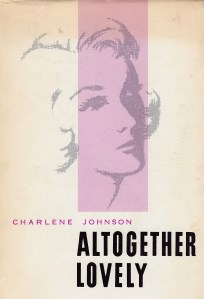
altkoAltogether Lovely, 1960
By Charlene Johnson

About This Book and Its Author: “Different!” this book’s dust jacket announces. “That is the word which best describes this book.”

I have to agree with that. The teenage advice book market has certain subsets. Religious books, especially those from an evangelical Christian perspective, are common. So are books that focus on beauty and fashion. Not many authors attempt to combine these two perspectives.

Charlene Johnson, though, was both a model and the wife of a budding minister. Knowing nothing more about her than what’s in this book, I can tell she brings a lot of enthusiasm (as measured by exclamation points) to both roles.

Johnson usually spends most of a chapter discussing beauty and personality, then shifts to spiritual life. These transitions can be abrupt. Consider this paragraph from the chapter on skin care:

“Interesting, isn’t it? To think of the glands, pores, body oils, eyes, brows, mouth, teeth and all. How wonderfully we are made! I have often wondered how any thinking person could ever be an atheist.”

The other thing I know about Johnson is that her adolescence must have been a lot different than mine. She calls the teenage years “the most sparkling, exciting years of your life.”

IMG_0003

Quotes from Altogether Lovely

“Everybody wants to be popular!”

“’Miss Popular Teen’ has that indescribable something known as personality. She sparkles! She’s alive!”

“(Overweight) is the biggest bar to good looks; the best looking outfit or hairdo in town just won’t look sharp on an overweight girl.”

When walking: “Keep smoothness and complete poise and regalness foremost in your mind.”

“Walk quietly, smoothly—like a bride.”

Really? Never? Even if you're at the supermarket, staring at the cereal selection or something?

Really? Never? Even if you’re at the supermarket, staring at the cereal selection or something?

“Notice people as they sit down. Observe the awkward contortions many people go through just to sit.”

Well...this one I can get behind.

Well…this one I can get behind.

On Lipstick: “Use light, bright shades. They are so much younger, so much prettier. A dark mouth is a hard mouth.”

“White gloves are a must with heels.”

Proper dress for church: “A teen-ager should always wear nylon stockings and probably French heels…A hat, white gloves and small pearl earrings are in excellent taste.”

“Parties, luncheons, and even teas are becoming a part of your social life; right?…I’m sure you know that such affairs are dressed-up occasions—meaning heels and white gloves.”
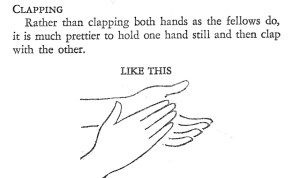
clap

By the way, Johnson’s seminary-student husband did the illustrations for this book.

Something you probably won’t see in a current advice book for evangelical Christian teens: “The pitter patter of the teenage heart—the heartbeats, the heartaches, the heartbreaks—they’re all thrillingly yours. Enjoy every wonderful minute of teenage romance. The dating period is one of the happiest, most captivating and important experiences of your lifetime.”

“If you were the boy, which girl would you rather spend time with: (1) Boring Beth—quiet, dull, uninteresting? or (2) Sunshiny Sue—full of vim, vigor, fun, and life?”

You ain’t seen nothing yet: “If I could only tell you girls how deeply concerned I am with the shocking divorce rate in our country.” The U.S. divorce rate doubled between 1960 and 1980. It has since declined slightly.

“Being a housewife is just about the most wonderful profession in all the world for any woman…The housewife is the very center of love and sunshine and kindness in the home.”

On husbands: “Don’t completely domesticate him. Certainly there are little things he will like to do: play with the kiddies, or flip pancakes, or do the ‘man’s work’ around the home. Let him offer to help you, he wishes; don’t ever insist.”

“When he comes home for the office, make him proud of you. Look lovely—your hair combed, your appearance neat, your lipstick on, a pretty smile, and a loving kiss. See that the children are clean and the house tidy. Have dinner ready. Make him whisper deep down inside every night, ‘There’s no place like home. How lucky I am.’”

The Six Basic Personality Types and What They Wear

Sweet and feminine:“This miss is usually small in stature, soft spoken, and fair.” She should wear full skirts, pastels, and flowers in her hair.

Sporty: These types should wear “tailored, tweedy clothes” and woodsy colognes.

Queenly: “A true lady.” She likes simple, elegant clothes “and is lost without her white gloves.”

Slightly Sophisticated: She is tall, slender and “likes extremes in fashion.”

Exotic: “She has a ‘different’ look about her, and dresses to dramatize that.”

Vivacious: Full of life and pep, she “has her own happy flare for individual clothes.”

An echo in here: On the subject of makeup, Johnson writes, “Young eyes need no enhancement. They have their own sparkle and fire.” This is oddly similar to the wording in another book we’ve looked at—Once Upon a Dream by Patti Page, also published in 1960. Page wrote, “If you’re young and healthy, your eyes have enough sparkle and fire without needing any ‘extra added attractions.’” I’m not sure what to make of this. Maybe young eyes having “sparkle and fire” was part of the zeitgeist in 1960.

Other Weird Words of Wisdom posts you might enjoy:

A Million and One Tricks with a Strand of Pearls Edition

The Five Types of People Who Go All the Way Edition

Crisp White Gloves Edition
Old-Time Radio Playlist: Christmas, Part 2

kittenThis is the second part of my Christmas OTR playlist. I’ll be posting more episodes each Tuesday and Thursday through Christmas.
Read part one of my Christmas playlist.

Mailing Christmas Packages”
Fibber McGee and Molly
, December 10, 1940


“Our papas all believe in Santa Claus…so why should we tell them any different if it makes them happy?”
Story: The McGees wait in line at the Post Office to mail Christmas packages. That’s as much “story” as a Fibber McGee and Molly episode needs.
About Fibber McGee and Molly: A top-rated program throughout the 1940s, this series was a creative partnership between performers Jim and Marian Jordan and writer Don Quinn. Absurd comedy, clever wordplay, and a down-to-earth feel were its trademarks.
Musical Notes
: The King’s Men’s song is, um, interesting.
Celebrity Name Droppings: Fibber mentions Oliver Hardy, Paul Whiteman, and Don Wilson—can you guess what common quality among them that he was citing?
Fun Fact: McGee tells Gildersleeve that he once worked for the post office. According to John Dunning’s On the Air, Jim Jordan actually did work briefly as a mailman in Peoria, Illinois.
My Verdict: No matter how much Christmas changes, long postal lines endure. The episode’s premise provides amusing ways for the McGees to encounter all the usual secondary characters, including Gildersleeve, Mrs. Uppington, and Teeny.

“Special Christmas Story”
Lum and Abner, December 24, 1942


“I’ll say one thing about the folks: In spite of the rationing and the dim-outs and everything, everybody’s doing all they can to keep up the Christmas spirit.”
About Lum and Abner: Chester Lauck and Norris Goff created and portrayed the title characters in this long-running comic serial. (They played all the other characters, too.) The show’s authentic rural humor stemmed from its creators’ small-town Arkansas background, and Lum and Abner’s rapport reflected the real-life friendship Lauck and Goff established in their youth.
Story: Last-minute shoppers at the Jot ‘Em Down Store are out of luck on Christmas eve, as Lum and Abner become engrossed with an electric train on display.
Referencing Radio: Cedric is quite a Lone Ranger fan.
My Verdict: This is a cute, schmaltz-free holiday episode.

“I’ll Be Seeing You”
Lux Radio Theater, December 24, 1945
“Yes, I think we’ll do just fine…just fine.”


Story: Zack and Mary meet on a train feel an immediate attraction. They spend time together during the Christmas holidays, but each carries a secret burden: Soldier Zack is recovering from shell shock, and Mary is on furlough from prison.
About Lux Radio Theater: Dunning calls Lux Radio Theater “the most important dramatic show in radio.” It is certainly the lushest, with big budgets and big stars to re-create stories from the big screen. It aired from 1934 to 1955.
Notable Performers: Joseph Cotten and Dorothy McGuire
Musical Notes: At Christmas dinner, everyone sings “O Little Town of Bethlehem.”
Referencing Radio: Mary makes a joking reference to Life Can Be Beautiful, a soap that ran from 1938 to 1954.
Interesting History: The announcer urges housewives to keep saving cooking fats; although the war and rationing had ended, soap manufacturers still faced a shortage of necessary oils.
Weird Words of Wisdom: Aunt Sarah has an unusual philosophy—always settle for second-best.
My Verdict: Joseph Cotten is one of my very favorite actors, so it’s no surprise that I find his performance outstanding. I’ve been indifferent to Dorothy McGuire’s movie acting, but she impressed me here, too. With just their voices, they both believably convey their characters’ fears and tentative yearnings. Teenage Barbara annoys, but I guess she’s supposed to.

“Five Days Off for Christmas”
Night Beat, December 21, 1951
“They say there’s a warmth about Christmas that spreads out like a fan and touches everyone—the holiday spirit, it’s called.”


Story: Reporter Randy Stone is thrilled to get a rare Christmas vacation from work, until he realizes that he has nowhere to go and no one to be with. While feeling sorry for himself, he receives a mysterious invitation. When the boy delivering that invitation gets hit by a car and vanishes, a shaken Randy has a mystery to solve.
About Night Beat: In this well written series, Randy Stone looks for human interest stories in Chicago’s darkened streets.
Notable Performers: In the 1940s and 1950s, series star Frank Lovejoy was a familiar voice on radio and a familiar face in films like The Hitchhiker.
My Verdict: Poor Randy. I’d spend Christmas with him, even if his self-pity makes him act stupid here. I mean, with all the people a reporter meets, why does he decide so quickly that he doesn’t know Kathryn Malloy?

“The Magic Christmas Tree”
Our Miss Brooks, December 25, 1949
“Oh, what fun it is to rock with a big, fat drunken cat.”


Story: Alone on Christmas Eve, Connie encounters her Madison High family, first in a fun fantasy sequence and then in reality.
About Our Miss Brooks: This popular comedy, built around Eve Arden’s sardonic comedy style as teacher Connie Brooks, ran for nine years on radio and five years on TV.
Notable Performers: Besides Arden, the series cast included radio and TV fixture Gale Gordon (Mr. Conklin) and future movie stars Jeff Chandler (Mr. Boynton) and Richard Crenna (Walter).
My Verdict: I like Our Miss Brooks, though some episodes are better than others. The high point of this one is the swaggering fantasy-Mr. Boynton and the kiss he shares with Connie—the studio audience reaction is entertaining. As a cat person, I also enjoy Minerva’s role here.

Other old-time radio playlists you might enjoy:

Christmas, Part 1
London Calling, Part 1
London Calling, Part 2

Family Affair Friday: Season 1, Episode 12, Love Me, Love Me Not

TV Radio Mirror April 1969

Welcome to the latest installment of my weekly Family Affair series!

Season 1, Episode 12, “Love Me, Love Me Not,” 12/5/1966

Written by: Peggy Chantler Dick. Directed by: William D. Russell.

Synopsis

In the opening scene, Jody accidentally breaks a vase with Uncle Bill’s golf club. Bill reacts with typical restraint, noting that accidents happen.

Later, Jody accompanies French to an Italian grocery and witnesses his friend Pepino being spanked for breaking a window.

Pepino gets tough love from his father, a character who escaped from Life with Luigi

Pepino gets tough love from his father, a character who apparently escaped from Life with Luigi

When Jody expresses his confusion, Papa Umberto explains that he punishes his son out of love.

Pepino himself seems less convinced about the spanking=love argument.

Pepino himself seems less convinced about the spanking=love argument.

Suddenly, Uncle Bill’s patience begins to seem like indifference, and Jody tries to provoke a spanking.

First, Jody gives Scotty the doorman Uncle Bill's favorite skiing sweater. This only earns Jody a commendation for generosity.

First, Jody gives Scotty the doorman Uncle Bill’s favorite skiing sweater. This only earns Jody a commendation for generosity.

Jody’s second transgression is disturbing the chess game Mr. French is playing by mail. But what finally sets Uncle Bill off is his worry when Jody runs away at night (though Jody never actually leaves the building).

The little runaway.

The little runaway.

The little runaway, discovered.

The little runaway, discovered.

Uncle Bill delivers a stern–though not physical–punishment but promptly begins to doubt himself and relent. Finally, he realizes where Jody’s coming from and gives the boy a punishment and a gentle spank (“for thinking for one minute that I don’t love you”).

preparing to spank

Preparing to lay the smack down.

Random Thoughts

This episode shows why Brian Keith’s Uncle Bill is such an ideal father figure–affectionate, playful, understanding. In these early episodes, Uncle Bill is warm and demonstrative with Jody in a way that seems unusual and refreshing for a 1960s TV father and son.

Aww...

Aww…

Johnny Whitaker is also adorable in this episode, especially in the scene at the end when he’s waiting for his spanking with closed eyes and gritted teeth.

Is this cute or what?

Is this cute or what?

Uncle Bill’s self-doubt with regard to parenting is realistic and continues the theme of adjustment which has been building all season.

Guest Cast

Pepino: Ricky Cordell. Umberto: Romo Vincent. Scotty: Karl Lukas.

Continuity Notes

The kids’ favorite TV show, Captain Hippopotamus, is mentioned twice. Uncle Bill’s partner, Ted Gaynor, is mentioned, though not seen.

Okay, this is a Jody episode, but how about a little random Buffy cuteness?

Okay, this is a Jody episode, but how about a little random Buffy cuteness?

Notable Quotes

“I wish I could get Uncle Bill to love me enough to sock me.”–Jody

“When he socks me, half of it will be yours.”–Jody to Buffy

“An apology is the act of a real man when he knows he’s wrong.”–Uncle Bill

aww again

So manly and rugged and yet so gentle and loving with kids…sigh.

Today’s Bonus Feature

This might be a little hard to follow. TV Radio Mirror April 1969 featured two articles that both had a split focus on Brian Keith and Diahann Carroll. The “TV Kids” article is worth reading, especially for the description of interaction between Keith and Johnny Whitaker.

(The other headlines on this magazine cover are ridiculous, and why did they use a cover photo that showed Anissa Jones at such a disadvantage?)

Weird Words of Wisdom: Mugging, Smooching, and Flinging the Woo Edition

“A girl who will use her head and not her lips in securing friends will find that they are the type that she can and may later love.”

Youth’s Courtship Problems, 1940
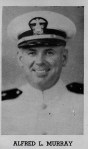
By Alfred L. Murray

About This Book and Its Author: Christian publishing house Zondervan published this book, the work of a former U.S. Navy chaplain named Alfred L. Murray. Though the book has a Christian viewpoint, it focuses on the way young people relate to each other, rather than their relationship with God. Murray is enthusiastic about the social benefits of dating, though of course he urges a conservative code of behavior.

Murray is fond of anecdotes and expert commentary. (His experts sometimes miss the mark, especially on medical topics. One thinks the frustrations of “petting” can lead to an enlarged prostate.)

This was Murray’s second book on youth courtship, and he wrote other books on various religious topics. He died in 1965, in Seabrook, New Hampshire, where he served as pastor of the Federated Church. He is buried in Arlington National Cemetery.

Fun Fact: Lamar Hunt, an influential figure in American sports, owned a “well thumbed” copy of this book during this college years, according to biographer Michael MacCambridge.

Quotes from Youth’s Courtship Problems

On “Mail-Order Dating”: “I have known at least four girls who, by correspondence, made friends with men whom they had never seen. The correspondence continued until the men proposed and the girls married them. One girl quarreled with her husband, and they separated in a few days. The second was deserted by her lover. The third went out of her mind. The fourth apparently resulted in a happy marriage.”

“Rouged cheeks and reddened lips, highly scented perfume, and bright colored fingernails are artificial and bear testimony that the person who is extravagant in display lacks good judgment and is not real…Any girl who indulges excessively in makeup appears common.”

“The moral collapse of an individual begins the moment he uses the sacred as if it were profane. One who uses the language of a kiss without discrimination is not worthy of intimate friendship…If a kiss is meaningless, what is the guarantee that life will not be judged by the same standards?”

“There is no virtue in staging public caressing parties.” I’ve got to agree with him there.

“That which differentiates necking and petting is that the first has certain powers of restraint and restrictions, while the last is noted for its liberty and license. When the time limit is removed from kissing, and fondling with the hands is introduced, the sexual urge is intensely increased.”

“It is yet too early to determine the meaning of the terms ‘mugging,’ ‘smooching,’ and ‘flinging the woo.’ If one were to guess, he might say that ‘smooching’ is necking; ‘flinging the woo’ is just love play; ‘mugging’ is petting on the heavy side.”

As an alternative to petting: “An interest must be developed in something both can share. It may be reading a book together. The Reader’s Digest will furnish one with sufficient topics to develop into interesting conversations for a date every day of the month.”

“I recently rode from Chicago to Philadelphia on a de luxe ‘crack train’ I could not find a place in the cars where women were not smoking. The were in the Pullman, the diner, and the club car…(The porter) went on to tell me that he used to make the trip and never see a woman smoke. ‘When one did come on, I knew that she was a bad woman, but now most of the women using this train smoke.’”

“I noticed that very few men on that trip were smoking. Those who did went to the lounge room and lit a cigar. The women smoked to excess and without discrimination.” I’ve never smoked in my life. Why does this book make me want to light up?

On marijuana: “It carries him out of the world of reality. But the price for this sensation is the habit, which quickly produces sexual perversion, insanity, and crime. It is the most dangerous drug in America. Those who smoke it will never be socially or morally the same.”

“There is a record of seventeen persons who attended a party, where ‘post office’ was played, having received syphilis infection. There was one infected person at the party. He kissed several girls who in turn were kissed by other fellows. All became victims of the dreaded disease.” In case you’re wondering if it’s really possible to contract syphilis through kissing—apparently, yes.  

“The girl that men like has intelligence, but she does not make a display of it.”

“When a man speaks harsh words, he is reflecting his thinking, but a woman who ‘flies off’ or appears irritated is expressing her feelings. Do not, therefore, take her little acts of unkindness too seriously. These are but emotional, not mental, reactions.”

“Women have a way of admiring the man they fear—fear because of his greatness.”

“Avoid all types of street conversations unless you are moving. It is the mark of poor breeding to stand on a street corner and carry on a conversation.”

Read the whole Weird Words of Wisdom series!