Spin Again Sunday: New Adventures of Gilligan Game (1974)

gilligan box

Today’s Game: The New Adventures of Gilligan Game

Manufactured by: Milton Bradley

Copyright Date: 1974

Game Box: Eye-catching in lime green, with all the characters represented in cartoon form. I don’t know what made cartoon Ginger’s hair go white, but I imagine life with Gilligan includes many shocking experiences.

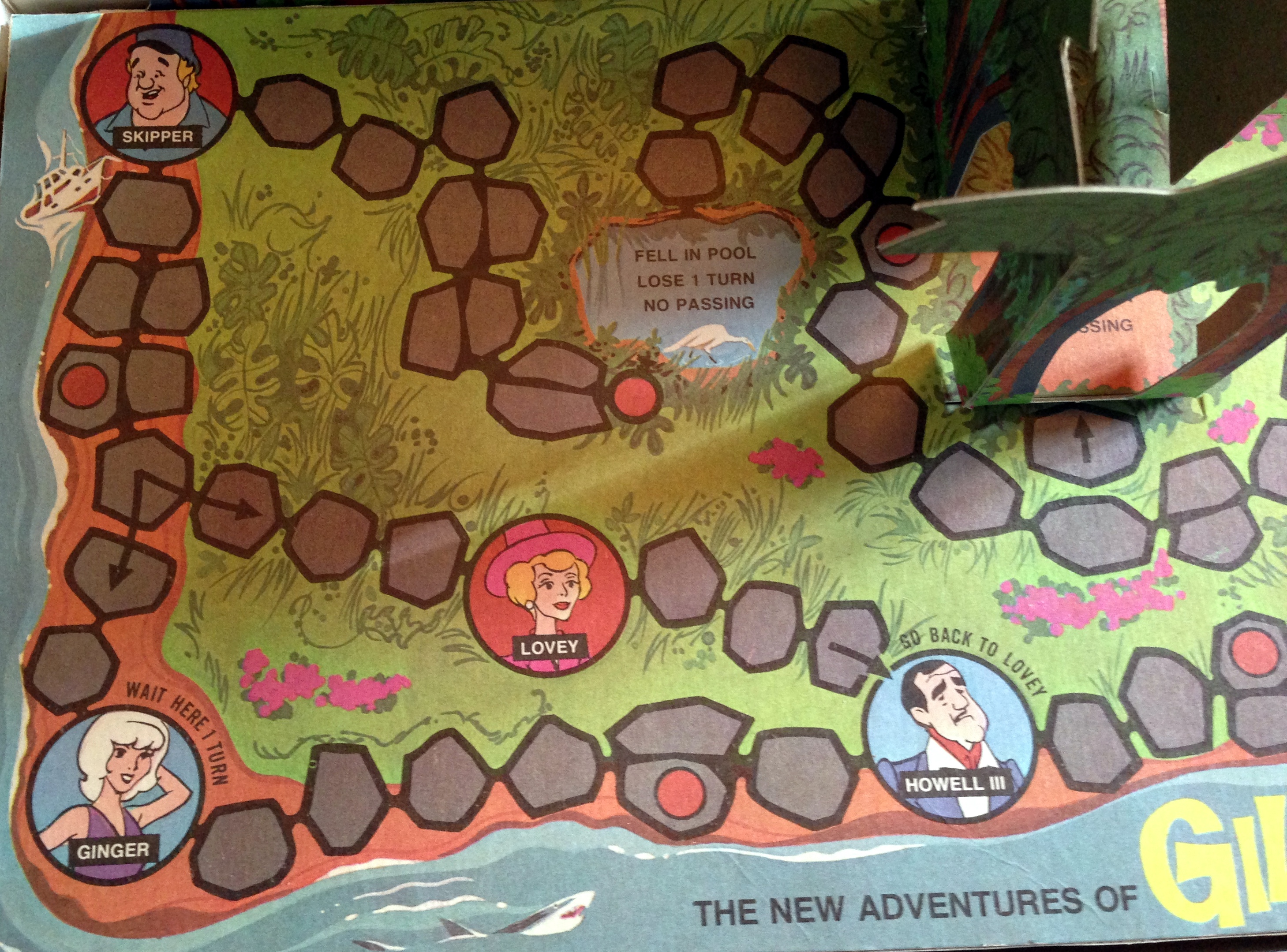
gilligan boardGame Board: Milton Bradley called this a “set-up and play” game. It doesn’t have a board, per se; a cardboard box insert serves that function. Some of the island’s topographical features fit into the insert, giving the game a 3-D look. This adds a bit of visual interest to what is a very basic game.

Recommended Ages: The box says 6 to 12, but I can’t imagine any over 8 enjoying this—or the cartoon, for that matter.

Object: Be first back to the hut.

Game Pieces: Standard plastic pawns.

gilligan board closeupGame Play: You just move your pawn around the “island,” according to your roll of the die. If you roll a six or land on a red space, you take a yellow card and follow its rhyming instructions—for example, “My-o My-o Me/You Can Go Ahead 3.”

Background: This game was not based upon the classic 1960s sitcom but upon the less-than-classic 1970s Filmation cartoon. This cartoon’s only real virtue was that it featured voices from five of the original sitcom cast members.

Other Spin Again Sunday posts you might enjoy:

Planet of the Apes Game

The Muppet Show Game

H.R. Pufnstuf Game

Spin Again Sunday: The Partridge Family Game (1971)

partridge family box

This Week’s Game: The Partridge Family Game, 1971

Manufactured By: Milton Bradley

Object: Being the first to reach the bus after a concert.

Recommended Ages: 7 to 12.

Game Box: A picture of the family, with everyone looking deliriously happy, except Danny. Maybe he’s wondering why they set up to play right outside their bus. The colorful Partridge logo also appears prominently.

Game Board: The same photo appears here, surrounded by a multicolored track.

partridge family board

Game Pieces: Character photos make these much cooler than ordinary plastic pawns. They aren’t durable, though–notice the damage done to Laurie. Keith, oddly, is pristine. Someone must have liked him.

They made these from the photo on the box, so Danny has that same dazed look on his face.

They made these from the photo on the box, so Danny has that same dazed look on his face.

Game Play: The instructions explain it in this ungrammatical fashion: “As on TV, many happenings occur to the Partridge family, this game describes one of them. They have finished playing at local arena and must hurry from there to their BUS to get traveling again. On the way they may have some delays.” (I guess BUS is important, since they put it in caps.)

Players advance along the track by rolling the dice. When they land on a partridge space, they take a card. The cards send them forward or backward, according to whether a particular family member has a good or bad experience. One feature adds a little excitement: If you land on an occupied space, the person who was there has to move backward to your starting point.

Most of these cards make sense, but look at this Laurie card: "Laurie belongs to the 'now generation.' Lose 1 turn."

Most of these cards make sense, but look at this Laurie card: “Laurie belongs to the ‘now generation.’ Lose 1 turn.”

My Thoughts: I paid about 50 cents for this very damaged game. I liked the colorful game board and figured I could do something crafty with it. Five years later, I still haven’t figured out what that will be yet.

Though the game play is boring, I’m sure I would have loved this game as child, and my Partridge pawns would have ended up in even worse shape than these.

Other Spin Again Sunday Posts You Might Enjoy:

The Game of Dragnet

The Waltons

Addams Family Card Game

Family Affair Friday (Not!): Season 2, Episode 12, “Our Friend Stanley,” 12/4/1967 (with vintage toy bonus)

Written by: Henry Garson and Edmund Beloin. Directed by: Charles Barton.

This week’s episode begins with French hustling the twins off to school.

In the elevator, they encounter a sad-looking boy clutched protectively by his mother.

In the elevator, they encounter a sad-looking boy clutched protectively by his mother.

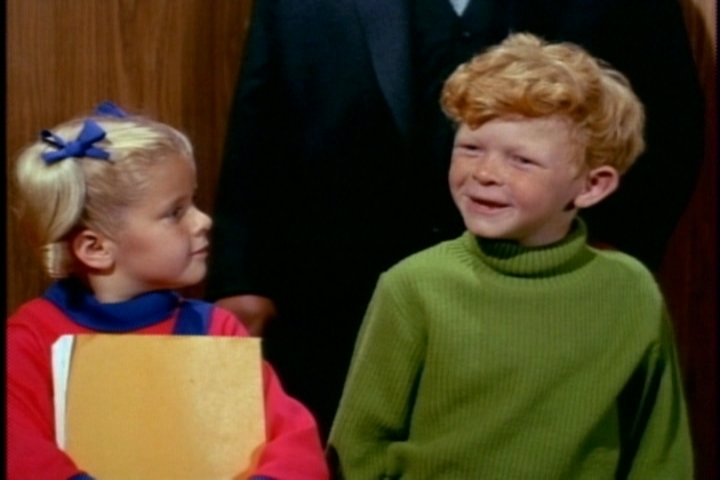
Buffy and Jody, firing off a series of questions that embarrass French, learn that Stanley is new to the building and getting ready to attend his first day at their school. They are pleased to learn that Stanley, like them, is in second grade. (Whew! We’ve emerged safely from last week’s time warp.)

They can’t understand, however, why Stanley and his mother are planning to take a taxi to school, rather than walking.

The light finally dawns when they see Stanley walk out of the elevator.

The light begins to dawn on them when they see Stanley walk out of the elevator.

French explains to them that Stanley has a brace on his leg and encourages them to be friendly and helpful to the boy at school.

(Leg braces always intrigued me when I was a kid. I saw them a lot on TV kids but never on any real ones. Apparently, they were frequently used by victims of polio, which was no longer an issue during my childhood–or Buffy’s and Jody’s.)
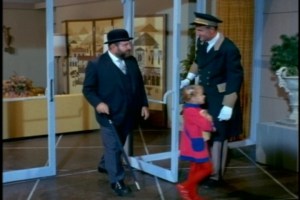
Oh, and one more thing before we get to the kids' school--we get a Scotty sighting in this episode!

Oh, and one more thing before we get to the kids’ school–we get a Scotty sighting in this episode!

At recess, Buffy notices that Stanley is sitting by himself and tells Jody that they should help him. Jody invites Stanley to play marbles with his multi-racial band of friends, but by the time he convinces Stanley to play, the other boys have moved on to leap-frog. Jody still encourages Stanley to join them.”If you fall, you fall,” he says, noting that all the boys fall sometimes.
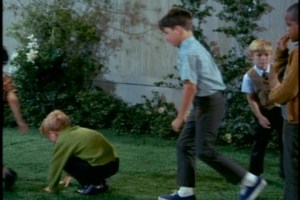
I have a bad feeling about this.

I have a bad feeling about this.

With exquisitely bad timing, Stanley’s mother picks this moment to show up at school with Stanley’s sweater.

Now I've got a really bad feeling about this.

Now I’ve got a really bad feeling about this.

Sure enough, Stanley hits the grass, and his mother doesn’t take it well.
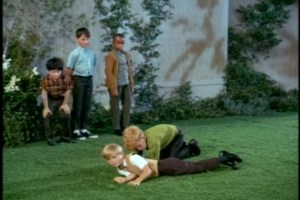
She bans Buffy and Jody from playing with Stanley again.

She bans Buffy and Jody from playing with Stanley again.

Well, that’s going to be awkward because meanwhile, back at the apartment building…

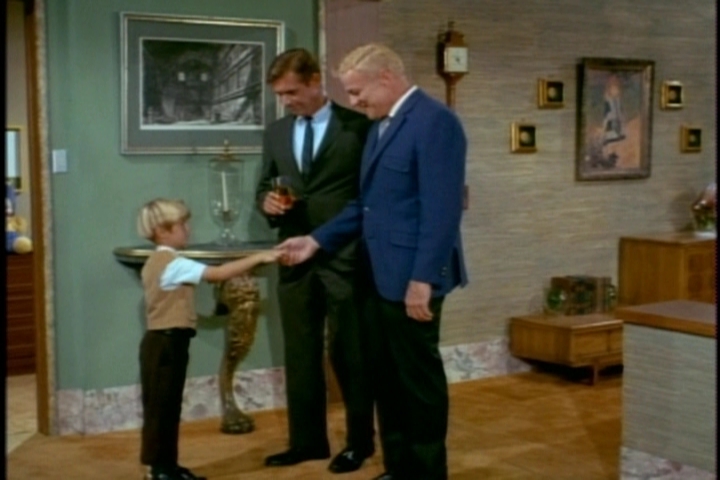
...Bill meets up with one of his many, many old friends in the lobby--and this old friend happens to be Stanley's father. (Incidentally, Bill smokes like a chimney throughout this episode.)

…Bill meets up with one of his many, many old friends–and this old friend happens to be Stanley’s father. (Incidentally, Bill smokes like a chimney throughout this episode.)

Doug invites Bill to stop by later to catch up with him and his wife Estelle. Bill’s visit is marked by pained glances between Doug and Estelle when the subject of children comes up. Sheesh, their kid has a leg brace, not that “elephant man” disease! Eventually, Stanley himself appears, and Bill notices how protective Estelle is of her son.
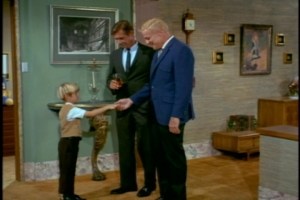
Stanley's apartment has lots of Family Affair green...and what is that table/shelf thing protruding from the wall?

Stanley’s apartment has lots of Family Affair green…and what is that table/shelf thing protruding from the wall?

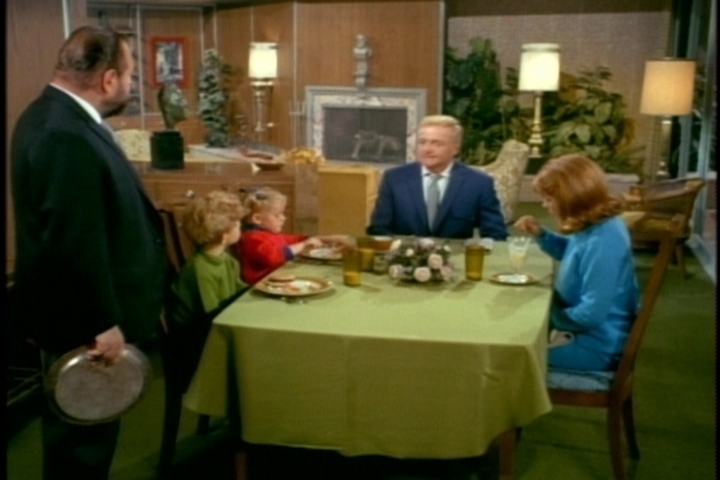
When he returns to his own apartment for dinner, Bill learns that Estelle has forbidden Stanley to play with Buffy and Jody.

A worried Bill tells French that this situation is bad for the twins as well as for Stanley--in the future, Buffy and Jody might try to avoid people with handicaps.

A worried Bill tells French that this situation is bad for the twins as well as for Stanley–in the future, Buffy and Jody might try to avoid people with handicaps.

He decides to have a man-to-man, smoker-to-smoker talk with Doug.

Doug agrees that Estelle is overprotective, but he is reluctant to intervene.

Doug agrees that Estelle is overprotective, but he is reluctant to intervene.

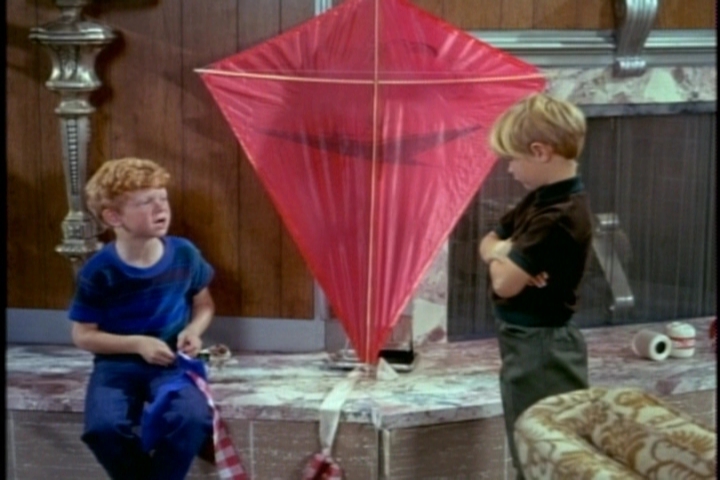
Eventually, however, he agrees to let Bill take Jody and Stanley to the park for some kite-flying.

Bill couldn't have come up with an activity that doesn't require running?

Bill couldn’t have come up with an activity that doesn’t require running?

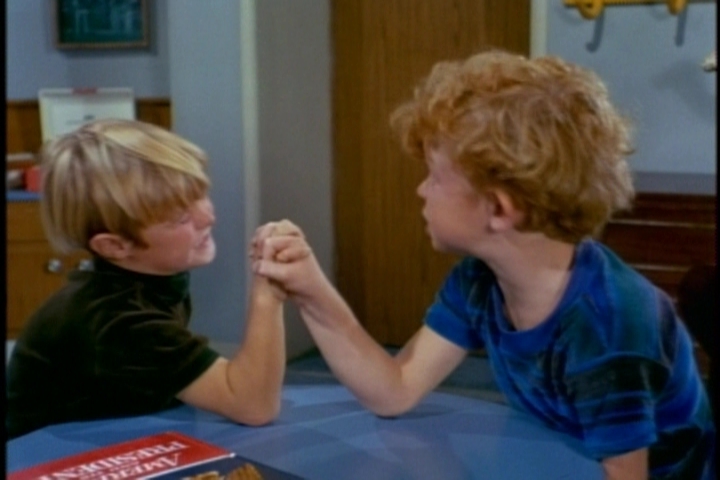
Even before they leave for the park, the situation deteriorates. Stanley has some kind of male-ego chip on his shoulder, and he challenges Jody to a fight. Our sweet-natured Jody has no interest in fighting, but Bill encourages the boys to settle their differences through “Indian wrestling.”

We called it arm wrestling when I was a kid, and not for any PC reasons, I'm sure. We weren't very PC about Native Americans back then.

We called it arm wrestling when I was a kid, and not for any PC reasons, I’m sure. We weren’t very PC about Native Americans back then.

Showing her usual flair for timing, Estelle barges in, having learned about the kite-flying outing and wanting to nip it in the bud.
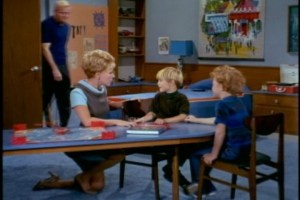
As it turns out, Stanley is an arm-wrestling wizard. When Estelle sees how proud he is to have beaten Jody, she realizes that he needs normal boy experiences.

As it turns out, Stanley is an arm-wrestling wizard. When Estelle sees how proud he is to have beaten Jody, she realizes that he needs normal boy experiences.

Soon, the boys are flying their kites in Central Park.

Buffy, who apparently prefers to sit with Mrs. Beasley, Bill, and Bill's second-hand smoke, expresses her admiration about the way Bill handled the Stanley situation.

Buffy, who prefers to sit with Mrs. Beasley, Bill, and Bill’s second-hand smoke, expresses her admiration about the way Bill handled the Stanley situation.

“I guess you just like kids,” she says.
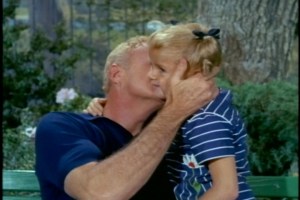
Awww.

Awww.

Commentary

This is a nice episode, one of many in which Buffy and Jody meet a child who is different from them in some way. Uncle Bill’s opinion, that it’s as important for twins to experience friendship with Stanley as it is for Stanley himself, seems rather progressive.
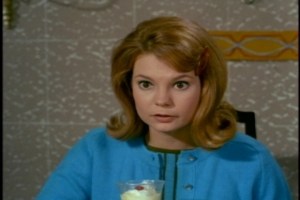
Another episode highlight: Buffy and Jody teasing Cissy about her latest boyfriend.

Another episode highlight: Buffy and Jody teasing Cissy about her latest boyfriend, Harold, a “tall, skinny guy whose bow tie wiggles up and down when he talks.”

Guest Cast

Stanley: Michael Freeman. Miss Jerome: Ila Britton. Eddie: Gary Dubin. Estelle: Sally Forrest. Scotty: Karl Lukas. Doug: John Lupton.

Michael Freeman was a cutie and an okay child actor, so it’s surprising he didn’t get more work. His most interesting credit is “The Boy Pusher” in the 1973 TV movie Go Ask Alice. (I see the whole movie is available on Youtube. That’s got to be good for some laughs.)

Dubin was Punky Lazaar in several Partridge Family episodes.Recent titles in his filmography suggest that his career has gone in, um, a different direction lately.

Lupton starred in a 1950s Western series called Broken Arrow and a short-lived 1960s daytime soap called Never Too Young. He played Tommy Horton on Days of Our Lives from 1967 to 1980. He appeared in an episode of the Sebastian Cabot series Checkmate and in the 1972 film Napolean and Samantha with Johnnie Whitaker.

John Lupton

John Lupton

Forrest found modest film success in movies directed by Ida Lupino (who would guest star on two Family Affair episodes herself); the first of these was Not Wanted in 1949.
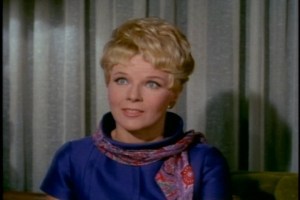
Sally Forrest

Sally Forrest

Inconsistency Alert

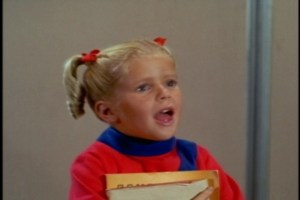
The length of Buffy’s pigtails varies from scene to scene–see below and note the length in relation to her ears. They are shorter in her scenes with Uncle Bill; Brian Keith’s abbreviated shooting schedule undoubtedly led to these scenes being shot at a time far removed from the episode’s other scenes.

VTS_01_8.VOB_000104603VTS_01_7.VOB_000622452

Less easy to explain is the way her hair bows change color from red to blue in between leaving the Davis apartment and entering the elevator. Freaky!
VTS_01_7.VOB_000557847VTS_01_7.VOB_000632615

Notable Quotes

“Once in a while, she just stands there and looks at us and says, ‘Why didn’t I become an airline hostess?”–Buffy, describing her teacher.

This Week’s Bonus Feature

I know I’ve been stingy with bonus features lately, but my husband bought me something yesterday that I just had to share.

Family Affair Colorforms, from 1970!

Family Affair Colorforms, from 1970!

This is one of the few Family Affair toys I didn’t have and one that I particularly wanted–I love Jody’s ridiculous expression on the box. Note also that Mrs. Beasley is wearing a red dress, and Cissy appears to be a 35-year-old woman.

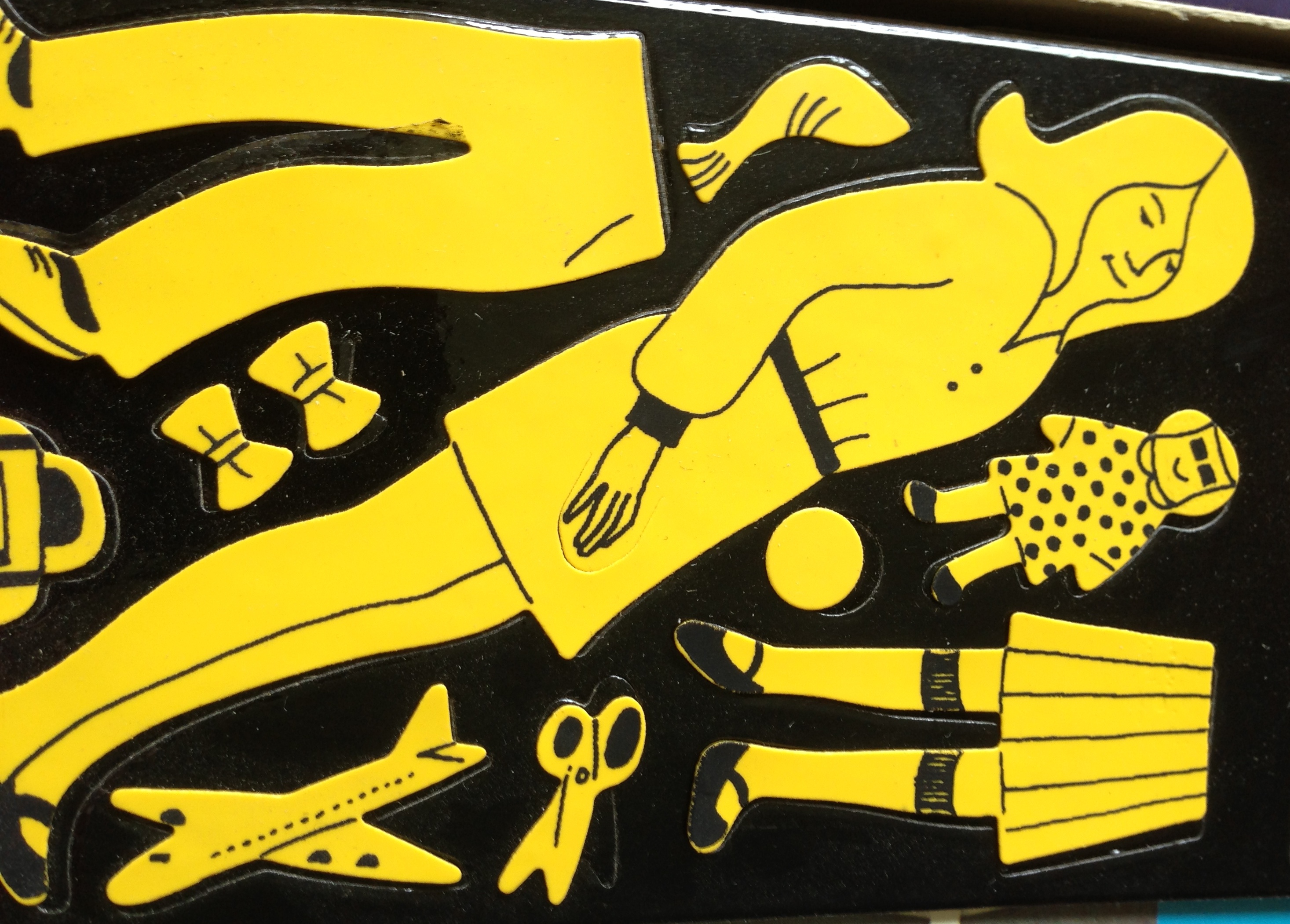
On the inside, the likenesses are even worse.

On the inside, the likenesses are even worse.

All the characters except Cissy have separate top and bottom halves, as well as separate arms.

Wiseacre kids must have had fun with this feature, such as by giving Jody a skirt, Bill a weight problem, and French some tiny legs.

Wiseacre kids must have had fun with this feature, such as by giving Jody a skirt, Bill a weight problem, and French some tiny legs.

I actually prefer the Colorforms version of the Davis apartment to the real one.

And Colorforms Buffy and Jody are lucky--they get a dog.

And Colorforms Buffy and Jody are lucky–they get a dog.

Spin Again Sunday: The Senior Prom Game (Circa 1950s)

senior prom box

Senior Prom–the game for girls whose parents were too cheap to spring for Barbie’s Queen of the Prom game.

In this week’s installment of Spin Again Sunday, we’re going to experience “all the thrills of a social season”–or at least as many of those thrills as a poorly made board game can provide.

This Week’s Game: The Senior Prom Game.

Copyright Date: Unknown, but the game appears to date from the 1950s.

Manufacturer: Warren Paper Products Company of Lafayette, Indiana. The company used the designation “Built-Rite” on their games (and jigsaw puzzles). If this game is any indication, they used the label ironically.

Object: To attain the status of prom queen.

Recommended Ages: 7 to 12.

Game Board: Actually, “board” is a bit of an overstatement for what is a flimsy piece of cardboard. In an unusual move, the manufacturers printed the game directions right on the board. I’m sure they did this to save money, but it does eliminate the possibility of losing the directions.

senior prom board

Game Box: The graphics are cute, with prom-goers depicted against a star-filled sky. The fact that the box brags about the “Large 15 x 18 Playing Board” may be be a hint that there’s not much here to brag about.

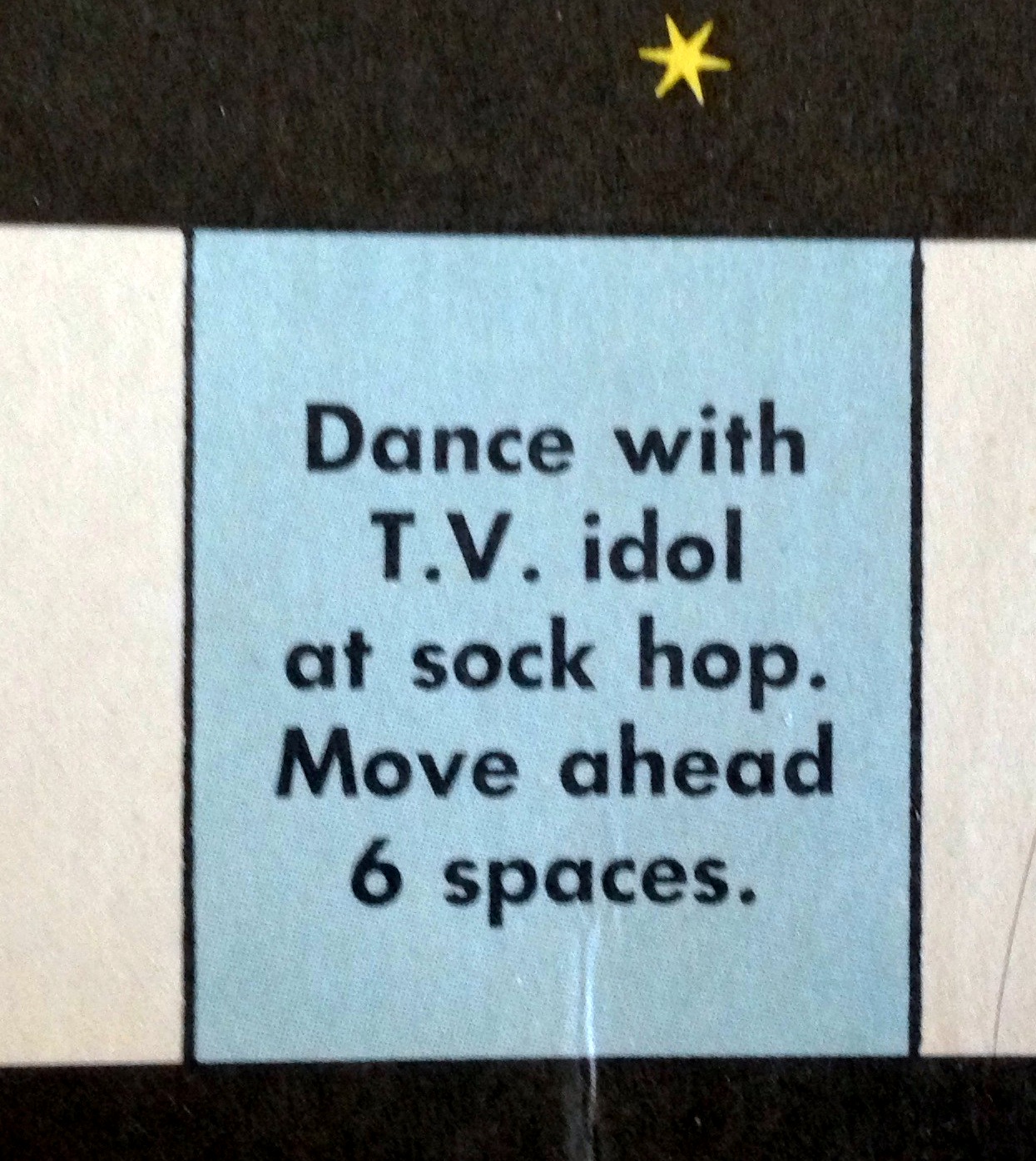
I can see why this would be worth a 6-space movement. Why would a "T.V. idol" be at your sock hop?

I can see why this would be worth a 6-space movement. Why would a “T.V. idol” be at your sock hop?

Game Markers: Square pieces of cardboard folded and inserted into round pieces of cardboard. These are supposed to represent crowns. Uh-huh.

Crowns? Really?

Crowns? Really?

Other Game Pieces: The colorful spinner has a metal arrow. Players try to collect cardboard circles marked with the words Date, Formal, Grades, or Dance.

IMG_2192

The cards players must collect.

Game Play: Players move along the board and try to collect the cardboard circles mentioned above. (I give the manufacturers credit for making good grades a pre-requisite for prom queen coronation.) With those cardboard circles in hand, a player can move to the inside track and try to land on a “Selected Candidate for Prom Queen” space. Each candidate places her marker on a numbered star; the first to make it that far and spin the number that matches her star space wins.

You can see more Warren “Built-Rite” games at the very cool Board Game Geek web site.

Other Spin Again Sunday posts you might enjoy:

What Shall I Be? (1972)

Barbie Miss Lively Livin’ (1970)

The Bride Game (1971)

Spin Again Sunday: The All in the Family Game (1972)

af boxHonesty, I have mixed feelings about the TV series All in the Family, probably because my family let me watch it at much too young an age. On a regular basis, the show assaulted my sensibilities with such concepts as cross burning and attempted rape. I can’t imagine letting my 10-year-old listen as a stream of racial epithets pour forth from the TV–but, thankfully, she doesn’t live in a world where she hears those words on a regular basis from relatives, as I did. Along with my parents’ guidance, All in the Family did reinforce to me how ridiculous racism was, and for that, I’m grateful.

Though most of the show’s characters creeped me out to varying degrees, I always loved Edith. She reminded me a lot of my beloved maternal grandmother–naive, confused, but kind-hearted. As a child, I was shocked when I first heard Jean Stapleton interviewed and realized she didn’t talk like Edith. It produced an early epiphany about how convincing acting can be.

I’m featuring this game in Jean Stapleton’s honor.

af answer

This Week’s Game: The All in the Family Game, Milton Bradley

Copyright Date: 1972

Recommended Ages: 10 to Adult

Object: “Guess Archie’s Answers”

Game Play: One person acts as “the MC” and asks questions from the game booklet. Players write their answers down on slips of paper and pass them to the MC. When the responses are read aloud, players earn points by guessing which player gave each answer. The MC also reads Archie’s answer to each question (or, in some cases, Edith’s answer). Players who matched that answer get an extra point.

af question

“Clever or unexpected responses often throw the party into peals of laughter,” the game box assures us. I can imagine that might be true, but the “official” answers from Archie and Edith aren’t exactly uproarious. Some examples:

How do you feel about being a sex symbol?

Archie: If the shoe fits–why take it off?

With my background, I should be a…

Archie: Boss over something.

What’s with hips?

Archie: They should be watched.

What do you think of Bangladesh?

Edith: I never played that game.

Spin Again Sunday: What Shall I Be? (1972)

what shall i be box

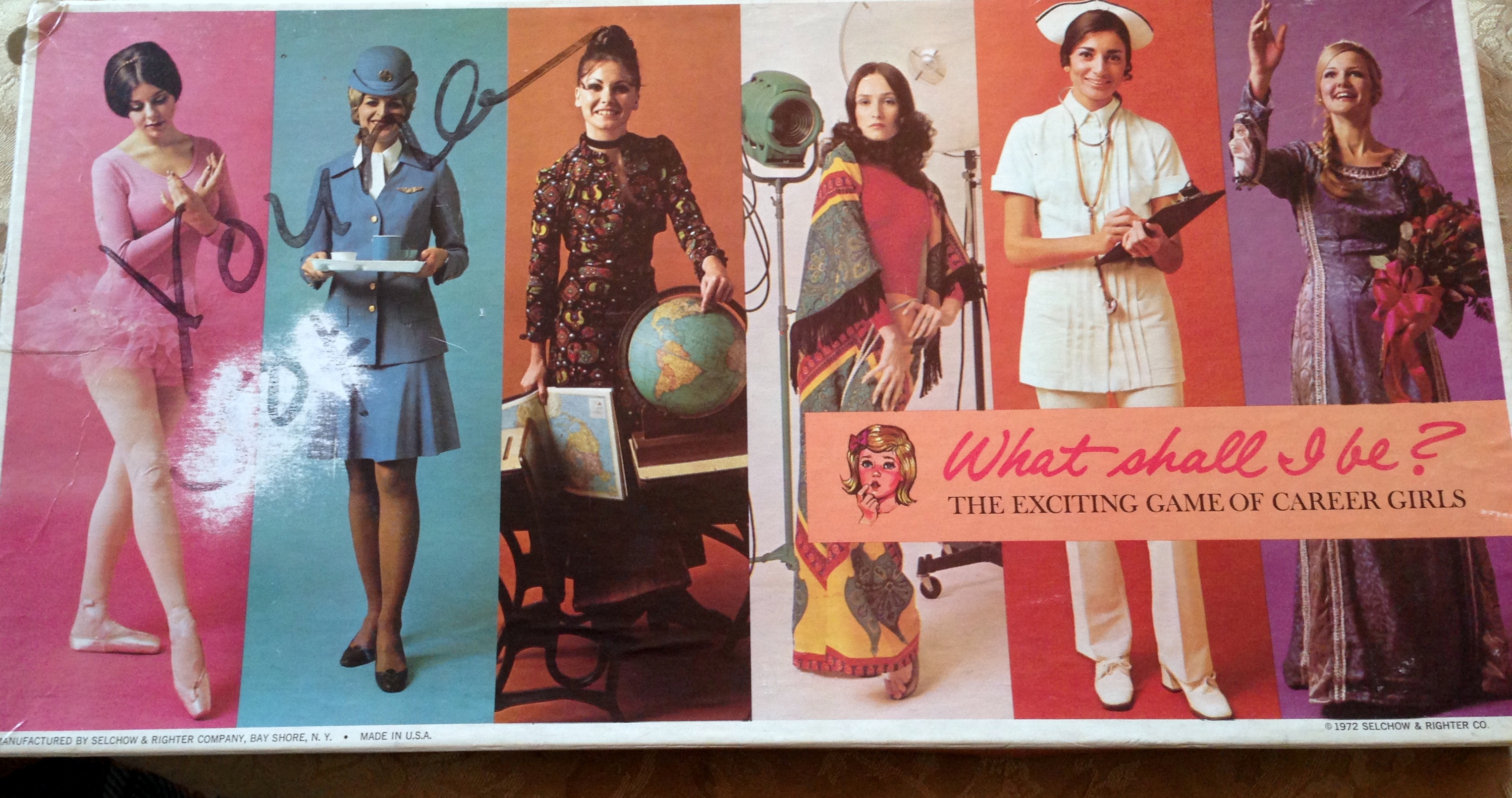
Spin Again Sunday is back! After a long hiatus–for which I apologize–I return with a game that explores the full gamut of careers available to women–ballerina, airline stewardess, teacher, model, nurse, and actress.

Actually, by 1972, even the good people at Selchow and Righter (who also brought us The Bride Game and The Emily Post Popularity Game) realized that their game was slightly retrograde. They could have opted to redesign the whole the game, but that probably would have cost a lot of money. Instead, they reissued their 1966 game board but added this disclaimer to the inside lid:

what shall i be disclaimer

I suppose they figured that would keep Gloria Steinem off their backs.

This Week’s Game: What Shall I Be? The Exciting Game of Career Girls

Manufactured: 1972, Selchow & Righter

Recommended For: Girls ages 8-13

Game Board: Drawings on the board–copyright 1966–show somewhat more conservative versions of the career girls than the full color photos on the 1972 box.

what shall i be board

Game Pieces: The pawns are your basic colored plastic items. The game also involves three kinds of cards. School Cards represent the formal training needed for each career.

what shall i be cards

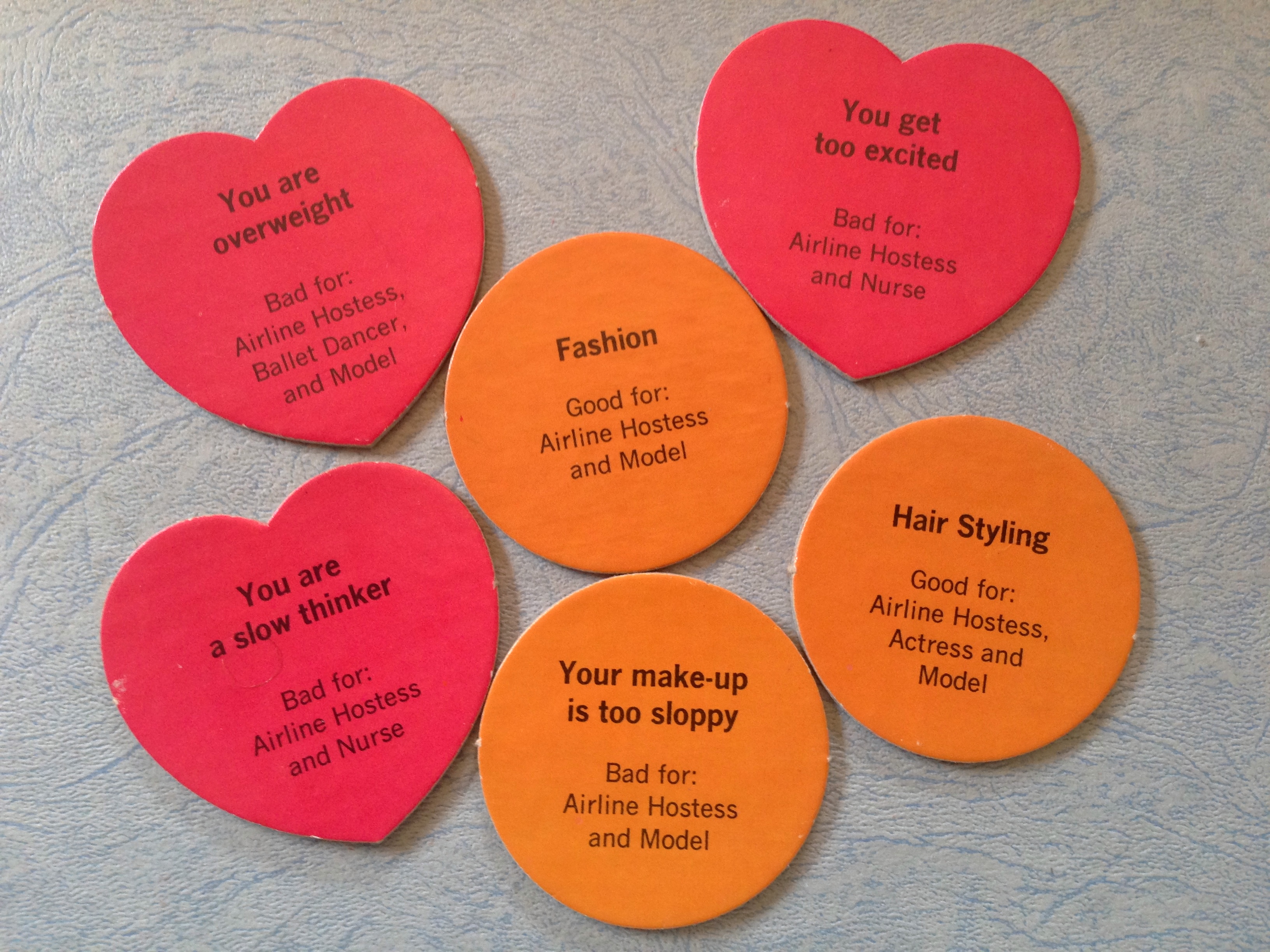
Players also need to collect round Subject Cards and heart-shaped Personality Cards that support their career ambitions. (As you can see, cards can also work against success in certain careers. No fat chicks need apply for stewardess!)

what shall i be cards 2Game Play: Players move around the board and collect cards according to the spaces on which they land. The first player who collects four school cards for one profession, plus two Subject Cards and two Personality Cards that support that profession wins.

My Verdict: As silly as it seems now, this game would have appealed to me when I was 8 or so. Remember those cheap toy doctor’s and nurse’s kits that you could buy anywhere? My mom was always trying to raise my consciousness by buying me the doctor one, but I always wanted the nurse version.

Other Spin Again Sunday posts you might enjoy

The Waltons

Barbie Miss Lively Livin’

Patty Duke Game

Spin Again Sunday: The Game of Dragnet

dragnet boxI’ve been a big fan of Dragnet since I discovered the late 1960s episodes when I was about 10. When I started listening to old-time radio, Dragnet quickly became one of my favorites in that medium, too. So this Christmas, when my husband presented me with The Game of Dragnet, I was delighted. (By the way, it’s really hard to explain gifts like this to “normal” friends who get jewelry and cookware as presents.)

This Week’s Game: The Game of Dragnet, 1955, Transogram.

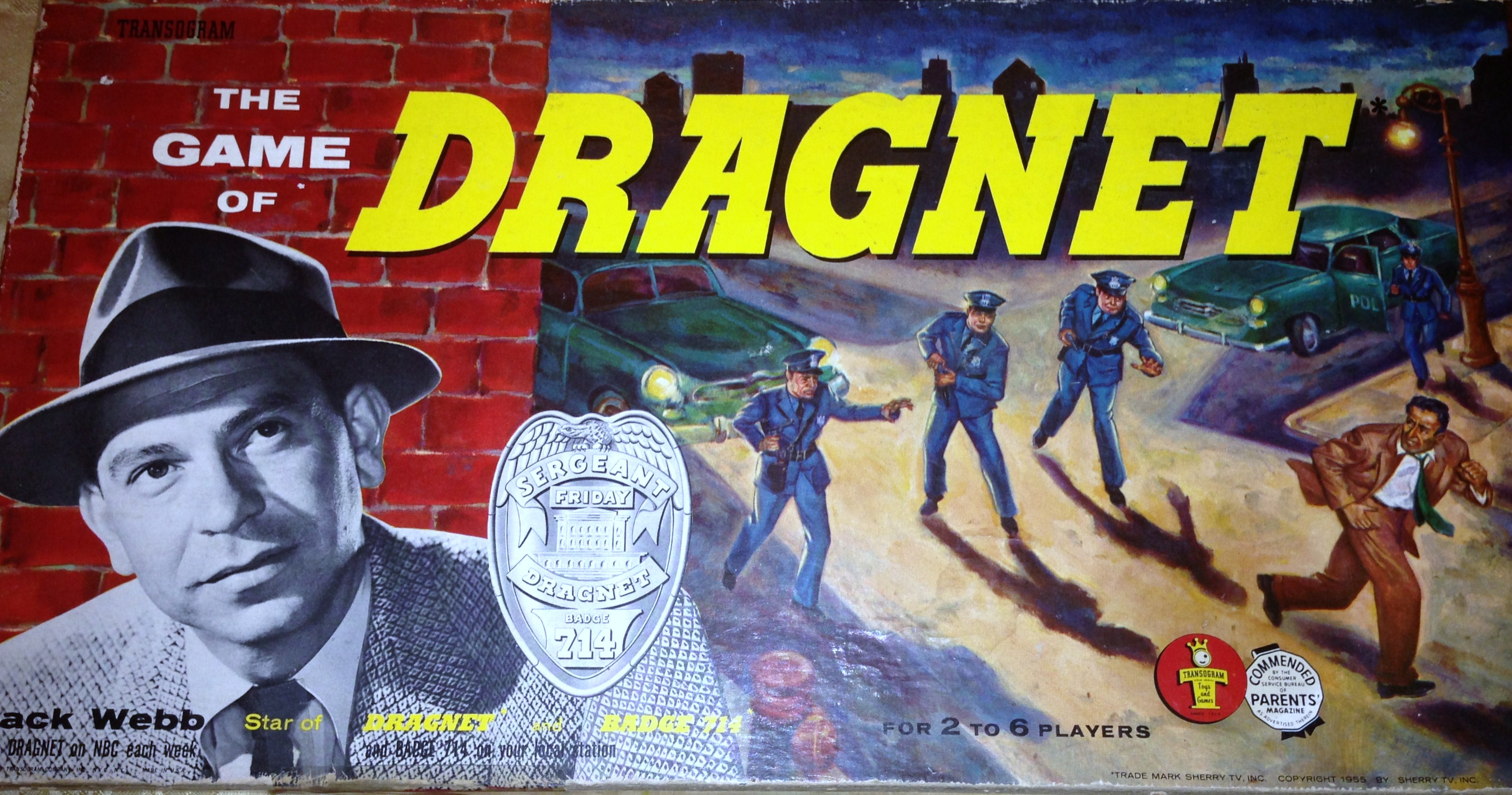
The Box: Sergeant Joe Friday, in black and white, gives us a rueful smile, while uniformed officers (in color) pursue a criminal nearby. Shouldn’t Friday be helping them? The box, board, and instructions all include the label “Badge 714” as a kind of subtitle. Remember when syndicated versions of shows that were still airing in prime time ran under alternate titles? Badge 714 was Dragnet’s syndication title.

The Promotional Blurb on the Box: “Do you have the instincts of a detective? Are you adept at interrogation, clever at deduction? You are! Then you must play this drama packed game! Here it is!—a realistic and exciting game of skill, deduction, and luck for teenagers and adults, based on DRAGNET, famous on radio, TV, and in the movies.”

This is actually only about one-fourth of the copy—it is the War and Peace of promotional blurbs.

dragnet board

The Board: The box copy also refers to this a “fascinating and absolutely unique game.” The board, however, is quite generic. Transogram and other companies often produced boards that they could re-purpose for subsequent games. All they would have to do to re-use this design is to swap out the center circle.
suspects dragnet cars

Two “suspects” flanked by police cars. Doesn’t that pink suspect look threatening? The green disc below is one of the numbered, interchangeable suspect bases.

Game Pieces: Six police squad cars in various colors and seven suspects. The latter are bell-shaped pieces of colored plastic that attach to interchangeable green bases. Each base bears a number.

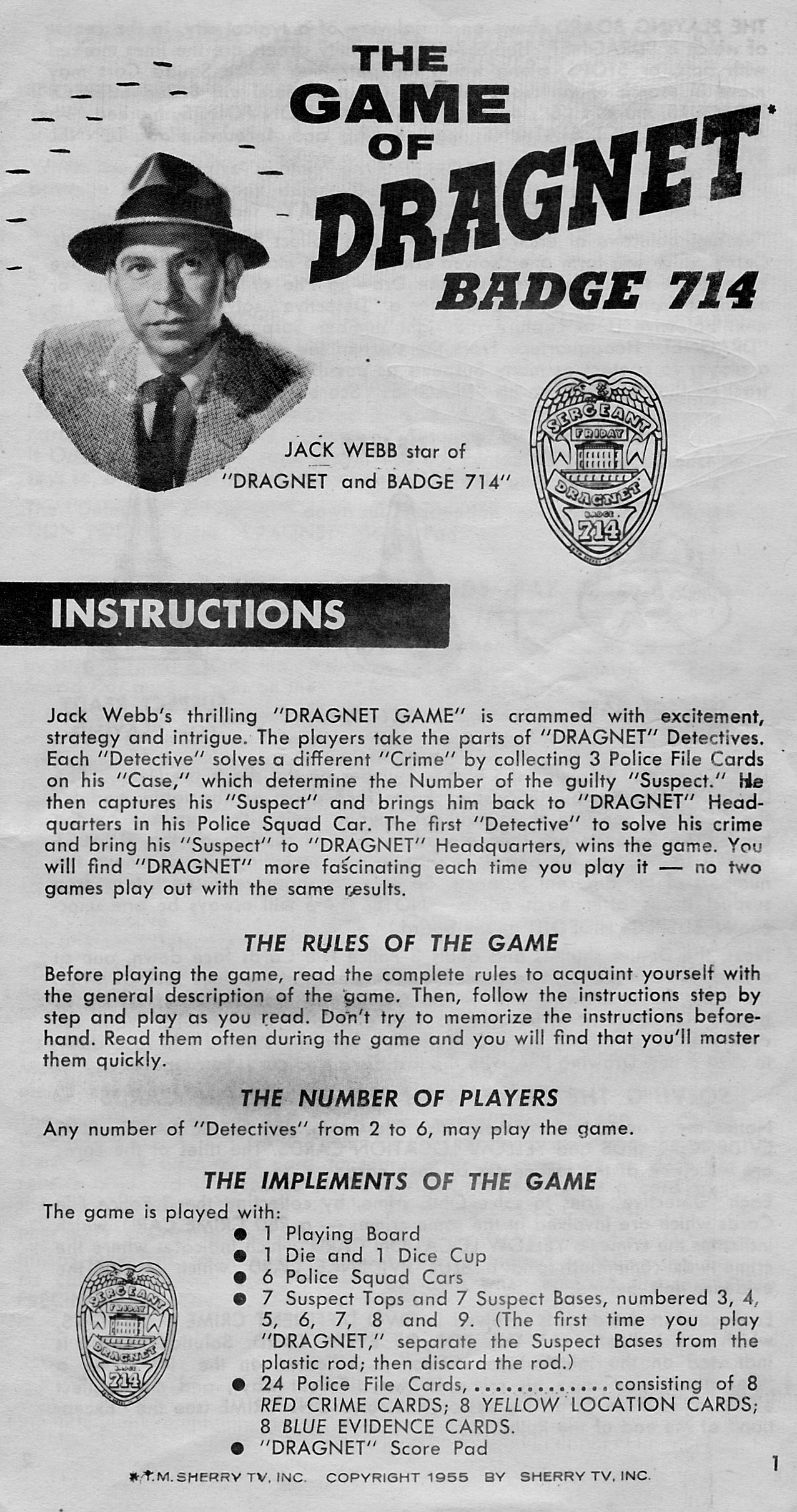
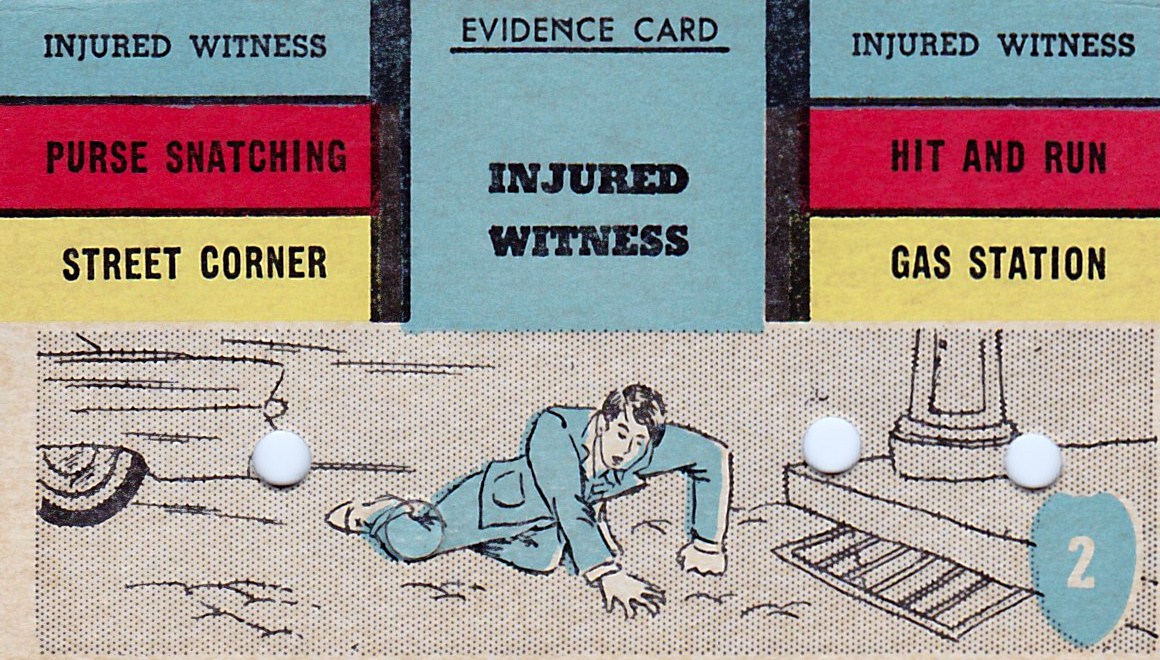
Crime File Cards: The most interesting thing about these is that they have random holes punched in them. This mystified me until I read that in the instructions that they “simulate authentic key-punched police file cards.”

Then, of course, I had to seek out more information about key punching.

dragnet instructions

If you want to play this game, set aside an afternoon for reading the instructions.

Game Play: It’s kind of like Clue, but much more complicated. Before the game starts, suspects are attached to bases and planted at various Suspect Hideouts around the board. Each player receives three police file cards. Each player will try to collect three police file cards that fit the same crime—a crime card, a location card, and an evidence card. Each of these cards also has a number on it. When a player adds the three numbers on their three correct cards together, they will get the number of the suspect they are seeking

dragnet card 2Players move around the board in their squad cards. When they land on a Suspect Hideout, they can look at the suspect’s number and record it on their score pad. When they land on an Interrogation Post, they can ask a yes-or-no question about a suspect (i.e., is the red suspect’s number odd?), as long as they don’t ask directly what the number is. When they land on a Precinct Station, they can take police file cards from other players.

dragnet card 1Once a player has his three cards and knows his suspect’s number, he must go to that suspect’s hideout and then return to police headquarters to win the game.

Whew! Actually becoming a police detective might be simpler than playing this game.

My Thoughts: This looks like it could be fun, as long you invest the time necessary to master all the rules.

Other Spin Again Sunday posts you might enjoy:

Gomer Pyle Game

Charlie’s Angels Game

Waltons Game