Spin Again Sunday: What Shall I Be? (1972)

what shall i be box

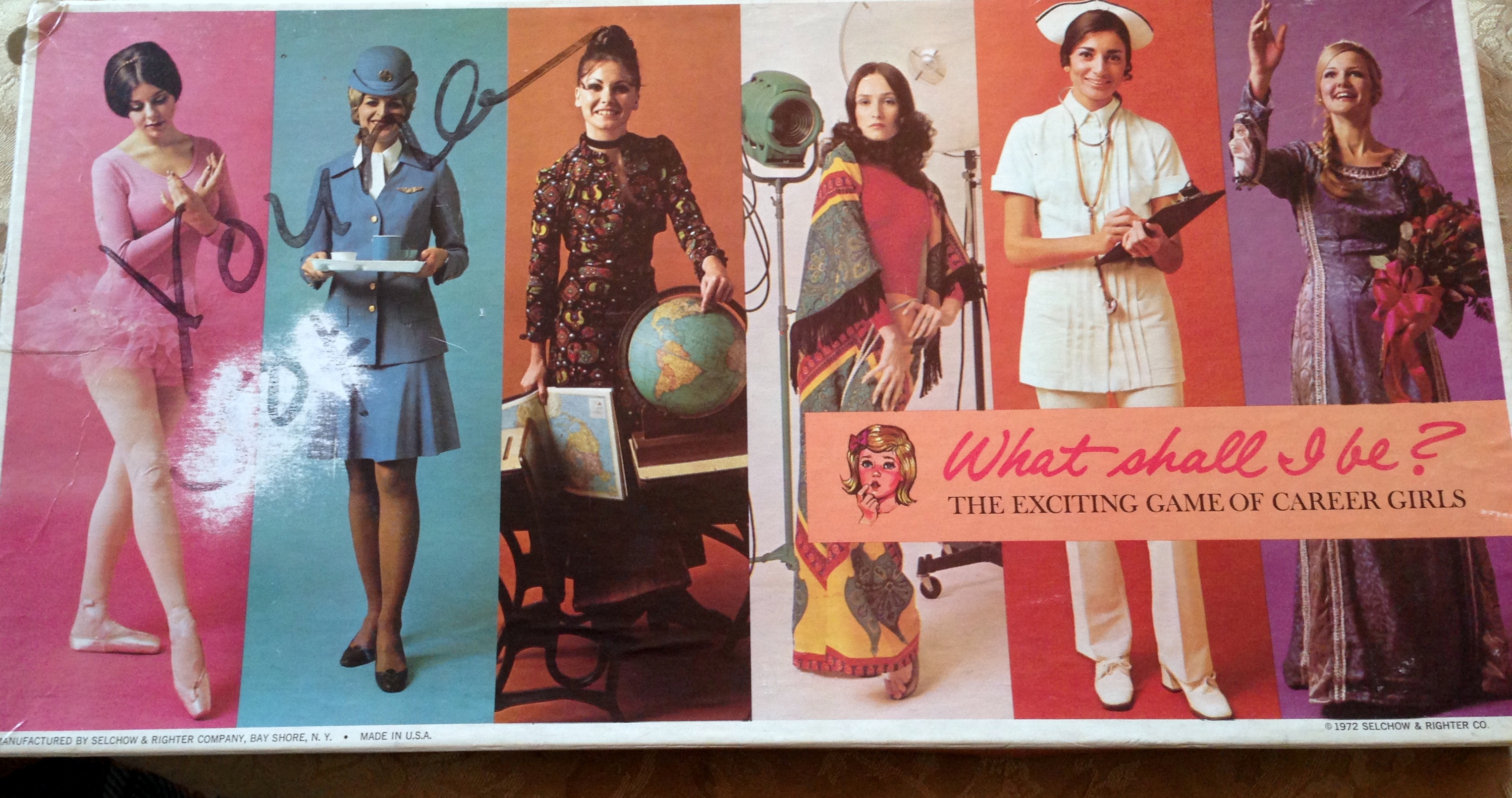
Spin Again Sunday is back! After a long hiatus–for which I apologize–I return with a game that explores the full gamut of careers available to women–ballerina, airline stewardess, teacher, model, nurse, and actress.

Actually, by 1972, even the good people at Selchow and Righter (who also brought us The Bride Game and The Emily Post Popularity Game) realized that their game was slightly retrograde. They could have opted to redesign the whole the game, but that probably would have cost a lot of money. Instead, they reissued their 1966 game board but added this disclaimer to the inside lid:

what shall i be disclaimer

I suppose they figured that would keep Gloria Steinem off their backs.

This Week’s Game: What Shall I Be? The Exciting Game of Career Girls

Manufactured: 1972, Selchow & Righter

Recommended For: Girls ages 8-13

Game Board: Drawings on the board–copyright 1966–show somewhat more conservative versions of the career girls than the full color photos on the 1972 box.

what shall i be board

Game Pieces: The pawns are your basic colored plastic items. The game also involves three kinds of cards. School Cards represent the formal training needed for each career.

what shall i be cards

Players also need to collect round Subject Cards and heart-shaped Personality Cards that support their career ambitions. (As you can see, cards can also work against success in certain careers. No fat chicks need apply for stewardess!)
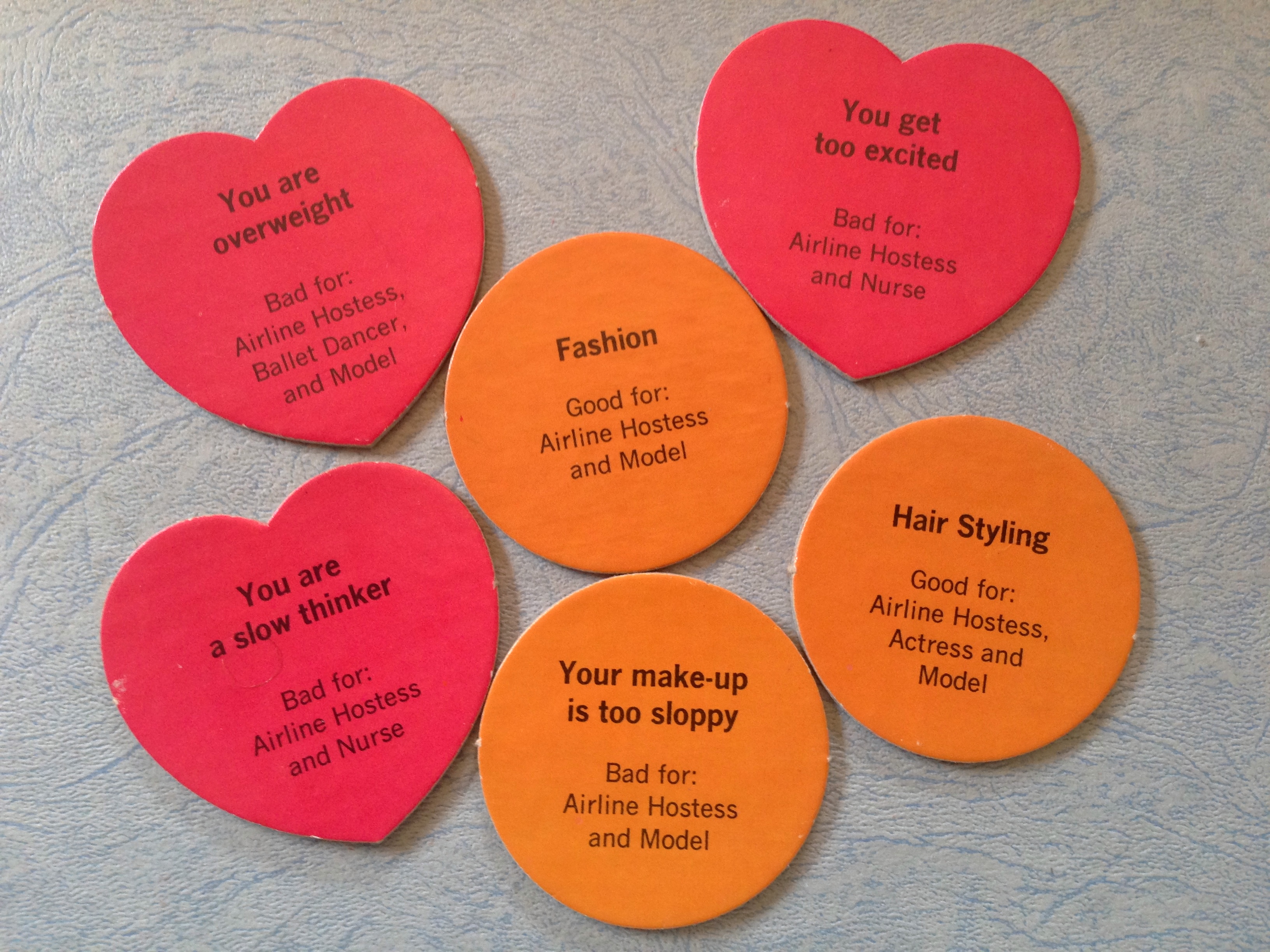
what shall i be cards 2Game Play: Players move around the board and collect cards according to the spaces on which they land. The first player who collects four school cards for one profession, plus two Subject Cards and two Personality Cards that support that profession wins.

My Verdict: As silly as it seems now, this game would have appealed to me when I was 8 or so. Remember those cheap toy doctor’s and nurse’s kits that you could buy anywhere? My mom was always trying to raise my consciousness by buying me the doctor one, but I always wanted the nurse version.

Other Spin Again Sunday posts you might enjoy
The Waltons

Barbie Miss Lively Livin’

Patty Duke Game

Spin Again Sunday: The Game of Dragnet

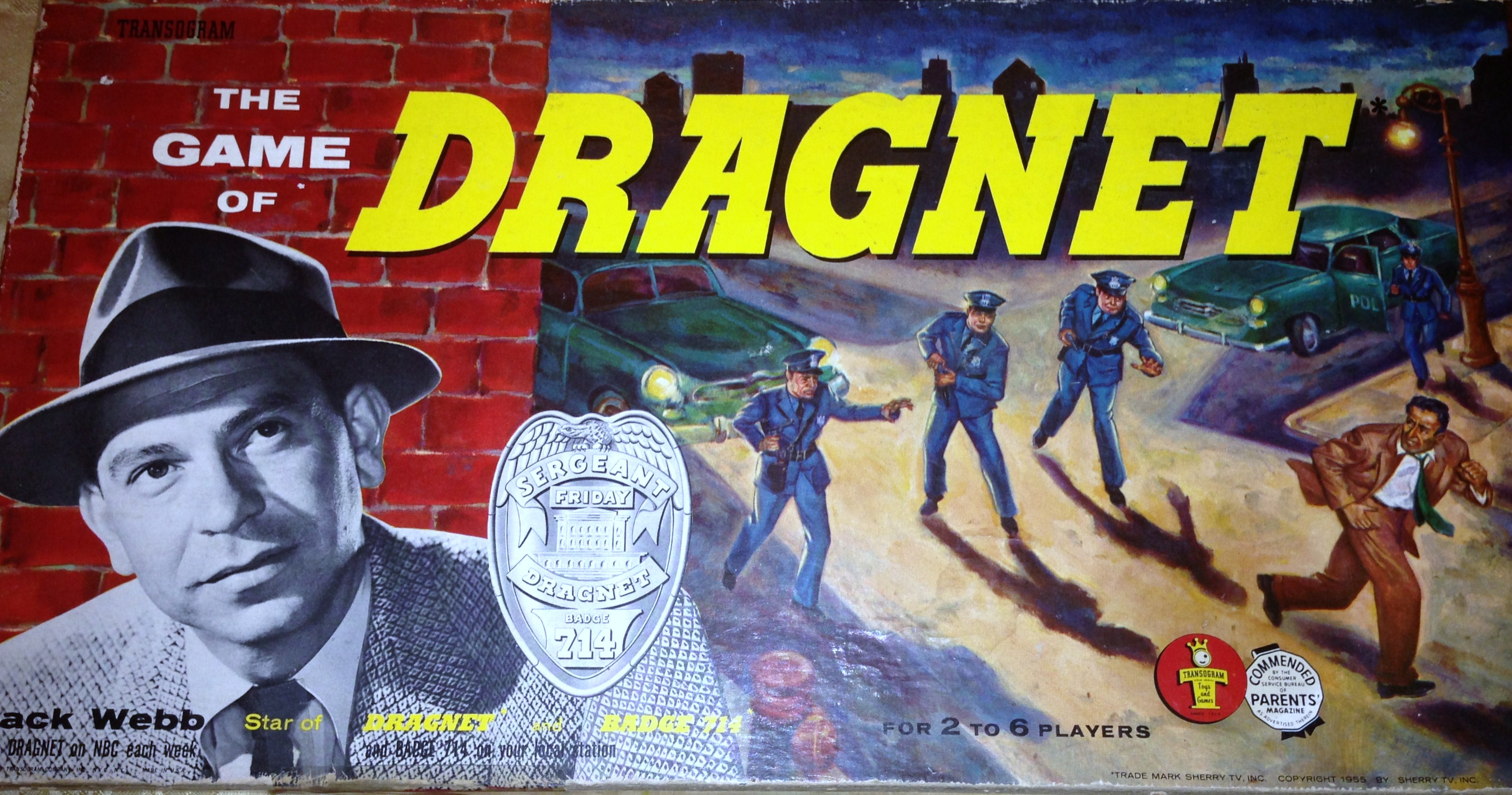
dragnet boxI’ve been a big fan of Dragnet since I discovered the late 1960s episodes when I was about 10. When I started listening to old-time radio, Dragnet quickly became one of my favorites in that medium, too. So this Christmas, when my husband presented me with The Game of Dragnet, I was delighted. (By the way, it’s really hard to explain gifts like this to “normal” friends who get jewelry and cookware as presents.)

This Week’s Game: The Game of Dragnet, 1955, Transogram.

The Box: Sergeant Joe Friday, in black and white, gives us a rueful smile, while uniformed officers (in color) pursue a criminal nearby. Shouldn’t Friday be helping them? The box, board, and instructions all include the label “Badge 714” as a kind of subtitle. Remember when syndicated versions of shows that were still airing in prime time ran under alternate titles? Badge 714 was Dragnet’s syndication title.

The Promotional Blurb on the Box: “Do you have the instincts of a detective? Are you adept at interrogation, clever at deduction? You are! Then you must play this drama packed game! Here it is!—a realistic and exciting game of skill, deduction, and luck for teenagers and adults, based on DRAGNET, famous on radio, TV, and in the movies.”

This is actually only about one-fourth of the copy—it is the War and Peace of promotional blurbs.

dragnet board

The Board: The box copy also refers to this a “fascinating and absolutely unique game.” The board, however, is quite generic. Transogram and other companies often produced boards that they could re-purpose for subsequent games. All they would have to do to re-use this design is to swap out the center circle.

suspects dragnet cars

Two “suspects” flanked by police cars. Doesn’t that pink suspect look threatening? The green disc below is one of the numbered, interchangeable suspect bases.

Game Pieces: Six police squad cars in various colors and seven suspects. The latter are bell-shaped pieces of colored plastic that attach to interchangeable green bases. Each base bears a number.

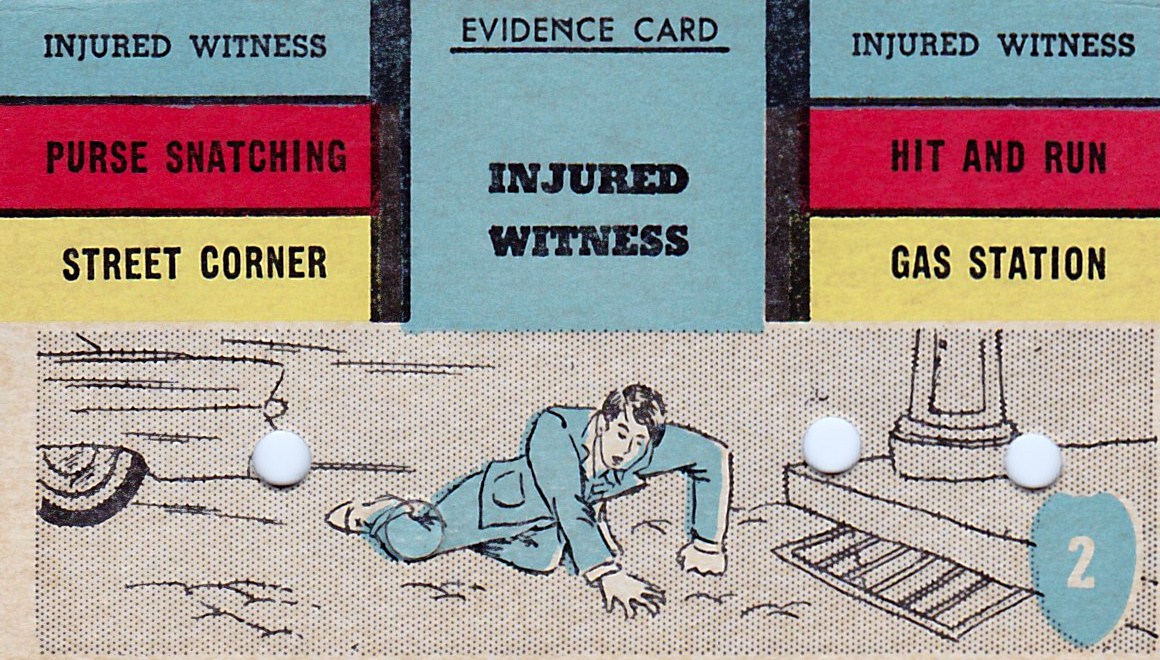
Crime File Cards: The most interesting thing about these is that they have random holes punched in them. This mystified me until I read that in the instructions that they “simulate authentic key-punched police file cards.”

Then, of course, I had to seek out more information about key punching.

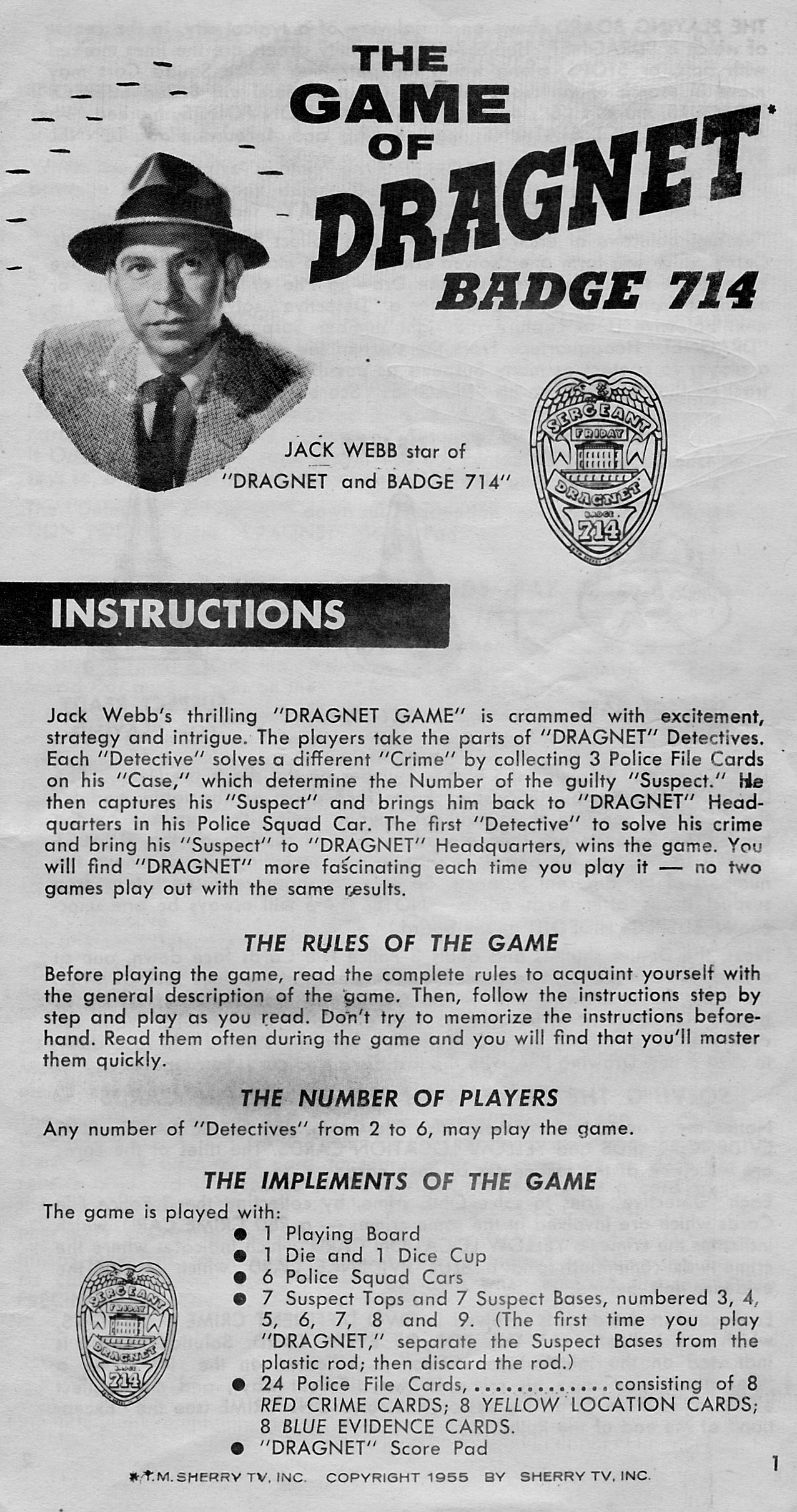
dragnet instructions

If you want to play this game, set aside an afternoon for reading the instructions.

Game Play: It’s kind of like Clue, but much more complicated. Before the game starts, suspects are attached to bases and planted at various Suspect Hideouts around the board. Each player receives three police file cards. Each player will try to collect three police file cards that fit the same crime—a crime card, a location card, and an evidence card. Each of these cards also has a number on it. When a player adds the three numbers on their three correct cards together, they will get the number of the suspect they are seeking

dragnet card 2Players move around the board in their squad cards. When they land on a Suspect Hideout, they can look at the suspect’s number and record it on their score pad. When they land on an Interrogation Post, they can ask a yes-or-no question about a suspect (i.e., is the red suspect’s number odd?), as long as they don’t ask directly what the number is. When they land on a Precinct Station, they can take police file cards from other players.

dragnet card 1Once a player has his three cards and knows his suspect’s number, he must go to that suspect’s hideout and then return to police headquarters to win the game.

Whew! Actually becoming a police detective might be simpler than playing this game.

My Thoughts: This looks like it could be fun, as long you invest the time necessary to master all the rules.

Other Spin Again Sunday posts you might enjoy:

Gomer Pyle Game

Charlie’s Angels Game

Waltons Game

Spin Again Sunday: The Bride Game, 1971

The Game: The Bride Game, “the exciting game of planning a wedding.”

Copyright Date: 1971.

Object: “To be the first girl to get her complete matching wedding party along with the necessary accessories for the wedding ceremony.”

Recommended For: “Girls 8 to 14.” I don’t think they really needed to specify girls.

The Box: What girl could resist that full-length portrait of wholesome bridehood? Well, lots of girls probably could and did, but it would have snared me.

The box photo immediately called Tricia Nixon to my mind.  That might have been what Selchow & Righter was going for—Tricia Nixon did marry in 1971. Tricia’s gown was downright sexy, however, compared to the prim one our box bride wears.

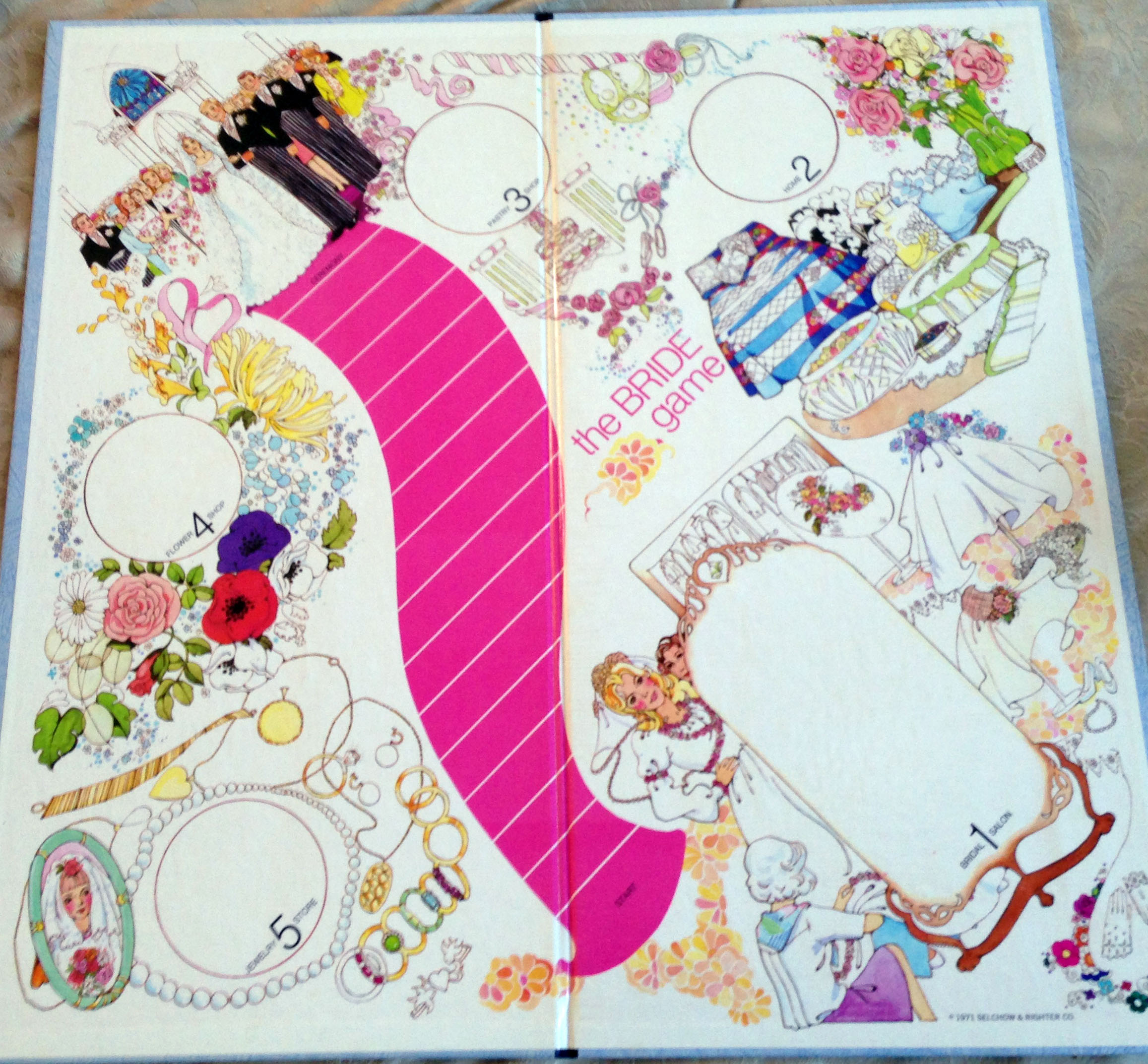
The Board: In the early 1970s, Selchow & Righter (best known for Parcheesi and Scrabble) tried to carve out a niche in girls’ games. In this series, we’ve seen another of their offerings—the Emily Post Popularity Game. Like that game’s board, this one features misty pastel graphics.

Game Pieces: Regular colored pegs, wooden rather than plastic. The die is unusual; it has a natural wooden finish and sports numerals instead of dots.

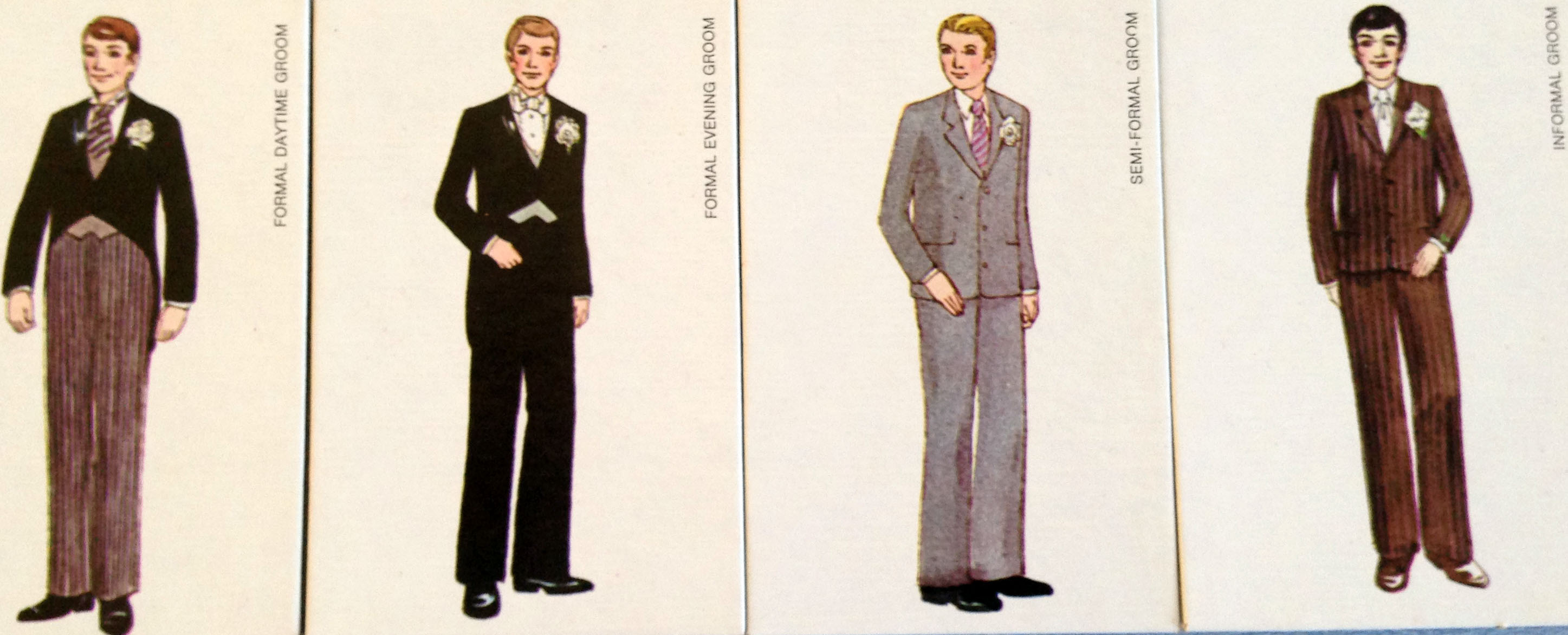
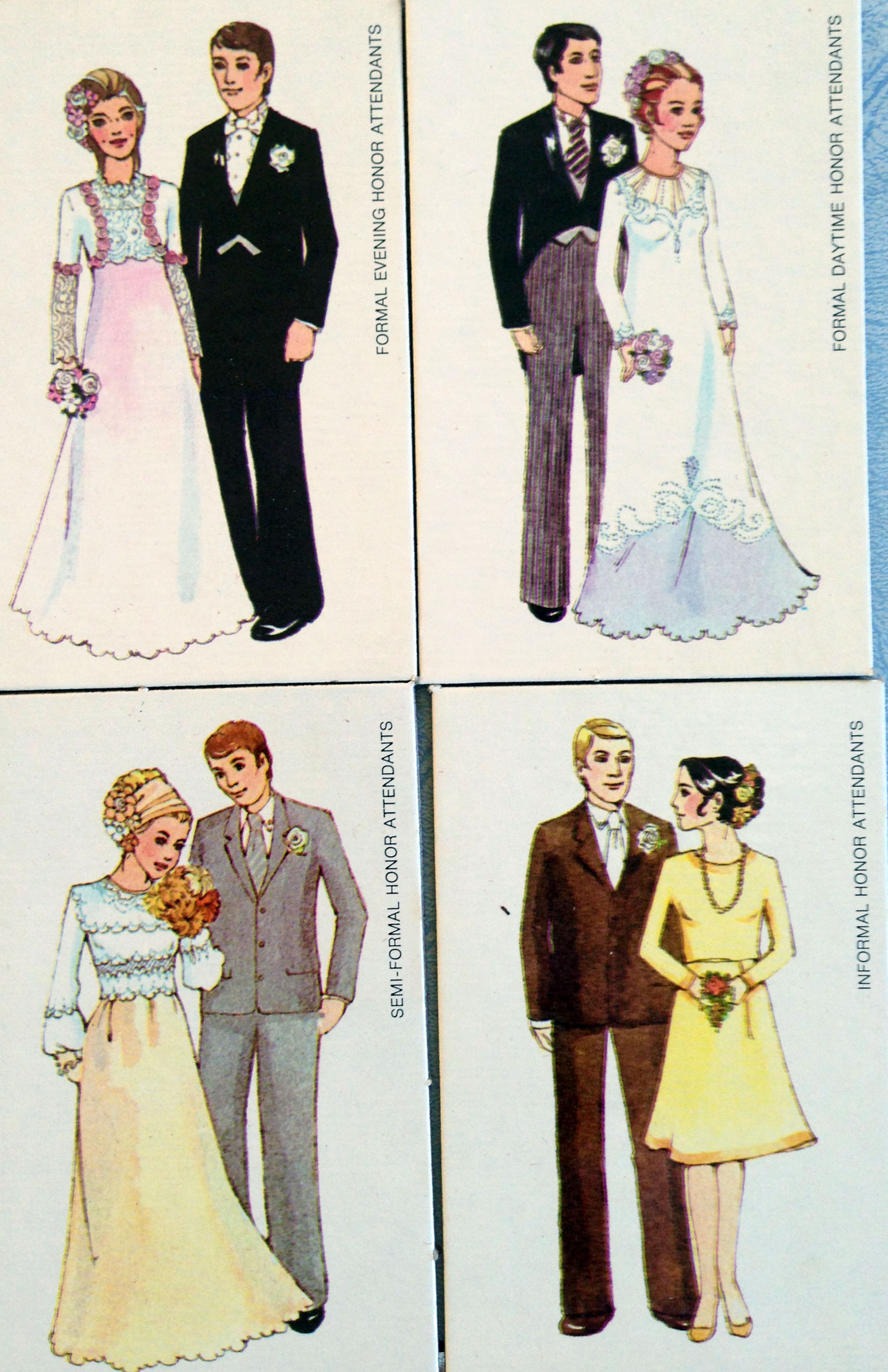
Game Play: Before she can march down the aisle, each player must collect cards representing a bride, a groom, and honor attendants ALL IN THE SAME STYLE. Yes, the instructions give that last part in all caps. You wouldn’t want to commit a disastrous faux pas by having a groom dressed in “Daytime Formal” style and a Maid of Honor dressed for a “Semi-Formal” wedding, would you?

The grooms

The attendants

The brides. So, readers, what apparel would you pick?

Some of the other game cards. I’m glad the snazzy lingerie is something new, rather than something old or, worse, borrowed.

Each player must also collect a wedding cake card, a bridal bouquet card, and a wedding ring card, as well as cards representing something old, something new, something borrowed, and something blue.

While collecting these cards, players circle the board and visit the pastry shop, flower shop, jewelry store, and bridal salon. When all the cards are in hand, players can start marching toward the altar.

Today’s Bonus Feature: When it comes to bride-related toys, this game doesn’t live up to the Bonnie Bride doll, who could actually toss her bouquet. You know it was a quality product, since it was “sold only at food markets.”

Spin Again Sunday: The Waltons (1974)

This week, my series on vintage board games is taking us to Walton’s Mountain.

The Game: The Waltons Game

Copyright Date: 1974.

Recommended Ages: 8 to 14.

Game Box: The colors are drab, which perhaps befits the Depression setting. The actor caricatures are good, as such things go. John Boy’s head is the biggest–frequent Waltons viewers will appreciate how fitting that is.

Object: “Be the first player to get rid of all your cards.”

Game board

Game Play: Like the H.R. Pufnstuf Game, this is a card game masquerading as a board game. All the cards are dealt at the beginning of the game; playing one card each turn, players try to complete puzzles featuring Waltons characters.

Game Board: The board, which features pictures of common Waltons settings, serves as a place to complete the puzzles. (The top puzzle, strangely, includes a non-regular cast member.)

An example of a completed puzzle. Anachronism alert: It’s very unlikely that a conservative 1930s farm wife would have had pierced ears.

My Thoughts: I’m surprised I didn’t own this game as a child because my family loved The Waltons. Watching the show together was a big weekly event, and it spawned a running joke that persists to this day. During the early seasons, the show’s end signaled my bedtime. My parents always tried to hustle me off to bed as the final scene faded to black, but I wasn’t having it. Didn’t Earl Hamner’s voice always announce, “Stay tuned for scenes from our next episode?” I would argue that I needed to see “the scenes.” My parents still bring this up when my own daughter is stalling at bedtime.

A John Boy card can be used to compete any puzzle. Of course it can.

Bonus Feature: Although we loved the show, my family also loved laughing at its corniness. I remember how amused we were by this Waltons parody on The Carol Burnett Show.  I don’t think we ever referred to the series as anything other than The Walnuts from then on. (The sketch more than lives up to my memories. Vincent Price and Joan Rivers as Ma and Pa Walton? Awesome!)

Read my whole Spin Again Sunday series!

Spin Again Sunday: Addams Family Card Game

For this pre-Halloween edition of my series on vintage games, I bring you an altogether ooky diversion.

This Week’s Game: Addams Family Card Game, 1965

Recommended Ages: 7 to 15.

Game Play: While I usually focus on board games, this is a simple card game. Cards show pictures of Addams Family characters. Gomez, Morticia, and the children each appear on 11 cards. Six wild cards show Lurch and Uncle Fester. The game proceeds like the game War. The player who amasses all the cards wins.

As the instruction card puts it, “Each character has the power to TAKE another. Gomez TAKES Morticia…Morticia TAKES the Children…the Children TAKE Gomez. The Lurch and Uncle Fester (Wild) cards are most powerful; they TAKE any of the other cards.”

It’s certainly fitting that Gomez TAKES Morticia. Was there ever a more passionate married couple in the world of classic TV?

Spin Again Sunday: Planet of the Apes Game + Old-Time Radio Bonus

Because my husband’s birthday is approaching, I’ve chosen The Planet of the Apes Game for this week’s installment of my vintage board game series.

My husband loves The Planet of the Apes and all its sequels. I, on the other hand, have always had an aversion to monkey-and-ape-based entertainment. I may have inherited this from my grandmother, who cringed whenever a chimp appeared on a TV sitcom (an all-too-common occurrence in the ’70s), or I may have developed it after a series of gorilla-related nightmares at age 3 (a Playskool Zoo started it all, but that’s a blog entry for another day).

Through marriage to an ape fan, I’ve managed to overcome my prejudices–at least to the extent of buying him ape memorabilia like this.

Today’s Game: Planet of the Apes

Copyright Date: 1974

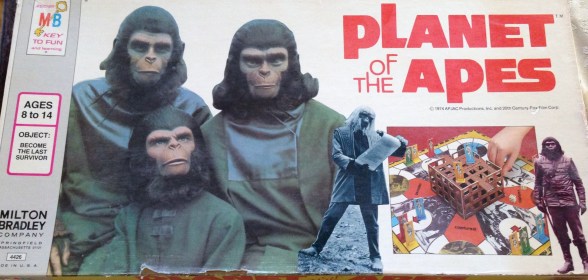
Game Box: Pretty appealing to a Planet of the Apes fan, I suppose. All the major apes are represented. I’m not sure why Dr. Zaius is in black and white when everyone else is in color.

Recommend Ages: 8 to 14.

Game Board: Simple, with lots of photos from the movie. The unique part is the cage that stands in the center.

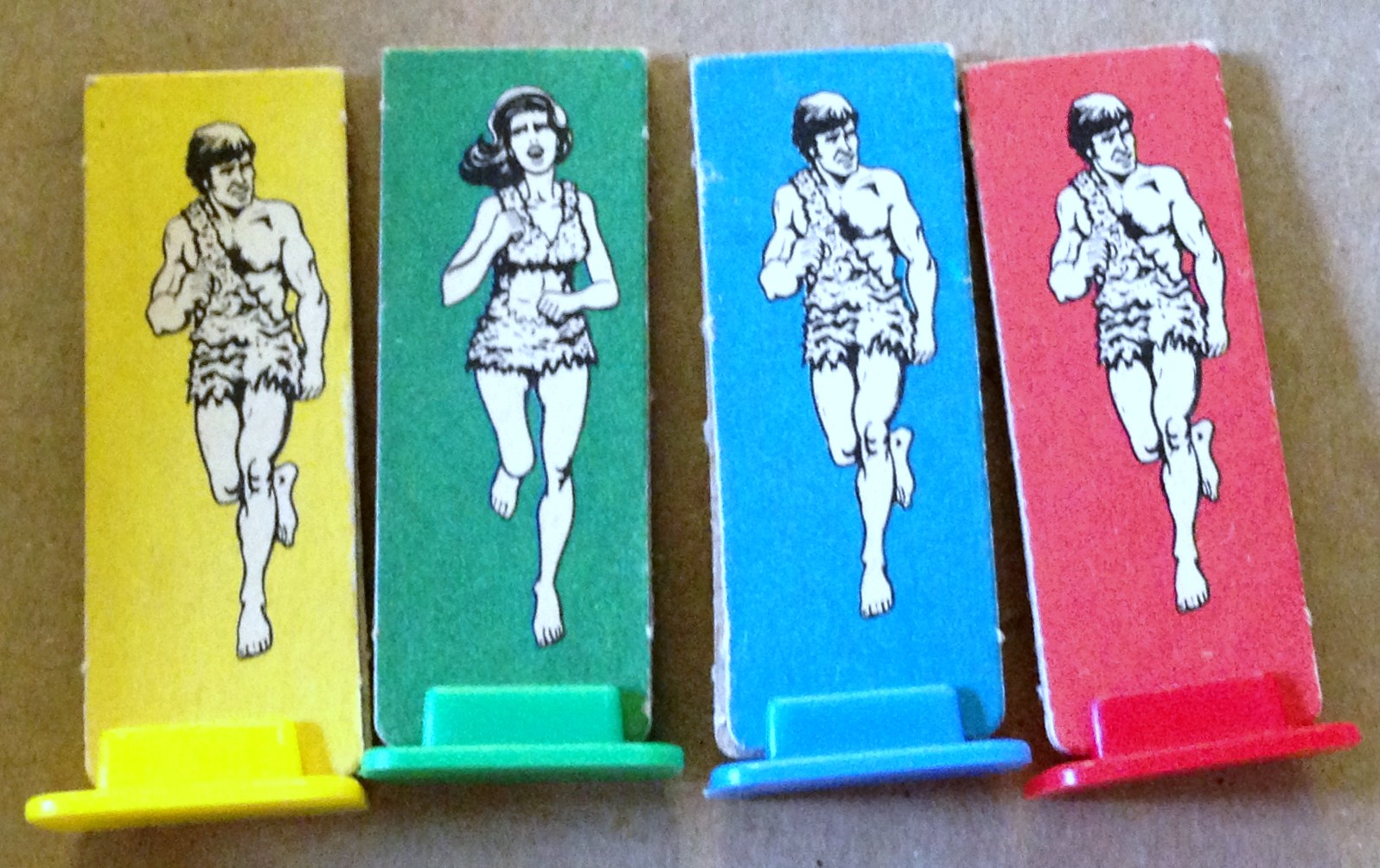
Game Pieces: Generic-looking male and female humans. At least we get front and back views.

Game Play: Each player gets four humans. You move them along the path until they land on a “Captured” space. Then you have to place your human atop the cage and let your opponent turn the cage’s knob. If the human falls in, he or she is captured. If not, they’re safe—for the moment.

Cage Fail: My cage is missing some key parts, so it doesn’t function. You can see how should work from this box closeup.

Object: “Become the last survivor.” Very cool object, my opinion. My husband kind of over-identifies with the movie’s apes, though. I think he’d rather see all his humans caged.

Today’s Bonus Feature: With my own stance on apes softening, I’ve developed an affinity for ape-themed old-time radio episodes. At least in those, you don’t have to see the apes. Sometime in November, I plan to post a whole playlist of ape episodes, but for now please enjoy this delightful example.
“Ape Song,” Murder at Midnight, March 31, 1947

“You treated me like an animal, Cecily–now an animal will treat you the way you deserve!”

Murder at Midnight has become a guilty pleasure of mine. It’s cheesy, but in a very entertaining way. This episode had me smiling all the way through.

Read more Spin Again Sunday
Listen to more Old-Time Radio

Spin Again Sunday: Dr. Kildare Game

Dr. Kildare Game, Ideal, 1962

It’s time to take two aspirin and enjoy the latest installment in my series about vintage board games.

Today’s Game: Dr. Kildare

Copyright Date: 1962

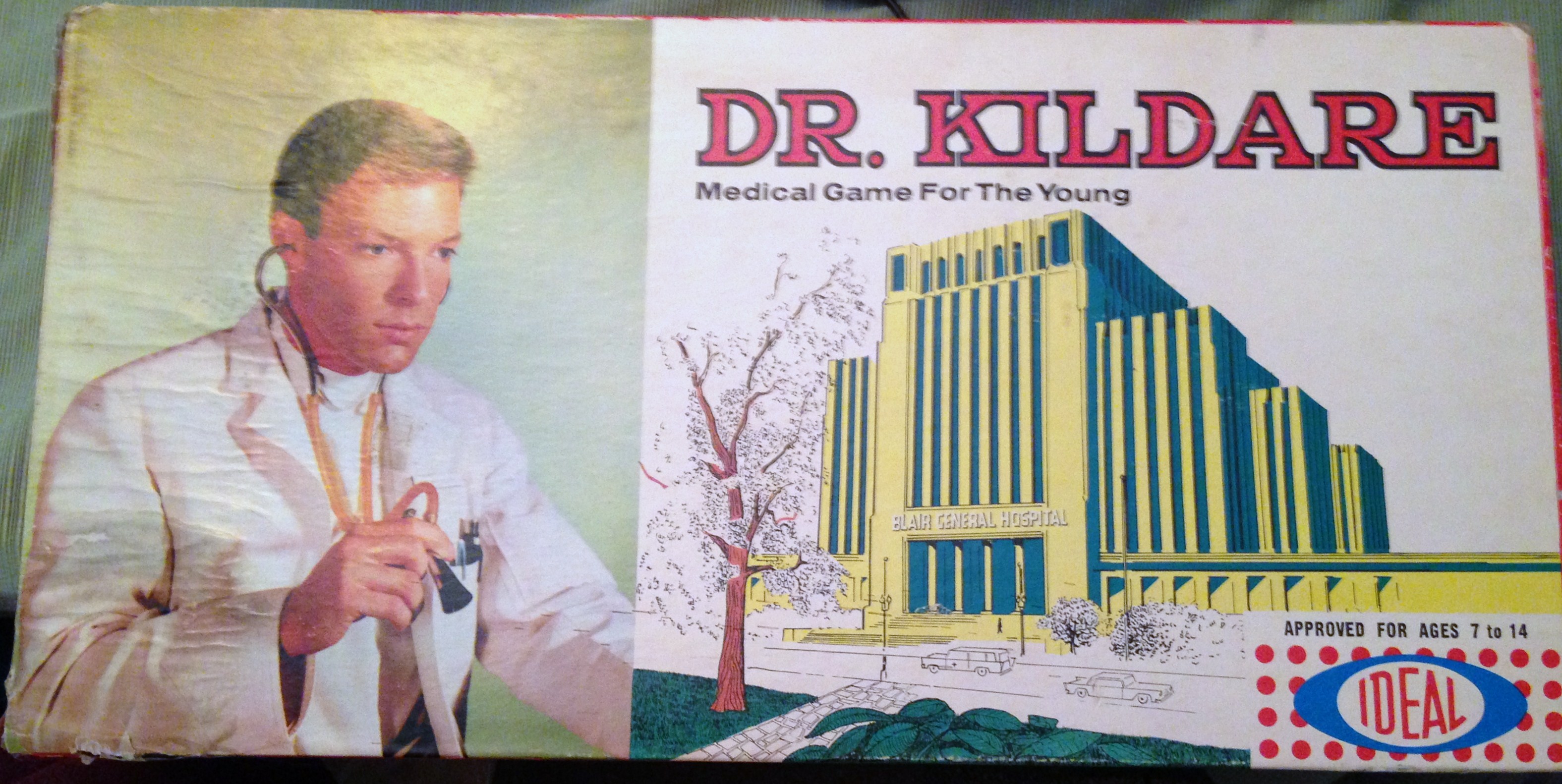
Mystifying Subtitle: “Medical Game for the Young.” I wonder why they felt the need to specify that it was for the young.

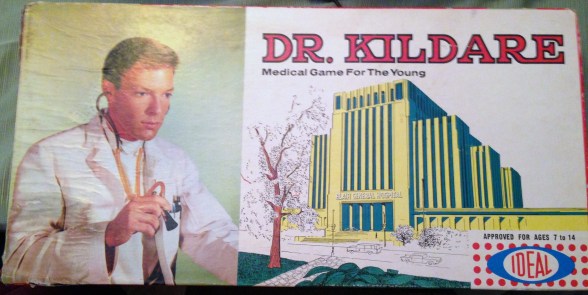
Game Box: I’m sure the draw for potential buyers was the large photo of dreamy Richard Chamberlain as Dr. Kildare, who is staring intently ahead and listening to an invisible person’s heartbeat.

The Analyzer

Recommend Ages: 7 to 14. Actually, it says “Approved for ages 7 to 14.” That’s a strangely officious way to put it.

Game Board: The board offers a cute representation of a hospital, with green corridors, patient rooms, an operating room, and more. The patients all seem happy, even the one traction.

Game Pieces: Dr. Kildare’s dreamy face again.

Game Play: Pretty cool. Players make their “rounds” through the hospital and diagnose their patients with the help of the “Analyzer.”  Patients’ conditions are written in code on diagnosis cards. I decoded two of them just for fun—nose bleed and sprained back.

Nice Touch: The instructions say that you can play the game by yourself.  I used to play board games against myself all the time—my brother was not really a board-game guy.

My Thoughts: I’ve never actually seen an episode of Dr. Kildare. It was a bit before my time. I saw The Thorn Birds at an impressionable age, though, so I can appreciate Richard Chamberlain’s charms. The game looks pretty entertaining—what kid doesn’t love decoding messages?

Another photo of Dr. McDreamy from the box insert. Okay, we get it, he’s handsome!

If you enjoyed this post, read the whole Spin Again Sunday series!