Weird Words of Wisdom: The 5 Types of People Who Go All the Way Edition

“Just how advisable is it for a farm girl to date a city boy? The chief concern here seems to be her ability to handle a date who is more sophisticated than she is. The old story of the traveling salesman and the farmer’s daughter has some basis in the tendency of certain urban males to try to exploit the presumably more naïve country girl.”

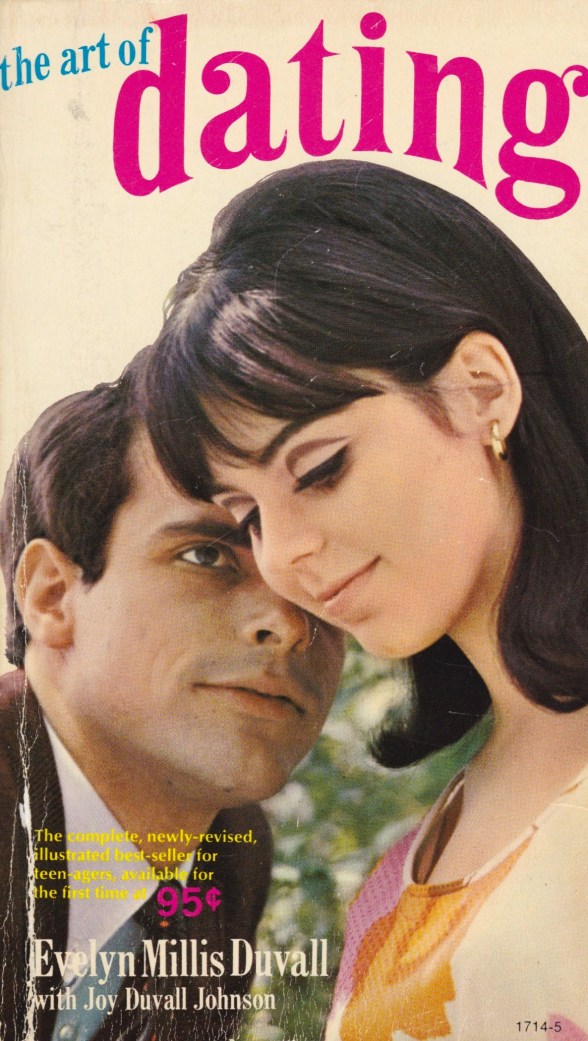
The Art of Dating, 1967 (1969 printing) By Evelyn Millis Duvall with Joy Duvall Johnson

About the Authors: Evelyn Millis Duvall, according to this book’s back cover, was “known nationally and internationally as a top-ranking authority on sex and family life education.” She was no intellectual slouch—she earned a Ph.D. in Human Development from the University of Chicago, and she was a Fellow of the American Sociological Association, which sounds impressive. Her earlier book The Facts of Life and Love for Teenagers went through many printings in the 1950s and 1960s. Her daughter, Joy Duvall Johnson, assisted her in writing this book. She was a University of Chicago graduate, too, with a master’s degree in “social group work.”

About This Book: Having read both this book and The Facts of Life and Love for Teenagers, I’ve found that two qualities distinguish Duvall in the advice-giving game: She has a research-based approach and an obsessive love of detail.

You can see the first quality in the many studies that she cites and statistics that she offers. Here is a fairly typical Duvall passage:

“Professors Kirkpatrick and Caplow found that the most usual course of love is one starting with mutual indifference and moving upward through attraction to love, and either dropping again to indifference, with the broken love affair, or remaining in love at a high level of mutual involvement. One out of every five love affairs studied is irregular in its course, with unpredictable shifts from love to hate to indifference to liking in various combinations throughout the history of the relationship. Somewhat fewer young men and women experience an even more vacillating kind of love that is off-again-on-again, with ups and downs like a roller coaster’s.”

Her love of detail pervades the entire book, which explores dating from every possible angle. Take her guidelines, for instance, about a movie date:

  • Paying for the tickets: “While the fellow buys the tickets, the girl steps aside and looks at the stills outside to avoid the boy any embarrassment he may feel at the ticket window.”
  • Walking in to the theater: “If there is no usher, the boy precedes the girl down the aisle, finds two seats, and steps aside so that the girl may be seated first; he then follows and seats himself behind her.”
  • During the film: “…throwing popcorn or paper, or otherwise behaving like a nuisance, is rude and crude.
  • Getting refreshments: “At (intermission) the boy may ask his date what she would like, then excuse himself while he gets it…If his budget doesn’t call for this extra, a boy should come prepared with some little offering to take the place of purchased refreshments, such as candy from a roll or mints or a stick of gum. The girl accepts the offer graciously without hinting that she would like something else.”
  • Acceptable affection: “The boy may hold the girl’s hand if she has no objection or place his arm over the back of her seat.”
  • Talking: “They may whisper their reactions to the picture or comment to each other about the characters or plot, so long as they neither embarrass each other nor annoy their neighbors.”
  • Leaving the Theater: “…the boy helps the girl into her wraps and waits is the aisle until the girl emerges and precedes him out of the theater. Then, the boy may suggest stopping at a soda fountain, if he wishes, or if it’s early, the girl may invite him to her home for ‘cake and milk’ or whatever she and her family have agreed upon for an evening snack.”

Whew! I was the most socially awkward teenager who ever lived, and even I wouldn’t have needed that much help to get through a simple movie.

Despite her scientific bent, Duvall occasionally lapses into flights of fancy that seem to be inspired by movies rather than real life, circa 1967. In addition to warning about the great urban-rural dating schism, she predicts soap-opera-esque consequences for dating outside one’s social class. She even cites the 1940 movie (or 1939 novel) Kitty Foyle to demonstrate the latter situation’s pitfalls!

Decoding a Previous Owner: A previous owner of my book went crazy underlining passages and scribbling in his or her own, sometimes smug, notes. At first I assumed this mad scribbler was a teenage reader, and it surprised me that any teen was taking this book so seriously in 1969. Then I started to notice that the underlinings included portions aimed at both girls and boys, and I wondered if the reader was a parent, teacher, or some kind of minister. Finally, I hit upon a note that confirmed a church affiliation: Below a passage that described church ladies hosting an after-prom party, my scribbler wrote, “Possibility for our women.” Oh, the fun of reading used books!

More quotes from The Art of Dating

“When the boy on the hill dates the girl from across the tracks, the general public is apt to assume that it’s because she is willing to let him take more liberties with her than would a girl from his own social group.”

Possible dating activity: “An old-fashioned taffy pull lends itself to hilarious, if sticky, informality.”

“Currently some segments of the young adult population try to express their individuality by extremes in hair style and dress. However young people respond to this, most want an attractive date. On one college campus, the men revolted against the trend of certain co-eds to be unkempt. They protested that they wanted girls to look feminine. Most fellows would agree.”

Dating costs: “College men find it often costs close to $5 for a ‘movie and malt’ date.”

Really? Just as responsible?: When you step into a car, you are just as responsible as the driver for what goes on…If (a girl) lets the boy drive too fast, she shares the guilt if an accident occurs.

Warning—writing about illegal drugs may be a gateway to abusing quotation marks: “Some teen groups have ‘parties’ where drugs provide ‘entertainment.’ At these parties teens are often exploited by dope peddlers who ‘contribute’ marijuana. Young people might be tempted to try a ‘reefer.'”

Smart girls: “Boys worry less about dating girls inferior to them in intellect, since it is generally expected that a girl won’t be as intelligent as the boy she dates. Indeed this is emphasized so strongly that a superior girl may find that if she has a reputation as a ‘brain,’ boys are afraid to date her. Such a girl may pretend to be dumber than she is on a date…But there are girls who resent having to ‘put their brains on ice,’ so they only go out with boys who like them as they are, who admire intelligence and are not threatened by a girl’s superior mental ability. A girl who dates a boy who is not her intellectual equal must decide whether she dares to be herself or whether she must put on an act.”

(You would think that two female, University-of-Chicago-educated social scientists might take a firmer stand on which is the right choice, but they let matters rest there.)

The five kinds of people who “go all the way” before marriage:

1. “The Unconventional person with few or no religious roots.”

2. Young people from the lower socioeconomic classes. (“In general, the middle-class girl or boy values chastity more highly.”)

3. People desperate for love and acceptance.

4. Rebellious types.

5. People who are deeply in love but, for some reason, cannot marry.

“The more mature girl knows that she doesn’t need to resort to either slapping or running in order to deal with the too amorous boyfriend. She wards off unwelcome behavior with a firm refusal to cooperate, accompanied by a knowing smile and a suggestion of some alternate activity. She may say, “Not now, Ambrose—let’s go get a hamburger; I’m hungry.”

Read the whole Weird Words of Wisdom series
Spin Again Sunday: Planet of the Apes Game + Old-Time Radio Bonus

Because my husband’s birthday is approaching, I’ve chosen The Planet of the Apes Game for this week’s installment of my vintage board game series.

My husband loves The Planet of the Apes and all its sequels. I, on the other hand, have always had an aversion to monkey-and-ape-based entertainment. I may have inherited this from my grandmother, who cringed whenever a chimp appeared on a TV sitcom (an all-too-common occurrence in the ’70s), or I may have developed it after a series of gorilla-related nightmares at age 3 (a Playskool Zoo started it all, but that’s a blog entry for another day).

Through marriage to an ape fan, I’ve managed to overcome my prejudices–at least to the extent of buying him ape memorabilia like this.

Today’s Game: Planet of the Apes

Copyright Date: 1974

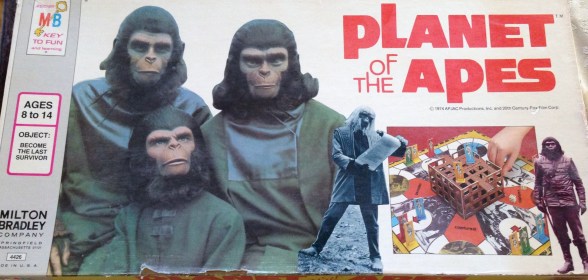
Game Box: Pretty appealing to a Planet of the Apes fan, I suppose. All the major apes are represented. I’m not sure why Dr. Zaius is in black and white when everyone else is in color.

Recommend Ages: 8 to 14.

Game Board: Simple, with lots of photos from the movie. The unique part is the cage that stands in the center.

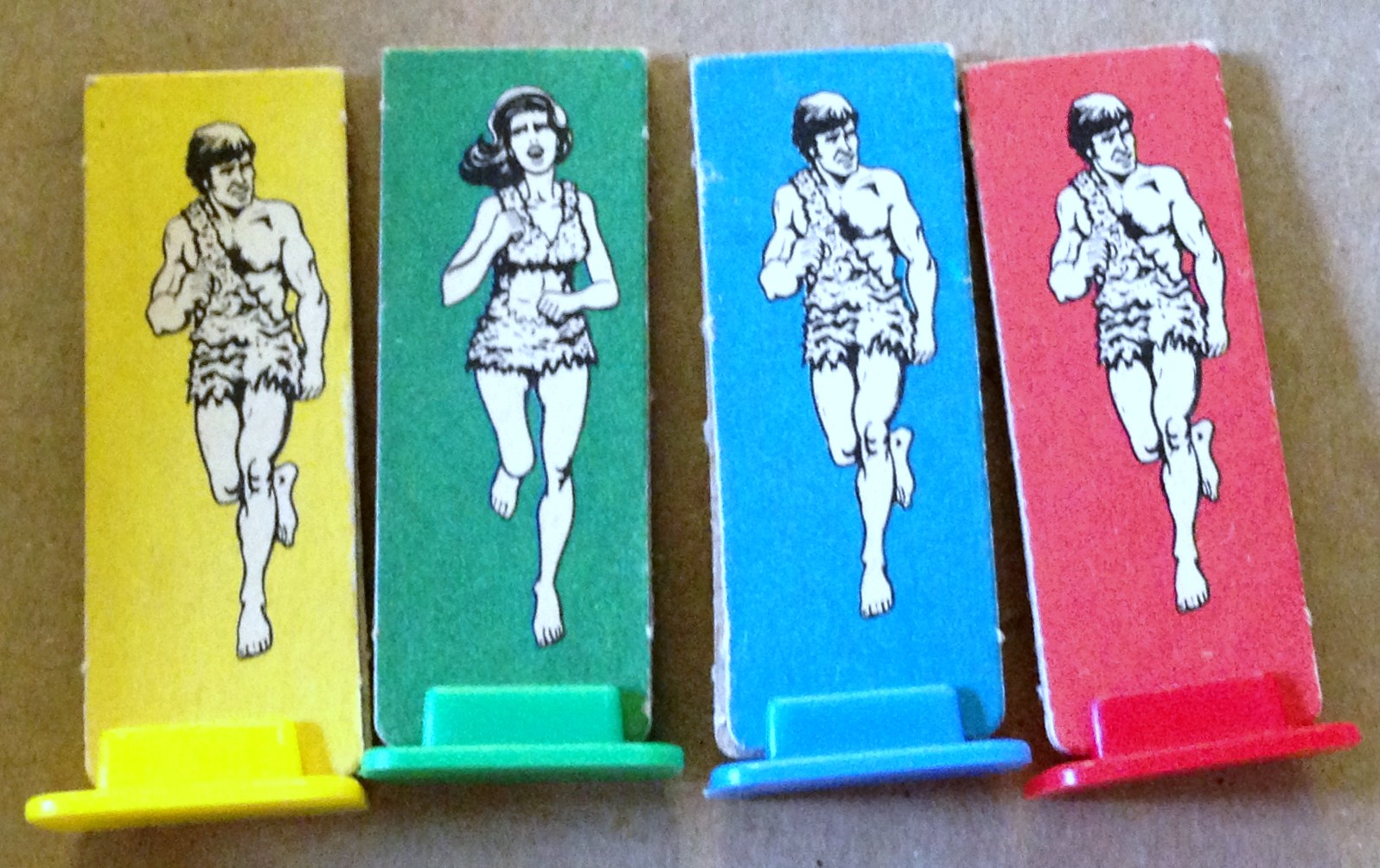
Game Pieces: Generic-looking male and female humans. At least we get front and back views.

Game Play: Each player gets four humans. You move them along the path until they land on a “Captured” space. Then you have to place your human atop the cage and let your opponent turn the cage’s knob. If the human falls in, he or she is captured. If not, they’re safe—for the moment.

Cage Fail: My cage is missing some key parts, so it doesn’t function. You can see how should work from this box closeup.

Object: “Become the last survivor.” Very cool object, my opinion. My husband kind of over-identifies with the movie’s apes, though. I think he’d rather see all his humans caged.

Today’s Bonus Feature: With my own stance on apes softening, I’ve developed an affinity for ape-themed old-time radio episodes. At least in those, you don’t have to see the apes. Sometime in November, I plan to post a whole playlist of ape episodes, but for now please enjoy this delightful example.

“Ape Song,” Murder at Midnight, March 31, 1947

“You treated me like an animal, Cecily–now an animal will treat you the way you deserve!”

Murder at Midnight has become a guilty pleasure of mine. It’s cheesy, but in a very entertaining way. This episode had me smiling all the way through.

Read more Spin Again Sunday
Listen to more Old-Time Radio

Room 222 Call Sheet: A Day in the Life of a 1970s Sitcom

Room 222 call sheet, 1970

When it comes to collecting, I’ve always admired people who have a laser-like focus. I’ve been a collector all my adult life, but the resulting collection is eclectic, to say the least. Today, I present one of the more interesting pieces of ephemera I own—a call sheet from the sitcom Room 222, which ran on ABC from 1969 to 1974.

The call sheet is interesting to me, anyway. (The fact that I was the only one to bid on it when it appeared on Ebay 10 or so years ago suggests the interest might not be widespread. That worked to my advantage though—I only paid $2 for it.) It provides a fascinating window into television production in the 1970s.

A call sheet, as Webster’s defines it, is simply “a daily schedule of filming for a movie or television show.” This call sheet dates from August 7, 1970, when filming was under way for two season two episodes. “Adam’s Lib,” a feminist story about a girl trying out for the boys’ basketball team, would air October 14, 1970; “What Would We Do Without Bobbie?,” an ugly duckling story, wouldn’t air until December 23, 1970.

The “Adam’s Lib” scene featured three day players—Tracy Carver as the basketball player, Terri Messina as the feminist activist, and “Darrell Carson” as the boy who helps them advance their plan to infiltrate the boys’ team. According to the Imdb, the actor’s name is Darrell Larson, and he’s the only one of the three who has acted steadily since then.

Larson, Messina, and Carver

This basketball court scene was shot at a playground in Los Angeles’ Rancho Park neighborhood. The female actors had to arrive at 7 a.m. for makeup that day, with Larson arriving 30 minutes later. It looks like they met up at 8 a.m. on Stage 10, Room 222’s usual filming location on the Twentieth Century Fox lot.

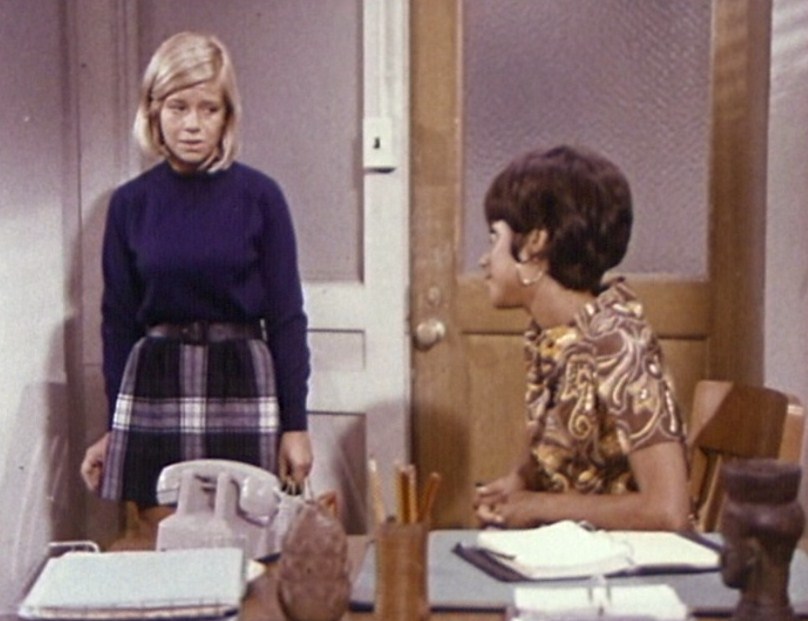
The “Bobbie” scenes, filmed on Stage 10, required the presence of series star Denise Nicholas as Liz McIntyre, recurring actor Howard Rice as Richie, and day player Nicole Jaffe as Bobbie.  Once again, the women reported for makeup 30 minutes earlier than the male actor. This group got a more leisurely start to their day; filming didn’t start until 10 a.m.
Jaffe and Nicholas in one of the office scenes. You might not recognize Jaffe’s face, but you would know her voice. She was the original Velma on Scooby-Doo.

At the bottom of the call sheet, we get a glimpse at what the cast would be doing the following week—reading and rehearsing on Monday, shooting a Walt Whitman exterior scene at Los Angeles High on Tuesday, and shooting more studio scenes on Wednesday (including a scene outside the “Berman Bungalow,” which would represent Bobbie’s house.)

William Wiard directed the filming on this day. Mike Salamunovich was the unit production manager. Both had long and prolific careers in television.

Room 222 call sheet, 1970, reverse side

The call sheet’s reverse side details the day’s production requirements. Those requirement were modest on August 7, 1970. They didn’t need any birds, livestock, wranglers, registered nurses, or firemen—not even any coffee or doughnuts. They did need one Los Angeles policeman, a stretch-out bus, a crab dolly and grip, and a “dialogue man.” (The call sheet almost consistently uses “man” in its crew terminology—mechanical effects men, camera men, prop men, makeup men. The only exception is “body makeup woman.”)

This little piece of TV history delights me so much that it might have launched me on a whole new field of collecting. Unfortunately, I haven’t had any luck finding similar items.

To close, I present the Room 222 opening, just because I love the music and the fashions.

Family Affair Friday: Season 1, Episode 7, Mrs. Beasley, Where Are You?, 10/24/1966

My 10-inch Buffy doll with her Mrs. Beasley. They’ve never been removed from the box, but Mrs. Beasley has plummeted to the ground–hey, just like in this episode.

This week, the latest installment of my Family Affair series features a classic Mrs. Beasley episode–and some dolly digressions.
Season 1, Episode 7, Mrs. Beasley, Where Are You?, 10/24/1966

Teleplay by: Phil Davis and John McGreevey. Story by: Phil Davis. Directed by: William D. Russell.

Synopsis

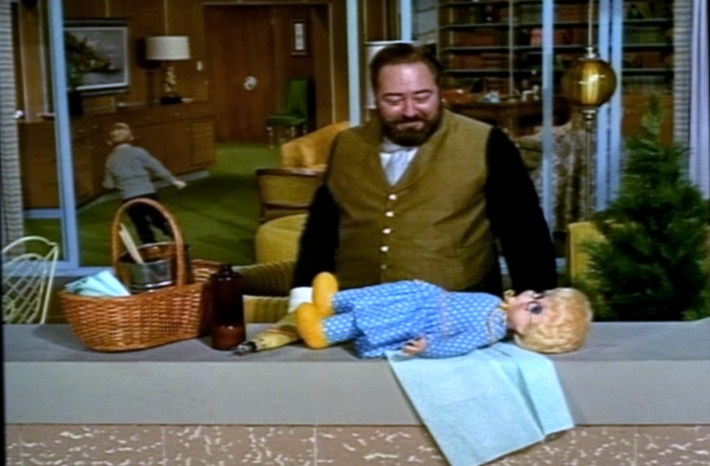
A seeming tragedy occurs when Mr. French accidently knocks Mrs. Beasley off the terrace, and the doll is nowhere to be found below.

What could go wrong here?

Yeah. That.

Meanwhile, a related subplot finds Uncle Bill’s weekend plans to “sleep, play golf and do a little mild socializing” thwarted by conflict with a neighbor–a neighbor whose little girl suddenly owns a doll (Effie Boots) the spitting image of Mrs. Beasley.

Effie Boots’ owner is the spitting image of Pamelyn Ferdin.

A despondent Buffy, however, testifies that the doll isn’t hers.  The whole Davis family suffers along with Buffy.

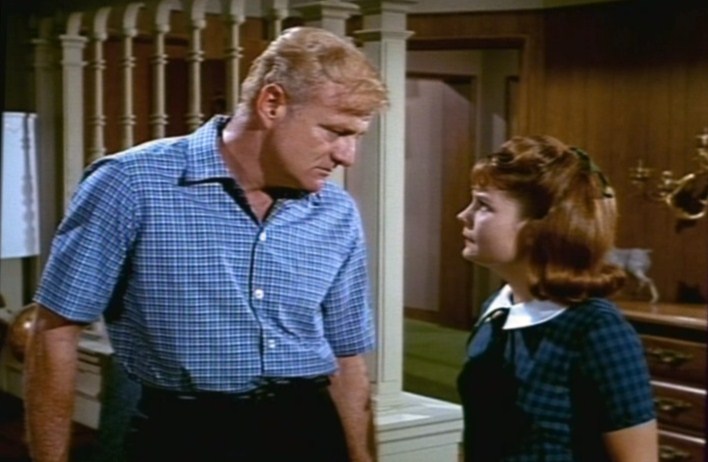
See the clothes these two are wearing while Cissy makes the scrunched-face-of-concern at Uncle BIll? Well, keep them in mind. We’ll get back to them later.

Jody offers to let Buffy sleep with his turtle. Awww.

A sweet sisterly moment. Double Awww.

When all seems lost, Uncle Bill and his girlfriend du jour find Buffy’s doll in the apartment building’s garbage cans.

“Competition is the lifeblood of free enterprise,” the ragpicker notes approvingly when he sees Bill and his date rifling through the trash. Aren’t ragpickers amusing?

The happy reunion.

Random Thoughts

It would take a cold heart to remain unmoved by Buffy’s suffering. As a Barbie collector, though, I enjoy the toy store scene the most: drool-worthy Mattel dolls as far as the eye can see. I don’t know if Mattel had released the Mrs. Beasley doll yet, but obviously the show had forged its relationship with the toy company.

The mid-1960s was a golden era in Barbie history. In this scene, you can see several “American Girl” Barbie dolls. These were only made for two years and are highly sought after today. The long-haired doll in the background is Barbie’s cousin Francie. The Barbie clothes of that era were especially glamorous. The doll in the foreground is wearing Fabulous Fashion. You can spot other dolls wearing Fashion Luncheon and Pan American Airways Stewardess. One price guide I own values the latter at $900 if it’s still in the box! The little dolls on the shelf above the saleslady are Barbie’s brother and sister, Tutti and Todd, along with their friend Chris. Mattel made a Buffy and Mrs. Beasley doll in that same size.

Guest Cast: George Nelson: Frank Maxwell. Diane: Joan Vohs. Clara: Ann McCrea. Saleslady: Cathleen Cordell. Melissa: Pamelyn Ferdin. Scotty: Karl Lukas. Ragpicker: Andy Albin. Maid: Pauline Drake. Pamelyn Ferdin is a familiar face, and voice, from the 1960s and ’70s. Among other roles, she played Edna on The Odd Couple and voiced Lucy in A Boy Named Charlie Brown and Fern in Charlotte’s Web. She also appeared (with Johnnie Whitaker) on Sigmund and the Seamonsters and was in the ’70s version of Lassie. On The Brady Bunch, she appeared in the episode where Jan sports a wig. She also played Francie in a 1972 made-for-TV version of A Tree Grows in Brooklyn. She would appear in three more episodes of Family Affair. Joan Vohs appeared in a second-season epidsode as Mrs. Scofield, then appeared in six third-season episodes as Miss Cummings. Andy Albin was a regular performer on Bob Newhart’s short-lived first series in 1961.
Continuity Notes: Cissy explains that after the death of her mother and father and separation from her siblings, Buffy had only Mrs. Beasley left as a friend.

Continuity error–Cissy and Uncle Bill are wearing the same clothes in this scene as they did in the “concerned conversation” scene above, but this scene takes place the next day.

Notable Quotes: “People you love always go away–I know.” Buffy

Well, that quote’s a bummer. So I will close instead with two random Buffy pictures. In Buffy’s happy scenes in this episode, Anissa Jones seems more animated than usual.

Anissa Jones cuteness.

I love that outfit, too. It reminds me of the Gymboree outfits I tried to get my daughter to wear when she was 4 and 5. (No dice.)

Today’s Bonus Feature

An article from Doll World, December 1996, about the small Buffy and Mrs. Beasley doll.

Read my whole Family Affair series!

Weird Words of Wisdom: Betty Betz and Vintage Teen Etiquette That Rhymes Edition

This is the latest installment in my Weird Words of Wisdom series.

“As mother used to say, ‘Be pretty if you can, witty if you must—and pleasant if it kills you!’”

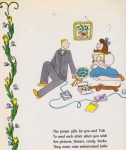
Your Manners are Showing: The Handbook of Teen-Age Know-How, 1946
By Betty Betz

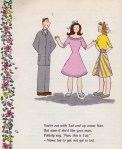
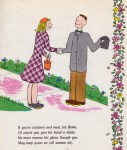
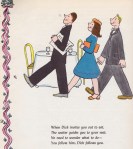
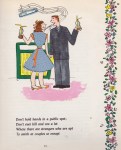
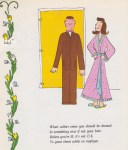
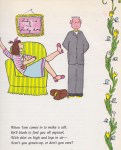
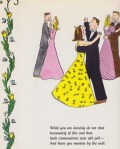
About This Book: Your Manners are Showing differs from most vintage teenage advice books in one key way—it shows teens how to behave with copious illustrations by Betty Betz. Verses by Anne Clark accompany the pictures; in between the illustrations, Betz provides short chapters on topics ranging from money to “vice” (drinking and smoking). Etiquette in verse actually strikes me as a pretty handy aid for mastering tricky concepts, like who gets introduced to whom.

About the Author: Where do I begin? Betty Betz journeyed from Hammond, Indiana, prom queen to 1940s and ’50s queen of all media. She was a Midwestern swimming champion, and her high school classmates named her Most Popular Girl in their school of 1,800. She attended Sarah Lawrence College and earned a guest editorship at Mademoiselle, which became the first magazine to publish her drawings. She went on to work for Esquire and Harper’s Bazaar. Eventually, she began to specialize in teenagers, writing a syndicated advice column for them and publishing several books. Her illustrations of teenage life turned up on everything from stationery to scrapbooks to jewelry boxes.

She was married briefly to Josef Lanz, the Austrian fashion designer who popularized the dirndl dress, a 1940s teen wardrobe staple. His family owned Lanz of Salzburg, which still exists, producing mostly nightgowns.

In 1956, she married her second husband, Frank McMahon, whom Time described as an “oil-rich Calgary wheeler-dealer.” She raised two daughters and settled down into a life of charity work and Palm Beach socializing. Betz died in 2010.

Among the other highlights of her brief career:

  • She published comic book stories featuring “Dollface and Her Gang.” (Dollface’s best friend was named Bun Brain. Really.)
  • She marketed a line of teenage clothing that included a hideous but creative item called a blouse-slip. As a slip, you could lounge around in it at home. If company stopped by, you could wrap a skirt around yourself and be good to go.
  • She hosted a TV talk show that Billboard called “a routine and lifeless concoction, devoid of warmth or sincerity.”
  • She founded the Betty Betz Angels Club for her fans, who pledged “to show respect and consideration to everyone, regardless of race or color.”
  • She served as a Hearst correspondent during the Korean War, providing readers with insights like this one from July 29, 1951: “…what baffles me most of all is the fact that communist ‘wacs’ don’t care for perfume or lipstick.”
  • She published Manners for Moppets, an etiquette book for children, in 1962. At the time, her family shuttled among homes in Vancouver, New York City, and Palm Beach. “An English nanny and a private plane make commuting painless,” The Calgary Herald wrote. “Having complete wardrobes in each house so she doesn’t have to pack and unpack all the time and hiring temporary help for each house as she gets there are other time and trouble savers.” I’ll bet.

Weird Words of Wisdom from Betty Betz

For the most part, I’ll let Betz’ illustrations (and Clark’s verse) speak for themselves. I can’t resist including a few quotes, though.

On tipping: “At least ten percent of the total bill is a sufficient tip, but never leave less than ten cents per person.”

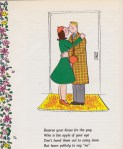
On saying goodnight: “There’s no excuse for a couple to stay out past midnight except for special parties, so make those good-nights short and sweet. Dawdling on the doorstep doesn’t get you anything but a razzing from the neighbors, and a black mark from the girl’s folks.”

On fashion for boys: “You’re no Percypants if you are particularly particular about which tie you wear with what suit, so give your clothes combos a little more thought…The best clothes for men are the traditional ones which never go out of style, so if (a salesman) tries to sell you Seabiscuit’s blanket for a sports jacket, tell him to give it back to the Indians.”

On shoes for boys: “If they’re scuffed with run down heels they label you right in the jerk department, so keep your booties laced and polished. When you buy shoes, get the strong and sturdy type which look more manly and last longer than the ‘cute and fancy’ styles. If it’s a dressup party, don’t wear your saddle shoes or moccasins, and never wear rubber soles for dancing.”

On fashion for girls: “If you think you can wear that dress three years from now and still adore it, it’s a good buy. But if it’s a poorly made ‘gag-rag,’ then don’t waste your money.”

On shoes for girls: “Exaggerated heelless or toeless siren sandals are downright unattractive on young legs, so avoid them.”

On girls’ accessories: “A neat purse, immaculate gloves, fresh handkerchiefs and simple, becoming hats are the classic equipment of fastidious and fascinating femmes.”

On where girls should turn for dating advice: “Say, your mother should know a little bit about it, since she managed to snare herself a pretty nice husband, and probably over some pretty high competition, too.”

Acceptable gifts for boys to give girls: Books, records, candy, flowers, a compact, or “your best photograph (unautographed, please).”

Acceptable gifts for girls to give boys: wallets, key chains, books, records, hand-knit socks, or “your prettiest picture.”

Traffic advice that cracks me up: When crossing streets, boys should walk on the side closest to traffic, “so that if there’s any mishap, he gets hit first.”

Wow! A Password?!: “There’s a password, ‘cabbage,’ which is used every time a boy doesn’t take the curb side of the sidewalk when he’s walking with one or more girls. Actually, there’s no need for a password, because every young man should automatically take the outside place without even thinking twice.”

On smoking: “If you like the taste of tobacco and your parents approve, there’s nothing harmful about smoking in moderation.

On drinking: “Light wines and beer are your best bet if you must drink something alcoholic. My favorite is a ‘Sherry Cobbler,” which sounds like a grownup drink, but actually is a plain lemonade with a little wine added.”

Recommended non-alcoholic drink if you want to appear to be drinking alcohol: A “Horse’s Neck”—ginger ale, with a slice of lemon peel.

On conversation: “My Mommy done told me that as long as I wasn’t really a brain-box, I should develop my ear for listening.”

And a final thought: “The trouble with etiquette books is that they’re like dentists…you never pay any attention to them until you’re in agony, and then often it’s too late.”

Read more Weird Words of Wisdom.

Old-Time Radio Playlist: Edgar Allan Poe, Part 2

As Halloween approaches, I present more old-time radio versions of Poe stories to entertain you on chilly nights. In this and Part 1 of my Poe playlist, I’ve tried to represent a large range of Poe stories and radio programs.

“The Tell-Tale Heart”

Columbia Workshop

July 11, 1937

“The tell-tale-heart effect, which you heard, was an actual human heartbeat, amplified more than 10 billion times.”—Announcer, Columbia Workshop

NBC Presents: Short Story

“My senses sharpen. Every second makes them sharper. I can hear the rhythmic beating of the old man’s heart…the beating of his heart.”

1951 (Unaired)

About These Series: Columbia Workshop was an early radio series that experimented with the new medium’s narrative possibilities. In dramatic radio’s dying days, NBC Presents: Short Story dramatized work by some of the world’s greatest writers. Try to imagine a major TV network airing series like these now (at its own cost—neither of these shows had a sponsor). Columbia Workshop aired on CBS for eight years, but the NBC program didn’t fare as well. According to The Digital Deli Too, the network pre-empted it frequently and ultimately left 11 episodes, including this one, unaired.

Thoughts on These Episodes: Though the sound quality is better on the NBC Presents episode, I prefer the Columbia Workshop version. The voices the NBC protagonist hears—and his reaction to them—become almost comical. In contrast, the voices that cry out from the wind and the rain and walls in the CBS version are eerily effective. The police are none too swift, though. Sample exchange:

Murderer: “You’re laughing at me! You’re torturing me! You’re making believe that you don’t hear so that I’ll confess!”

Policeman: “My dear young man, you’re working yourself into a frenzy. I think we better leave you to yourself.”

These officers should really lay off the wine.

Read “The Tell-Tale Heart

“Metzengerstein”

Columbia Workshop

December 16, 1937

“Tonight is the end of the house of Metzengerstein!”

Thoughts on This Episode: This episode does a good job capturing the story’s creepy atmosphere. Castles, curses, horses, fire—what more do you need for an exciting half hour?

Read “Metzengerstein

“Narrative of Arthur Gordon Pym”

Weird Circle

September 19, 1943

“The wind was screaming through the sails like an insane witch on a broomstick.”

About This Series: Many radio series explored horror and suspense. One thing that differentiated The Weird Circle was its source material; it frequently presented “literary” horror stories, including several of Poe’s tales.

Thoughts on This Episode: I’ve tried to read Poe’s Narrative of Arthur Gordon Pym of Nantucket, his only novel-length work, but just can’t plow through it. I think I’m allergic to nautical adventures. I’ve read enough, though, to know that this adaptation takes major liberties with the story. It also abandons the 19th century setting for a modern one. Phrases like “The captain’s nuts!” and “Awww, shut up!” jar in a Poe story. I would still rather listen to this than try to read the novel again, though.

Read The Narrative of Arthur Gordon Pym of Nantucket

“The Pit and the Pendulum”

Suspense

November 10, 1957

“Minutes…hours…days… Who can say how long it was? It might have been many days before that hideous blade swept so closely as to fan me with its acrid breath.”

About This Series: Suspense billed itself, with ample justification, as “radio’s outstanding theater of thrills.” Extremely popular, it ran for 22 years (1940-1962). For much of that time, it attracted top Hollywood stars, who often got the chance to play roles that contrasted with their on-screen image. By 1957, the show’s star power was diminishing, but it was still presenting outstanding radio drama.

Thoughts on This Episode: Vincent Price and Edgar Allan Poe—an unbeatable combination! I think this is my favorite Poe story—it’s exciting and has a merciful lack of beautiful dead women. It needs little elaboration to succeed as a radio drama, and Vincent Price (who would star in the Roger Corman film version of The Pit and the Pendulum four years later) gives a good performance.

Read “The Pit and the Pendulum

“Berenice”

CBS Radio Mystery Theater

January 9, 1975

“The teeth! The teeth! The terrifying teeth!”

About This Series: Although not exactly “old-time radio, CBS Radio Mystery Theater represented the last major gasp of network radio drama. The show ran on weeknights from 1974 to 1982. E.G. Marshall hosted, and radio veteran Himan Brown produced the program.

Thoughts on This Episode: CBS Radio Mystery Theater presented an entire week of Poe stories in January 1975. With about 45 minutes to fill in each episode (not counting commercials), the program had to expand on Poe’s shorter stories.

“Berenice” sticks with the outline of Poe’s story but adds a love triangle and lets us meet Berenice for ourselves; in Poe’s story, we only see her through the narrator’s  disordered vision. (The most interesting part of the short story, to me, is Poe’s detailed description of Egaeus’ mental illness. I wondered how modern professionals would diagnose him and found this interesting paper suggesting he was schizophrenic.) The story doesn’t benefit from these additions, but the ending still packs a punch.

Read “Berenice

“The Masque of the Red Death”

CBS Radio Mystery Theater

January 10, 1975

“Oh, wow. I mean, like, wow.”

Thoughts on This EpisodeCBSRMT transports Poe’s plague story to the apocalyptic future that is 1996 (hee) and turns it into an ecological morality play. The morality is confusing, though—I’m a liberal, card-carrying Sierra Club member, and even I don’t understand how the rich capitalist is making the world’s situation worse by protecting his family from the red death. The episode lacks the lurid atmosphere that illuminates Poe’s story, but it’s entertaining as a window into 1970s concerns.

Read “The Masque of the Red Death

Next week, I’ll be posting a bunch of Halloween-themed old-time radio!

My other old-time radio posts:

Old-Time Radio Playlist: Edgar Allan Poe, Part 1

Old-Time Radio Episode Spotlight: Those Magnificent Cats in their Flying Machines

Old-Time Radio Playlist: Till Death Do Us Part (and That Might Be Sooner Than You Think)

Old-Time Radio Episode Spotlight: A Snapped-Worthy 1920s True Story

Old-Time Radio Episode Spotlight: CSI, 1940s Style

Old-Time Radio Playlist: London Calling, Part 1

Old-Time Radio Playlist: London Calling, Part 2

Spin Again Sunday: Dr. Kildare Game

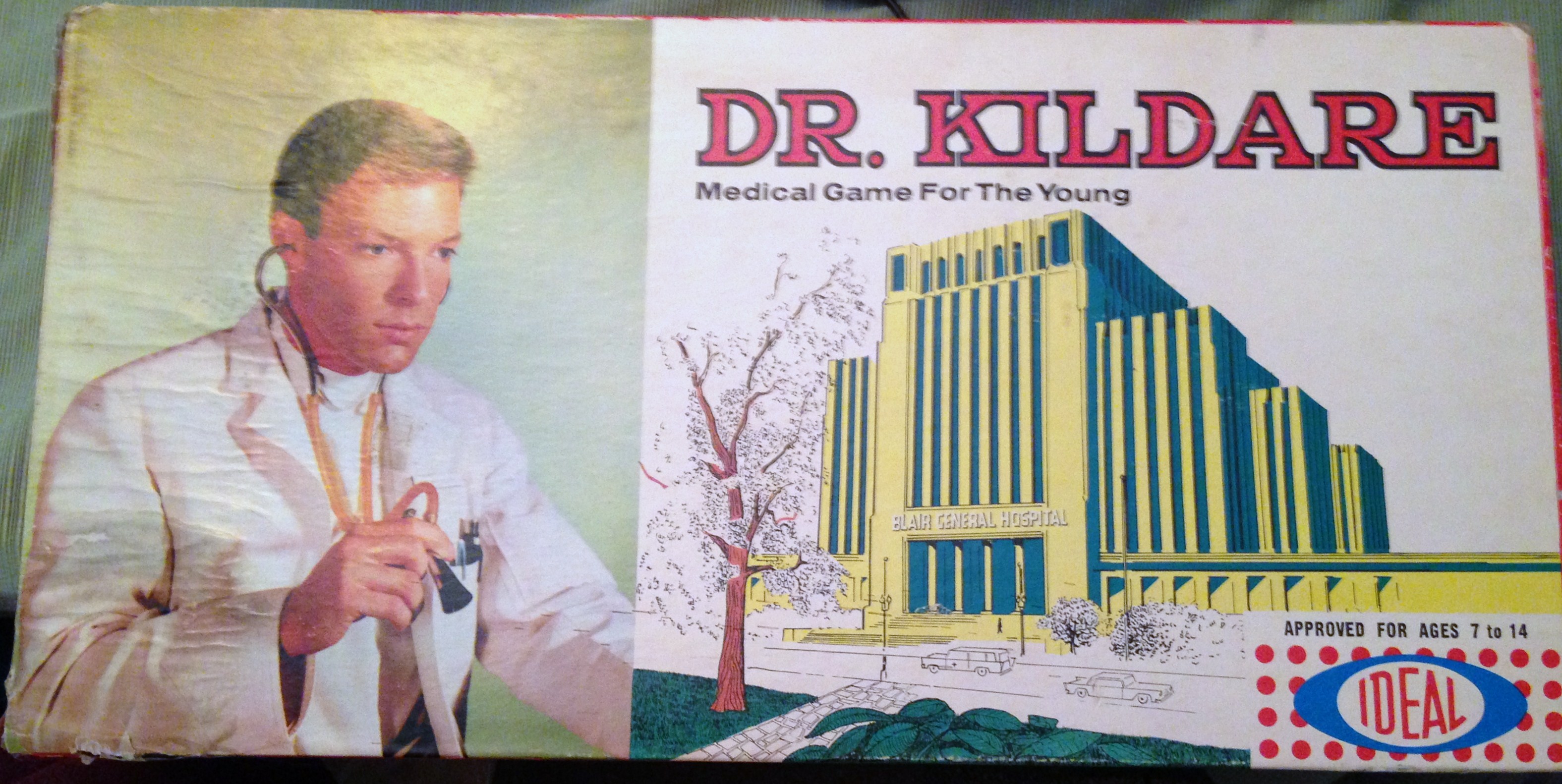
Dr. Kildare Game, Ideal, 1962

It’s time to take two aspirin and enjoy the latest installment in my series about vintage board games.

Today’s Game: Dr. Kildare

Copyright Date: 1962

Mystifying Subtitle: “Medical Game for the Young.” I wonder why they felt the need to specify that it was for the young.

Game Box: I’m sure the draw for potential buyers was the large photo of dreamy Richard Chamberlain as Dr. Kildare, who is staring intently ahead and listening to an invisible person’s heartbeat.

The Analyzer

Recommend Ages: 7 to 14. Actually, it says “Approved for ages 7 to 14.” That’s a strangely officious way to put it.

Game Board: The board offers a cute representation of a hospital, with green corridors, patient rooms, an operating room, and more. The patients all seem happy, even the one traction.

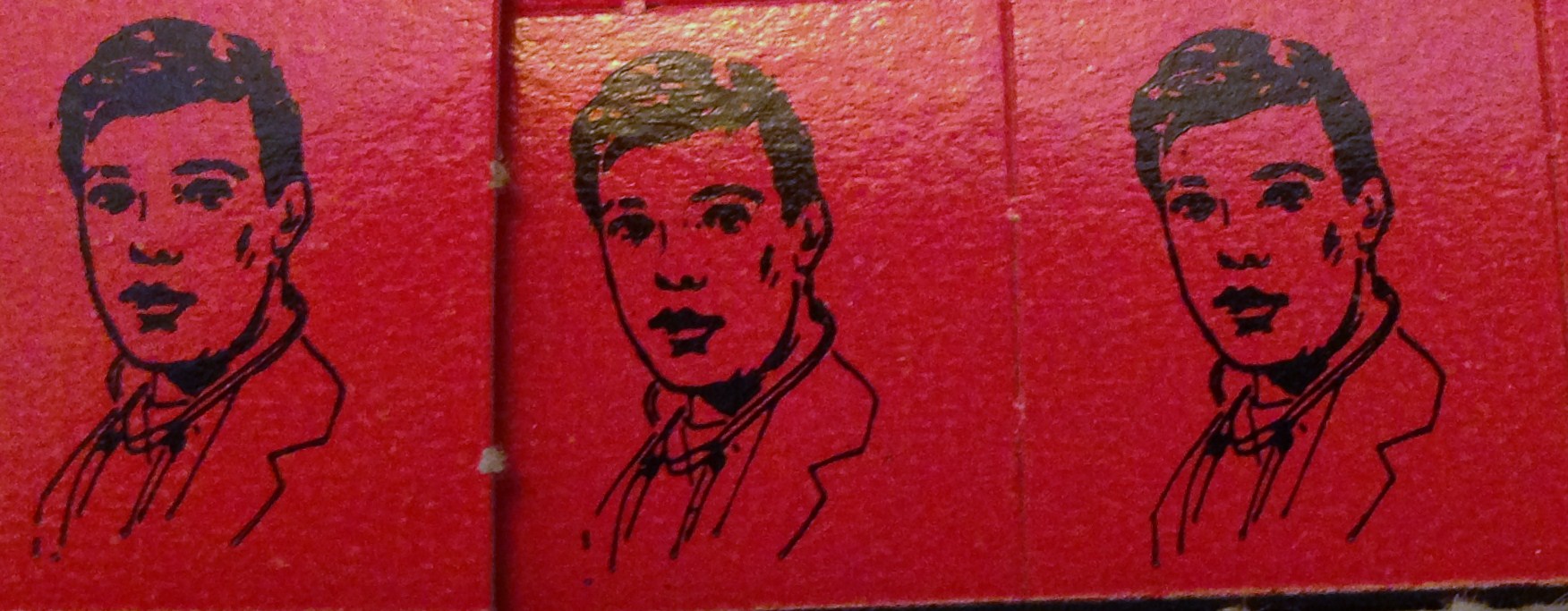
Game Pieces: Dr. Kildare’s dreamy face again.

Game Play: Pretty cool. Players make their “rounds” through the hospital and diagnose their patients with the help of the “Analyzer.”  Patients’ conditions are written in code on diagnosis cards. I decoded two of them just for fun—nose bleed and sprained back.

Nice Touch: The instructions say that you can play the game by yourself.  I used to play board games against myself all the time—my brother was not really a board-game guy.

My Thoughts: I’ve never actually seen an episode of Dr. Kildare. It was a bit before my time. I saw The Thorn Birds at an impressionable age, though, so I can appreciate Richard Chamberlain’s charms. The game looks pretty entertaining—what kid doesn’t love decoding messages?

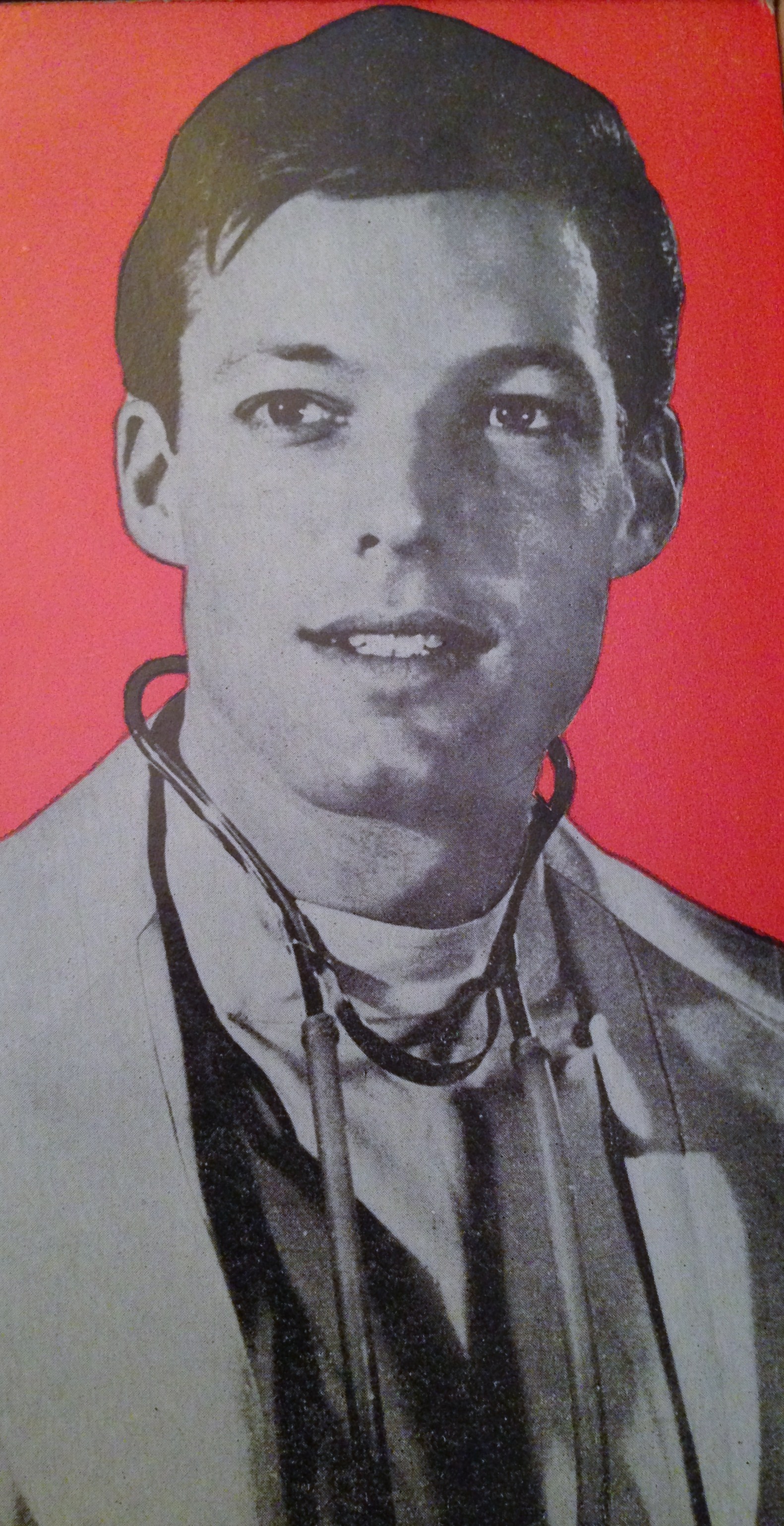
Another photo of Dr. McDreamy from the box insert. Okay, we get it, he’s handsome!

If you enjoyed this post, read the whole Spin Again Sunday series!