Old-Time Radio Playlist: Christmas, Part 1

Starting today, I’ll be posting holiday old-time radio episodes every Tuesday and Thursday through Christmas day. I have about 600 to pick from, so let me know if you have any requests!

“The Radio-Phonograph”


The Adventures of Ozzie and Harriet, December 19, 1948
“Harriet, dear, there are two times when you’re not supposed to be sensible: Finding a husband and Christmas.”
About The Adventures of Ozzie and Harriet: Ozzie Nelson first found fame as a bandleader. He hired Harriet Hilliard as his girl singer, and the two soon married. They appeared on radio’s The Red Skelton Show for three years before Ozzie developed this family comedy for them. To say it was successful is an understatement—The Adventures of Ozzie and Harriet aired on radio from 1944 to 1954 and on television from 1952 to 1966.
Story:  Having recently made the major purchase of a radio-phonograph, Ozzie and Harriet make the sensible decision to forego buying each other Christmas gifts. If you think they have no trouble sticking to that decision, you’ve clearly never watched or listened to a situation comedy.
Notable Performers: Tommy Bernard and Henry Blair play David and Ricky—the Nelson boys wouldn’t start playing themselves until April 1949. Radio stalwart Lurene Tuttle plays Harriet’s mother. Janet Waldo plays Emmy Lou, an annoying teenage character who reflects the late 1940s fascination with “bobby-soxers.”
Referencing Radio: The announcer mentions Just Plain Bill, a soap opera that ran from 1932 to 1955.
Musical Notes: Ozzie sings a bit of “Darktown Strutters’ Ball,” a jazz standard that dates from 1917. (It’ll always be dear to me for inspiring the punch line of Ted Baxter’s knock-knock joke.)
My Verdict: Television’s Nelsons never did much for me, but the radio show has a warmth and charm that’s won me over. You probably won’t laugh out loud over this episode, but you might enjoy its pleasant holiday feel.

“The Crosby Family,” December 20, 1950


The Bing Crosby Chesterfield Show
“I still can’t understand why parents insist on stifling their kids’ mental development at this time of the year.”
About The Bing Crosby Chesterfield Show: Perhaps the most popular performer of his era, Bing Crosby appeared on radio regularly from the 1930s through the 1950s. Chesterfield cigarettes sponsored a 30-minute Crosby show that aired from 1949 to 1952.
Notable Performers: It’s strictly a family affair, here—Bing appears with wife Dixie Lee and sons Gary, Dennis, Philip, and Lindsay.
Musical Notes: Bing opens the show by singing “Adeste Fideles,” first in Latin and then in English. (During the English version, the studio audience joins in.) Bing and Gary sing a jazzy “Jingle Bells and a song called “That Christmas Feeling.” Lindsay and Bing croon “I’d Like to Hitch a Ride with Santa Claus.” Philip and Dennis sing “The Snowman.” Bing closes the show with “Silent Night.”
My Verdict: Great music, and the family banter is more amusing than I would have expected. This program exudes so much holiday warmth that you can almost forget every negative thing you’ve heard about Bing’s family life. Almost.

“Names on the Land,” December 24, 1945


Cavalcade of America
“We hope you liked America, wrapped up in tinsel bright. To each one, Merry Christmas, and to all, a fond goodnight.”    
About Cavalcade of America
: Sponsored by Dupont, Cavalcade of America aired on radio from 1935 to 1953. It highlighted important stories, from the celebrated to the unsung, in American history.
Story: A versifying train conductor leads listeners on an alphabetical journey across America, and his passengers explain the origins of odd place names, from Animus to Zoar.
Based Upon: The book Names on the Land by George Rippey Stewart, first published in 1945 and, happily, reissued in 2008.
Notable Performers: Frank Morgan, the Wizard of Oz himself, plays the train conductor.
My Verdict: This is like H.L. Mencken meets Dr. Seuss—and I mean that in a good way. Names have always fascinated me, both personal and place names, and I’ve read and re-read the chapters on names in Mencken’s The American Language. This show is right up my alley. The verse, as performed by Morgan, sparkles. Without any flag-waving, the whole thing evokes a good feeling about the American character.  As Matt Weiland wrote about Stewart’s book, it’s a “plea for the triumph of cardinal American virtues: buoyancy and tolerance, curiosity and confidence, love of the land and faith in the future.”

“Christmas Story,” December 23, 1952


Gunsmoke
“I just want to say that this is the best dog-gone Christmas I ever had.”
About Gunsmoke: Radio’s Gunsmoke aired from 1952 to 1961, a forerunner of the popular TV show that ran from 1955 to 1975. The radio version is known for its grittier portrayal of Dodge City and its inhabitants and for the inventiveness of its sound patterns.
Story: It’s Christmas Eve and Matt is returning to Dodge City, though he has little hope of making it home for Christmas: He’s 40 miles from Dodge and has lost his horse to a broken leg. A drifter who offers him a ride wants to hear about Christmas, so Matt describes the previous year’s holiday.
My Verdict: Gunsmoke is one of my top three favorite radio programs, along with Vic and Sade and The Jack Benny Show. The show’s portrayal of the old West is so dark, though, and its typical body count is so high, that I have to experience the show in small doses. That’s why the Christmas episode is such a relief—it shines like a Christmas tree in the middle of a darkened prairie.

“The English Butler,” December 23, 1945


The Jack Benny Program
“It seems impossible that there could be any more suffering than mankind has just endured, but it is possible and it will happen, if we lose sight of the lessons so bitterly learned. Let us remember that men everywhere are our neighbors and their life and freedom is as precious them as ours is to us.”
About The Jack Benny Program: I feel inadequate to explain The Jack Benny Program, and its importance in American radio. I’ve found that the International Jack Benny Fan Club is a good source for information.
Story: Jack’s Beverly Hills neighbors the Colmans are making a reluctant appearance at his house for dinner. To impress them, Jack hires an “English” butler with an impenetrable accent.
Google-Worthy References: Ronald Colman gets a big laugh when he says, “I’ll never forget when Benny invited us to his house three years ago and we didn’t show up. It made him so angry he wrote a letter to Britain asking for his bundle back.” Bundles for Britain, launched in 1940, was an American charitable program that provided knitted goods and used clothing to British citizens enduring Germany’s bombing. (I can’t resist sharing a passage from Life’s May 19, 1942, issue, which profiled Bundles for Britain founder Natalie Wales Latham: “Energetic and precocious, New England-born Mrs. Latham has been married and divorced twice. It was she who popularized the mother-and-daughter fashion fad which Life reported three summers ago. In 1939, on a vacation after her second divorce, she began thinking about Britain’s plight, noticed that no one seemed to know how to help, said to herself, ‘This is the damndest thing,’ and forthwith started Bundles for Britain.”
Notable Performers: Ronald and Benita Colman.
Musical Notes: Jack plays, and Ronald Colman mocks, “It’s Been a Long, Long Time.” Throughout the fall of 1945, competing versions of this Jule Styne and Sammy Cahn postwar hit were duking it out for chart pre-eminence. According to Wikipedia, a recording by Harry James with vocalist Kitty Kallen topped the Billboard charts the week this episode aired.
My Verdict: Jack harassing his Beverly Hills neighbors never fails to amuse me. The classy Colmans make the best foils of all for Jack’s pretensions. Their 20 appearances on the Benny show are delightful. This episode offers many pleasures, from “Manchester” to Ronald Colman’s moving Christmas toast. And on Christmas episodes, I don’t even feel the need to fast forward through the soloist’s performance; Larry Stevens’ Ave Maria is lovely.

Weird Words of Wisdom: Mugging, Smooching, and Flinging the Woo Edition

“A girl who will use her head and not her lips in securing friends will find that they are the type that she can and may later love.”

Youth’s Courtship Problems, 1940
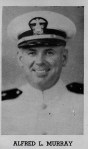
By Alfred L. Murray

About This Book and Its Author: Christian publishing house Zondervan published this book, the work of a former U.S. Navy chaplain named Alfred L. Murray. Though the book has a Christian viewpoint, it focuses on the way young people relate to each other, rather than their relationship with God. Murray is enthusiastic about the social benefits of dating, though of course he urges a conservative code of behavior.
Murray is fond of anecdotes and expert commentary. (His experts sometimes miss the mark, especially on medical topics. One thinks the frustrations of “petting” can lead to an enlarged prostate.)

This was Murray’s second book on youth courtship, and he wrote other books on various religious topics. He died in 1965, in Seabrook, New Hampshire, where he served as pastor of the Federated Church. He is buried in Arlington National Cemetery.

Fun Fact: Lamar Hunt, an influential figure in American sports, owned a “well thumbed” copy of this book during this college years, according to biographer Michael MacCambridge.

Quotes from Youth’s Courtship Problems

On “Mail-Order Dating”: “I have known at least four girls who, by correspondence, made friends with men whom they had never seen. The correspondence continued until the men proposed and the girls married them. One girl quarreled with her husband, and they separated in a few days. The second was deserted by her lover. The third went out of her mind. The fourth apparently resulted in a happy marriage.”

“Rouged cheeks and reddened lips, highly scented perfume, and bright colored fingernails are artificial and bear testimony that the person who is extravagant in display lacks good judgment and is not real…Any girl who indulges excessively in makeup appears common.”

“The moral collapse of an individual begins the moment he uses the sacred as if it were profane. One who uses the language of a kiss without discrimination is not worthy of intimate friendship…If a kiss is meaningless, what is the guarantee that life will not be judged by the same standards?”

“There is no virtue in staging public caressing parties.” I’ve got to agree with him there.

“That which differentiates necking and petting is that the first has certain powers of restraint and restrictions, while the last is noted for its liberty and license. When the time limit is removed from kissing, and fondling with the hands is introduced, the sexual urge is intensely increased.”

“It is yet too early to determine the meaning of the terms ‘mugging,’ ‘smooching,’ and ‘flinging the woo.’ If one were to guess, he might say that ‘smooching’ is necking; ‘flinging the woo’ is just love play; ‘mugging’ is petting on the heavy side.”

As an alternative to petting: “An interest must be developed in something both can share. It may be reading a book together. The Reader’s Digest will furnish one with sufficient topics to develop into interesting conversations for a date every day of the month.”

“I recently rode from Chicago to Philadelphia on a de luxe ‘crack train’ I could not find a place in the cars where women were not smoking. The were in the Pullman, the diner, and the club car…(The porter) went on to tell me that he used to make the trip and never see a woman smoke. ‘When one did come on, I knew that she was a bad woman, but now most of the women using this train smoke.’”

“I noticed that very few men on that trip were smoking. Those who did went to the lounge room and lit a cigar. The women smoked to excess and without discrimination.” I’ve never smoked in my life. Why does this book make me want to light up?

On marijuana: “It carries him out of the world of reality. But the price for this sensation is the habit, which quickly produces sexual perversion, insanity, and crime. It is the most dangerous drug in America. Those who smoke it will never be socially or morally the same.”

“There is a record of seventeen persons who attended a party, where ‘post office’ was played, having received syphilis infection. There was one infected person at the party. He kissed several girls who in turn were kissed by other fellows. All became victims of the dreaded disease.” In case you’re wondering if it’s really possible to contract syphilis through kissing—apparently, yes.  

“The girl that men like has intelligence, but she does not make a display of it.”

“When a man speaks harsh words, he is reflecting his thinking, but a woman who ‘flies off’ or appears irritated is expressing her feelings. Do not, therefore, take her little acts of unkindness too seriously. These are but emotional, not mental, reactions.”

“Women have a way of admiring the man they fear—fear because of his greatness.”

“Avoid all types of street conversations unless you are moving. It is the mark of poor breeding to stand on a street corner and carry on a conversation.”

Read the whole Weird Words of Wisdom series!

Old-Time Radio Episode Spotlight: “Home for Thanksgiving”

“A day of thanksgiving belongs to no one people and no one land, but is in the hearts of all people of all nations who love and understand, and who face each today with courage and each tomorrow with unbounded faith.”–Paul Henreid in “Home for Thanksgiving,” Family Theater, November 27, 1947.

About This Episode: This is a heart-warming story about a former German prisoner of war returning to his battle-scarred hometown with his pregnant American bride. Paul Henreid’s performance transcends the sometimes stilted dialogue. (Joan Leslie’s performance, not so much.)
Google-worthy Reference: UNRAA, the United Nations Relief and Rehabilitation Administration, an international effort to bring relief to war victims.

To everyone celebrating Thanksgiving today, best wishes for a warm and wonderful holiday. I’d like to offer my own thanks to those who’ve become regular readers of this blog since I started it in August. It’s great fun sharing my embarrassing treasures with you!

U.S. President Harry Truman meets Thanksgiving dinner. (Apparently, the practice of “pardoning” the ceremonial White House turkey didn’t start until 1989.) Source: Public Domain Review

Old-Time Radio Playlist: Halloween, Part 2

Last week I presented some Halloween “treats” from the world of old-time radio—lighthearted holiday episodes. Today, I’m offering a few “tricks”—spooky Halloween episodes and a few classic horror stories.

Enjoy—and let me hear from you. What are your favorite old-time radio Halloween episodes? What’s your favorite show in the suspense or horror genre?

November 7, 1937
Columbia Workshop, The Horla

By early radio standards, this is a good adaptation of a creepy Guy de Maupassant story.

July 11, 1938
Mercury Theater, Dracula

This is faithful adaptation with a great cast: Martin Gabel (if you’ve seen What’s My Line? re-runs, you may remember him as Mr. Arlene Francis), Agnes Moorehead, and, of course, Orson Welles. The Mercury Theater’s actual Halloween episode, The War of the Worlds, might seem more appropriate for this playlist, but I wanted to choose something slightly less well known.

February 20, 1944
The Weird Circle, Frankenstein

Many radio shows adapted Mary Shelley’s story—I picked this version rather randomly. I’d love to hear opinions about the best radio Frankenstein.

October 27, 1947
Quiet Please, Don’t Tell Me About Halloween

“Marry in haste, repent at leisure” takes on new meaning when your spouse is immortal. This is an entertaining episode of Quiet, Please, a series of psychological horror stories that aired from 1947 to 1949. Wyllis Cooper created the show and wrote every episode—an amazing feat, in my opinion. Not every episode is brilliant, but they are all interesting. This episode has a bonus for me as a Guiding Light fan: Charita Bauer, who played Bert on GL, is the female lead.

January 10, 1948
Favorite Story, Dr. Jeckyll and Mr. Hyde

Ronald Colman hosted this series, which presented a classic story each week, supposedly picked by a celebrity. Colman tells us that Alfred Hitchcock picked this classic Robert Louis Stevenson story. Radio stalwart Bill Conrad gives powerful performance in the dual role.

October 31, 1948
Quiet Please, Calling All Souls

This episode has a good story, but the organ music grates—that’s one aspect of old-time radio I just don’t love.

October 31, 1949
Inner Sanctum Mysteries, A Corpse for Halloween

I’m not a big Inner Sanctum fan, and this story loses me a little. It does have compensations, however: Its Halloween setting, its tiger motif (I like anything cat-related), and its star—Larry Haines. As with Charita Bauer, I know Haines from the world of daytime TV drama; he played Stu on Search for Tomorrow for 35 years. He was also a prolific radio actor, and he gives a good performance here as a guy who’s cracking up.

March 14, 1951
NBC Short Story, The Lottery

Long before there was The Hunger Games, there was this classic Shirley Jackson story. No one faces any monsters here; the horror that unfolds is the horror that human beings can inflict on each other when they cling blindly to destructive traditions. Even when you know what’s coming, the end packs a huge punch. The music is appropriately haunting.

October 30, 1976
CBS Radio Mystery Theater, The Witches’ Sabbath

This story doesn’t reference Halloween, but its subject matter suits the holiday. Once again, we encounter Larry Haines as a man cracking under a strain—his performance is even better here than in the Inner Sanctum Mysteries episode above. The conversations between his character and the bartender amused me.

Enjoy more old-time radio playlists:

Halloween, Part 1

Edgar Allan Poe, Part 1

Edgar Allan Poe, Part 2

Old-Time Radio Playlist: Halloween, Part 1

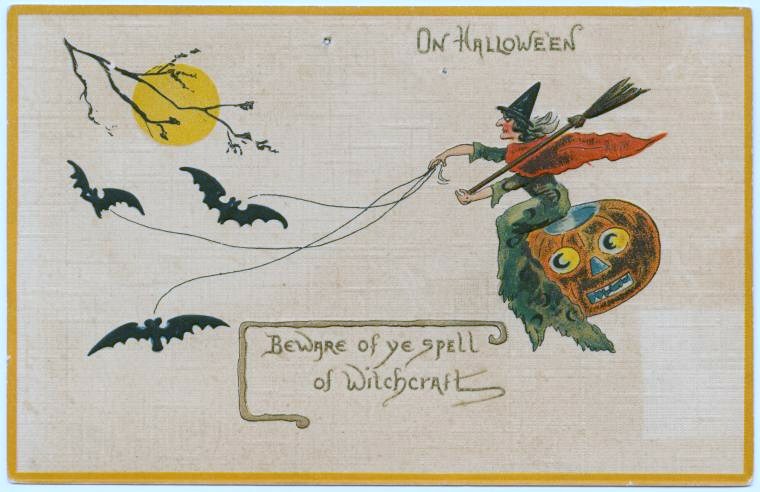
Vintage Halloween Postcard from The Public Domain Review

Today, I present a selection of Halloween treats–some lighthearted old-time radio episodes that capture an interesting period in the history of Halloween.

(On Tuesday, October 30, I’ll post some Halloween”tricks”–spooky holiday offerings and classic horror stories.)

European immigrants to the United States popularized Halloween celebrations in the late 19th century.

By the turn of the century, there was a move to downplay the scarier aspects of the holiday. According to History.com, “Halloween parties for both children and adults became the most common way to celebrate the day. Parties focused on games, foods of the season and festive costumes.”

By the 1920s and 1930s, pranks were a big part of the holiday, “often devolving into vandalism, physical assaults and sporadic acts of violence.”

Most of these radio shows date from the 1940s, when trick-or-treating was just beginning to transition into a community-sanctioned, kid-friendly activity. I’m guessing that’s why so many of the adults in these shows seem ambivalent about Halloween–looking back fondly on their own parties and pranks, but wary of letting their children participate in trick-or-treating.

Unknown Date
Air Castle, Halloween

Air Castle was a children’s show that ran in the late 1920s and early 1930s. It was entirely the work of Baron Keyes, who starred as the “Story Man” and provided voices and sound effects to represent various fanciful characters. This Halloween episode is cute!

October 19, 1933
Martha Meade Society Program, Halloween Parties

This cooking show provides a nice slice of 1930s life. From this and other radio shows, I’ve gleaned that doughnuts were a popular Halloween tradition in the early 20th century.

October 24, 1939
Fibber McGee and Molly, Halloween Party at Gildersleeve’s House

This would be a good starter episode for a new Fibber listener. It’s filled with typical wordplay and punning humor, and most of the classic supporting characters appear.

October 31, 1940
The Aldrich Family, Halloween Prank Backfires

Just about every episode of this family comedy involves a misunderstanding that snowballs out of control. These Halloween hi-jinx are typical.

November 2, 1941
Jack Benny, Halloween with Basil Rathbone

I’m in love with the Jack Benny Program. To really appreciate the series, you need to listen to a long run of consecutive episodes. Characterizations and jokes build from week to week. This is my favorite of several Halloween episodes–Jack annoying his Beverly Hills neighbors is always a win.

October 29, 1944
Edgar Bergen and Charlie McCarthy, Halloween

Guest star Orson Welles is quite amusing, especially when he ad-libs.

October 29, 1944
The Life of Riley, Haunted House   

Near the end, this takes a surprisingly sharp turn into patriotic messaging. You’ll have that sometimes in World-War-II-era programs.

October 31, 1944
Lum and Abner, Discuss Halloween Pranks

Lum and Abner has been growing on me lately, and this episode is a cute one.

November 1, 1946
Baby Snooks, Halloween

Fanny Brice’s mischievous Baby Snooks is a natural for Halloween pranks. This episode has a strong start, but a weak finish, in my opinion.

October 29, 1947
Philco Radio Time, Boris Karloff and Victor Moore

Boris Karloff was the go-to guest for variety-show Halloween episodes. Here, he’s the guest of Bing Crosby, and he and Bing actually sing together (along with comedian Victor Moore)!

October 31, 1948
Adventures of Ozzie and Harriet, The Haunted House       

I always found the TV version of Ozzie and Harriet bland, but the radio episodes I’ve listened to have been surprisingly chuckle-worthy.

October 31, 1948
Adventures of Sam Spade, The Fairly-Bright Caper    

I’m not a huge Sam Spade fan–ditzy Effie gets on my nerves–but this has a nice Halloween flavor.

Oct 31, 1948
Jack Benny, Trick or Treating with the Beavers

This is another good Halloween episode, with an inventive way of bringing the supporting cast into the story.

October 31, 1951
The Great Gildersleeve, Halloween and Gildy Finds a Lost Boy

I’m not the biggest Gildy fan, but this episode has great warmth.

November 7, 1951
The Halls of Ivy, Halloween

I really enjoy this series, which stars Ronald and Benita Colman. Having spent plenty of time in academia, I appreciate the college setting, and the Colmans are just charming.

Oct 29, 1953
Father Knows Best, Halloween Blues

Robert Young’s character is in preachy mode, and the end doesn’t work for me, but this is an interesting look at those changing Halloween customs.

Listen to more old-time radio!

Weird Words of Wisdom: Betty Betz and Vintage Teen Etiquette That Rhymes Edition

This is the latest installment in my Weird Words of Wisdom series.

“As mother used to say, ‘Be pretty if you can, witty if you must—and pleasant if it kills you!’”

Your Manners are Showing: The Handbook of Teen-Age Know-How, 1946
By Betty Betz

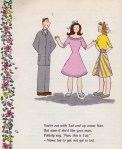
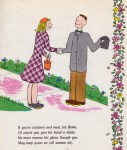
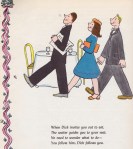
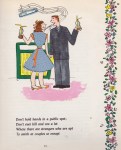
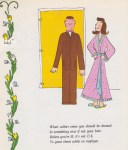
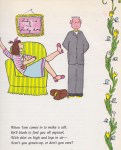
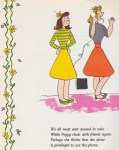
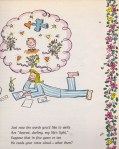
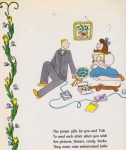
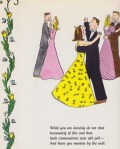
About This Book: Your Manners are Showing differs from most vintage teenage advice books in one key way—it shows teens how to behave with copious illustrations by Betty Betz. Verses by Anne Clark accompany the pictures; in between the illustrations, Betz provides short chapters on topics ranging from money to “vice” (drinking and smoking). Etiquette in verse actually strikes me as a pretty handy aid for mastering tricky concepts, like who gets introduced to whom.

About the Author: Where do I begin? Betty Betz journeyed from Hammond, Indiana, prom queen to 1940s and ’50s queen of all media. She was a Midwestern swimming champion, and her high school classmates named her Most Popular Girl in their school of 1,800. She attended Sarah Lawrence College and earned a guest editorship at Mademoiselle, which became the first magazine to publish her drawings. She went on to work for Esquire and Harper’s Bazaar. Eventually, she began to specialize in teenagers, writing a syndicated advice column for them and publishing several books. Her illustrations of teenage life turned up on everything from stationery to scrapbooks to jewelry boxes.

She was married briefly to Josef Lanz, the Austrian fashion designer who popularized the dirndl dress, a 1940s teen wardrobe staple. His family owned Lanz of Salzburg, which still exists, producing mostly nightgowns.

In 1956, she married her second husband, Frank McMahon, whom Time described as an “oil-rich Calgary wheeler-dealer.” She raised two daughters and settled down into a life of charity work and Palm Beach socializing. Betz died in 2010.

Among the other highlights of her brief career:

  • She published comic book stories featuring “Dollface and Her Gang.” (Dollface’s best friend was named Bun Brain. Really.)
  • She marketed a line of teenage clothing that included a hideous but creative item called a blouse-slip. As a slip, you could lounge around in it at home. If company stopped by, you could wrap a skirt around yourself and be good to go.
  • She hosted a TV talk show that Billboard called “a routine and lifeless concoction, devoid of warmth or sincerity.”
  • She founded the Betty Betz Angels Club for her fans, who pledged “to show respect and consideration to everyone, regardless of race or color.”
  • She served as a Hearst correspondent during the Korean War, providing readers with insights like this one from July 29, 1951: “…what baffles me most of all is the fact that communist ‘wacs’ don’t care for perfume or lipstick.”
  • She published Manners for Moppets, an etiquette book for children, in 1962. At the time, her family shuttled among homes in Vancouver, New York City, and Palm Beach. “An English nanny and a private plane make commuting painless,” The Calgary Herald wrote. “Having complete wardrobes in each house so she doesn’t have to pack and unpack all the time and hiring temporary help for each house as she gets there are other time and trouble savers.” I’ll bet.

Weird Words of Wisdom from Betty Betz

For the most part, I’ll let Betz’ illustrations (and Clark’s verse) speak for themselves. I can’t resist including a few quotes, though.

On tipping: “At least ten percent of the total bill is a sufficient tip, but never leave less than ten cents per person.”

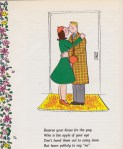
On saying goodnight: “There’s no excuse for a couple to stay out past midnight except for special parties, so make those good-nights short and sweet. Dawdling on the doorstep doesn’t get you anything but a razzing from the neighbors, and a black mark from the girl’s folks.”

On fashion for boys: “You’re no Percypants if you are particularly particular about which tie you wear with what suit, so give your clothes combos a little more thought…The best clothes for men are the traditional ones which never go out of style, so if (a salesman) tries to sell you Seabiscuit’s blanket for a sports jacket, tell him to give it back to the Indians.”

On shoes for boys: “If they’re scuffed with run down heels they label you right in the jerk department, so keep your booties laced and polished. When you buy shoes, get the strong and sturdy type which look more manly and last longer than the ‘cute and fancy’ styles. If it’s a dressup party, don’t wear your saddle shoes or moccasins, and never wear rubber soles for dancing.”

On fashion for girls: “If you think you can wear that dress three years from now and still adore it, it’s a good buy. But if it’s a poorly made ‘gag-rag,’ then don’t waste your money.”

On shoes for girls: “Exaggerated heelless or toeless siren sandals are downright unattractive on young legs, so avoid them.”

On girls’ accessories: “A neat purse, immaculate gloves, fresh handkerchiefs and simple, becoming hats are the classic equipment of fastidious and fascinating femmes.”

On where girls should turn for dating advice: “Say, your mother should know a little bit about it, since she managed to snare herself a pretty nice husband, and probably over some pretty high competition, too.”

Acceptable gifts for boys to give girls: Books, records, candy, flowers, a compact, or “your best photograph (unautographed, please).”

Acceptable gifts for girls to give boys: wallets, key chains, books, records, hand-knit socks, or “your prettiest picture.”

Traffic advice that cracks me up: When crossing streets, boys should walk on the side closest to traffic, “so that if there’s any mishap, he gets hit first.”

Wow! A Password?!: “There’s a password, ‘cabbage,’ which is used every time a boy doesn’t take the curb side of the sidewalk when he’s walking with one or more girls. Actually, there’s no need for a password, because every young man should automatically take the outside place without even thinking twice.”

On smoking: “If you like the taste of tobacco and your parents approve, there’s nothing harmful about smoking in moderation.

On drinking: “Light wines and beer are your best bet if you must drink something alcoholic. My favorite is a ‘Sherry Cobbler,” which sounds like a grownup drink, but actually is a plain lemonade with a little wine added.”

Recommended non-alcoholic drink if you want to appear to be drinking alcohol: A “Horse’s Neck”—ginger ale, with a slice of lemon peel.

On conversation: “My Mommy done told me that as long as I wasn’t really a brain-box, I should develop my ear for listening.”

And a final thought: “The trouble with etiquette books is that they’re like dentists…you never pay any attention to them until you’re in agony, and then often it’s too late.”

Read more Weird Words of Wisdom.

Old-Time Radio Playlist: Edgar Allan Poe, Part 2

As Halloween approaches, I present more old-time radio versions of Poe stories to entertain you on chilly nights. In this and Part 1 of my Poe playlist, I’ve tried to represent a large range of Poe stories and radio programs.

“The Tell-Tale Heart”

Columbia Workshop

July 11, 1937

“The tell-tale-heart effect, which you heard, was an actual human heartbeat, amplified more than 10 billion times.”—Announcer, Columbia Workshop

NBC Presents: Short Story

“My senses sharpen. Every second makes them sharper. I can hear the rhythmic beating of the old man’s heart…the beating of his heart.”

1951 (Unaired)

About These Series: Columbia Workshop was an early radio series that experimented with the new medium’s narrative possibilities. In dramatic radio’s dying days, NBC Presents: Short Story dramatized work by some of the world’s greatest writers. Try to imagine a major TV network airing series like these now (at its own cost—neither of these shows had a sponsor). Columbia Workshop aired on CBS for eight years, but the NBC program didn’t fare as well. According to The Digital Deli Too, the network pre-empted it frequently and ultimately left 11 episodes, including this one, unaired.

Thoughts on These Episodes: Though the sound quality is better on the NBC Presents episode, I prefer the Columbia Workshop version. The voices the NBC protagonist hears—and his reaction to them—become almost comical. In contrast, the voices that cry out from the wind and the rain and walls in the CBS version are eerily effective. The police are none too swift, though. Sample exchange:

Murderer: “You’re laughing at me! You’re torturing me! You’re making believe that you don’t hear so that I’ll confess!”

Policeman: “My dear young man, you’re working yourself into a frenzy. I think we better leave you to yourself.”

These officers should really lay off the wine.

Read “The Tell-Tale Heart

“Metzengerstein”

Columbia Workshop

December 16, 1937

“Tonight is the end of the house of Metzengerstein!”

Thoughts on This Episode: This episode does a good job capturing the story’s creepy atmosphere. Castles, curses, horses, fire—what more do you need for an exciting half hour?

Read “Metzengerstein

“Narrative of Arthur Gordon Pym”

Weird Circle

September 19, 1943

“The wind was screaming through the sails like an insane witch on a broomstick.”

About This Series: Many radio series explored horror and suspense. One thing that differentiated The Weird Circle was its source material; it frequently presented “literary” horror stories, including several of Poe’s tales.

Thoughts on This Episode: I’ve tried to read Poe’s Narrative of Arthur Gordon Pym of Nantucket, his only novel-length work, but just can’t plow through it. I think I’m allergic to nautical adventures. I’ve read enough, though, to know that this adaptation takes major liberties with the story. It also abandons the 19th century setting for a modern one. Phrases like “The captain’s nuts!” and “Awww, shut up!” jar in a Poe story. I would still rather listen to this than try to read the novel again, though.

Read The Narrative of Arthur Gordon Pym of Nantucket

“The Pit and the Pendulum”

Suspense

November 10, 1957

“Minutes…hours…days… Who can say how long it was? It might have been many days before that hideous blade swept so closely as to fan me with its acrid breath.”

About This Series: Suspense billed itself, with ample justification, as “radio’s outstanding theater of thrills.” Extremely popular, it ran for 22 years (1940-1962). For much of that time, it attracted top Hollywood stars, who often got the chance to play roles that contrasted with their on-screen image. By 1957, the show’s star power was diminishing, but it was still presenting outstanding radio drama.

Thoughts on This Episode: Vincent Price and Edgar Allan Poe—an unbeatable combination! I think this is my favorite Poe story—it’s exciting and has a merciful lack of beautiful dead women. It needs little elaboration to succeed as a radio drama, and Vincent Price (who would star in the Roger Corman film version of The Pit and the Pendulum four years later) gives a good performance.

Read “The Pit and the Pendulum

“Berenice”

CBS Radio Mystery Theater

January 9, 1975

“The teeth! The teeth! The terrifying teeth!”

About This Series: Although not exactly “old-time radio, CBS Radio Mystery Theater represented the last major gasp of network radio drama. The show ran on weeknights from 1974 to 1982. E.G. Marshall hosted, and radio veteran Himan Brown produced the program.

Thoughts on This Episode: CBS Radio Mystery Theater presented an entire week of Poe stories in January 1975. With about 45 minutes to fill in each episode (not counting commercials), the program had to expand on Poe’s shorter stories.

“Berenice” sticks with the outline of Poe’s story but adds a love triangle and lets us meet Berenice for ourselves; in Poe’s story, we only see her through the narrator’s  disordered vision. (The most interesting part of the short story, to me, is Poe’s detailed description of Egaeus’ mental illness. I wondered how modern professionals would diagnose him and found this interesting paper suggesting he was schizophrenic.) The story doesn’t benefit from these additions, but the ending still packs a punch.

Read “Berenice

“The Masque of the Red Death”

CBS Radio Mystery Theater

January 10, 1975

“Oh, wow. I mean, like, wow.”

Thoughts on This EpisodeCBSRMT transports Poe’s plague story to the apocalyptic future that is 1996 (hee) and turns it into an ecological morality play. The morality is confusing, though—I’m a liberal, card-carrying Sierra Club member, and even I don’t understand how the rich capitalist is making the world’s situation worse by protecting his family from the red death. The episode lacks the lurid atmosphere that illuminates Poe’s story, but it’s entertaining as a window into 1970s concerns.

Read “The Masque of the Red Death

Next week, I’ll be posting a bunch of Halloween-themed old-time radio!

My other old-time radio posts:

Old-Time Radio Playlist: Edgar Allan Poe, Part 1

Old-Time Radio Episode Spotlight: Those Magnificent Cats in their Flying Machines

Old-Time Radio Playlist: Till Death Do Us Part (and That Might Be Sooner Than You Think)

Old-Time Radio Episode Spotlight: A Snapped-Worthy 1920s True Story

Old-Time Radio Episode Spotlight: CSI, 1940s Style

Old-Time Radio Playlist: London Calling, Part 1

Old-Time Radio Playlist: London Calling, Part 2