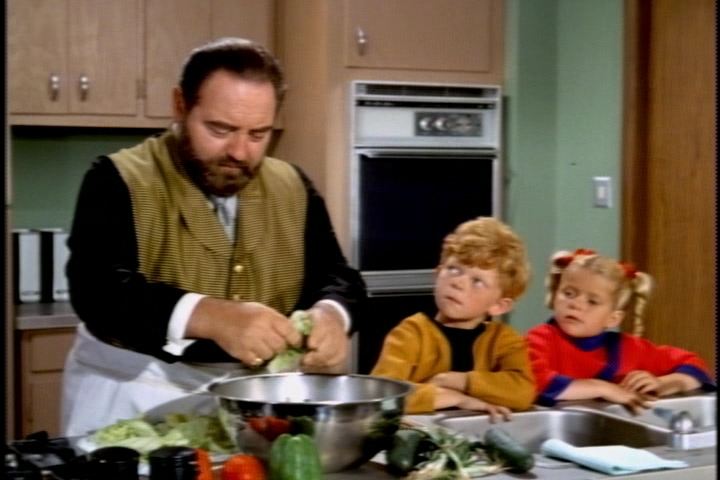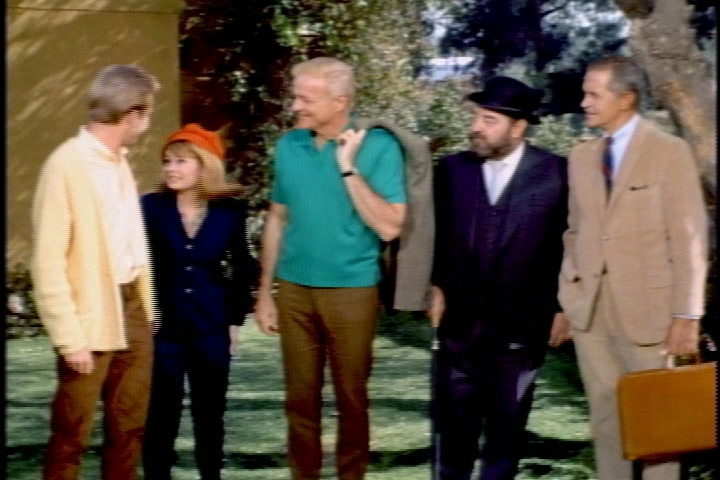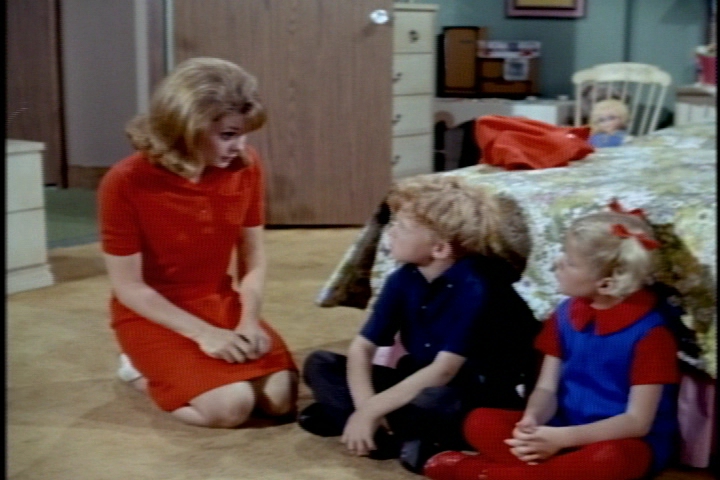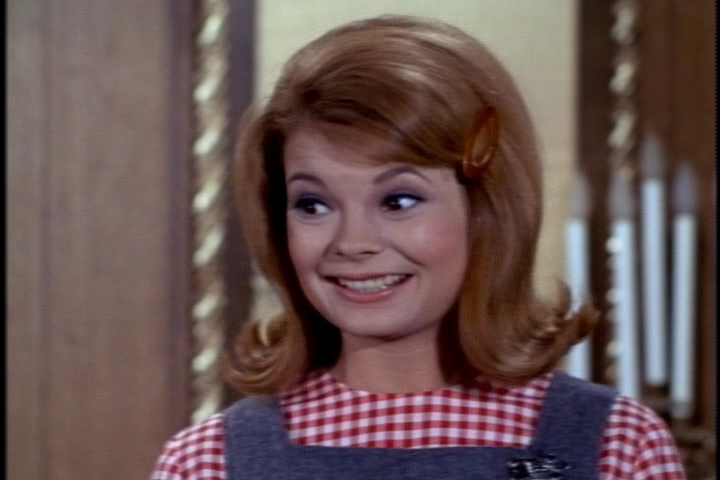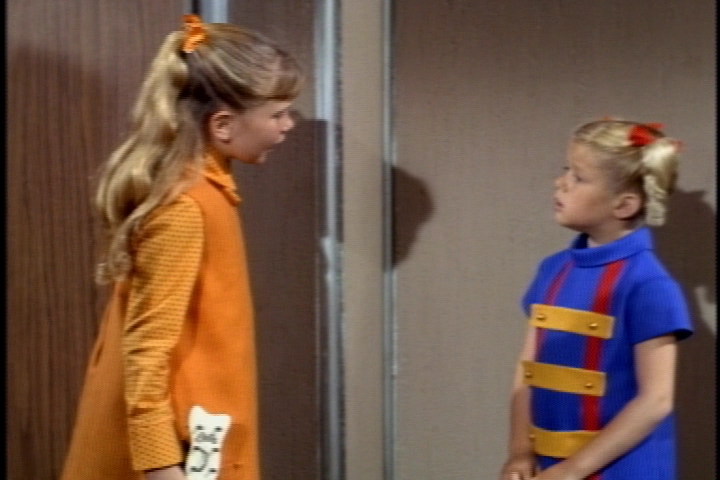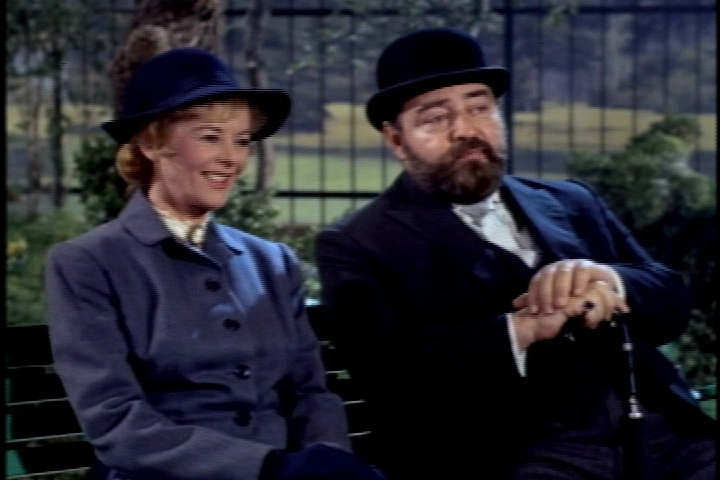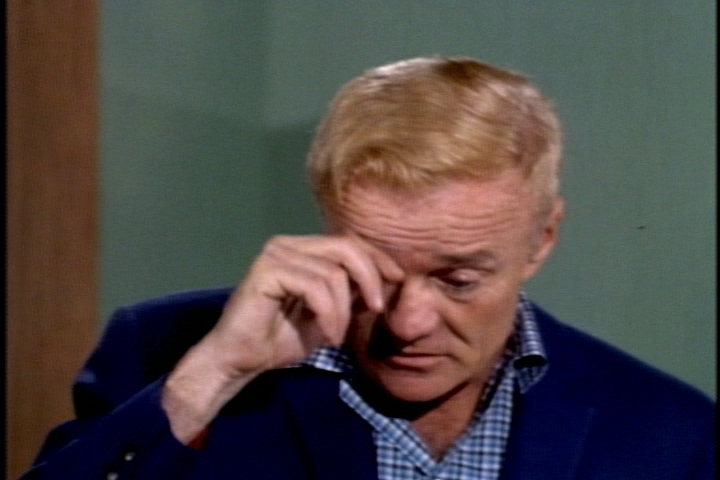
Family Affair Friday: Season 2, Episode 23, “A Member of the Family,” 2/19/1968

Written by: Henry Garson and Edmund Beloin. Directed by: Charles Barton.

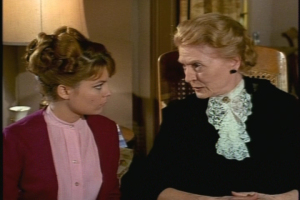
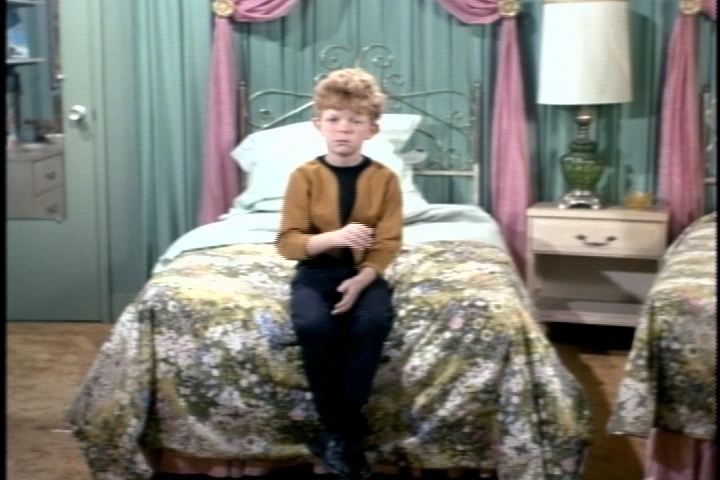
When we look in on the Davis family this week, Jody is getting ready to go roller skating. He’s getting ready a bit prematurely, in fact.

"We do not put on our roller skates until we reach pavement," French advises him.

“We do not put on our roller skates until we reach pavement,” French advises him.

Buffy is going roller skating, too, with plans to teach Mrs. Beasley how to skate. First, however, the kids want to see what Cissy is doing out on the terrace. As it turns out, she’s drawing a picture of Uncle Bill–a “crack-a-ture,” as Jody calls it. The kids to want to know what all the mountains are in the picture. The “mountains,” Cissy informs them, are Uncle Bill’s muscles.
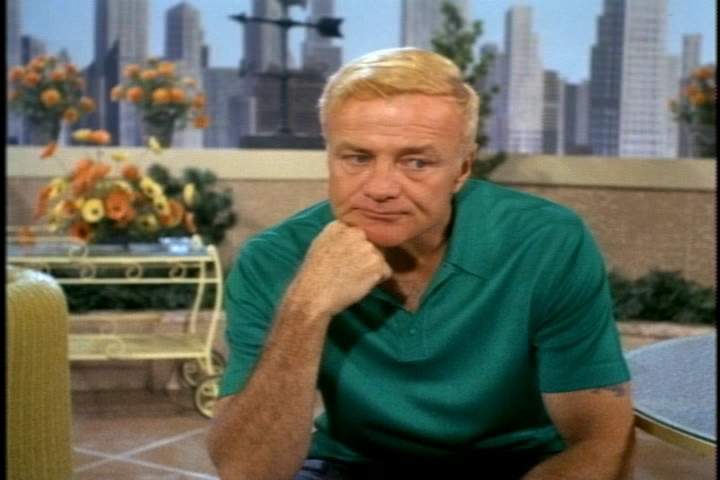
Oh, does he have nicely sculpted arm muscles? I hadn't noticed.

Oh, does he have nicely sculpted arm muscles? I hadn’t noticed.

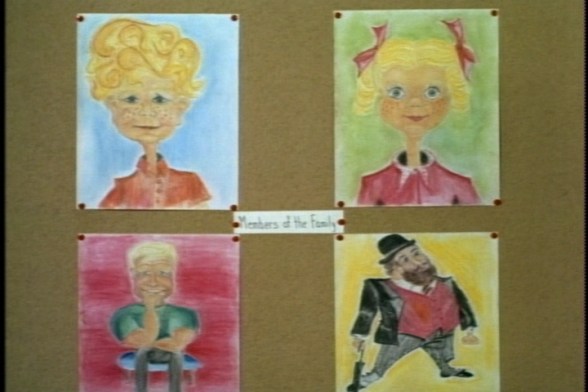
Cissy informs the kids that she’ll be displaying her work at a high school art exhibit. She’ll be including caricatures of Uncle Bill and the twins–all the members of the family.

French looks hurt, and his mood doesn’t improve when Cissy asks him to provide hors d’oeuvres for the exhibit. Cissy can tell he’s upset, but she doesn’t know why. After French and the kids leave, a perceptive Uncle Bill explains the situation.
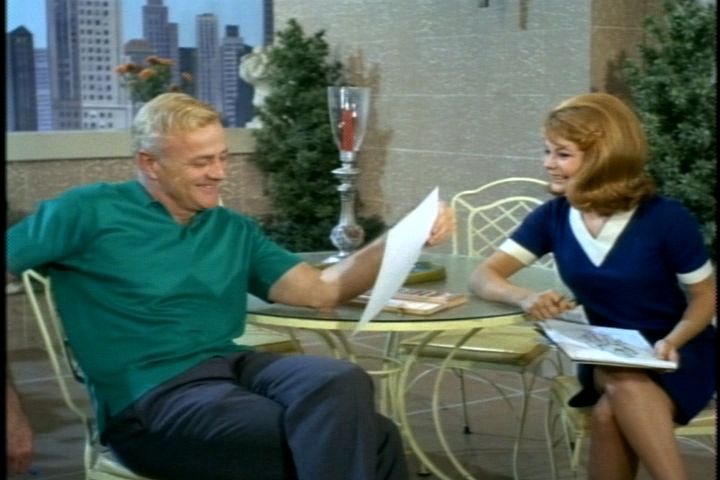
VTS_01_6.VOB_000367018

Cissy says she does, in fact, plan to display a caricature of French. She’s been working on it all week in secret so that she can surprise French at the exhibit.

Meanwhile, at the park, Buffy and Jody wonder why French is acting like “an old growly bear.” He feels even worse when he runs into his frenemy Withers.

It seems, according to Hardcastle, that Withers is the envy of all the gentlemen's gentlemen at the moment.

It seems, according to Hardcastle, that Withers is the envy of all the gentlemen’s gentlemen at the moment.

In fact, they are planning a bon voyage party for him. Smithers’ employers are going to Europe and taking him with them. French admits that he hasn’t been on a trip abroad with Bill since the kids took up residence with them.

“Some of us are merely employees, and some of us are members of the family,” Withers says, twisting the knife.

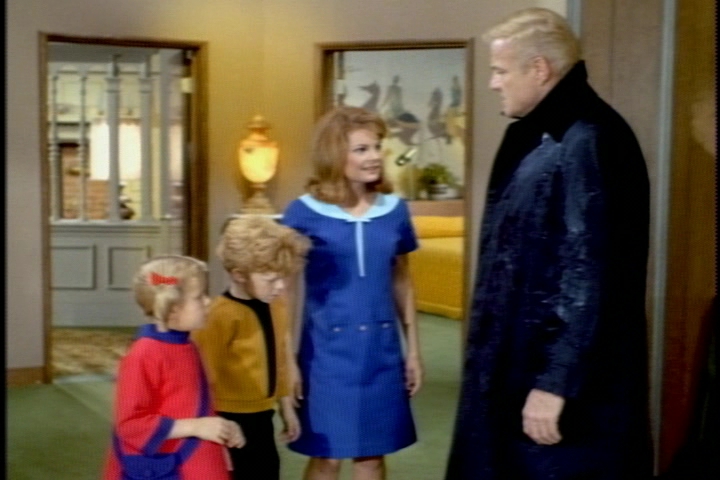
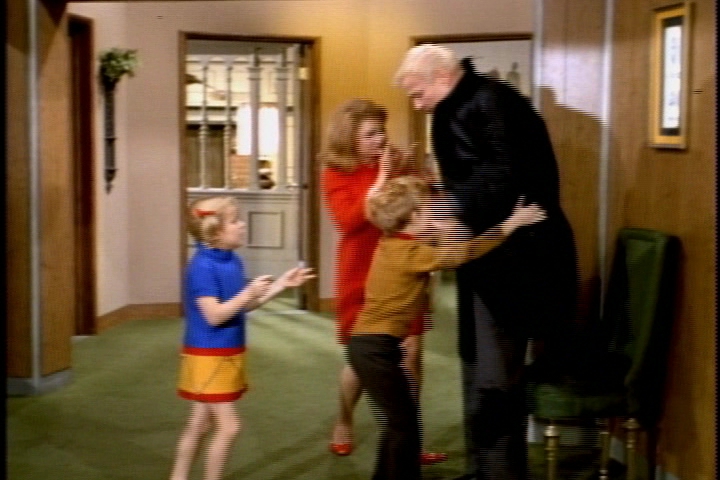
Later, however, Bill gives French a private heads-up that his picture will appear in the exhibit. He even shows it to him.

Understandably, he’s in a much better mood the next day when he runs into Miss Faversham at school pick-up time. He can’t resist telling her about the exhibit and the fact that he’s included. He invites her to opening and asks her spread the word to Withers and Hardcastle.

When the kids emerge from school, they sing a song taunting a "skinny" boy who's been calling their friend Peter "four-eyes."

When the kids emerge from school, they sing a song taunting a “skinny” boy who’s been calling their friend Peter “four-eyes.”

French affects shock and horror, then tells them about crying himself to sleep every night because his childhood friends said, “Here comes Fatty,” whenever he approached.The kids are properly abashed and head off to apologize to Tony.
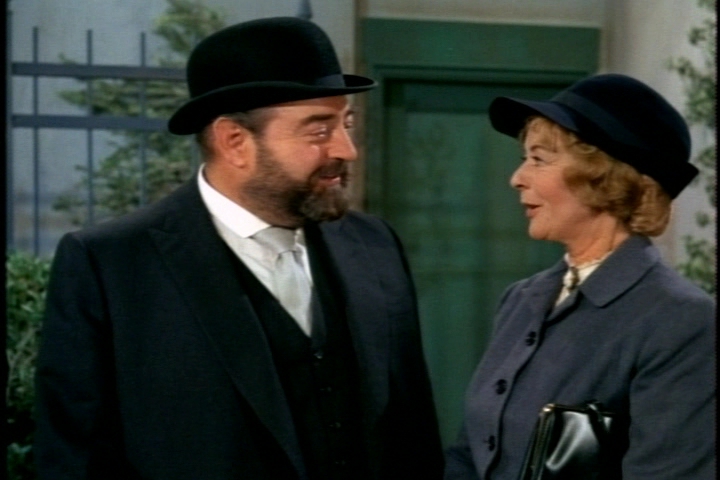
French gives Miss Faversham a wink and tells her that "overdramatic fiction" gets through to children better than anything else.

French gives Miss Faversham a wink and tells her that “overdramatic fiction” gets through to children better than anything else.

That’s a tip you won’t find in many parenting manuals.
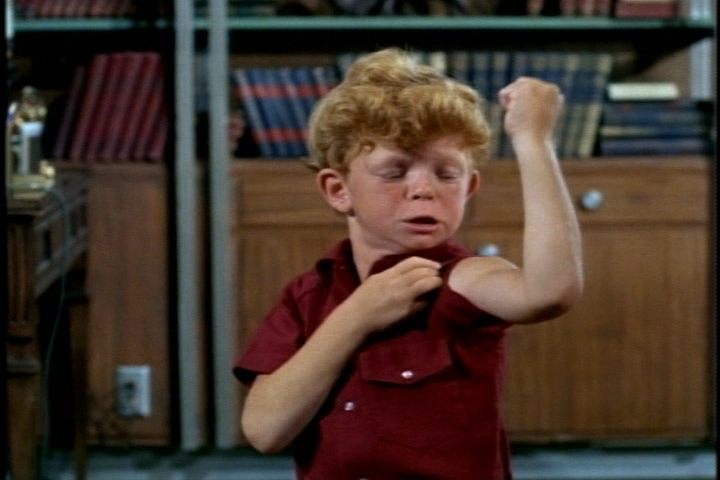
Back at home, the kids pose for their own caricatures. Jody wants muscles like Uncle Bill, but his defining characteristic seems to be "a zillion freckles."

Back at home, the kids pose for their own caricatures. Jody wants muscles like Uncle Bill, but his defining characteristic seems to be “a zillion freckles.”

While she’s waiting, Buffy happens to see the French caricature.
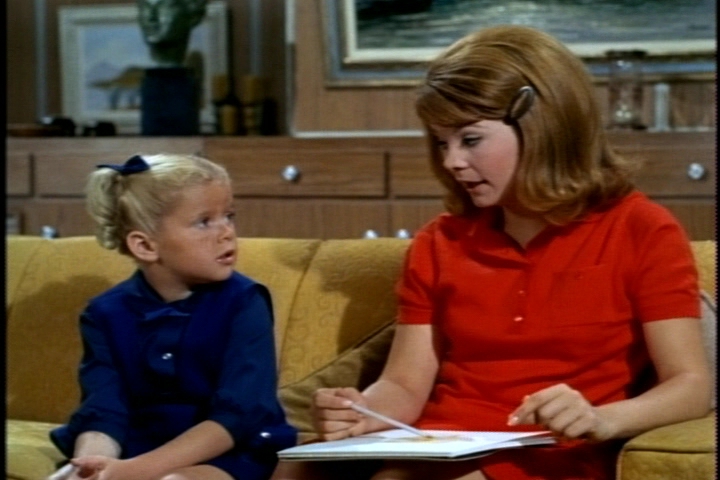
The alarmed twins share the "Here comes Fatty" story with Cissy.

The alarmed twins share the “Here comes Fatty” story with Cissy.

They’re worried that French will find the picture offensive.

"I didn't realize Mr. French is so sensitive," Cissy exclaims.

“I didn’t realize Mr. French is so sensitive,” Cissy exclaims.

She decides that she won’t display French’s picture after all. Oh, dear.

Later, Sharon stops by and asks if Cissy can go with her to The Blue Yonder that evening. Bill’s out of town until just before the exhibit, so Cissy has to seek approval from French. She doesn’t think Bill would mind, even though they’ll be out until midnight and it’s a school night.

Seriously, Cissy?

Seriously, Cissy?

French says no, of course, and Sharon mutters about how strict the “establishment” is in the Davis home.

Soon, the art exhibit is almost under way at last.
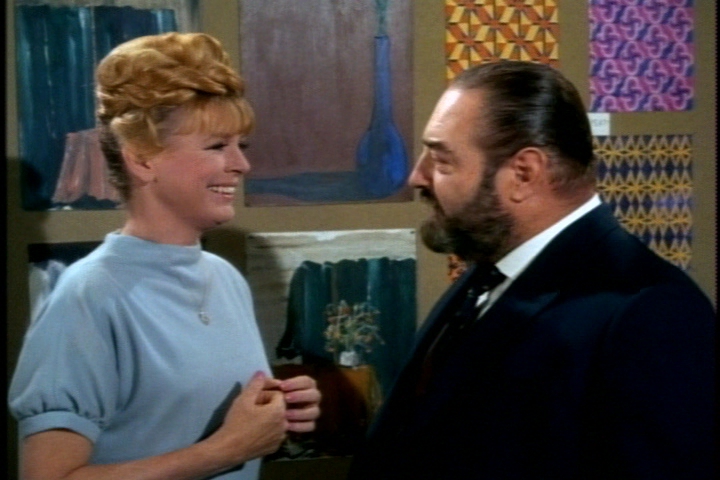
Helping Mrs. Scofield with the snacks, French is taken aback when the teacher mentions Cissy's three pictures.

Helping Mrs. Scofield with the snacks, French is taken aback when the teacher mentions Cissy’s THREE pictures.

Cissy’s gone home to change for the opening, but French checks out her display area. Sure enough, his picture is missing. He assumes that saying no to Cissy earlier cost him his place in the exhibit. He gets on the phone to head off his friends, but he’s too late.

Doesn't Miss F look sharp in her street clothes?

Doesn’t Miss F look sharp in her street clothes?

Luckily, Bill has arrived at home and straightened things out. Telling Cissy how much French liked her picture, he encourages her to sneak in the gallery’s back entrance and add it to her display. By the time French’s friends make their way to Cissy’s area, the picture is in place.
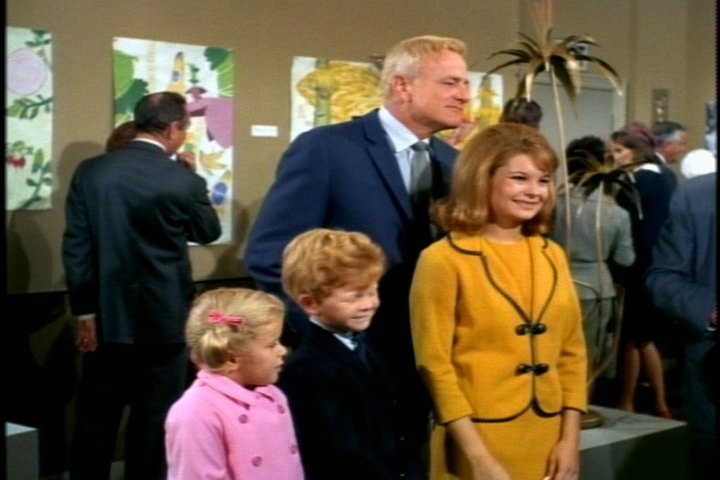
"It's a nice family--the whole group," Bill says.

“It’s a nice family–the whole group,” Bill says.

French is delighted, of course.
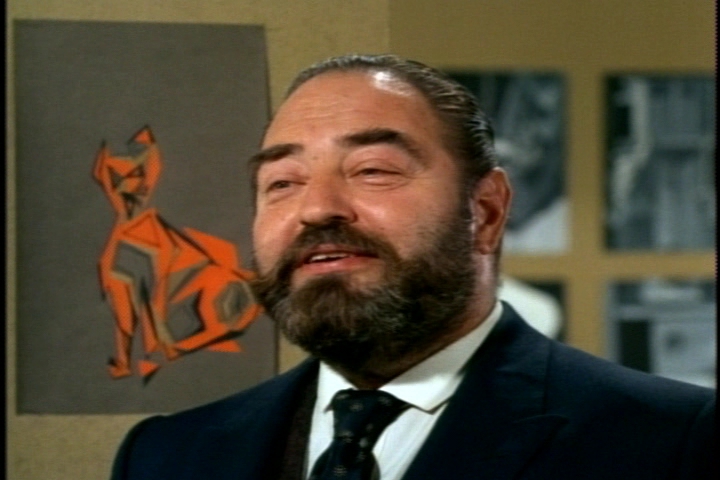
And, along with his hor d'oeuvres, he gets to taste some sweet, sweet

And, along with his hor d’oeuvres, he gets to taste some sweet, sweet schadenfreude.

It seems Withers’ employers aren’t taking him along to Europe after all.

Which caricature do you like best?

Which caricature do you like best?

Commentary

This is one of the best French episodes–his sadness at being excluded is poignant.

Of course, you have to overlook all the contrivances that drive the plot. For instance, why does Cissy want to surprise French with his picture, when the others posed for theirs?

Guest Cast

Withers: Richard Peel. Mrs. Scofield: Joan Vohs. Peter: Randy Whipple. Sharon: Sherry Alberoni. Miss Faversham: Heather Angel. Mr. Hardcastle: Noel Drayton. All are Family Affair veterans, but we haven’t seen Drayton as Mr. Hardcastle since the second episode of the series. Vohs will appear most often in the third season as the twins’ teacher Miss Cummings.

Random fashion note: I like Cissy's casual, exhibit set-up outfit.

Random fashion note: I like Cissy’s casual, exhibit-set-up outfit.

Continuity Notes

Cissy’s artistic talent is a good call-back–we learned about it in season one.

Fun Facts

Mrs. Beasley doesn’t like sea lions because they splash too much.

French’s childhood friends actually called him “Chubby”–and he liked it.
The Twilight Zone and Alfred Hitchcock Presents: Family Affair Connections, Part 1

Source: IMDb.com

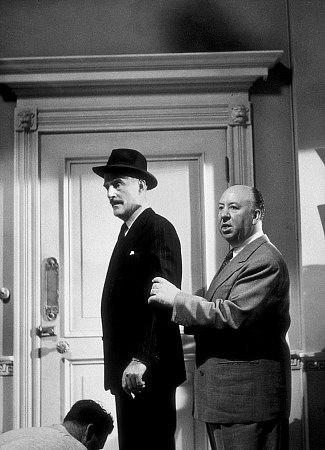
John Williams and Alfred Hitchcock. Source: IMDb.com

What connections can possibly exist between the sugary 1960s sitcom Family Affair and TV’s two creepiest anthology programs? Television actors made the rounds in the 1950s and 1960s, so perhaps its not surprising that both of Family Affair‘s lead actors and many of its recurring guest stars show up in these anthology shows. (It probably helped that both the Hitchcock show and Family Affair made good use of aging British actors.) It’s a treat, though, to see them in roles so different from the ones I spotlight each week in my Family Affair series.

I’d originally planned this post for October 2, the broadcast anniversary for both Alfred Hitchcock Presents (which debuted in 1955) and The Twilight Zone (which aired its first episode four years later). I found so many interesting connections, however, that this post took longer to prepare than I’d anticipated. Its length also required breaking it into two parts.

John Williams

John Williams is the strongest link between Family Affair and the world of Alfred Hitchcock. Williams played Nigel French in nine first-season Family Affair episodes, while Sebastian Cabot recovered from an illness. His most famous career role, however, was Chief Inspector Hubbard in Hitchcock’s film Dial M for Murder. (He originated the role on Broadway and earned a Tony award for his performance.) He also appeared in Hitchcock’s To Catch a Thief.

Williams was obviously a Hitchcock favorite–he would appear in no fewer than 10 episodes of Alfred Hitchcock Presents. The three-part episode “I Killed the Count” from Season 2 finds Williams in his most characteristic role as a stuffy Scotland Yard inspector. His character uncovers no shortage of suspects in a tangled murder case. The fun is in watching his exasperation build as “I killed the count” becomes an “I am Spartacus”-style refrain among people eager to confess.

(One of the suspects is played by Alan Napier, who appeared in a third-season Family Affair episode but is best known as Alfred from TV’s Batman. Nora Marlowe also has a small role in Part 3 of “I Killed the Count.” She appeared in four Family Affair episodes, as various nanny friends of Giles French. Her most memorable TV role was Flossie Brimmer on The Waltons.)

Parts two and three of “I Killed the Count” are also on Youtube and available through Netflix.

In another second-season episode, “Wet Saturday,” criminals get the best of Williams. If you’ve ever longed to see Nigel French get slapped around, this is the episode for you. Also interesting is the happy epilogue that Hitchcock tacked on in his closing comments, to counteract the downbeat on-screen ending.

Kathryn Givney, who plays the murderer's mother in this episode, was Mrs. Allenby in the memorable first-season Family Affair episode "The Thursday Man."

Kathryn Givney, who plays the murderer’s mother in this episode, was Mrs. Allenby in the memorable first-season Family Affair episode “The Thursday Man.”

Williams also made one appearance on The Twilight Zone, in an hour-long episode called “The Bard.” This isn’t a great episode; it strives too hard for hipness as it satirizes TV hackery. Williams’ turn as William Shakespeare is amusing, though. Who else could imbue the words Cat on a Hot Tin Roof with so much contempt merely by enunciating each consonant deliberately? The rest of the cast provides plenty of interest, too. It includes future movie star Burt Reynolds and future Dyna Girl Judy Strangis.

Brian Keith

Brian Keith never appeared on The Twilight Zone, but he did appear on five episodes of Alfred Hitchcock Presents (including one after the show’s 1962 expansion and re-titling as The Alfred Hitchcock Hour). The most interesting for Family Affair fans is probably “Cell 227,” in which Keith portrays a condemned prisoner. The script is a bit preachy and lacks the typical Hitchcock atmosphere, though the ending provides a suitably grim “gotcha.” Keith gives his usual strong performance, and it’s a major departure from Uncle Bill.

Liam Sullivan, who appeared in one Season Three episode of Family Affair, plays a priest here. Frank Nelson, an annoying neighbor in two memorable Family Affair episodes (“Mrs. Beasley, Where Are You?” and “Ballerina Buffy”), has a more sympathetic role as a lawyer fighting to save Keith’s character.

Keith himself plays a crusading lawyer in “The Test.” His courtroom tactics are questionable, but there’s a method to his madness. This one has a thought-provoking, ambiguous ending.

Sebastian Cabot

Sebastian Cabot appears in the first-season Twilight Zone episode “Nice Place to Visit.” As the spiritual guide of a recently deceased thug, he’s Giles-French-like throughout most of the episode. The ending twist, while predictable, shows him in a very different light.

Cabot also appeared in one Alfred Hitchcock Presents episode, Season One’s “A Bullet for Baldwin.” He’s Baldwin, and the episode’s opening events suggest that Cabot’s appearance will be brief. As you might expect on this show, things are more complicated than they seem.

(An extra treat for me in this episode is the presence of John Qualen, who played Earl Williams in my very favorite movie, His Girl Friday. Too bad he never appeared on Family Affair.)

Ida Lupino

Legendary actress and director Ida Lupino appeared as French’s old flame Maudie Marchwood in two Family Affair episodes. She appeared in one Twilight Zone episode, Season One’s “Sixteen-Millimeter Shrine.” The paranormal twist in this one comes too late to add much interest to the story of a fading actress living in the past. Lupino is always interesting, but this script doesn’t do her any favors; it reads like her character is 70, while Lupino was just over 40 when this aired!

(Lupino directed the much better Twilight Zone episode “The Masks.”)

Alice Frost, who appeared in the memorable Family Affair episode “The Candy Striper,” also appears here and gets to do some good screaming.

Paul Hartman

A first-season Family Affair guest star, Hartman appeared on three episodes of Alfred Hitchcock Presents.

You remember him--he sold Buffy and Jody a broken down horse.

You remember him–he sold Buffy and Jody a broken down horse.

On The Twilight Zone, he played a police sergeant in the second-season episode “Back There,” a time-travel yarn involving Abraham Lincoln’s assassination. Nora Marlowe shows up again here. (Also of interest to classic TV fans: This episode stars Russell Johnson, the professor from Gilligan’s Island.)

The full episode doesn’t seem to be on Youtube, but you can watch it through Netflix or Amazon Prime Instant Video.

Louise Latham

Louise Latham launched her screen career in Hitchcock’s Marnie as the title character’s mother.

On Family Affair, of course, she was Aunt Fran--a character who cast a longer shadow than her three appearances would suggest.

On Family Affair, of course, she was Aunt Fran–a character who cast a longer shadow than her three appearances would suggest.

She made one appearance on The Alfred Hitchcock Hour, and it was a good one. “An Unlocked Window” has everything–a spooky house, a violent storm, and a serial killer on the loose. Latham gives a showy performance as a housekeeper who progresses from merely annoying to drunken and deranged. The episode’s ending doesn’t completely surprise, but it does pack a punch. (Bonus for my fellow cat lovers: A nice-looking tabby gets plenty of screen time.)

Another connection involving this episode: Stanley Cortez served as director of photography here, as well as on the first two episodes of Family Affair. A veteran cinematographer, Cortez had worked on such movies as The Magnificent Ambersons and Night of the Hunter.

Heather Angel

Surprisingly, Heather Angel never appeared on the Hitchcock series. She would have been well suited for various British dowager parts, and she did have small parts in two Hitchcock films, Suspicion and Lifeboat.

On Family Affair, Angel played Miss Faversham in a whopping 18 episodes.

On Family Affair, Angel played Miss Faversham in a whopping 18 episodes–many more than any other recurring cast member.

Other Posts You Might Enjoy:

Leave It to Beaver: A Father’s Journey

Room 222 Call Sheet: A Day in the Life of a 1970s Sitcom

Assorted Ephemera: My Three Sons Coloring Book (1971)

Family Affair Friday(ish): Season 2, Episode 22, “A Matter of Tonsils,” 2/12/1968

I apologize for the delay in posting this installment. I had to go out of town somewhat unexpectedly last week.

Written by: Henry Garson and Edmund Beloin. Directed by: Charles Barton.

It’s breakfast time in the Davis household, but not everyone is eating.

Cissy says she's watching her weight so she can achieve the "Carnaby Street look," like Twiggy.

Cissy says she’s watching her weight so she can achieve the “Carnaby Street look,” like Twiggy.

“Oh for the days of Queen Victoria,” French sighs. How old is French?

Buffy is trying to eat, but every swallow leaves her wincing in pain.

Buffy is trying to eat, but every swallow leaves her wincing in pain. Uh-oh.

Bill, who’s getting ready to leave for Chicago, notices Buffy’s discomfort. He tells French to keep Buffy home from school and take her to see Dr. Felsom.

Buffy is upset about having to miss music appreciation at school. Jody, a boy after my own heart, suggests sending Buffy to school and letting him stay home.

Buffy is upset about having to miss music appreciation at school. Jody, a boy after my own heart, suggests sending Buffy to school and letting him stay home.

Dr. Felsom gives French some bad news–Buffy’s tonsils are enlarged and will have to come out.

I hope Dr. Felsom doesn't treat many asthma patients because those books look pretty musty.

I hope Dr. Felsom doesn’t treat many asthma patients because those books look pretty musty.

He stresses that it’s a minor operation, but French says no operation is minor when you’re dealing with “two bachelors unaccustomed to the care and feeding of children.”

VTS_01_5.VOB_000121852

Uncle Bill reacts with alarm when French calls him in Chicago with the news. (Good thing his hotel room has a soothing Family-Affair-green decor.)

“What a time to be a thousand miles away!” he cries. During this scene, Brian Keith yells his lines into the phone, while French talks normally. Let’s fanwank that they have a bad connection, on Bill’s side only.

Jody, meanwhile, is impressed that Buffy gets to eat as much ice cream as she wants. “I wish I had tonsils,” he says, and tries to take a look at Buffy’s.

I bet the kids had a hard time keeping straight faces during this scene.

I bet the kids had a hard time keeping straight faces during this scene.

Having rushed back from Chicago, Bill tells Dr. Felsom to find the best tonsil man in New York for Buffy’s operation. He wants to reserve a private suite for her, but the doctor convinces him that Buffy will feel more comfortable in the children’s ward.

The adults break the news to Buffy that she’s going to the hospital overnight for an operation. She doesn’t seem concerned, although everyone telling her to stay calm and praising her bravery probably makes her a little nervous.

Jody and Buffy say a sad goodbye, and he offers to let her take his turtle to the hospital. She declines, but she does take Mrs. Beasley.

Poor Jody, all alone.

Poor Jody, all alone.

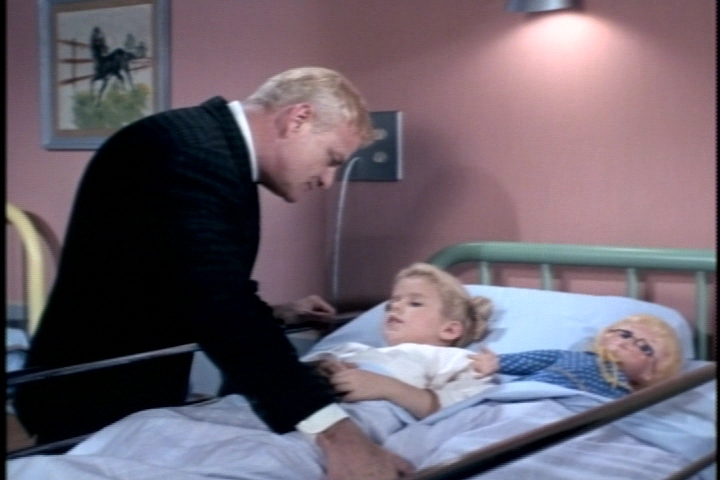
Bill gets Buffy settled at the hospital and apologizes to the nurse for acting so nervous.

"You wouldn't be a parent if you weren't nervous," she says. Ain't that the truth.

“You wouldn’t be a parent if you weren’t nervous,” she says.

Ain’t that the truth.

Note that while the hospital corridors are Family-Affair-green, the children's ward is Robby-and-Katie's-room-pink. (I've been watching a lot of My Three Sons lately.)

Note that while the hospital corridors are Family-Affair-green, the children’s ward is Robby-and-Katie’s-room-pink. (I’ve been watching a lot of My Three Sons lately.)

Back at home, Jody is also complaining of a sore throat, but Bill and French assume that it’s a psychosomatic complaint brought on by Buffy’s illness.

VTS_01_5.VOB_001099662

Bill decides that Jody needs some attention, too, so he spends some time with him and gives him a piggyback ride.

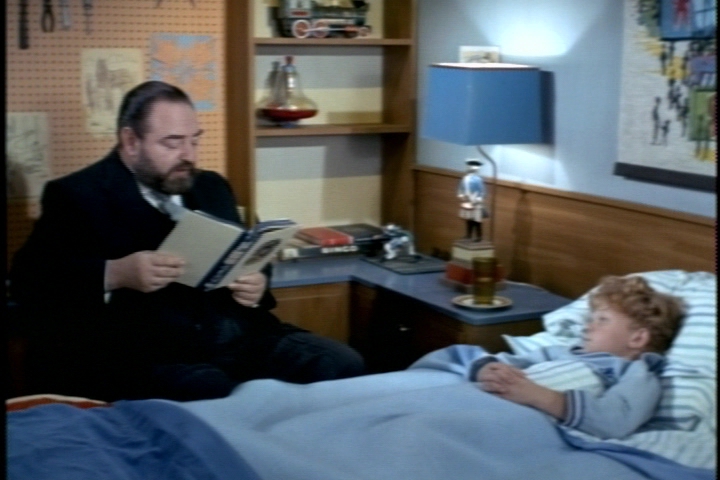
That night at bedtime, French reads to Jody about Ali Baba, but Jody can’t concentrate. He keeps asking tonsil-related questions until French gives up on reading.

"I'm not a vet!" French snaps after Jody asks whether horses have tonsils.

“I’m not a vet!” French snaps after Jody asks whether horses have tonsils.

The next day, Buffy’s operation goes smoothly, and Bill gets ready to head back to Chicago.

Not so fast, Bill.

Not so fast, Bill.

French shows up at the hospital with Jody, who has been sent home from school because of his sore throat. Dr. Felsom takes a quick peek and pronounces Jody’s tonsils worse than Buffy’s.

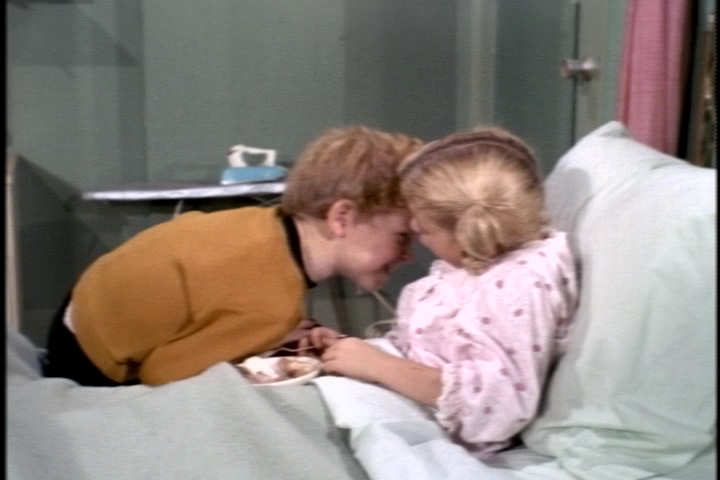
Soon Jody's checked in to the hospital right next to Buffy.

Soon Jody’s checked in to the hospital right next to Buffy.

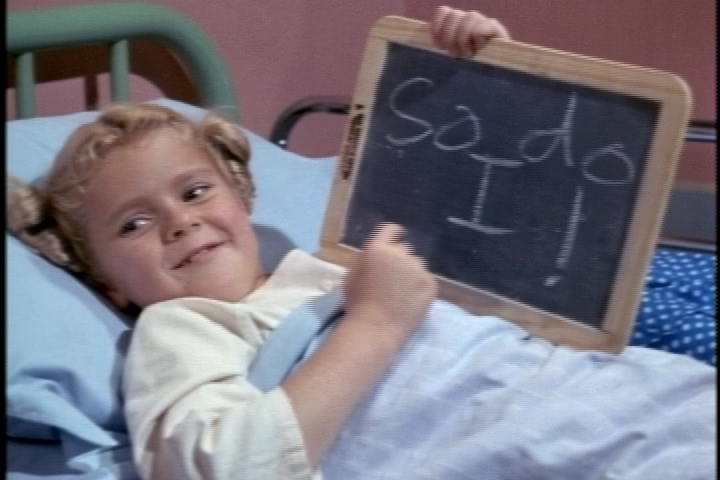
He’s glad to be reunited with his sister and delighted to start on his ice-cream diet. The only thing the kids can’t understand is why Bill and Mr. French are so afraid of hospitals. The next time they have their tonsils out, Jody thinks it would be good idea to keep Bill and French in the dark about it.

Buffy agrees.

Buffy agrees, emphatically.

Commentary

Classic TV led me to believe that one day I would have my tonsils removed. I would get to eat ice cream all day. I would get to stay home from school and bask in adult attention.

It never happened. Thanks a lot, evolving medical standards.

The emotions in this episode ring true, from Jody’s feeling left out, to Bill and French’s panicky concern for Buffy, to the the way the kids sense the adults’ stress. At different points in the script, both French and Bill observe that no surgery is “minor” when it comes to children, and I would certainly agree with that as a parent. I was a mess when my daughter got tubes in her ears, and that didn’t even require an overnight stay.

Sweetness abounds in this episode. It’s touching to see how Jody worries about Buffy and misses her while they are apart. Brian Keith does his usual great job showing fatherly tenderness, especially in the scene just before Buffy’s surgery.

(I wonder if those hospital scenes were hard for Keith, who lost his 8-year-old son to pneumonia less than five years earlier.)

When an episode offers little to snark on, my eyes travel to the decor.

Look at this interesting cat statue in Dr. Felsom's office. I'm guessing his wife takes ceramics because it looks like some of my mother's 1970s output.

Look at this interesting cat statue in Dr. Felsom’s office. I’m guessing his wife takes ceramics because it looks like some of my mother’s 1970s output.

More disturbing is this clown picture in the children's ward. How is it helpful to terrify the children before surgery?

More disturbing is this clown picture in the children’s ward. How is it helpful to terrify the children before surgery?

Guest Cast

Dr. Felson: Oliver McGowan. Miss Jones: Carol Nugent.

Well, this is interesting. Former child actress Carol Nugent was the daughter of Carl Nugent, property master on My Three Sons. (On Family Affair, he served in that role for the pilot only.) Carol was married to Nick Adams, who starred as Johnny Yuma on the 1959-61 TV series The Rebel. Adams died of a drug overdose a week before this Family Affair episode aired. In 2002, Carol married none other than John G. Stephens, Family Affair production supervisor! (Stephens was widowed in 2001 after more than 40 years of marriage to actress Joan Vohs, whom we’ll see in our next episode.) Nugent’s son Jeb Adams had a brief acting career in the 1980s, highlighted by his role as Chris in the movie Flowers in the Attic.

Researching this family can lead you down quite a rabbit hole. Carol Nugent’s nephew, Adam Taylor, was married to Anne Lockhart. She’s the daughter of June Lockhart, a one-time Family Affair guest star. Taylor’s father was Buck Taylor and his grandfather was prolific character actor Dub Taylor; both of these men crossed professional paths with Brian Keith several times.

This is McGowan’s second of three appearances as a doctor on the show.

Continuity Notes

The script mentions Jody’s turtle and Captain Hippopotamus. We also learn that Jody and Buffy are still 6, despite being in second grade now. Time really drags in their world.

Memo from David O. Selznick: The Corinthian, 1943

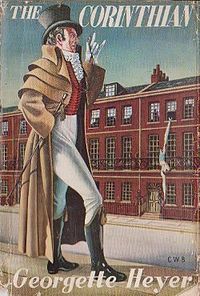
GreatImaginaryFilm-Caine_zpsfdf9dfa1Georgette Heyer created the “Regency Romance” genre. By 1940, she had published Georgian romances and a mystery and historical novels set during the Regency period. That year, she was working on a detective novel but found herself unable to concentrate on it due to her worries about the war. Instead, she dashed off a lighthearted romance set during the Regency period. The Corinthian would set the pattern for almost two dozen subsequent Heyer works and scores of books by her imitators.

While Heyer enjoyed popular success, critics ignored her work. Despite the cinematic possibilities of her novels, which combine romance, humor, intrigue, and adventure, filmmakers ignored her as well. Only two of her works have received film treatments—The Reluctant Widow became a British film called The Inheritance (1950), and Arabella was the basis for a German film in 1959.

As soon as I read about this blogathon, I knew I wanted to give Heyer life on screen. And, since I was dreaming, I decided to dream big. Few golden-age producers were as successful at adapting books for the screen as David O. Selznick. As a child he absorbed classics like David Copperfield and Anna Karenina, which he later brought to the screen. Throughout his career, he also adapted popular contemporary works, including Portrait of Jennie, Rebecca, and—of course—Gone With the Wind.

After completing the Academy-Award-winning Rebecca, Selznick liquidated his company and took a short break from filmmaking. As Irene Mayer Selznick described in her autobiography A Private View, Selznick was battling depression and amphetamine addiction during this period and found it impossible to make a sustained effort on any picture.

In my imaginary world, however, Selznick came across Heyer’s novel and found in reading it the same diverting escape she found in writing it. Believing that the movie-going public might be ready for a similar diversion, he determined to produce it. Production took place late in 1942 for an early 1943 release.
Producing an imaginary movie has many advantages; the greatest is that you don’t have to worry about studio contracts. In casting my movie, however, I have tried to stay somewhat within the realm of possibility. I nabbed my leading man before he started military service. For my leading lady, I chose a genuine Selznick discovery, although I moved up the date of her breakthrough. For the supporting cast and production staff, I sought people with whom Selznick had previously worked.

What follows are excerpts from Selznick’s imaginary memos about this film. Selznick was a legendary memo writer. In some cases, I have re-purposed his own words from the 1972 collection Memo from David O. Selznick to serve my film’s purposes.

Note: For those unfamiliar with The Corinthian, Wikipedia provides a good plot summary and detailed list of characters.

The Property

To: Miss Katharine Brown

Source: Wikipedia

Source: Wikipedia

I have gone over and carefully thought about The Corinthian. I do feel that it has showmanship values, though it is a very simple and slight story compared to Gone With the Wind or Rebecca. For that reason, I have hopes that it might be simpler to film and relatively inexpensive, and the public might welcome it as an escape from the world situation. Obviously, we do not want to pay a large price for a book by an obscure author, so I would only recommend purchasing it if we can get a good bargain. If your information about Miss Heyer’s finances is correct, we should be able to do so.

The Casting

To: Mr. Daniel O’Shea*

For the role of Pen Creed, I think it is essential that we use a new face. As described by the author, the character is only 17 years old, with an innocent, open demeanor and a hint of merriment. It is essential that we cast someone with a combination of exciting beauty and fresh purity. (Another advantage to a fresh actress is that she won’t object to the haircut required for a character who disguises herself as a boy throughout most of the picture.)

Rhonda Fleming Source: Wikipedia

Rhonda Fleming
Source: Wikipedia

To: Mr. Daniel O’Shea

I am seriously considering Anne Baxter for the role of Pen. She did an excellent test for Rebecca, and the main strike against her was her youth. In The Corinthian, of course, that would be an asset. I have also considered Jennifer, but I don’t think she is the right type for this role.

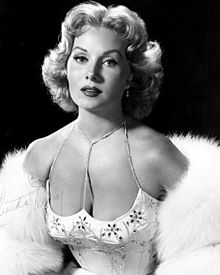
We have another young woman named Rhonda Fleming under contract, and we are preparing a test for her. Since the plan is to film in Technicolor, her red hair would be an advantage, especially in the scene where Cedric Brandon recognizes her from her lock of hair. Of course, we would have to engage a dialogue coach for extensive work on her accent.

To: Mr. Daniel O’Shea

With Miss Fleming in place, the choice of a leading man with box office stature becomes critical. Heyer’s hero is a world-weary man of fashion, but he has a strong masculine presence that saves him from being a “pretty boy.” The character is about 30, and I think if we cast an actor much older than that, the pairing of him with Miss Fleming will be distasteful.

Robert Taylor Source: Wikipedia

Robert Taylor
Source: Wikipedia

Of course, the great difficulty is that most men of the right age are tied up with military service. The most perfect actor I can imagine for the role is Errol Flynn, but I don’t think this is the time to cast him in a romance with a teen-aged heroine. I’ve heard that we might be able to get Robert Taylor before he starts his service.

To: Mr. Daniel O’Shea

For the supporting characters, I think things will proceed most smoothly if we choose British actors in most cases. We should look at the actors used in Rebecca and Jane Eyre as a starting point. For the character of Lydia, it is important that we choose an actress who comes across as less mature and less clever than our heroine.

The Director

To: Mr. John Hay Whitney

In a director, we need someone with a light touch for comedy and experience with Technicolor. I wish I could use George, who has a great sense of the style of a book and of a picture and who could undoubtedly draw a good performance from Rhonda. Bill Wellman has the experience with color, but I don’t think he would be right for this picture. Someone like John Cromwell might be the safest choice, if we hold Mr. Menzies responsible for the physical aspects of the production and the final word on Technicolor issues.

The Script

To: Miss Katharine Brown

The ideal script, as far as I am concerned, would be one that contained very little original dialog. Dialog is one of the novel’s strengths, so we need a writer who will adapt it as faithfully as possible. Ben Hecht is good at conveying the mood of a novel, but I question whether he’s right because of the English atmosphere. Clemence Dane is a possibility, as is Aldous Huxley.

To: Mr. Aldous Huxley

With such a short novel, I think there is very little that can be cut without hurting the story. Certainly, the opening scene with Richard and his sister and mother should be shortened so the audience can meet the heroine more quickly. I would also recommend keeping the scenes relating to the diamond heist as short as possible. Overall, the film needs to have a brisk pace. Short scenes are at the very essence of good motion-picture making, and one of the great values that we have in this medium, by comparison with the stage.

I agree that the number of characters is high, but most are essential to the story. I don’t think we need to see the father of the Brandon brothers but can imply his character through their actions. I don’t think we need to see Pen’s intended either, which spares us the difficulty of casting a man “with a face like a fish.”

To Mr. Cromwell:

I think we must be very careful in both the script and in the reading of the lines by English actors to avoid anything which might be difficult for an American to understand—as to actual phrasing and as to dialect. This issue is most acute with Jimmy Yarde and his criminal slang. I think we should commission the script girl, or some other American, to watch this point carefully throughout the making of the picture and to call to your attention anything which she thinks is dangerous from this standpoint.

The Production and Post-Production

Beau Brummel. In the novel, he is a friend of the hero.

Beau Brummel. In the novel, he is a friend of the hero.

To: Mr. Cromwell

Regarding the wardrobe, I would like to be as historically accurate in the women’s costumes as possible, avoiding the mess MGM made of Pride and Prejudice. I trust Walter Plunkett and Rene Hubert when it comes to period costumes.

It might be wise to bring in Gile Steele to give the men’s costumes extra attention. Richard’s attention to his clothing is central to his character, but we have to make sure his costumes don’t look ridiculous to modern audiences, even if it means sacrificing some historical accuracy.

To: Max Steiner

In preparing your score, spend whatever time you have free in study of the music of the period.

To: Miss Katharine Brown

I will admit that I have had some concerns about the title, as I don’t think audiences will be familiar with the term as Heyer uses it. Any synonym I can think of, such as “dandy” or “bon vivant” has effeminate connotations we want to avoid. It will probably be best to stay with Heyer’s title and make the meaning clear in the script itself. My experience has been that if a book has succeed with a title that seems a bad picture title, picture producers are foolish to worry about it.

Cast

Richard Wyndham: Robert Taylor
Penelope Creed: Rhonda Fleming
Lord George Trevor: Robert Morley
Lady Louisa Trevor: Agnes Moorehead
Lady Aurelia Wyndham: Gladys Cooper
Melissa Brandon: Valerie Hobson
Beverley Brandon: Eric Blore
Cedric Brandon: Reginald Denny
Piers Luttrell: Hugh Marlowe
Lydia Daubenay: Joan Greenwood
Jimmy Yarde: Gordon Harker
Horace Trimble: Trevor Howard

* Executive Vice President and General Manager, David O. Selznick Productions, Inc.

Assorted Ephemera: My Three Sons Coloring Book (1971)

This month, I am honoring the premiere anniversaries of many classic TV shows. Check back frequently for TV collectibles, fan magazine articles, special editions of Spin Again Sunday, and more. I will also be posting unique content on Facebook and Instagram.

This month, I am honoring the premiere anniversaries of many classic TV shows. Check back frequently for TV collectibles, fan magazine articles, special editions of Spin Again Sunday, and more. I will also be posting unique content on Facebook and Instagram.

My Three Sons premiered on September 29, 1960, and ran for 12 years. The latter half of the show saw many changes for widower Steve Douglas and his family–the show changed networks, switched from black and white to color, and re-located its setting from the Midwest to Southern California (a change prompted by a real-life change in production facilities).

One son married and departed, a new son joined the family through adoption, grandfather Bub left, and salty Uncle Charley took over as caretaker. In its last few years, the all-male cast got an estrogen infusion: Second son Rob married Katie and moved her into the family home; third son Chip eloped with Polly; and Steve married widow Barbara, who had a young daughter.

my three sons coloring book cover

The coloring book barely mentions Polly, though she was part of the show by 1971. I can’t blame Saalfield. The Chip-Polly marriage was an unfortunate development, mainly because the actors playing the newlyweds looked like 12-year-olds.

It’s not hard to imagine what Executive Producer Don Fedderson was thinking when he introduced Barbara’s daughter, Dodie. Family Affair‘s Buffy and her doll Mrs. Beasley were a merchandising gold mine. Collectibles like this coloring book and Dodie paper dolls–both printed by Saalfield–represented attempts to recapture the Buffy magic. Producers even gave Dodie a companion doll, Myrtle.

Abnormally short girl with unlikely name + strange-looking doll = cha-ching!

Unusually short girl with unlikely name + strange-looking doll = cha-ching!

Dodie merchandising didn’t come close to matching the success of Buffy and Mrs. Beasley, though.

This coloring book features “Dodie’s Favorite Things to Do,” a theme that enabled Saalfield to use random toy and teddy bear pictures for about half the content.

The other pages feature the Douglas family. The illustrator does a pretty good job making Steve look recognizable.

The other pages feature the Douglas family. The illustrator does a decent job with the likenesses, especially Fred MacMurray’s.

Rob and Katie’s triplets are in almost as many pictures as Dodie.

Fun fact: The episode featuring the triplets' birth aired on the day I was born.

Fun fact: The episode featuring the triplets’ birth aired on the day I was born.

The coloring book includes paper dolls of the triplets and Dodie.

It also includes this creepiness--kids are supposed to transform it into a picture of what they want to be when they grow up.

It also includes this creepiness. Kids are supposed to transform it into a picture of what they want to be when they grow up.

One of Dodie's own career aspirations is stewardess.

One of Dodie’s own career aspirations is stewardess.

Uncle Charley gets some ink in the coloring book (although it spells his name wrong).

my three sons coloring book uncle charlie

What a fascinating revelation.

The image below is the only one that comes directly from the show.

I take back what I said about the decent likenesses. I think they borrowed this face from a Planet of the Apes coloring book.

I take back what I said about the decent likenesses. I think they borrowed this face from a Planet of the Apes coloring book.

Embarrassing Treasures Field Trip: The Mid-Atlantic Nostalgia Convention 2013

They had me at Margaret O’Brien.

I don’t remember what made me browse the web site for the Mid-Atlantic Nostalgia Convention earlier this year, but as soon as I saw Margaret O’Brien on the celebrity list, I ordered my tickets.

MANC takes place each fall in Baltimore. For three days, celebrities make themselves available for autograph signings and Q&A sessions; experts hold seminars on old-time radio, classic television, and classic movie topics; vendors sell movie posters, books, and other collectibles; and classic screen performances play in the Movie Room.

I’ve thought about attending before (and I really wish I’d attended in 2009, when Johnny Whitaker and one-time Family Affair guest star Lee Meriwether were guests). The chance to see my favorite child star in person stirred me into seizing the moment. It’s a sad reality that few golden-age stars remain with us, and we lose more every year.

This was the first nostalgia convention I’ve attended, and what follows is a brief, impressionistic review. Unfortunately, it lacks photos—I forgot to pack my camera, and my iPhone images didn’t turn out well.

Educational Sessions

Mornings at MANC are devoted to presentations on vintage entertainment topics. The presenters are people who’ve invested enormous time into learning about their subject. John C. Abbott, for instance, has produced an exhaustive three-volume work called The Who is Johnny Dollar? Matter about radio’s famous insurance investigator. He’s analyzed not only the remaining recorded episodes but those that exist only in script form. He can tell you everything from Johnny’s address to how many times he’s been shot.

Sally Stephens talked about Gracie Allen’s 1940 run for the presidency, a months-long joke that played out on several radio shows and in live appearances. Stephens effectively integrated radio clips into her presentation, which made her topic come alive.

Joanna Wilson gave a great presentation on TV adaptions of A Christmas Carol. I’d been eagerly anticipating this presentation for two reasons:

  • I love TV Christmas specials and episodes.
  • Wilson is a fellow Classic TV Blog Association member, and I hoped to meet her and to purchase her book, ‘Tis the Season TV.

Wilson’s presentation didn’t disappoint–her passion for her subject matter really came through, and the audience responded with similar enthusiasm. I have to admit that I’m not a big fan of straight A Christmas Carol adaptations. (What does it say about me that my favorite theatrical version features the Muppets?) I still enjoyed learning about all the versions TV has produced, and I was glad that Wilson touched on many of my favorite Dickens-influenced TV episodes, including ones from The Andy Griffith Show, Bewitched, The Avengers, and Family Ties.

It was fun to meet another blogger, and I’m enjoying Wilson’s book, which I highly recommend to all Christmas TV fans.

(Be sure to read her convention recap, too–it has pictures!)

Author Gene Blottner did a presentation on film noir star Audrey Totter and made good use of clips from Totter’s career.

Garyn Roberts, a noted Ray Bradbury scholar, hosted a celebration of the author and gave another talk about Dick Tracy in popular culture.

Celebrity Appearances

As Ed Asner walked into his Q&A session, his cell phone rang. Nodding to the audience, he quipped, “It’s for you.”

This was the perfect introduction for Asner, who was as gruff, unfiltered, and entertaining as you would expect. He had high praise for many of his former co-stars, especially Ted Knight from The Mary Tyler Moore Show and Nancy Marchand from Lou Grant. (He also had high praise for Marchand’s legs.) 

Johnny Crawford from The Rifleman appeared on a panel with Jeff Connors, real-life son of Rifleman star Chuck Connors. Both men recalled the elder Connors with affection. Crawford said that Connors was protective toward him on the set; no director who treated Crawford unkindly would continue working on the show.

Crawford reminisced about some of his favorite guest stars on the show, including John Anderson and Royal Dano. He especially enjoyed working with two-time guest star Sammy Davis Jr., who loved Westerns.

His favorite episodes from the show are “The Pet” and “The Sharpshooter.” (Sam Peckinpah wrote the latter’s script.)

All the talk about the show’s warm father-son dynamic inspired me to make The Rifleman a regular part of my Me-TV viewing.

Crawford also talked his experiences as a first-season Mouseketeer and joked about his crush on Karen, which Cubby thwarted.

Julie Newmar shared a Q&A session with Elizabeth Shepherd, a British actress best known for her role in 1964’s The Tomb of Ligeia, as well as her status as The Avengers‘ first Emma Peel. (Producers quickly replaced her with Diana Rigg, and the scenes that Shepherd shot for the show no longer exist.)

Newmar and Shepherd made an interesting study in contrasts. Newmar was expansive, dramatic, and occasionally random. (She sometimes interrupted Shepherd to ask her an off-the-wall question.) Shepherd was down-to-earth and good at telling stories, as when she described her perilous encounters with trained ravens during the filming of The Omen II.

Newmar said her ballet background gave her the cat-like physique that served her well in her famous Batman role. Her most challenging role was on the short-lived series My Living Doll because it was difficult to find the humanity in her robot character.

An experienced Shakespearean stage actress, Shepherd made an interesting point about theater being a burgeoning new field to the Elizabethans, as social media is to us today. She treated the MANC audience to an excellent dramatic recitation from Shakespeare.

(Note to the loud talker behind me who rarely shut his mouth throughout the Newmar and Shepherd Q&A: Not cool. Seriously. When everyone around you is glaring, it’s time to shut up.)

Margaret O’Brien exuded graciousness throughout her presentation.

She had good things to say about nearly everyone she worked with, from Charles Laughton (“He was wonderful”) to Lionel Barrymore (“He was almost like a grandfather”) to Judy Garland (“She loved children”).

She even had a good relationship with studio head Louis B. Mayer, who wanted to marry her mother, glamorous flamenco dancer Gladys Flores.

O’Brien talked again and again about the supportive, protective role her mother played in her life. Flores made sure that O’Brien got the salary she deserved for Meet Me in Saint Louis. She kept O’Brien in line during the perilous teenage years, once busting her at a nightclub after she sneaked out with Natalie Wood. She kept the child-hating Wallace Beery from stealing O’Brien’s hot lunch on the set of Bad Bascomb. (Beery seemed to be the only person in Hollywood to earn O’Brien’s ire.)

It’s apparent that her mother’s influence kept O’Brien from the pitfalls of child stardom and enabled her to simply enjoy the movie-making process.

O’Brien, who traveled to Japan in 1952 to make the movie Girls Hand in Hand, talked about the importance of travel and getting to know people from other cultures. Again, she praised the influence of her mother, who served as her role model as a strong, independent woman.

“I never feel that I can’t do something,” O’Brien said.

Autographs and Vendors

The welcoming letter in the convention program noted that some people attend only to collect autographs, while skipping all the sessions. I took the opposite approach. I’ve never been an autograph collector, and I feel awkward approaching celebrities–there’s nothing that I could say that they haven’t heard thousands of times. MANC attracts a knowledgeable crowd, so audience members covered most of the questions I would have asked during the Q&A sessions. (I did hope to ask Robert Loggia about his work with Brian Keith on Disney’s Elfego Baca, but Loggia is in frail health, and I couldn’t bring myself to bother him.)

For those who do want to collect autographs, MANC is ideal. Celebrities are available for long periods throughout the three-day conference, so lines stay short, and fans have time to chat with their favorite stars.

Vendor tables lined the main hallway leading to the seminar room. When I didn’t see anything I wanted there, I figured the spending money I brought with me was safe. On the second day, I realized that many more vendors were offering their wares on another floor. I picked up a few vintage books and magazines and a set of Dr. Doolittle paper dolls. I also bought several current books, including books about Peggy Ann Garner and 1950s live television by author Sandra Grabman, who attended the convention.

My only regret was that I didn’t find any good games for future Spin Again Sunday posts.

My overall experience at MANC was wonderful, and I would highly recommend it to all fans of vintage entertainment. The $15-a-day admission price is a small price to pay for seeing your favorite stars in person and hearing from experts on interesting topics. I hope to go again in coming years. (I definitely will if Kathy Garver appears–I’m not missing another Family Affair star!)

Family Affair Friday: Season 2, Episode 21, “A House in the Country,” 2/5/1968

Written by: Ed James. Directed by: Charles Barton.

Bill’s date this week is cute, but he’s not paying any attention to her.

Eventually, she gets him to open up about his worries--he's suddenly decided that New York is no place to raise kids.

Eventually, she gets him to open up about his worries–he’s suddenly decided that New York is no place to raise kids.

Bill loves the city, but he thinks the “dirty air,” pushing and shoving, and three-block walk to the park make it a bad environment for his nieces and nephew.

His mood grows even darker on the way home.

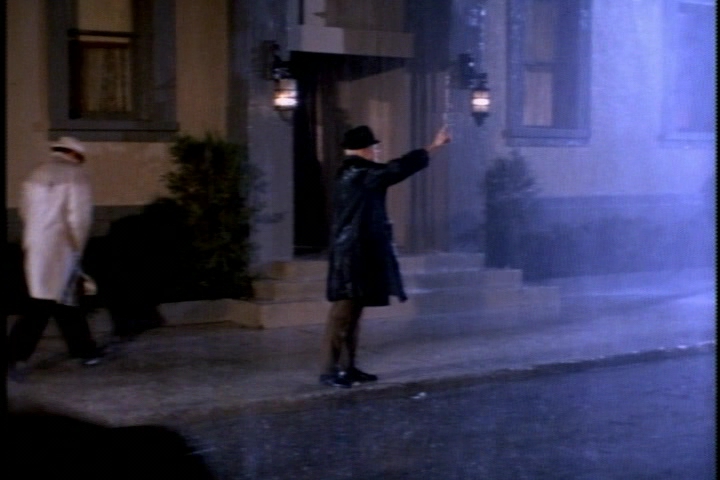
Having had its one annual snowstorm last week, New York is now experiencing heavy rain.

Having had its one annual snowstorm last week, New York is now experiencing heavy rain.

Unable to get a taxi, Bill is a sodden mess by the time he walks back to the apartment.

French doesn't make things any better by calling the rain "invigorating." I guess that's the Englishman in him talking.

French doesn’t make things any better by calling the rain “invigorating.” I guess that’s the Englishman in him talking.

Observing her uncle’s reaction, Buffy says, “I think he’s getting another mood.”

Bill sends the kids off to do their homework.

Bill sends the kids off to do their homework.

Somehow, they end up in the kitchen bothering French instead.

Giles French Cooking Tip: Always tear lettuce with your hands instead of cutting it with a knife, which can give it a metallic flavor.

Giles French Cooking Tip: Always tear lettuce with your hands instead of cutting it with a knife, which can give it a metallic flavor.

Buffy and Jody wonder aloud why the metal bowl doesn’t have the same effect.

Then they wander off to bother Bill again, leaving French to ponder the metal bowl conundrum.

Then they wander off to find Bill, leaving French to ponder the metal bowl conundrum.

Buffy and Jody ask Bill if they can watch him make faces as he shaves. He obliges them, but he’s soon shocked to hear the foul language Jody has learned in the wicked city.

"It sure is a stinkin' day, ain't it?"

“It sure is a stinkin’ day, ain’t it?”

Before Bill’s delicate sensibilities can recover, Jody also mentions the “crummy rain.”

After Bill sends Jody off to fetch French, Buffy tells her uncle that she’s no longer taking Mrs. Beasley to the park. Buffy’s friend Pamela was nearly hit by a car the day before, and Pamela’s doll Gertrude suffered a smashed head. Buffy notes that Pamela is having a funeral for Gertrude when the weather improves.

“That should be fun,” Buffy notes brightly.

When French arrives, Bill sends Buffy to join her brother in the kitchen.

Bill interrogates French about where Jody learned such terrible language.

Bill interrogates French about where Jody learned such terrible language.

Of all the people he could blame–school friends, park ruffians–French chooses Scotty to throw under the bus. He does try to defend the doorman, though, by calling him “the salt of the earth” and adding that such language is “typical of city life.”

That was the wrong thing to say.

Just to make Bill’s terrible, horrible, no good, very bad day complete, Cissy barges in asking about the appropriate age to become engaged. Bill doesn’t care for her box-boy intended; he says the boy “looks like a refugee from the House of David.”

Cissy doesn't get it and neither do I, but it seems to have something to do with the length of his hair.

Cissy doesn’t get it and neither do I, but it seems to have something to do with the length of his hair.

After all this drama, Bill makes up his mind–he’s ready to chuck city life.

So, we're off to Connecticut, which is having a very, very late fall, apparently.

So, we’re off to Connecticut, which is having a very, very late fall, apparently.

“This is the only place to bring up kids,” Bill’s realtor assures him as they check out a lovely property.

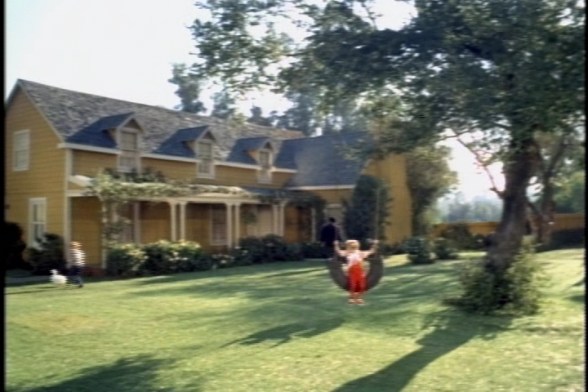
The kids seem happy: Jody tortures water fowl while Buffy enjoys a tire swing. Is that cut-off tire style common? My old tire swing was a whole tire.

The kids seem happy: Jody tortures water fowl while Buffy enjoys a tire swing. (Is that cut-off style common? My old tire swing was a whole tire.)

French notes approvingly that the place resembles the Duke of Glenmore’s weekend estate in Kent–although he does emphasize the word “weekend.”

And countryside or no, Cissy doesn't let any grass grow under her feet. She's already got her hooks in the grandson of a neighbor.

And countryside or no, Cissy doesn’t let any grass grow under her feet. She’s already got her hooks in the grandson of a neighbor.

French, sensing that Bill has made up his mind, tells Buffy and Jody that “this bird sanctuary is about to be our new home.”

While the twins think the country is a nice place to visit, they don't want to live there.

While the twins think the country is a nice place to visit, they don’t want to live there.

Jody says he’ll miss blowing Scotty’s whistle, and Buffy worries that she’ll miss Gertrude’s funeral.

Cissy tells them they all need to go along with Uncle Bill's wishes. (They really must be getting ready to move--the desk has already disappeared from the girls' room.)

Cissy tells them they all need to go along with Uncle Bill’s wishes.

She reminds them that “no one has ever been as kind to them” as Uncle Bill, and that if he hadn’t intervened, they’d still be scattered. Actually, she’s going a bit overboard here. Surely their own parents were “kind” to them.

The twins agree to put on a happy face about the move, which becomes more difficult when Bill tells them they’ll be moving by the end of the week. How do you close on a house that quickly?!

Their "happy faces" look like this, but they still manage to fool Bill.

The kids “happy faces” look like this, but they manage to fool Bill.

Buffy returns some borrowed toys to Pamela, who’s upset that Buffy will miss the doll funeral.

She was supposed to serve as "all the pallbearers."

She was supposed to serve as “all the pallbearers.”

Jody says his goodbyes to Scotty, who leaves him with some words of wisdom.

"If you think life is tough now, just wait till you grow up."

“If you think life is tough now, just wait till you grow up.”

Cissy parts with her boyfriend, despite his pleas that they get married. She could get a job, too, and they could have “a real swinging time.”

Cissy manages to resist this offer. (Is his hair really any longer than Connecticut Guy's?)

Cissy manages to resist this offer. (Is his hair really any longer than Connecticut Guy’s?)

Meanwhile, French vents to Miss Faversham about the move.

She makes the mistake of suggesting that he could give notice if he doesn't want to leave the city.

She makes the mistake of suggesting that he could give notice if he doesn’t want to leave the city.

French goes all, "My Dear Miss Faversham" on her.

French goes all “My Dear Miss Faversham” on her and says he owes Bill “a full measure of loyalty.”

Back at home, the Davis apartment is emptying rapidly.

This is the first African-American actor we've seen on the show for weeks.

This is the first African-American actor we’ve seen on the show for weeks. Too bad he doesn’t get any lines.

The kids are looking so miserable that even Bill starts to pick up on it.

The kids look so miserable that even Bill picks up on it.

Cissy explains that they are sad about leaving “the first real home we’ve had as a family,” a place where they’ve felt “warm and safe and loved.”

Once again, she’s forgetting their actual “first real home,” but she gets through to Bill.

He announces that the family is staying put.

He announces that the family is staying put.

Good thing that reversing a house purchase is not at all difficult.

Bill must be wondering, though, what to do with all the Family Affair green paint he'd undoubtedly ordered to spruce up the country house.

Bill must be wondering, though, what to do with all the Family Affair green paint he’d undoubtedly ordered to spruce up the country house.

Soon, it's raining again in the city, and Bill is searching in vain for a cab. (He should really think about buying an umbrella.)

Soon, it’s raining again in the city, and Bill is searching in vain for a cab. (He should really think about buying an umbrella.)

But when he returns home to a happy family, and the Violins of Emotional Resonance ring out, he decides city life isn’t so bad.

Commentary

This script has lots of cute dialogue, but it also has room for improvement. If, for example, Bill overheard the kids talking about some Terre Haute experiences they missed, his desire to leave the city would seem less like a wild hair. If he reminisced a bit about his own Indiana boyhood, his motivation would be more clear. And his change of heart at the end would be more plausible if the house sale hadn’t already gone through.

Random wardrobe observation: Buffy looks like a xylophone in this dress...

Random wardrobe observation: Buffy looks like a xylophone in this dress…

...and like a drum in this matching one.

…and like a drum in this matching one.

Guest Cast

Mr. Pendergast: Mauritz Hugo. Scotty: Karl Lukas. Jerry: Patrick Moore. Mr. Burgess: Walter Reed. Pamela: Debi Storm. Marcia: Lynn Borden. Danny: Dennis Olivieri. Miss Faversham: Heather Angel.
Most of our guest actors are familiar faces. Lukas and Angel, of course, are frequent guests. Borden and Olivieri are both making their second of three Family Affair appearances, and Storm and Moore are making their second and final ones. Hugo made a career out playing bit parts in TV and movie Westerns. Reed quit acting a few years after this episode aired and became a real estate broker.

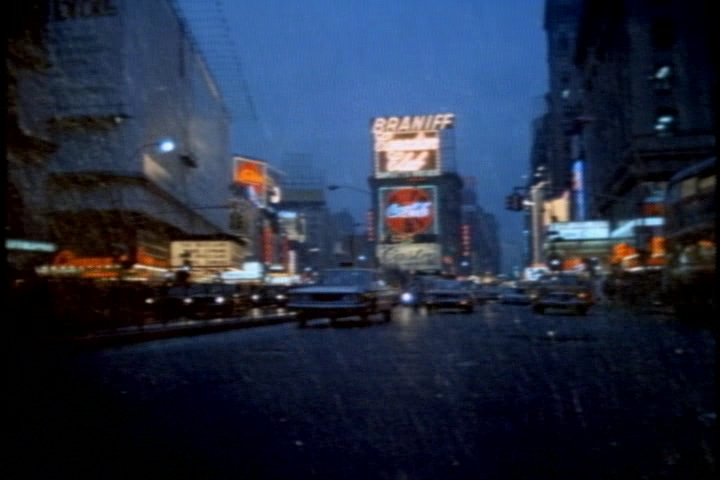
I like this rainy Times Square establishing shot.

I like this rainy Times Square establishing shot, with the Braniff sign and all. This interesting page about Braniff says the sign went up in 1964 and was the largest moving display billboard in the world at the time.