I’m dealing with the migraine from hell today, so I have to postpone my regular Family Affair Friday entry until tomorrow. Don’t miss it–it’ll be a good one!
Weird Words of Wisdom: Where the Boys Are (You’d Better Wear a Skirt) Edition
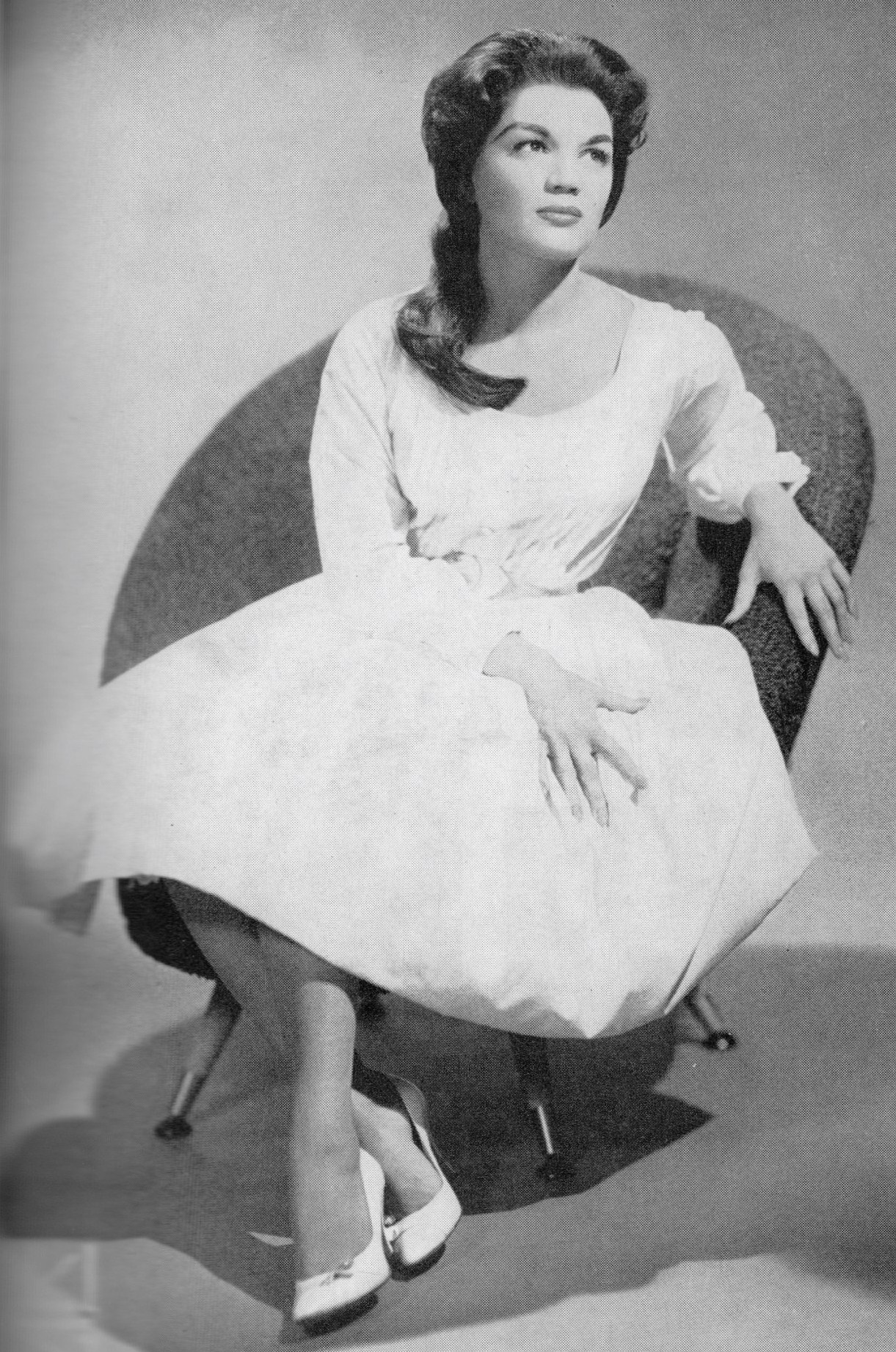
Connie Francis (suitably skirted)
“Never wear slacks on a date, unless it’s a rugged outdoor picnic or an evening at an amusement park. Otherwise, I think slacks are an insult to a boy.”
For Every Young Heart, 1963
By Connie Francis
About the Book: We’ve encountered celebrity advice books before in this series, but Connie Francis is both our first female celebrity author. Of course, one always has to wonder how much “authoring” these celebrities did. Francis’ book feels more authentic than most. Her advice—both the good stuff and the weird stuff—feels specific and individual. Knowing little about Francis when I picked up this book, I quickly formed a clear mental image of her—tough, smart, moody, romantic, and ambivalent about her parents’ influence in her life.
About the Author: I’m always happy to write about an author who’s still alive. Connie Francis is a survivor, in every sense of the word. As a teenager, she appeared on a TV variety show called Startime Kids, and she received much criticism about her looks and weight during those years. Her recording career was slow to take off, and she was on the verge of giving up when American Bandstand made Who’s Sorry Now? her first hit in 1958. (She had brains to fall back on—she received a scholarship to New York University and was planning to study medicine.) And as an adult, she would endure many tragedies (which I don’t want to write about here, lest it ruin the mood for laughing at her fashion, beauty, and dating tips.)
 Okay, Then—Let’s Start With Hair Care: “Going to the beauty parlor is an art in itself. Some ladies lean back, close their eyes, and snooze. Others read movie magazines or daydream. This is okay if you’re over forty and have money. But it’s not for you…Sit up and take notice.”
“Wash your hair with regular shampoo, rinse thoroughly, then soak with beer just before setting. It adds tremendous body to fine or limp hair.” (Note: You have to leave the beer, open, outside the refrigerator for two or three days prior to use.)
On Teasing Your Hair: “This is one of the most useful tricks a girl can learn. It involves back-combing the hair from underneath, which adds body, so that with very little curl you can make your hair look like something special. Right this minute, my hair needs setting, but if I had to go out unexpectedly I could whip it into a definite bouffant style by teasing, hold it with hair spray and breeze out for the evening with perfect confidence.”
On Washing Your Hair, Um, Frequently?: “My hair is very oily, so every three days it gets washed.”
On Fashion: “The little black dress or navy suit is the backbone of my wardrobe. I have five or six basic outfits that can go anywhere, from the office in the morning to dinner at the Stork Club and dancing at the Peppermint Lounge at night. The only change I need is a scarf or a piece of jewelry.
On Fashion for Petite Girls: “So instead of buying three strands, you buy one. Instead of the big chalk beads, you buy little ones. And if everything you wear is small, like you, you’ll have a larger overall appearance. Stay away from medium or heavy patterns, circular designs, and two-tone outfits. Verticals give you height. Solid colors, small all-over patterns, and lightweight, clingy fabrics are most flattering.”
On Makeup: “Dark minimizes, light accentuates…For instance, my nose is too wide, so I always use a darker makeup on its sides than on the rest of my face.”
On Lipstick: “For most women, this is a good rule: Darker by night, lighter by day, and always coordinated with the color of your outfit.”
On Brows: “The outer line of the eyebrow should end a 45-degree angle from the tip of your nose.”
On Eyeliner: “This is the most valuable cosmetic I ever found. After experimenting with many kinds, I think black pancake makeup is ideal.”
 Getting Along with Boys
“…from the age of nine or ten, (a girl is) more alive, happier, and more of a person with a male around. It doesn’t matter how old he is—nine or ten like herself, twenty-two or eight-five, married or single. All he has to be is male.”
How 11-Year-Old Connie Learned “a New, Improved Formula for Getting Along with Men”: At a Halloween party, she encountered a boy named Eugene who had been picking on her at school:
“And then—whether it was the costume or the lipstick or the fact that I really did feel like a gypsy princess for one wonderful night—a strange thing happened. A lovely, soft, feminine feeling crept over me, transforming the glare to an angel’s smile. Instinctively, I minced forward, lowered my eyes shyly and cooed, “Hel-loo…”
“G-g-gosh!” Eugene breathed, “you look pretty!” “Oh,” I said coyly, “do you really think so?” Half an hour later, there I sat, perched on a cold radiator, collecting kisses from the stag line—and now it was the other girls turn to glare!”
Connie’s First Real Date: A showing of should It Should Happen to You with Judy Holliday and Jack Lemmon, and a second feature of Francis Joins the WACS with Donald O’Connor. (She got so disgusted with her date’s loud guffaws that she stormed out of the theater and went home. If he was laughing at Francis Joins the WACS, I can understand her reaction.)
Telling Tales on Herself: That is one of several unflattering stories Connie tells about herself. Others include the times Connie:
• Beat up a fellow seventh-grade girl
• Got into a shoving match with an overweight male classmate on her first day of high school
• Threw a cup of coffee across the room and stormed out the studio after recording Who’s Sorry Now?
Dating Don’ts
“There are certain places a girl should never go alone, or even with another girl—certain hangouts, bowling alleys, bars, and other places where boys tend to gather and girls don’t.”
“Don’t ever stand near a bar and talk. Never drink at a bar, even if you’re drinking ginger ale.”
“Most people can tell right away who’s a lady, just by the way she talks. And the quickest way to lower yourself in the eyes of anyone—a boy, especially, is to use even one unladylike word.”
“Every man likes a woman to allow him to be a man. Unfortunately, some women, especially in the United States, don’t allow men to be men. They do everything for themselves, because they’re always trying to prove how independent they are.”
“A woman who doesn’t expect the little courtesies isn’t a lady, and a man who doesn’t perform them isn’t a gentleman…I think an unmannerly man is 95 percent the woman’s fault.”
On Sharing Expenses on a Date: “Out. Not under any circumstances should a woman touch one nickel of her own money on a date, unless she’s stranded 50 miles from home and her date needs 15 cents for a subway token. But why get in such a silly fix, anyway?”
“A girl who goes out deliberately to get picked up lives dangerously. And most boys will assume that she’s what she probably is.”
Dating Dos
“Of course, the best way for a girl to be interesting to a boy is to be interested in him. I’ve sat through many an evening not knowing what on earth my date was talking about, but just nodding and smiling and looking at him very, very intently, and occasionally putting in a word of my own like ‘Really!’ or ‘My goodness!’—and he’s walked away thinking ‘Gee, what a brilliant conversation we had!’”
“Anyhow, not only does a kiss on the first date not compromise a girl’s reputation, but nowadays a boy expects it. That doesn’t make it right, of course, but it doesn’t make it wrong, either. A girl knows instinctively the kind of boy she can trust and the kind she can’t. She can sense when a boy respects her, and if a date doesn’t have any real feeling of warmth and friendship for you, he doesn’t deserve a kiss—or a second date, either.”
“The one unfailing way to let a boy know you like him is this: Tell him. I believe letting a boy know in a very lighthearted, casual way that won’t embarrass either of us…When we’re standing in line for a movie or waiting to get into a restaurant, I’ll say: ‘Know something? I like you,’ very casually, then change the subject.”
“As far as necking is concerned, there’s nothing wrong with it in moderation, if there’s a warm, respectful feeling between two people.”
Suggested questions to get dates to open up: “Are you a lonely person? Are you Happy? If you had 48 hours to yourself, what would you like to do most?”
Putting on the Brakes
“If a boy really loves you as much as he says, he’ll want to put a ring on your finger.”
“A girl can become sexually aroused just as quickly and irrationally as any boy. She wasn’t born with any handy ‘monitor’ that automatically helps her put on the brakes, but she has to develop one in her mind in order to protect her self-respect and reputation.”
(Connie wasn’t just talking the talk about chastity. In 1984, she told People Magazine that when she married her first husband, at age 26, it was because “because I wanted to have sex.” That marriage only lasted three months.)
With the Above Said, the Most Racy-Sounding Passage in the Book, if Taken Out of Context: “I finally had to force myself to have fun. I went to Europe and Las Vegas and forced myself to date one boy after another. I kept dating until I found the feelings I had for one or two boys weren’t so fantastic after all. I found, in fact, that I could feel just as happy and have just as good a time with 25 others.”
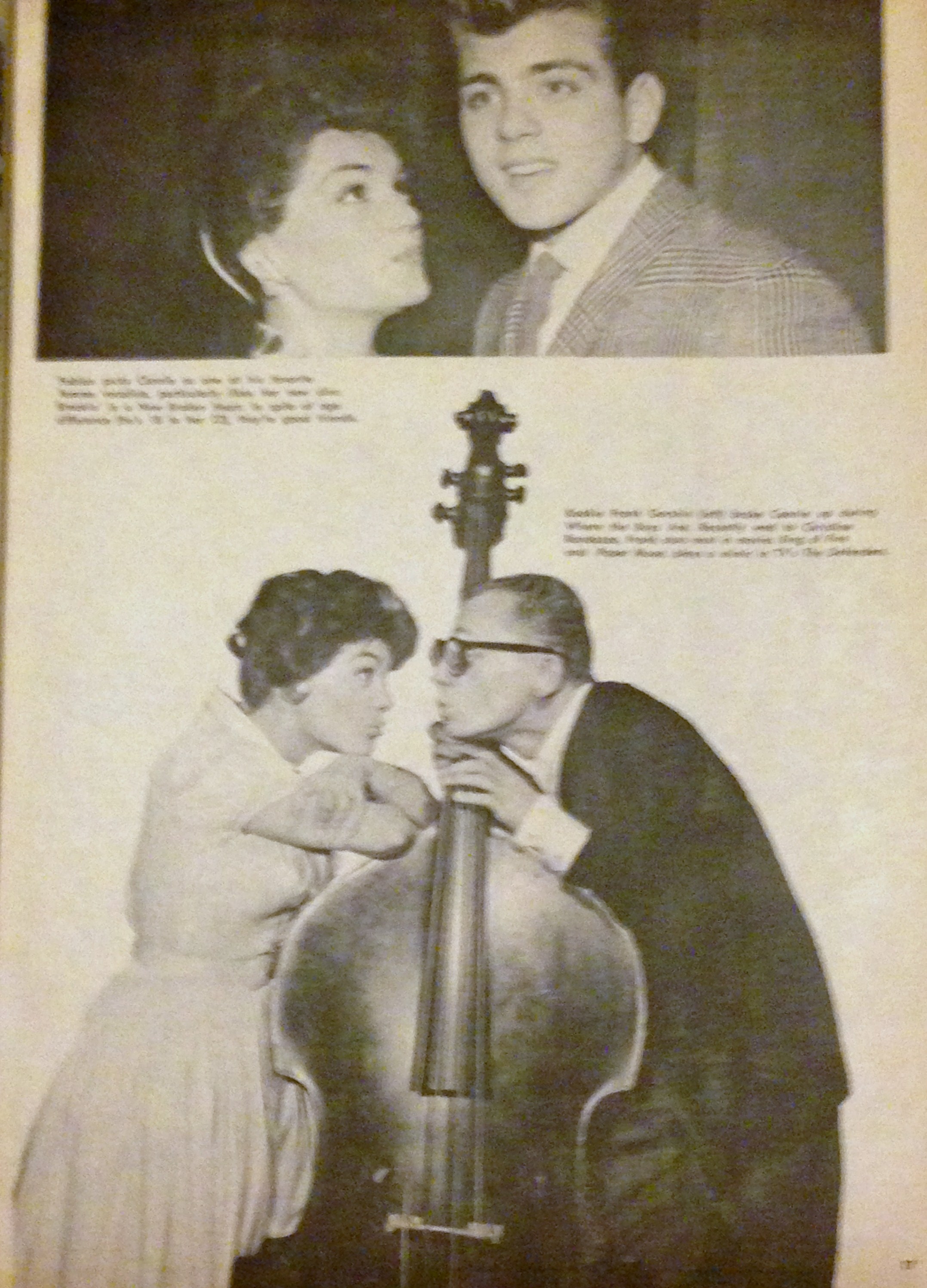
Connie’s First Real Love (Bobby Darin?): “I was in love in my teens, and at the time it was the most important thing in the world to me. Every day, because I was in love and my parents didn’t approve, there was an argument at home. School became secondary. My singing became unimportant compared to my feelings for this boy. The day was happy or sad depending on what he said to me or what I said to him, or what my parents said or didn’t say about him or me or us. Then, when we did break up, it took me just as long or longer to get over it.”
It’s tempting to assume she’s talking about Bobby Darin here. Certainly the part about parental disapproval fits. Here’s an exchange she had last year with Village Voice blogger Michael Musto:
Musto: Your father was extremely strict, right?
(Connie): He wasn’t just strict — he was a vigilante with every boy I had a milkshake with. I was not allowed to date in high school or go to the prom, and even in college he had a problem.
(Musto): Is it true he broke up you and Bobby Darin?
Connie: With a gun. He learned Bobby and I were starting to elope one night. We were 18, 19. I was doing the Jackie Gleason show and Bobby and I were cuddling in a corner. He barged through the rehearsal room of the Sullivan Theater with a gun in his pocket and a fierce determination to obliterate Bobby once and for all. One of the biggest regrets of my life is I didn’t marry Bobby.
In For Every Young Heart, some of Francis’ ambivalence toward her parents comes through. She describes how she taught herself shorthand because her mother was always snooping in her diary. She also talks about how she learned a confusing version of “the facts of life” in a whispered conversation with a girlfriend because her parents never told her anything.
“Every child has a right to know about life,” she asserts. “The day a youngster asks his first question about sex is the day he deserves an answer.”
Connie’s Ideal Husband: “He shouldn’t be overemotional, yet he must be very affectionate, responsive and warm. His laugh shouldn’t be so loud that everybody turns around to look, but he has to have a wonderful sense of humor. He has to be subtle and self-contained—the type who can say two words and I’ll understand; a man who can look at me across the room, and every look will mean something. Oh, yes, and he has to be very smart, alert, witty. He has to know he’s the boss without saying, ‘Listen here, I’m the boss.’ He can’t shout at me, but he’ll know just how to tell me what to do, because every woman loves to be ordered around the right way.”
Hmm. You start to get an inkling about why none of her four marriages lasted longer than five years.
More Wisdom from For Every Young Heart:
“The opinion that smoking is a drag—on your health, most of all—is pretty modern these days. Every day, new data piles up pointing to possible links between cigarettes and lung cancer.”
“If a boy has never been in a bar or never tried to drink or smoke by the time he’s out of his teens, he would be very unusual. These are things most boys have to experience in order to feel grown up and manly.”
“The only time a boy may have a feeling of responsibility for himself and girl is when he’s deeply in love, when he has a true feeling of respect for her, and when he’s far-sighted enough to think of the future, including the day they’ll want to get married with a fresh, wholesome start toward life together. But 99 percent of the time, the boy doesn’t feel this way, and that means the girl has to.”
“A girl must always have the kind of reputation that will make a boy very, very proud to take her home and introduce her to his mother.”
“…there’s just one reason for going steady, and that’s as a prelude to engagement.”
“Not only does a wife have to be a mother, friend, advisor, and scrubwoman—she must also never let her husband feel that it’s a great burden for her.”
“In my teens, I used to think it was the most important thing in the world for a woman to be tremendously independent. But I know now that no matter how independent you are, if you really love a man, nine times out of ten his wishes are more important than yours.”
“I will want nothing less than a big wedding, in a pretty church, with all my family and all my friends there to share it. That’s a girl’s one big day, and anybody who says you’re not entitled to it because it’s corny is not going to make the greatest or most understanding husband.”
If you enjoyed this post, read the whole Weird Words of Wisdom series!
Bonus Feature: Connie singing what I’m officially declaring the Weird Words of Wisdom theme song.
Bonus Feature 2: More advice from Connie! This article from the October 1961 issue of Teen Talk Magazine is called “Who Should Say No First?”


It Takes a (Fisher Price Play Family) Village

The gift I’d wished the hardest for in 1974–the Fisher Price Play Family Village.
My parents captured many Christmas morning photographs when I was young, but this one from 1974 is a little unusual. Most of our Christmas photos are candids taken in the midst of our present-opening frenzy. In this one, I’m pausing to pose in front of a half-unwrapped gift. The smile on my face shows how happy I was to uncover that gift–the Fisher Price Play Family Village.
Fisher Price began producing the Village in 1973. At age 6, I longed for it as intensely as I would long for the Barbie Star Traveler a few years later. I’d loved Play Family toys since I was a toddler, and the Village was the ultimate play set, with a fire station, police station, dentist’s office, apartment, restaurant, theater, garage, and more.
I’ve been wanting to acquire a Village for years, but finding a complete one at a price I was willing to pay proved difficult. Finally, about a month ago, I was able to add this toy to my collection.
I wanted to share a few pictures of it, simply because its colorful lithography and smiling people make me happy. As much as I enjoy nostalgia, I try not to fall into the trap of pining for a simpler time. In 1974, our country was dealing with Watergate, continued involvement in Vietnam, and an oil embargo–things were anything but simple. But a toy like Play Family Village transports me to a time when my parents still stood between me and the outside world’s troubles, and daily life seemed almost as uncomplicated as a walk down Play Family Main Street.
-

- The gift I’d wished the hardest for in 1974–the Fisher Price Play Family Village.
-

- This half of the village includes the fire station, dentist’s office, and theater.
-

- Cute touch–the apartment includes a Fisher Price record player.
-

- The box–a little worse for wear after 40 years, but aren’t we all.
-
- It must be hard to practice dentistry without hands.
-

- Off to save a cat from a tree!
-

- She’s smiling because he hasn’t given her the bill for her car repair yet.
-

- Life isn’t entirely perfect in the Village–but when frowning ne’er-do-wells strike, smiling police officers throw them in the slammer.
-

- This guy would never “go postal.”
-

- Here’s something a modern village wouldn’t need–a phone booth.
-

- Someone’s had her doughnuts this morning.
-

- It must be hard to deliver mail that’s bigger than you are.
-

- A mother-daughter lunch.
-
- The “entrance” to the Village’s finest dining establishment.
-

- The theater is featuring an animal act today.
Spin Again Sunday: Happy Days
Aaaaaayyyyyyyy. Ready for dating, drag racing, and drive-ins? Sure you are–you’re not some kind of a nerd are you?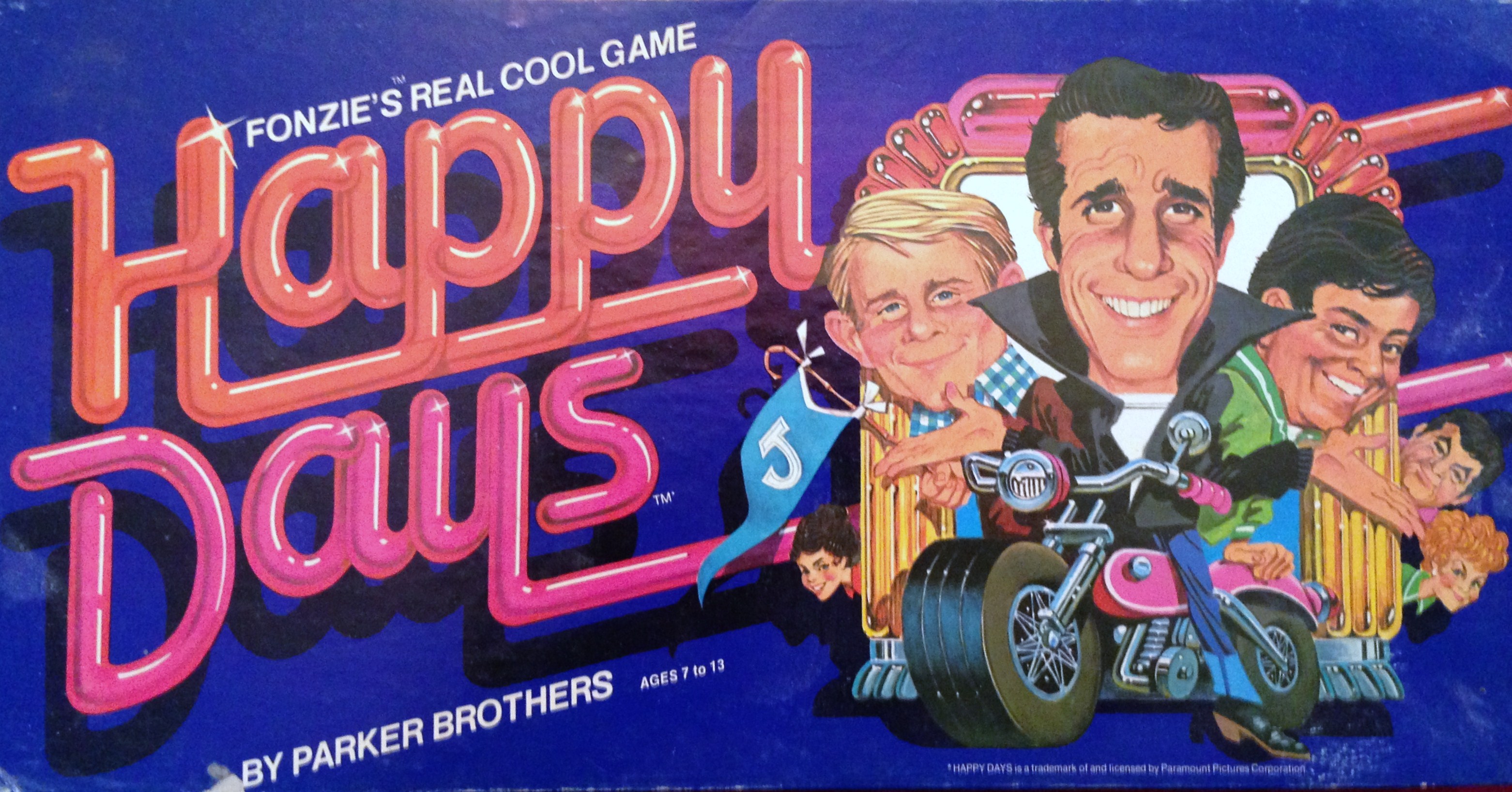
Today’s Game: Happy Days (“Fonzie’s Real Cool Game”)
Copyright Date: 1976.
Game Box: The most striking features are neon-light-style lettering and cartoon caricatures of cast members. These caricatures are a cut above those on most games–they actually resemble their real life counterparts. Fonzie is front and center, of course, flanked by Richie and Potsie. The other Cunninghams are peeking around the jukebox. Ralph Malph is MIA.
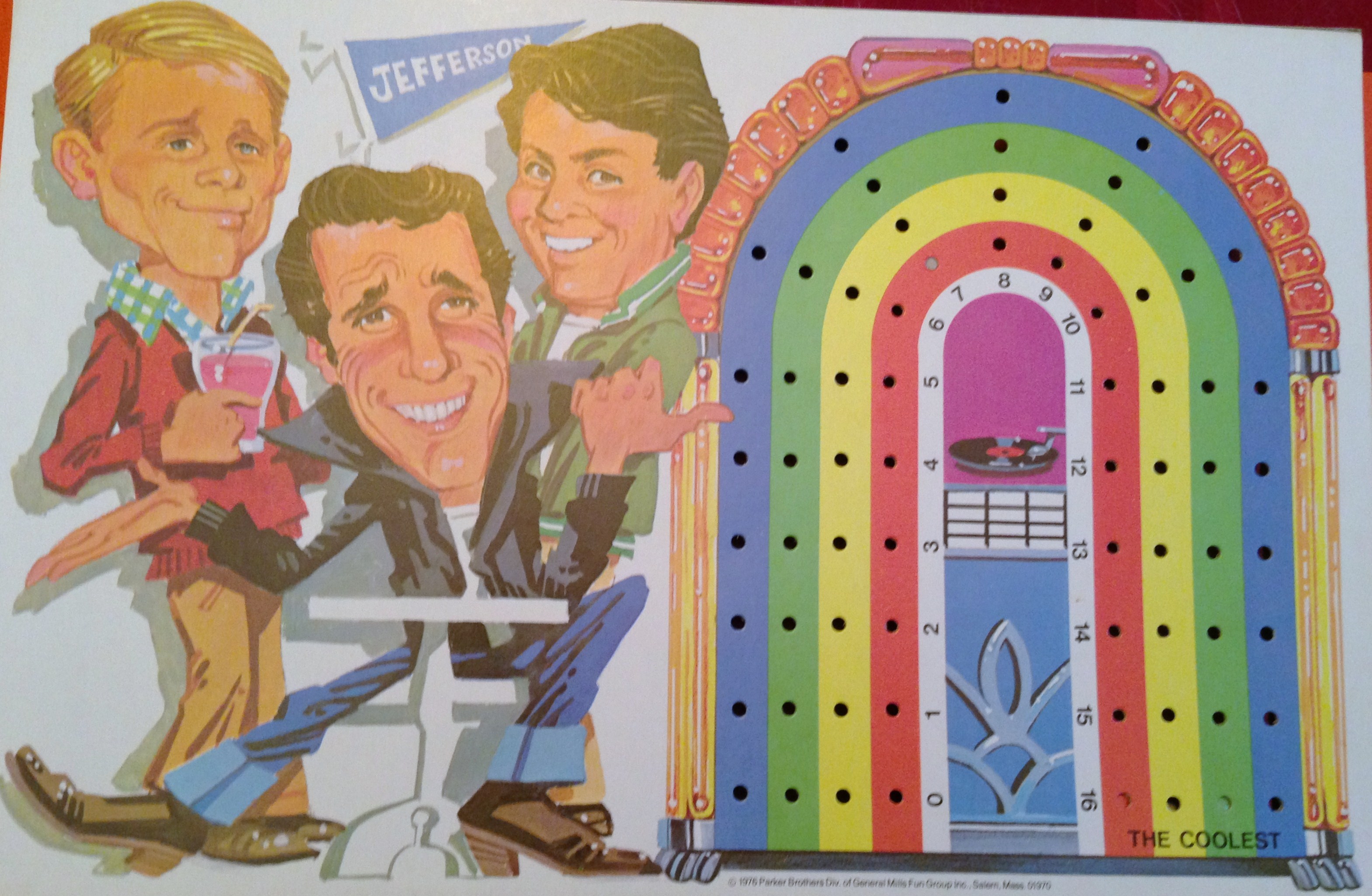
Game Board: Colorful, if not grammatical–“Sumthin’ to do?” I do wonder why Fonzie is sitting on various houses in the corner spaces. The  drag strip that cuts diagonally across the board is an original touch.
Bonus Feature: The game also includes a peg board with a rainbow-hued jukebox for tracking players’ cool points. Fonzie, Richie, and Potsie show up again here. Donny Most must have pissed off a Parker brother.
Recommended Ages: 7 to 13.
Game Play, As the Box Describes It:”See, it’s like spending time with the Fonz–you go on dates, challenge other players to drag races, or maybe just cruise down to Arnold’s. But beware, you can lose cool points as easily as you gain them. Hey, Nerd, don’t get caught hangin’ out at home. That would be uncool.”
My Thoughts: As innocent as this game is, I can’t imagine today’s parents going for it. I mean, drag racing is pretty dangerous. There are things called “score points” that you can only receive in combination with a date card–hmm. And talk about bullying–the game itself calls kids names!

Carole Lombard, October 6, 1908-January 16, 1942

Carole Lombard was born on this date in 1908. I’ve always felt that, though she certainly had Golden-Age-Hollywood glamor, she also had a strangely modern quality–I can envision her as a 21st century movie star. Dell published this special magazine in 1942 after her death.
Family Affair Friday: Episode 5, Season 1, “Marmalade”

This is part of my weekly series about the classic CBS sitcom Family Affair.
Season 1, Episode 5, “Marmalade,” 10/10/66
Written by: Henry Garson and Edmund Beloin. Directed by: William D. Russell.
Synopsis
Uncle Bill’s latest love interest, Ellen Latimer, is an advertising firm employee who thinks French would be perfect in a “small” ad for Dunholt Marmalade.
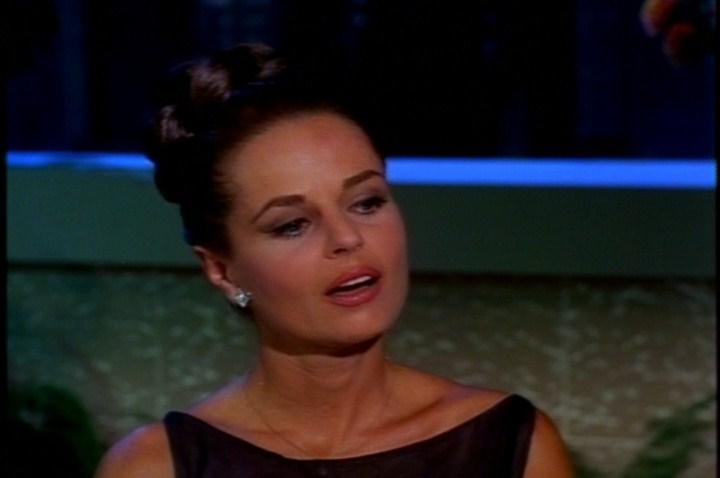
The lovely Miss Latimer
French reluctantly agrees and endures the photo shoot.
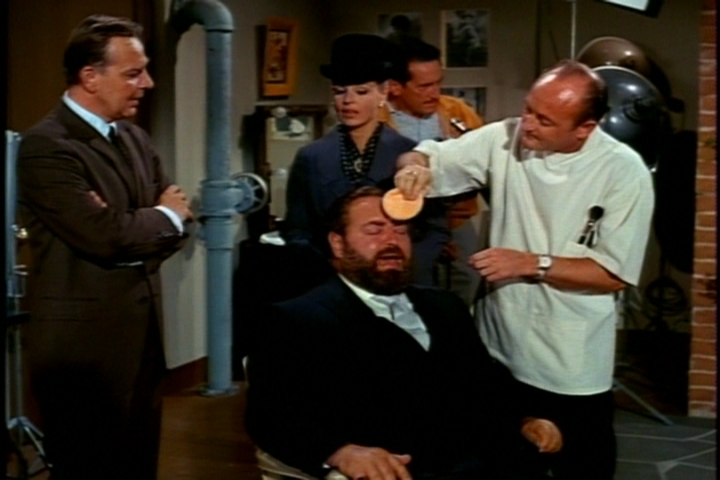
“Must I go through with this pitty-patting on my brow?”
When the resulting full-page ad attracts contempt from fellow gentleman’s gentleman Withers but adulation from the ladies, French begins to like and even court the attention.

French and his fan club
He readily agrees to a five-week national promotional tour–until he actually tastes the marmalade.
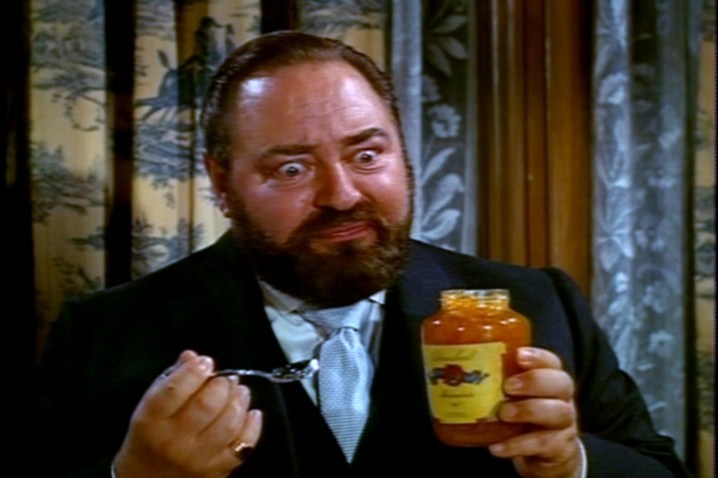
The taste
Random Thoughts
Sebastian Cabot is very funny as he runs the gamut from disdainful to enthusiastic and back in the world of advertising.
This script seems to have more funny lines than most.

The kids react to the ad:
Buffy: “He’s pretty.”
Jody: “Maybe he’s smiling ‘cause we weren’t there.”
Notable Quotes
“We are not a male model, sir.”—French
“Never let it be said that Bill Davis didn’t do his best to promote a pretty girl.”—Uncle Bill
“It might have been easier with Laurence Olivier”—Uncle Bill
Guest Cast
Ellen Latimer: Mary Murphy. Mr. Hayden: Woodrow Parfrey. Withers: Richard Peel. Miss Reynolds: Nora Marlowe. Miss Peters: Peggy Rea. Miss Howard: Pauline Drake. Woman: Kathryn Minner. Photographer: Lou Krugman. Mary Murphy’s other TV credits from the ’60s include Perry Mason, Outer Limits, Honey West and The Fugitive. She had a memorable movie appearance with Marlon Brando in The Wild One.

Random fashion note–I like hats.
Woodrow Parfrey appeared in many TV shows and movies. Of note are roles in Planet of the Apes and Back to the Planet of the Apes. He also played Ike Godsey in The Homecoming, the original Waltons special that preceded the series.

Woodrow Parfrey plays Miss Latimer’s boss. Hmm, his office sports the same green paint that pervades the Davis apartment and Bill’s office.
Nora Marlowe also had a Waltons connection—she played the recurring role of Mrs. Flossie Brimmer. And Peggy Rea played Rose on The Waltons. Her other TV credits included the role of Lulu Hogg on The Dukes of Hazzard and regular roles in Step by Step and Grace Under Fire. Both Murphy and Rea died last year.
Fun Facts
WXOY is having a Velvet Vultures festival. Mr. French reads Punch.
Continuity Notes
This is the first appearance of the snooty Withers.

A Withers-ing glance
Bonus Feature

Coloring book, Whitman, 1968
Old-Time Radio Playlist: Edgar Allan Poe

Edgar Allan Poe
October seems like a good time to enter the eerie world of Edgar Allan Poe. Not only is Halloween approaching, but so is the anniversary of Poe’s death. He died on October 7, 1849, at age 40, from unknown causes.
Radio programs presented Poe’s stories often, and it’s easy to see why. They make exciting listening experiences, painting vivid images in listeners’ imagination.
For this playlist, I have tried to gather the widest number of Poe stories from the widest number of radio programs.
Dim the lights, sit back, and lose yourself in the strange world of Edgar Allan Poe.
“And puzzle they did, these French police, and with them the rest of the world.”
“Rue Morgue Mysteries”
Unsolved Mysteries
1949
About this Series: A syndicated 15-minute show, Unsolved Mysteries aired ostensibly true stories and posited solutions to historical mysteries.
Thoughts on this Episode: Unsolved Mysteries treats Poe’s “The Murders in the Rue Morgue” as a fictionalized account of a true crime, and the show comes up with a different solution to that crime. Poe’s story, history’s first detective story, didn’t have any basis in fact, however. (He did base a later story, “The Mystery of Marie Roget” on a real New York murder.)
Read “The Murders in the Rue Morgue”
“Even after two days at sea, death did not destroy that waxen beauty.”
“The Oblong Box”
The Weird Circle
February 18, 1945
About this Series: Many radio series explored horror and suspense. One thing that differentiated The Weird Circle was its source material; it frequently presented “literary” horror stories, including several of Poe’s tales.
Thoughts on this Episode: This show adds a murderous twist to make Poe’s story even more twisted. It’s an enjoyable adaptation, although the acting gets overwrought at times.
Read “The Oblong Box”
“I determined then to even the score, to revenge the desecration of my name, of my family honor.”
“The Cask of Amontillado”
Hall of Fantasy
January 19, 1953
About this Series: This was another radio show dedicated to tales of suspense and the supernatural.
Thoughts on this Episode: We have no big name stars here, but this is a satisfying dramatization of Poe’s tale of revenge.
Read “The Cask of Amontillado”
“And so it happened, that at the end of a dull, dark, and soundless day in the middle of October, I found myself as the shades of evening drew on, within view of the grim and melancholy House of Usher”
“The Fall of the House of Usher”
Escape
October 22, 1947
About this Series: Escape was “radio’s greatest series of high adventure,” according to John Dunning’s On the Air. It ran from 1947 to 1954, a sister series to the longer-running Suspense.
Thoughts on this Episode: Paul Frees, who plays the narrator, was one of the most prolific voice actors of the 20th century. People unfamiliar with his radio career may know him as Boris Badenov, Burgermeister Meisterburger, or the host ghost in Disney’s Haunted Mansion attraction. His powerful, deep voice brings the dread and decay in Poe’s story vividly to life.
Read “The Fall of the House of Usher”
“You scream with the terror of it! You scream, and scream, and scream!”
“The Premature Burial”
CBS Radio Mystery Theater
January 6, 1975
About this Series: Although not exactly “old-time radio,” CBS Radio Mystery Theater represented the last major gasp of radio drama. The show ran on weeknights from 1974 to 1982. E.G. Marshall hosted, and radio veteran Himan Brown produced the program.
Thoughts on this Episode: Poe’s story barely qualifies as a story at all—it is mostly a rumination on the horror of being buried alive. And Poe sure can ruminate:
It may be asserted, without hesitation, that no event is so terribly well adapted to inspire the supremeness of bodily and of mental distress, as is burial before death. The unendurable oppression of the lungs- the stifling fumes from the damp earth–the clinging to the death garments–the rigid embrace of the narrow house–the blackness of the absolute Night–the silence like a sea that overwhelms–the unseen but palpable presence of the Conqueror Worm–these things, with the thoughts of the air and grass above, with memory of dear friends who would fly to save us if but informed of our fate, and with consciousness that of this fate they can never be informed–that our hopeless portion is that of the really dead–these considerations, I say, carry into the heart, which still palpitates, a degree of appalling and intolerable horror from which the most daring imagination must recoil.
This episode creates a 45-minute story from an incident that is only briefly described in Poe’s story. It does so pretty well, although I found the third act a bit weak. Keir Dullea, best known for his role in 2001: A Space Odyssey, stars in this episode (and many others in the series).
Other Old-Time Radio Playlists
 Embarrassing Treasures