Old-Time Radio Playlist: Christmas, Part 3

draft_lens18469959module153045563photo_1315359699JollyI’ve been sick the past two days, which has put me behind on my blogging schedule. This is the third part of my Christmas OTR playlist.

This week, Family Affair Friday will appear on Saturday.

Read part one and part two of my Christmas playlist.

“First Song—Let it Snow”

Dinah Shore Chevrolet Show, December 22, 1954

“First Song—Sleigh Ride”

Dinah Shore Chevrolet Show, December 24, 1954

“Even though the snow may be artificial out here in Hollywood, the sentiment isn’t at all.”

About the Dinah Shore Chevrolet Show: Popular singer Dinah Shore was a fixture on radio throughout the 1940s; according to the Digital Deli Too, she headlined six different shows. The television era brought her even greater fame. The Dinah Shore Show, sponsored by Chevrolet, premiered in 1951 as a 15-minute, twice-a-week program and became an instant hit. From 1953 to 1955, the Dinah Shore Chevrolet Show also aired on radio.
Musical Notes: Songs on the first show include “Let it Snow,” a Rodgers and Hammerstein song called “Happy Christmas, Little Friend,” and the pop standard “Teach Me Tonight.” The second show is all Christmas—besides “Sleigh Ride,” it includes “Silver Bells” and a medley of religious Christmas carols. (I wonder if Shore, who was Jewish, felt strange singing those.
My Verdict: I like the 15-minute length of these—it allows for several songs but limits the cheesy variety show comedy banter.

“’Twas the Night Before Christmas”

The Great Gildersleeve, December 24, 1944

“The only excuse for the kind of suffering that’s going on, all over the world, is if we can make sure it never happens again…Let’s sing the way we used to when we were at home together, and let’s hope that before so very long, all the peoples of the world will be able to join in with us.”
About The Great Gildersleeve: This show, built around a character first heard on Fibber McGee and Molly, was the first successful spinoff. It ran from 1941 to 1957.
Story: December 23rd finds Gildy blue. He’s expecting to be the subject of a breach of promise suit, and he thinks his frenemy Judge Hooker will be handling the case against him. When the judge tells him there’s no case, Gildy is finally ready to celebrate Christmas with family, friends, and his two favorite flames.
Musical Notes: The cast sings “Joy to the World,” then Harold Peary breaks, um, whatever you would call the fourth wall in radio, and invites the studio and radio audience to join in.
My Verdict: Maybe my sinus infection is making me sappy, but I got teary listening to the closing speech and song.

“Christmas Shopping for Perfume and a Necktie,” December 17, 1939

The Jack Benny Program

“You walked in, Sugarfoot. Nobody dragged you.”

Story: usual in the Jell-o era, things ramble a bit before Jack and Mary head out to do Jack’s Christmas shopping.
Celebrity Name Droppings: Gary Cooper, Barbara Stanwyck and Robert Taylor, Clark Gable and Carole Lombard.
Jell-o Hell No Suggestion of the Week: Lemon Jell-o with stewed figs and whipped cream.
My Verdict: I think most fans prefer the more polished Lucky Strike shows, but I love the freewheeling Jell-o era. The shopping trip has some fun supporting characters, and jokes about Mary’s history with the May Company are always welcome.

“Christmas for Carole”

Suspense, December 21, 1950

“You asked for this, kid. Now do as you’re told.”

Story: A bank teller’s pregnant wife is having complications and needs full-time nursing care. Unable to afford it, the teller decides to take a one- time trip into the criminal world.
Notable Performers: Singer Dennis Day, best known as a member of the Jack Benny cast, gives a good dramatic performance. Suspense often enabled actors to stretch their range in this way.
Musical Notes: You don’t think you’ll get through this without Day singing do you? He performs “The First Noel.”
My Verdict: The story keeps you guessing, and although everything works out a little too neatly in the end, you can forgive such things at Christmas.

Old-Time Radio Playlist: Christmas, Part 2

kittenThis is the second part of my Christmas OTR playlist. I’ll be posting more episodes each Tuesday and Thursday through Christmas.

Read part one of my Christmas playlist.

Mailing Christmas Packages”
Fibber McGee and Molly
, December 10, 1940


“Our papas all believe in Santa Claus…so why should we tell them any different if it makes them happy?”
Story: The McGees wait in line at the Post Office to mail Christmas packages. That’s as much “story” as a Fibber McGee and Molly episode needs.
About Fibber McGee and Molly: A top-rated program throughout the 1940s, this series was a creative partnership between performers Jim and Marian Jordan and writer Don Quinn. Absurd comedy, clever wordplay, and a down-to-earth feel were its trademarks.
Musical Notes
: The King’s Men’s song is, um, interesting.
Celebrity Name Droppings: Fibber mentions Oliver Hardy, Paul Whiteman, and Don Wilson—can you guess what common quality among them that he was citing?
Fun Fact: McGee tells Gildersleeve that he once worked for the post office. According to John Dunning’s On the Air, Jim Jordan actually did work briefly as a mailman in Peoria, Illinois.
My Verdict: No matter how much Christmas changes, long postal lines endure. The episode’s premise provides amusing ways for the McGees to encounter all the usual secondary characters, including Gildersleeve, Mrs. Uppington, and Teeny.

“Special Christmas Story”
Lum and Abner, December 24, 1942


“I’ll say one thing about the folks: In spite of the rationing and the dim-outs and everything, everybody’s doing all they can to keep up the Christmas spirit.”
About Lum and Abner: Chester Lauck and Norris Goff created and portrayed the title characters in this long-running comic serial. (They played all the other characters, too.) The show’s authentic rural humor stemmed from its creators’ small-town Arkansas background, and Lum and Abner’s rapport reflected the real-life friendship Lauck and Goff established in their youth.
Story: Last-minute shoppers at the Jot ‘Em Down Store are out of luck on Christmas eve, as Lum and Abner become engrossed with an electric train on display.
Referencing Radio: Cedric is quite a Lone Ranger fan.
My Verdict: This is a cute, schmaltz-free holiday episode.

“I’ll Be Seeing You”
Lux Radio Theater, December 24, 1945
“Yes, I think we’ll do just fine…just fine.”


Story: Zack and Mary meet on a train feel an immediate attraction. They spend time together during the Christmas holidays, but each carries a secret burden: Soldier Zack is recovering from shell shock, and Mary is on furlough from prison.
About Lux Radio Theater: Dunning calls Lux Radio Theater “the most important dramatic show in radio.” It is certainly the lushest, with big budgets and big stars to re-create stories from the big screen. It aired from 1934 to 1955.
Notable Performers: Joseph Cotten and Dorothy McGuire
Musical Notes: At Christmas dinner, everyone sings “O Little Town of Bethlehem.”
Referencing Radio: Mary makes a joking reference to Life Can Be Beautiful, a soap that ran from 1938 to 1954.
Interesting History: The announcer urges housewives to keep saving cooking fats; although the war and rationing had ended, soap manufacturers still faced a shortage of necessary oils.
Weird Words of Wisdom: Aunt Sarah has an unusual philosophy—always settle for second-best.
My Verdict: Joseph Cotten is one of my very favorite actors, so it’s no surprise that I find his performance outstanding. I’ve been indifferent to Dorothy McGuire’s movie acting, but she impressed me here, too. With just their voices, they both believably convey their characters’ fears and tentative yearnings. Teenage Barbara annoys, but I guess she’s supposed to.

“Five Days Off for Christmas”
Night Beat, December 21, 1951
“They say there’s a warmth about Christmas that spreads out like a fan and touches everyone—the holiday spirit, it’s called.”


Story: Reporter Randy Stone is thrilled to get a rare Christmas vacation from work, until he realizes that he has nowhere to go and no one to be with. While feeling sorry for himself, he receives a mysterious invitation. When the boy delivering that invitation gets hit by a car and vanishes, a shaken Randy has a mystery to solve.
About Night Beat: In this well written series, Randy Stone looks for human interest stories in Chicago’s darkened streets.
Notable Performers: In the 1940s and 1950s, series star Frank Lovejoy was a familiar voice on radio and a familiar face in films like The Hitchhiker.
My Verdict: Poor Randy. I’d spend Christmas with him, even if his self-pity makes him act stupid here. I mean, with all the people a reporter meets, why does he decide so quickly that he doesn’t know Kathryn Malloy?

“The Magic Christmas Tree”
Our Miss Brooks, December 25, 1949
“Oh, what fun it is to rock with a big, fat drunken cat.”


Story: Alone on Christmas Eve, Connie encounters her Madison High family, first in a fun fantasy sequence and then in reality.
About Our Miss Brooks: This popular comedy, built around Eve Arden’s sardonic comedy style as teacher Connie Brooks, ran for nine years on radio and five years on TV.
Notable Performers: Besides Arden, the series cast included radio and TV fixture Gale Gordon (Mr. Conklin) and future movie stars Jeff Chandler (Mr. Boynton) and Richard Crenna (Walter).
My Verdict: I like Our Miss Brooks, though some episodes are better than others. The high point of this one is the swaggering fantasy-Mr. Boynton and the kiss he shares with Connie—the studio audience reaction is entertaining. As a cat person, I also enjoy Minerva’s role here.

Other old-time radio playlists you might enjoy:

Christmas, Part 1
London Calling, Part 1
London Calling, Part 2

Old-Time Radio Playlist: Christmas, Part 1

Starting today, I’ll be posting holiday old-time radio episodes every Tuesday and Thursday through Christmas day. I have about 600 to pick from, so let me know if you have any requests!

“The Radio-Phonograph”


The Adventures of Ozzie and Harriet, December 19, 1948
“Harriet, dear, there are two times when you’re not supposed to be sensible: Finding a husband and Christmas.”
About The Adventures of Ozzie and Harriet: Ozzie Nelson first found fame as a bandleader. He hired Harriet Hilliard as his girl singer, and the two soon married. They appeared on radio’s The Red Skelton Show for three years before Ozzie developed this family comedy for them. To say it was successful is an understatement—The Adventures of Ozzie and Harriet aired on radio from 1944 to 1954 and on television from 1952 to 1966.
Story:  Having recently made the major purchase of a radio-phonograph, Ozzie and Harriet make the sensible decision to forego buying each other Christmas gifts. If you think they have no trouble sticking to that decision, you’ve clearly never watched or listened to a situation comedy.
Notable Performers: Tommy Bernard and Henry Blair play David and Ricky—the Nelson boys wouldn’t start playing themselves until April 1949. Radio stalwart Lurene Tuttle plays Harriet’s mother. Janet Waldo plays Emmy Lou, an annoying teenage character who reflects the late 1940s fascination with “bobby-soxers.”
Referencing Radio: The announcer mentions Just Plain Bill, a soap opera that ran from 1932 to 1955.
Musical Notes: Ozzie sings a bit of “Darktown Strutters’ Ball,” a jazz standard that dates from 1917. (It’ll always be dear to me for inspiring the punch line of Ted Baxter’s knock-knock joke.)
My Verdict: Television’s Nelsons never did much for me, but the radio show has a warmth and charm that’s won me over. You probably won’t laugh out loud over this episode, but you might enjoy its pleasant holiday feel.

“The Crosby Family,” December 20, 1950


The Bing Crosby Chesterfield Show
“I still can’t understand why parents insist on stifling their kids’ mental development at this time of the year.”
About The Bing Crosby Chesterfield Show: Perhaps the most popular performer of his era, Bing Crosby appeared on radio regularly from the 1930s through the 1950s. Chesterfield cigarettes sponsored a 30-minute Crosby show that aired from 1949 to 1952.
Notable Performers: It’s strictly a family affair, here—Bing appears with wife Dixie Lee and sons Gary, Dennis, Philip, and Lindsay.
Musical Notes: Bing opens the show by singing “Adeste Fideles,” first in Latin and then in English. (During the English version, the studio audience joins in.) Bing and Gary sing a jazzy “Jingle Bells and a song called “That Christmas Feeling.” Lindsay and Bing croon “I’d Like to Hitch a Ride with Santa Claus.” Philip and Dennis sing “The Snowman.” Bing closes the show with “Silent Night.”
My Verdict: Great music, and the family banter is more amusing than I would have expected. This program exudes so much holiday warmth that you can almost forget every negative thing you’ve heard about Bing’s family life. Almost.

“Names on the Land,” December 24, 1945


Cavalcade of America
“We hope you liked America, wrapped up in tinsel bright. To each one, Merry Christmas, and to all, a fond goodnight.”    
About Cavalcade of America
: Sponsored by Dupont, Cavalcade of America aired on radio from 1935 to 1953. It highlighted important stories, from the celebrated to the unsung, in American history.
Story: A versifying train conductor leads listeners on an alphabetical journey across America, and his passengers explain the origins of odd place names, from Animus to Zoar.
Based Upon: The book Names on the Land by George Rippey Stewart, first published in 1945 and, happily, reissued in 2008.
Notable Performers: Frank Morgan, the Wizard of Oz himself, plays the train conductor.
My Verdict: This is like H.L. Mencken meets Dr. Seuss—and I mean that in a good way. Names have always fascinated me, both personal and place names, and I’ve read and re-read the chapters on names in Mencken’s The American Language. This show is right up my alley. The verse, as performed by Morgan, sparkles. Without any flag-waving, the whole thing evokes a good feeling about the American character.  As Matt Weiland wrote about Stewart’s book, it’s a “plea for the triumph of cardinal American virtues: buoyancy and tolerance, curiosity and confidence, love of the land and faith in the future.”

“Christmas Story,” December 23, 1952


Gunsmoke
“I just want to say that this is the best dog-gone Christmas I ever had.”
About Gunsmoke: Radio’s Gunsmoke aired from 1952 to 1961, a forerunner of the popular TV show that ran from 1955 to 1975. The radio version is known for its grittier portrayal of Dodge City and its inhabitants and for the inventiveness of its sound patterns.
Story: It’s Christmas Eve and Matt is returning to Dodge City, though he has little hope of making it home for Christmas: He’s 40 miles from Dodge and has lost his horse to a broken leg. A drifter who offers him a ride wants to hear about Christmas, so Matt describes the previous year’s holiday.
My Verdict: Gunsmoke is one of my top three favorite radio programs, along with Vic and Sade and The Jack Benny Show. The show’s portrayal of the old West is so dark, though, and its typical body count is so high, that I have to experience the show in small doses. That’s why the Christmas episode is such a relief—it shines like a Christmas tree in the middle of a darkened prairie.

“The English Butler,” December 23, 1945


The Jack Benny Program
“It seems impossible that there could be any more suffering than mankind has just endured, but it is possible and it will happen, if we lose sight of the lessons so bitterly learned. Let us remember that men everywhere are our neighbors and their life and freedom is as precious them as ours is to us.”
About The Jack Benny Program: I feel inadequate to explain The Jack Benny Program, and its importance in American radio. I’ve found that the International Jack Benny Fan Club is a good source for information.
Story: Jack’s Beverly Hills neighbors the Colmans are making a reluctant appearance at his house for dinner. To impress them, Jack hires an “English” butler with an impenetrable accent.
Google-Worthy References: Ronald Colman gets a big laugh when he says, “I’ll never forget when Benny invited us to his house three years ago and we didn’t show up. It made him so angry he wrote a letter to Britain asking for his bundle back.” Bundles for Britain, launched in 1940, was an American charitable program that provided knitted goods and used clothing to British citizens enduring Germany’s bombing. (I can’t resist sharing a passage from Life’s May 19, 1942, issue, which profiled Bundles for Britain founder Natalie Wales Latham: “Energetic and precocious, New England-born Mrs. Latham has been married and divorced twice. It was she who popularized the mother-and-daughter fashion fad which Life reported three summers ago. In 1939, on a vacation after her second divorce, she began thinking about Britain’s plight, noticed that no one seemed to know how to help, said to herself, ‘This is the damndest thing,’ and forthwith started Bundles for Britain.”
Notable Performers: Ronald and Benita Colman.
Musical Notes: Jack plays, and Ronald Colman mocks, “It’s Been a Long, Long Time.” Throughout the fall of 1945, competing versions of this Jule Styne and Sammy Cahn postwar hit were duking it out for chart pre-eminence. According to Wikipedia, a recording by Harry James with vocalist Kitty Kallen topped the Billboard charts the week this episode aired.
My Verdict: Jack harassing his Beverly Hills neighbors never fails to amuse me. The classy Colmans make the best foils of all for Jack’s pretensions. Their 20 appearances on the Benny show are delightful. This episode offers many pleasures, from “Manchester” to Ronald Colman’s moving Christmas toast. And on Christmas episodes, I don’t even feel the need to fast forward through the soloist’s performance; Larry Stevens’ Ave Maria is lovely.

Weird Words of Wisdom: A Million and One Tricks With a Strand of Pearls Edition

“If you don’t know what foods are fattening, ask your chubby friends, because they will know.”

This week’s offering in my Weird Words of Wisdom series will help you get your glamour on for upcoming holiday celebrations—or at least help you learn to stand like a model.

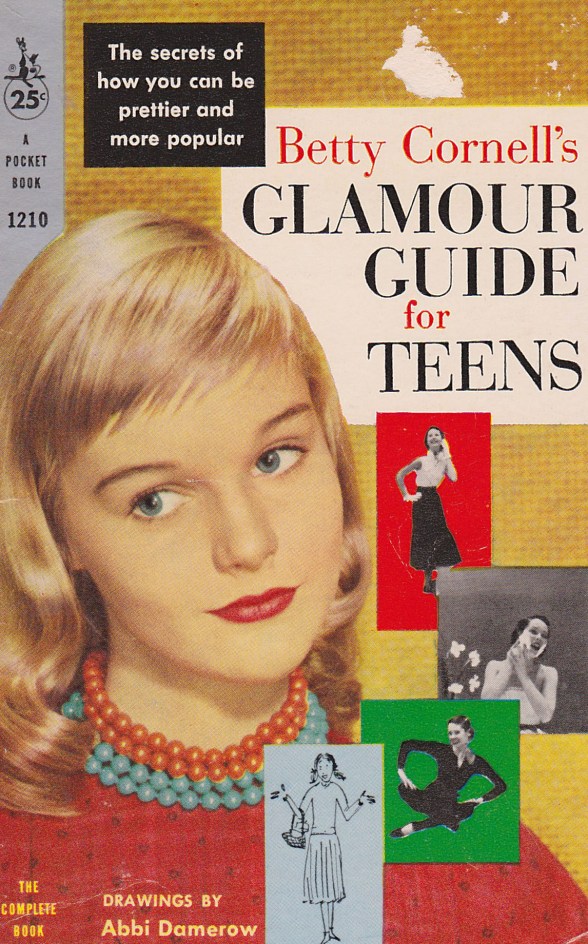
Betty Cornell’s Glamour Guide for Teens, 1951 (1958 printing)

About the Book: This 25-paperback, written by “famous model” Betty Cornell, purports to offer the secrets of beauty and popularity. Actually, it focuses mostly on grooming basics.

About the Author: Betty Cornell is not the pensive blond on the book’s front cover—she is the white-gloved brunette on the inset photos and the back cover. In the 1940s, she was one of the country’s busiest models of juniors’ fashions, but she actually got her start modeling plus-size clothes. She tells her own story in this book’s introduction—the story of how she went from a “tubby teen” to the possessor of “one of the smallest waistlines of any model in New York.”

At age 16, she decided to “really go to work” on her weight problem. By 1947, according to this syndicated newspaper column, she stood 5’ 8.5” tall and weighed only 90 pounds! (The article claims that her waist measured 19.5 inches, and her hips and bust were both 30 inches.)

It’s lucky that 1958 readers didn’t know her 1940s stats, or they might have raised skeptical eyebrows at all her cautions against starvation diets and overly dramatic weight loss.

In 1951, when this book was first published, Cornell had aged out of her career as a junior model. Writing books for teens was the start of a new career. Her other titles would include All About Boys, Betty Cornell’s Teenage Popularity Guide, and (more oddly) Betty Cornell’s Teenage Knitting Book.

In 1952, she married John Joseph “Jack” Huston of Philadelphia and went on to raise three children. Jack died in 2010, at which time Betty was still alive. In 1977, she was one of several former models interviewed for the book Eileen Ford’s Beauty Now and Forever: Secrets of Beauty after 35. Now that’s a book I’ve got to get my hands on!

The Basics of a High School Wardrobe, According to Betty Cornell

Several slips
Half-slips in nylon and cotton (“Cotton to starch for wear under summer skirts”)
Three or four bras
Panties (“Preferably shirred to give good curve control”)
Girdle
Two or three pairs of nylon stockings
White wool socks for sports
Colored socks to match sweaters and skirts
Assorted sweaters, both long- and short-sleeved. (“Pastel colors look pretty in short-sleeved pull-ons.”)
One good basic suit in a neutral color.
Skirts, both pleated and plain, in dark colors and plaids. (“Wool usually wears the best.”)
A raincoat.
A good basic coat, box cut or flare cut.
A dressy coat. (“Here you can take to fitted lines, for you will wear this coat with party dresses and well-cut fitted suits.”)
A party dress.
A formal.
Low-heeled school shoes.
Dress-up shoes. (With Cuban heel—in calf or suede.)
Evening slippers.
Warm gloves for school.
Dress-up gloves. (“A pair of white cottons, kept clean, will fill almost every bill.”)
A hat. (“For church and formal afternoon parties.”)

Sample Menus for Weight Control
Breakfast: Half a grapefruit, 1 poached egg on rye or whole wheat toast with small amount of butter, 1 glass of milk.
Lunch: Small container of cottage cheese, fresh fruit, any kind of lean meat sandwich, consommé, milk
Dinner:  1 glass of tomato juice, generous serving of broiled calf’s liver, serving of cooked carrots, tomato and lettuce salad with lemon juice, fruit Jello, milk.

The liver alone would do much to control my appetite.

Recommended Hairstyles, Based on Face Shape

Round Face: Smooth sides. “The simpler the hair style the better.”
Square Face: Should be short or shoulder-length, never chin-length. “A short bang or flip at the forehead is a flattering touch.”
Long and Narrow Face: Should always be wavy, never straight. “In-between lengths are the best.”
Heart-Shaped Face: “A soft bang at the forehead will help to mask the width.”
Pear-Shaped Face: “She should keep the interest to the top and have her hair at the bottom short enough to curl just slightly over the edges of the jaw.”
Oval Face: “The teen with the oval face may do as she pleases.” (Wow!)

Quotes from Betty Cornell’s Glamour Guide for Teens

“Often it is necessary to squeeze blackheads in order to force out the little plugs of dirt…After squeezing, rub the skin with ice cubes.”

“Beautiful hair is about the most important thing a girl has.”

“When it comes to shampooing your own hair, plan to save at least one night a week for the job. Most teens prefer Thursday night because it puts their hair in shape for the weekend.”

“As for making up your eyes, don’t. Young eyes need no enhancement.”

“To walk gracefully one must move the leg in one piece.”

“The next time you get up to dance, pull in those tummy muscles, tuck in your fanny, pull up your rib cage, and then dance. If you keep your arm lightly on your partner’s shoulder and your head high, you’ll look as light as a thistledown, be you five feet one or five feet eleven.”

“If you’ve ever watched a model in repose, you’ll notice that she stands with one foot at a right angle to the other, rather like a ballet dancer.”

“You should shave your legs at least once a week, and your underarms less often…”

Why every girl should wear a girdle: “Even a teen with a trim figure needs to coax her curves a bit when it comes to wearing slim skirts and slacks. To me there is nothing more repellent than a protruding fanny or a bulging tummy marring the outline of a narrow silhouette.”

“Get to be known for your sense of color or your sense of accessory. Be the girl who knows her way with a scarf or can do a million and one tricks with a strand of pearls.”

Weird Words of Wisdom: Speak Softly and Carry a Hot Breakfast Edition

“It is not enough, if you want to be liked, if you want to be loved, to be merely good. You also have to fight for the good things you want. You have to compete with other girls. What’s more you have to make up your mind to win. Otherwise you’ll not have your pick of the best boys. You’ll only have what’s left over.”

Once Upon a Dream: A Personal Chat with All Teenagers, 1960
By Patti Page

About the Book: Patti Page opens up about her own weaknesses and insecurities as she tells young fans her Cinderella story–a story that transformed Clara Ann Fowler, “that shy, overfed, part Cherokee choir singer from Claremore, Oklahoma,” into a “Singing Rage.” (Although a Cinderella motif pervades the book, the title references a song from Walt Disney’s 1959 film Sleeping Beauty.)

As we’ve seen before in this series, celebrity-written advice books for teens proliferated in the 1950s and early 1960s. While I always wonder how much the celebrities actually “wrote,” I found this book’s voice consistent and believable.

About Patti Page: All I knew about Patti Page going into this book was that she sang “How Much is That Doggie in the Window?” and “The Tennessee Waltz.” The latter was one of the best-selling songs of all time, and Page was the top-selling female artist in the 1950s.

Her rags-to-riches story had a genuinely ragged start—she was the 10th of 11 children, and money was so scarce that she sometimes went to school barefoot. In this book, she tells a moving story about the time she wanted a Mickey Mouse watch so badly that she made one out of paper.

She made up her mind to escape poverty and began to plan for a career as a commercial artist. She took a job making posters at a Tulsa radio station, soon found herself performing on the air whenever they needed a girl singer, and was “discovered” when band manager Jack Rael passed through town and heard her voice on the radio.

To her teenage readers, Page presents herself as shy and insecure, with ongoing weight issues. She talks about a period in her life when she burst into tears after every performance, and she uses the language of psychoanalysis freely.

She writes a lot about her husband, choreographer Charles O’Curran, whom she married in 1956. She doesn’t mention that she had an earlier, short-lived marriage, or that she was O’Curran’s third wife (Betty Hutton was his second). Page and O’Curran would divorce in 1972.

I’ve chosen some of Page’s sillier-sounding statements to feature here, but this book actually gives plenty of good advice. She encourages girls to be themselves, to care about others, and to develop their minds. Though she has a typically 1950s obsession with “femininity,” she advises girls against playing dumb and against letting boys get in the way of their dreams. She even manages to talk about religion without sounding preachy.

Today, at 85, Page is still performing.

Quotes from Once Upon a Dream: Inner and Outer Beauty

“Charm is simply the art of being pleasing…charm is the magic wand that can transform an ugly duckling into a princess, or a shy quiet type into the belle of the ball.”

“The girl who thinks she can get by with an overweight figure by calling attention to her face is only fooling herself. Eventually people notice her figure too. In the same way, the gayest of hats will not make up for a shabby pair of shoes. A tight-fitting sweater is a poor substitute for a bad complexion. No matter how elaborately you do your hair, which may be your good feature, how long do you really think it will keep people from noticing your teeth, which may not be so good?”

Examples that prove personality is more important than beauty: Helen Hayes, Lynn Fontanne, Katharine Cornell, Mary Martin, Ethel Merman. (“True, they’re older now than when they first rose to fame on Broadway, but even in their youth they were never what we might call great beauties.”)

“Once a week…is usually enough to keep the average girl’s hair clean. Thursday or Friday night’s the best time to do it—so you’re all set to look your best for the week-end.” Ew. If I followed this schedule, even as a middle-aged woman, my scalp could help America achieve energy independence.

“If you’re young and healthy, your eyes have enough sparkle and fire without needing any ‘extra added attractions.’ Besides, if you’re an adolescent, you’re mysterious enough. Mascara and eye shadow would make you positively inscrutable.”

“It’s impossible to apply rouge so that it looks natural on tender young cheeks…If you feel you’ve absolutely no color at all, I’d rather you pinched your cheeks—as grandmother used to. After all, she got her man.”

“A lipstick should not only blend with your own coloring but with the color of your dress.”

“The more inconspicuous your clothes, the better. “You don’t want them to distract attention from you. (It is only older women who tend to wear startling colors and daring designs to make up for tired faces and bad figures.)” She’s starting to hurt my feelings now.

Getting Along with Boys

“If you can’t be empathetic, at least be observant, especially when it comes to boys. It’s not so hard to figure out what gives them pleasure and what makes their hair stand on end.”

“Very often, for women especially, conversational ability is only a talent for listening rather than for talking. Of all the women I know, the one I have most often heard described as a brilliant conversationalist scarcely says a world. But when she sits listening to a man, she looks at him as intently as though he were first man she had ever met, and as though speech were something he had just invented.”

“Passion is violence. It is loss of reason. It is a loss of control so complete that it’s too late to say yes, no, or maybe…So the only way to handle an invitation to passion is to say No! And make the reason for your no a moral one.”

“…at one time, a woman’s greatest pride before marriage was in her chastity. It was proof she was good and pure in heart. It meant she had something precious and rather wonderful to give to the one man of her choice. But to take away this pride in virtue and to joke, as some people do, about virginity is to cheapen something rather wonderful. To indulge in sex as a biological act, rather than an expression of love, is to strip a woman’s life of dignity, meaning, and fulfillment.”

“For all their teasing and loose talk, boys—and men, too—are really looking for a girl with the courage to have standards and the wisdom to say no. It’s true, if you say no, there’s a chance you’ll never see the young man again. But there’s an even greater chance he’ll ask you to marry him.”

“There are, so far as I know, only two types of males who don’t resent an aggressive female, and I don’t think you want either of them. One is the vain ladies’ man who waits for girls to call him. He appreciates each call. It’s a tribute, he feels, to his irresistible charms. But this type of man is incapable of love. He can love only himself. The second is the weakling type, with a domineering mother, who likes girls who take charge because they remind him of his mother.”

About the kind of girl who’s a pal to boys: “This type of girl, like most people on earth, eventually does get married. It isn’t necessarily a romantic marriage. In fact, it’s usually a sensible one. But it works because both husband and wife are comfortable.”

“If you will just remember that woman’s traditional role is to help a man make something of himself, you will realize that there is always the chance that you can help the drip of today become the man of the moment tomorrow.”

“When you’re shopping for a dress, do you like to have three to choose from or thirty? Well, it seems to me that choosing a husband is a much more vital decision. And how can a girl be sure she’s making the right choice if she only knows the three or four boys she’s gone steady with?”

“And necking, contrary to popular belief, is not a way to hold a boy—it’s a sure way to lose him. No boy values anything that is too easily won. What’s more, nothing remains static. Necking either develops into something more, after a while, or it dies. Either way, you stand a good chance of the boy’s losing interest in you.”

Marriage and Femininity

“My advice to you is to have a career—not instead of marriage but before it. A career is not only, in my opinion, your best preparation for marriage, but the most enjoyable way to pass the time until you’re over 21 and ready for marriage.”

“…your generation seems to know—at a much younger age than I ever did—that for a truly feminine woman, the only true answer to life is a marriage based on true love.”

On keeping her weight down: “…it’s no longer a matter of professional pride alone. Loving my husband, I have also learned what it means to be a woman. So it’s now a matter of personal pride—the pride of a woman who is loved—that I be as pleasing as I can to my husband. (And my husband just doesn’t happen to like overweight women.)”

“…many men in enumerating the qualities they expect of the ideal woman or the model wife say, ‘Above all she must have a soft voice.’”

An interesting quote, considering that she and her husband had both been married before: “Divorce takes a terrible emotional toll. Something that is sweet and lovely and trusting seems to vanish forever from your life. Sure, you can make a second, more sensible marriage, but it won’t be the romance the first one was when you had the thrill of sharing that first apartment, that first ice cube, maybe even that first baby.” First ice cube?

“…the only way to get a man to come home every night and want to stay there is simply to make your home the place where he enjoys himself the most.”

“I think you’ll find, when your married, that it isn’t nearly so important for you to be interesting as it is to make your husband feel that he’s interesting.”

“The main purpose of marriage, which some people forget, is not just to find someone to share a life with, it’s to raise children. This is why you were born, and why you used to play with dolls.”

“I read somewhere that 60 percent of American husbands get their own breakfasts while their wives stay in bed. To me, this is a sign of trouble…How can (a wife) expect her husband’s continued love if she won’t even get up when he does and see him off to work?”

If you enjoyed this post, take a look at the whole Weird Words of Wisdom series.

And, if you want to see Page in action, here is a 1956 episode of The Patti Page Show.

Old-Time Radio Playlist: Halloween, Part 1

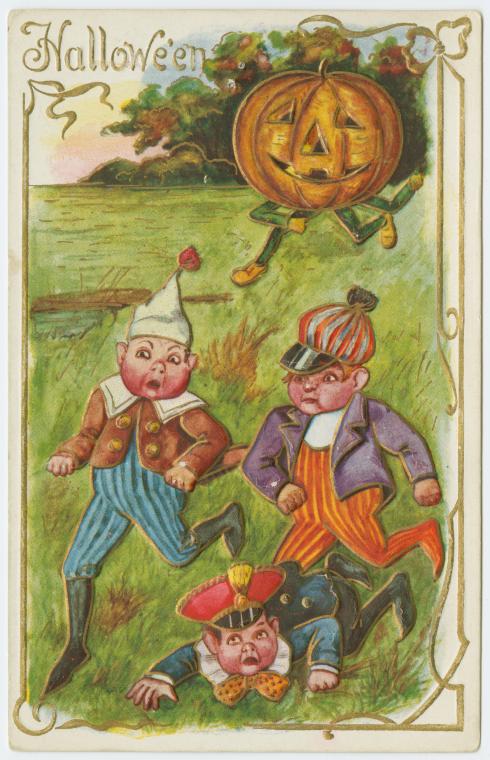
Vintage Halloween Postcard from The Public Domain Review

Today, I present a selection of Halloween treats–some lighthearted old-time radio episodes that capture an interesting period in the history of Halloween.

(On Tuesday, October 30, I’ll post some Halloween”tricks”–spooky holiday offerings and classic horror stories.)

European immigrants to the United States popularized Halloween celebrations in the late 19th century.

By the turn of the century, there was a move to downplay the scarier aspects of the holiday. According to History.com, “Halloween parties for both children and adults became the most common way to celebrate the day. Parties focused on games, foods of the season and festive costumes.”

By the 1920s and 1930s, pranks were a big part of the holiday, “often devolving into vandalism, physical assaults and sporadic acts of violence.”

Most of these radio shows date from the 1940s, when trick-or-treating was just beginning to transition into a community-sanctioned, kid-friendly activity. I’m guessing that’s why so many of the adults in these shows seem ambivalent about Halloween–looking back fondly on their own parties and pranks, but wary of letting their children participate in trick-or-treating.

Unknown Date
Air Castle, Halloween

Air Castle was a children’s show that ran in the late 1920s and early 1930s. It was entirely the work of Baron Keyes, who starred as the “Story Man” and provided voices and sound effects to represent various fanciful characters. This Halloween episode is cute!

October 19, 1933
Martha Meade Society Program, Halloween Parties

This cooking show provides a nice slice of 1930s life. From this and other radio shows, I’ve gleaned that doughnuts were a popular Halloween tradition in the early 20th century.

October 24, 1939
Fibber McGee and Molly, Halloween Party at Gildersleeve’s House

This would be a good starter episode for a new Fibber listener. It’s filled with typical wordplay and punning humor, and most of the classic supporting characters appear.

October 31, 1940
The Aldrich Family, Halloween Prank Backfires

Just about every episode of this family comedy involves a misunderstanding that snowballs out of control. These Halloween hi-jinx are typical.

November 2, 1941
Jack Benny, Halloween with Basil Rathbone

I’m in love with the Jack Benny Program. To really appreciate the series, you need to listen to a long run of consecutive episodes. Characterizations and jokes build from week to week. This is my favorite of several Halloween episodes–Jack annoying his Beverly Hills neighbors is always a win.

October 29, 1944
Edgar Bergen and Charlie McCarthy, Halloween

Guest star Orson Welles is quite amusing, especially when he ad-libs.

October 29, 1944
The Life of Riley, Haunted House   

Near the end, this takes a surprisingly sharp turn into patriotic messaging. You’ll have that sometimes in World-War-II-era programs.

October 31, 1944
Lum and Abner, Discuss Halloween Pranks

Lum and Abner has been growing on me lately, and this episode is a cute one.

November 1, 1946
Baby Snooks, Halloween

Fanny Brice’s mischievous Baby Snooks is a natural for Halloween pranks. This episode has a strong start, but a weak finish, in my opinion.

October 29, 1947
Philco Radio Time, Boris Karloff and Victor Moore

Boris Karloff was the go-to guest for variety-show Halloween episodes. Here, he’s the guest of Bing Crosby, and he and Bing actually sing together (along with comedian Victor Moore)!

October 31, 1948
Adventures of Ozzie and Harriet, The Haunted House       

I always found the TV version of Ozzie and Harriet bland, but the radio episodes I’ve listened to have been surprisingly chuckle-worthy.

October 31, 1948
Adventures of Sam Spade, The Fairly-Bright Caper    

I’m not a huge Sam Spade fan–ditzy Effie gets on my nerves–but this has a nice Halloween flavor.

Oct 31, 1948
Jack Benny, Trick or Treating with the Beavers

This is another good Halloween episode, with an inventive way of bringing the supporting cast into the story.

October 31, 1951
The Great Gildersleeve, Halloween and Gildy Finds a Lost Boy

I’m not the biggest Gildy fan, but this episode has great warmth.

November 7, 1951
The Halls of Ivy, Halloween

I really enjoy this series, which stars Ronald and Benita Colman. Having spent plenty of time in academia, I appreciate the college setting, and the Colmans are just charming.

Oct 29, 1953
Father Knows Best, Halloween Blues

Robert Young’s character is in preachy mode, and the end doesn’t work for me, but this is an interesting look at those changing Halloween customs.

Listen to more old-time radio!

Weird Words of Wisdom: Betty Betz and Vintage Teen Etiquette That Rhymes Edition

This is the latest installment in my Weird Words of Wisdom series.

“As mother used to say, ‘Be pretty if you can, witty if you must—and pleasant if it kills you!’”

Your Manners are Showing: The Handbook of Teen-Age Know-How, 1946
By Betty Betz

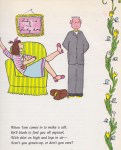
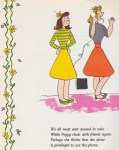
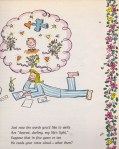
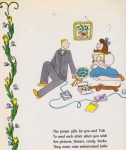
About This Book: Your Manners are Showing differs from most vintage teenage advice books in one key way—it shows teens how to behave with copious illustrations by Betty Betz. Verses by Anne Clark accompany the pictures; in between the illustrations, Betz provides short chapters on topics ranging from money to “vice” (drinking and smoking). Etiquette in verse actually strikes me as a pretty handy aid for mastering tricky concepts, like who gets introduced to whom.

About the Author: Where do I begin? Betty Betz journeyed from Hammond, Indiana, prom queen to 1940s and ’50s queen of all media. She was a Midwestern swimming champion, and her high school classmates named her Most Popular Girl in their school of 1,800. She attended Sarah Lawrence College and earned a guest editorship at Mademoiselle, which became the first magazine to publish her drawings. She went on to work for Esquire and Harper’s Bazaar. Eventually, she began to specialize in teenagers, writing a syndicated advice column for them and publishing several books. Her illustrations of teenage life turned up on everything from stationery to scrapbooks to jewelry boxes.

She was married briefly to Josef Lanz, the Austrian fashion designer who popularized the dirndl dress, a 1940s teen wardrobe staple. His family owned Lanz of Salzburg, which still exists, producing mostly nightgowns.

In 1956, she married her second husband, Frank McMahon, whom Time described as an “oil-rich Calgary wheeler-dealer.” She raised two daughters and settled down into a life of charity work and Palm Beach socializing. Betz died in 2010.

Among the other highlights of her brief career:

  • She published comic book stories featuring “Dollface and Her Gang.” (Dollface’s best friend was named Bun Brain. Really.)
  • She marketed a line of teenage clothing that included a hideous but creative item called a blouse-slip. As a slip, you could lounge around in it at home. If company stopped by, you could wrap a skirt around yourself and be good to go.
  • She hosted a TV talk show that Billboard called “a routine and lifeless concoction, devoid of warmth or sincerity.”
  • She founded the Betty Betz Angels Club for her fans, who pledged “to show respect and consideration to everyone, regardless of race or color.”
  • She served as a Hearst correspondent during the Korean War, providing readers with insights like this one from July 29, 1951: “…what baffles me most of all is the fact that communist ‘wacs’ don’t care for perfume or lipstick.”
  • She published Manners for Moppets, an etiquette book for children, in 1962. At the time, her family shuttled among homes in Vancouver, New York City, and Palm Beach. “An English nanny and a private plane make commuting painless,” The Calgary Herald wrote. “Having complete wardrobes in each house so she doesn’t have to pack and unpack all the time and hiring temporary help for each house as she gets there are other time and trouble savers.” I’ll bet.

Weird Words of Wisdom from Betty Betz

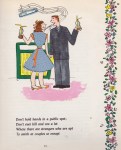
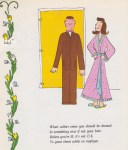
For the most part, I’ll let Betz’ illustrations (and Clark’s verse) speak for themselves. I can’t resist including a few quotes, though.

On tipping: “At least ten percent of the total bill is a sufficient tip, but never leave less than ten cents per person.”

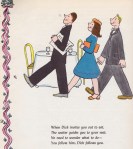
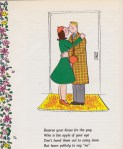
On saying goodnight: “There’s no excuse for a couple to stay out past midnight except for special parties, so make those good-nights short and sweet. Dawdling on the doorstep doesn’t get you anything but a razzing from the neighbors, and a black mark from the girl’s folks.”

On fashion for boys: “You’re no Percypants if you are particularly particular about which tie you wear with what suit, so give your clothes combos a little more thought…The best clothes for men are the traditional ones which never go out of style, so if (a salesman) tries to sell you Seabiscuit’s blanket for a sports jacket, tell him to give it back to the Indians.”

On shoes for boys: “If they’re scuffed with run down heels they label you right in the jerk department, so keep your booties laced and polished. When you buy shoes, get the strong and sturdy type which look more manly and last longer than the ‘cute and fancy’ styles. If it’s a dressup party, don’t wear your saddle shoes or moccasins, and never wear rubber soles for dancing.”

On fashion for girls: “If you think you can wear that dress three years from now and still adore it, it’s a good buy. But if it’s a poorly made ‘gag-rag,’ then don’t waste your money.”

On shoes for girls: “Exaggerated heelless or toeless siren sandals are downright unattractive on young legs, so avoid them.”

On girls’ accessories: “A neat purse, immaculate gloves, fresh handkerchiefs and simple, becoming hats are the classic equipment of fastidious and fascinating femmes.”

On where girls should turn for dating advice: “Say, your mother should know a little bit about it, since she managed to snare herself a pretty nice husband, and probably over some pretty high competition, too.”

Acceptable gifts for boys to give girls: Books, records, candy, flowers, a compact, or “your best photograph (unautographed, please).”

Acceptable gifts for girls to give boys: wallets, key chains, books, records, hand-knit socks, or “your prettiest picture.”

Traffic advice that cracks me up: When crossing streets, boys should walk on the side closest to traffic, “so that if there’s any mishap, he gets hit first.”

Wow! A Password?!: “There’s a password, ‘cabbage,’ which is used every time a boy doesn’t take the curb side of the sidewalk when he’s walking with one or more girls. Actually, there’s no need for a password, because every young man should automatically take the outside place without even thinking twice.”

On smoking: “If you like the taste of tobacco and your parents approve, there’s nothing harmful about smoking in moderation.

On drinking: “Light wines and beer are your best bet if you must drink something alcoholic. My favorite is a ‘Sherry Cobbler,” which sounds like a grownup drink, but actually is a plain lemonade with a little wine added.”

Recommended non-alcoholic drink if you want to appear to be drinking alcohol: A “Horse’s Neck”—ginger ale, with a slice of lemon peel.

On conversation: “My Mommy done told me that as long as I wasn’t really a brain-box, I should develop my ear for listening.”

And a final thought: “The trouble with etiquette books is that they’re like dentists…you never pay any attention to them until you’re in agony, and then often it’s too late.”

Read more Weird Words of Wisdom.