Mr. Blandings: A Lighthearted Movie for a Somber Day

Mr. Blandings Builds His Dream House is a cute movie.

The opening narration, describing New Yorkers’ “carefree, orderly existence,” over traffic-jam footage, is cute.

The montage of Blandings family members arriving at their new home, with narrator Melvyn Douglas mimicking their responses, is cute.

The self-referential ending is downright adorable.

Some people use the word “cute” dismissively. Once, when I tried to wangle my seven-year-old daughter into a Gymboree outfit, she cried, “I don’t want to be cute; I want to be cool!” Personally, I have a higher-than-average cuteness tolerance (witness my devotion to Family Affair).

On a day like today, which holds so many somber memories, it’s comforting to escape into a lighthearted movie like Mr. Blandings.

A moment from the Blandings filming. Director H.C. Potter, left, was best known for his work on comedies.

Movie Impressions: The movie’s opening scenes, which depict a typical morning in the Blandings’ Manhattan apartment, are mostly quiet. A claustrophobic feeling builds as Jim Blandings (Cary Grant) negotiates overstuffed closets and a crowded bathroom. By the time Jim finds out that his wife Muriel (Myrna Loy) has been pricing renovations—and finds how just how pricy those renovations will be—he is ready to escape the city.

(Reviewing the movie, Time took issue with the unrealistically large set that represents a New York apartment: “You could encamp a platoon of homeless veterans in the parlor alone.” This seems to be a perennial complaint about Hollywood depictions of Manhattanites’ homes.)

Once Jim makes up his mind to buy a country house, he lets nothing stand in his way, including reason, caution, or good advice from his lawyer and best friend, Bill. He pays well over the going rate for run-down house and 50 acres of land, fails to notice a clause in the contract that reduces the property size to 35 acres, refuses to let his lawyer renegotiate the price, and then balks at having a structural engineer examine the house.

“Why is he acting so stupid?” my husband asked at this point.

I didn’t have an answer, but I do find it interesting that in the Blandings’ marriage, the husband is the emotional, impulsive one. Grant’s ebullient screen persona and Loy’s placid one work perfectly for this twist on traditional gender roles.

The Blandings end up tearing down the dilapidated house and building a new one (of course, Jim authorizes the demolition before considering the mortgage implications). The mishaps that ensue will resonate with any homeowner. (The guy who digs their well reminds me of every contractor I’ve ever known.) Loy’s paint scene is a highlight—she requests such colors as an apple red “somewhere between a healthy Winesap and an unripened Jonathan.” To the painter, this means “red.”

Adding to Jim’s distress is his growing suspicion that Bill and Muriel have feelings for each other. Critics hated this plot element, which wasn’t present in the popular novel this movie is based on.

“Eric Hodgins’ bestselling Mr. Blandings Builds His Dream House was a quietly hilarious account of a man’s troubles with a new house,” Time wrote in 1951. “Though Blandings was short on sex appeal, it sold more than 300,000 copies and was bought by the movies. Then Hollywood, which thinks sex is so important that it created a Production Code to keep sex out, added a triangle to the plot. The Cary Grant-Myrna Loy movie was advertised with leering posters: ‘Does Cary suspect the wolf at the door is his best friend?’”

This part of the movie does feel unnecessary. The saving grace is that it occurs late in the movie and doesn’t amount to much—Jim quickly realizes that he’s being silly. (And the scene in which a neighbor gets the wrong idea about Muriel and Bill, who are alone at the new house on a rainy night, is somewhat amusing.)

Historical Context: In 1948, American were starting to embark for the suburbs en masse. According to David Ames, professor of urban affairs and public policy and geography at the University of Delaware, “Post-World War II suburban growth was indeed monumental. From 1918 to 1940, suburbanites grew modestly from seventeen to twenty percent of the nation’s population. By 1960, however, they had doubled to account for forty percent of the nation’s total and far more than doubled in absolute numbers.”

The Blandings’ House: The Blandings built a Colonial-style house. As Douglas Brenner wrote in the New York Times Magazine last year, “(the Blandings) relationship with early-American style personified the hopes and struggles of moviegoers from coast to coast. The Blandings’ country home became so popular that Kellogg’s cereal boxes offered a cardboard cutout model, and Manhattan charity fund-raisers oversaw the construction of a full-scale Dream House knockoff on a vacant lot in Midtown.” In fact, RKO built 73 replica houses around the country and raffled them off to promote the movie.

Jim Blandings, Ad Man: On the spectrum of fictional ad men, Jim stands closer to Darrin Stephens than Don Draper. Distracted by domestic strife, he almost loses his job, until a woman comes up with the slogan that saves his bacon (or ham, in this case).

Supporting Cast Notes: Lurene Tuttle, who plays Jim’s secretary, appeared in character roles across the TV dial from the 1950s through the 1980s. She was also a prolific and talented radio performer. Her most famous radio role was another secretary—Sam Spade’s Effie. Lex Barker, who played a small role in Mr. Blandings, would break through the next year when he made his first of five Tarzan movies. Louise Beavers plays the maid in this movie; unfortunately, she rarely got the chance to play anything else.

Final Fun Fact: Blandings author Eric Hodgins wrote a long article for Life about his experiences on the movie set. Much discussion, he notes, went into determining Jim Blanding’s salary. Hodgins advocated $25,000; producers objected that “to the average moviegoer the man earning that amount has no troubles.” They pushed for $10,000, but ultimately changed it to $15,000. (For context, the average New York City family earned $5,105 in 1950.)

Other Posts About Classic Movies:
A Love Affair with Words: His Girl Friday

Old Time Radio Episode Spotlight: CSI, 1940s Style

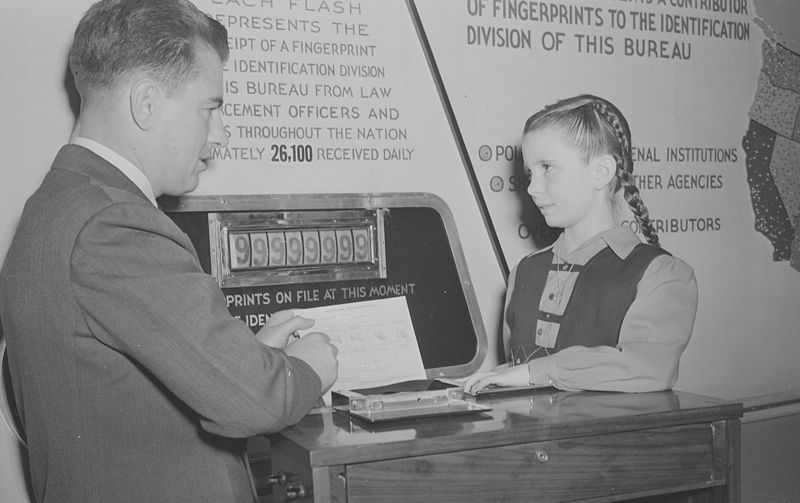
It’s always freaky when several of my interests collide. Crime, old-time radio, and classic movies–it all comes together in this photo of the FBI photographing Margaret O’Brien.

“The 91 million prints we have on file here at the FBI are the biggest man trap ever devised.”

Adventure Ahead, August 26, 1944

This is not a great radio show. In my experience, the cheese factor in old-time radio correlates directly with the number of organ flourishes a show contains. But this show’s subject–how the FBI lab helped police solve crimes in the 1940s–intrigues me.

Adventure Ahead was a Saturday morning show aimed at young boys. In this episode, a boy tours the FBI crime lab and learns how agents help solve crimes through blood and hair analysis, ballistics, and fingerprint identification.

(This show uses what TV Tropes calls the Little Jimmy trope: “Little Jimmy is a young character without any distinguishable traits other than complete ignorance related to the subject at hand. Most likely found in educational films, commercials, and public service announcements. Their only job is to represent the young and stupid viewers of the film who know nothing about common sense and would very well get into a car with a stranger offering candy unless some superhero or other fictional character comes along and tells them that it’s wrong. He’s typically young, white and freckled.” Here, our Little Jimmy is named Tommy.)

Because I live near America’s largest fingerprint database, I paid special attention to the information about FBI fingerprint files. After listening to the show, I couldn’t resist doing some research on the history of fingerprint identification and how the FBI collection has changed over the years.

Soon after J. Edgar Hoover became FBI director in 1924, the Bureau established an Identification Division.
Within nine years, it contained 5 million cards. By 1944, when this radio show aired, these numbers had soared to 91 million. Actress Margaret O’Brien provided the Bureau’s 100 millionth set of fingerprints two years later.

This radio show describes a fingerprint matching system that involved punched cards and “steel fingers.” The FBI first used computers to search fingerprint files in 1980, but didn’t establish a fully computerized system, the Integrated Automated Fingerprint Identification System, until 1999.

The FBI is now building a huge database of other biometric information, from iris scans to tattoos.

A Love Affair with Words: His Girl Friday

My husband balked at re-watching my favorite movie with me this weekend.

 “How can you not love this?” I asked, a few minutes into the film.

“It’s just so much…talking!” he sputtered.

His Girl Friday is, indeed, all talk. Its characters talk so much, so quickly, that their words overlap, ringing out into a musical counterpoint.  

Words attracted me to His Girl Friday the first time I encountered the movie, during my teenage years. As I flipped channels, this exchange captured my attention:

 Walter: This other fellow–I’m sorry that I didn’t get a chance to see him. I’m more or less particular about whom my wife marries. Where is he?

Hildy: Oh, he”s right on the job, waiting for me out there.

Walter. Hmm…Do you mind if I meet him?

Hildy: Oh, no, Walter. It wouldn’t do any good, really.

Walter: Now, you’re not afraid are you?

Hildy: Afraid? Of course not!

Walter: Then, come on! Let’s see this paragon. Is he as good as you say?

Hildy: He’s better!

Walter: Well, then, what does he want with you?

The Front Page, a 1928 Broadway hit written by Ben Hecht and Charles MacArthur, is His Girl Friday’s source. In the play, star reporter Hildy Johnson wants to escape the seedy world of journalism by marrying and finding “respectable” work. His managing editor, Walter Burns, thwarts him at every turn as the two collaborate on a bombshell story—a prison break by condemned murderer Earl Williams.

In His Girl Friday, Director Howard Hawks transforms Hildy Johnson into a woman, a change that raises the stakes considerably. Hildy’s choice between journalism and respectability is also a choice between a career and a traditional feminine role, and a choice between two very different men—her insurance-salesman fiancé Bruce Baldwin and her ex-husband, Walter Burns.

Two kinds of people populate His Girl Friday’s world. The journalists make up one group—a fast-talking, irreverent group. Walter Burns is this group’s apotheosis; nothing matters to him except the power and pleasure he derives from words. On the other hand, we have earnest people like Bruce; Earl Williams and his friend Molly Malloy; and prospective “city sealer” Joe Pettibone, who blows the lid off the mayor’s plan to execute a mentally ill man. These people speak slowly, mean what they say, and become lost in the journalists’ layered ironies and wise cracks.

Rosalind Russell’s Hildy operates well within both groups. Adopting a hushed interview style, she elicits Earl’s story. Showing sympathy that her male counterparts lack, she wins Molly’s trust. Admiring goodness and simplicity, she works to protect Bruce from Walter’s machinations.

In the end, though, Hildy can’t escape Walter and the lure of word craft. Words are weapons in their sparring, but also bind them in moments of shared delight that Bruce can’t comprehend. (Consider his delayed reaction, in the restaurant scene, when Hildy sees through Walter’s lies about another reporter. Bruce’s confusion produces contempt in Walter and embarrassment in Hildy.)

As James Walters wrote in the Journal of Film and Video:

“The film makes clear Hildy and Walter’s delight in controlling language, their near-delirium in playing together with the pace, tone, and rhythm of words. Their fluent use of language connects them with a world in which the ability to use words dictates a person’s status and in which, as in Molly’s case, an inability signals a person’s collapse…Indeed, there is a truthfulness in their shared vocal rhythms and patterns, as though their profound affinity emerges naturally and unavoidably whenever they are together.”

Choosing Walter’s world means giving up a lot, from little courtesies accorded to ladies, to society’s respect, to hopes of home and family and “a halfway-normal life.” For Hildy, however, giving up the mental exercise that Walter and writing provide would be a more bitter sacrifice.

His Girl Friday influenced my own choices, propelling me toward journalism school and a writing career. One day, in my college newspaper offices, the managing editor mentioned a Cary Grant movie she’d watched the night before.

“Have you ever seen His Girl Friday?” I asked.

 My reserved editor suddenly turned gushy: “Isn’t she great?!”

Hildy became a heroine ahead of her time when she announced, “I’m no suburban bridge player. I’m a newspaper man.”

Final Fun Facts: Hawks pioneered the overlapping dialog style that distinguishes His Girl Friday, but Grant and Russell made some delightful contributions to the script as well. Grant’s ad-libs include Walter’s description of Bruce as looking like “you know, that fellow in the movies…Ralph Bellamy.” Rosalind Russell, in her autobiography Life is a Banquet, described her secret hiring of a comedy writer to punch up the script. He added such bits as her murmured “slap happy” and her hand-signal-of-warning, both in the restaurant scene.

Note: His Girl Friday is available for streaming, free, at Hulu, and for free downloading and streaming at Internet Archive.

Old-Time Radio Playlist: London Calling, Part 2

I continue this week with the second part of my Olympics-inspired playlist.

“Confession”


Escape, December 31, 1947
“You are lost in a London fog, uncertain whether the figures looming around you are real or creatures of your imagination. And somewhere in the wet grayness lurks a murderer, from whom you must escape.”
Story: A Canadian soldier, shell-shocked from his World War II service, becomes disoriented on a foggy London evening and encounters a mysterious woman who soon ends up dead.
Based Upon: A short story by Algernon Blackwood, a prolific and influential author of horror fiction.
Notable Cast Members: Bill Conrad, one the best and most ubiquitous actors in old-time radio, plays the soldier. Fellow Generation Xers will remember Conrad best as TV’s Cannon and Jake from Jake and The Fatman. It can be hard, at first, to erase that visual from your mind as you listen to his radio work. His powerful performances soon engage your full attention, however. In my opinion, he did his finest work as Matt Dillon on radio’s Gunsmoke.
Peggy Webber, who plays the mysterious woman, will be familiar to viewers of TV’s Dragnet because she appeared in roughly a zillion episodes. She also worked as a writer, producer, and director in the early days of television, and she helped to found the California Artists Radio Theatre.
About Escape: Escape was “radio’s greatest series of high adventure,” according to John Dunning’s On the Air. It ran from 1947 to 1954, a sister series to the longer-running Suspense. Several things distinguish the two series. First, Suspense had bigger budgets and, thus, big-name guest stars, throughout most of its run. Those big budgets came from sponsors, which Escape didn’t have. This is a plus for the modern Escape listener—you don’t have to hear, or fast-forward through, grating commercials. (Yes, Autolite, I’m looking at you.) Escape tended to use more exotic settings than Suspense and dabbled more in the supernatural. Also, on Suspense things tended to end well; Escape often went for the darker ending. (I wonder how much sponsors, or the lack thereof, had to do with this.) Both series are excellent—they are in my top five favorite radio shows, and which one ranks higher just depends upon my mood.
My Verdict: This is a solid episode. A sense of dread slowly envelops the listener as the fog envelops Conrad’s character, and the ending is satisfyingly chilling.

“The Hands of Mr. Ottermole”


Suspense, December 2, 1948
“By all means, sergeant, let’s talk about…murder.”
Story: A journalist and a police sergeant talk about a serial strangler who’s menacing London. Since the script takes pains to avoid telling us the men’s names, it’s obvious one of them is the deadly Mr. Ottermole.
Based Upon: A short story of the same name by Thomas Burke, an author who specialized in portraying London and its working-class citizens. Burke published “The Hands of Mr. Ottermole” in 1931. According to Ellery Queen, “No finer crime story has ever been written, period.”
Notable Cast Members: Vincent Price and Claude Rains star in this episode. Price, of course, was made for creepy tales like this, but it’s Claude Rains who really shines.
About Suspense: Suspense billed itself, with ample justification, as “radio’s outstanding theater of thrills.” Extremely popular, it ran for 22 years (1940-1962). For much of that time, it attracted top Hollywood stars, who often got the chance to play roles that contrasted with their on-screen image. William Spier produced Suspense in its best years and, according to Dunning, “personally guided every aspect of the show, molding story, voice, sound effects, and music into audio masterpieces.”
My Verdict: Suspense is another of my top-five shows and an excellent introduction to old-time radio for new listeners. This episode is very good, with a script that keeps you guessing and an outstanding performance by Rains.
Final Fun Fact: Alfred Hitchcock Presents offered a TV adaptation of this story in 1957. You can watch it free via Hulu.

Disaster in London”


Top Secret, August 6, 1950
“I think I will never feel anything again, ever.”
Story: A double agent is collaborating on a scheme to poison the London water supply with deadly bacteria.
Notable Cast Members: Top Secret starred Ilona Massey, or “beautiful Ilona Massey,” as she’s billed here. Nope, I had never heard of her either. She was a Hungarian actress who had a brief movie and television career.
About Top Secret: This NBC spy drama ran for only four months in 1950.
My verdict: This show is interesting. Spies didn’t proliferate in old-time radio the way cowboys and detectives did. Massey’s female spy is not ditzy or dependent on the men surrounding her. She’s a classic spy—world-weary, but brutally efficient. As this episode opens, she’s seeing to it that an enemy agent meets his doom under an oncoming subway train! She shows compassion, however, for the mother of the story’s double agent. This is the first Top Secret episode I’ve heard, and I will definitely seek out more. (Unfortunately, the sound quality is poor.)

“Portrait of London”


The CBS Radio Workshop, July 20, 1956
“This is possibly one of the most lovely views. I thought it was good from Westminster Bridge, but I shall always now think that Big Ben has a very special one. I’m looking directly down on Westminster Bridge, over the Thames. I can see St. Paul’s, and it is the perfect time of day, the end of the day, and the sun is shining.”
About the Episode: Sarah Churchill, actress and daughter of Sir Winston Churchill, narrates a documentary-style tour of London. Her tour includes the London Zoo, where she visits a lion that the Lions Club of America donated to her father; Petticoat Lane Market, where a seller demonstrates small figures of Sir Winston that puff on cigars; a rainy rehearsal for Trooping the Colour; and a trip to the top of the tower that houses Big Ben.
About The CBS Radio Workshop: Coming at the end of the radio era, this was an experimental anthology program that wasn’t afraid to take chances. Dunning quotes CBS Vice President Howard Barnes as saying, “We’ll never get a sponsor anyway, so we might as well try anything.”
My Verdict: This is absolutely charming. The sound patterns and interviews with Londoners and tourists come together to paint a vivid picture of the city. Sarah Churchill was beset by personal problems during the 1950s, but she makes a warm and enthusiastic host here. I’m a lifelong Anglophile, but I’ve only had the privilege of visiting London once. This program made me long to go again.
Google-Worthy References: While visiting Big Ben, Churchill learned that pennies are placed on the clock’s pendulum to adjust its timekeeping for accuracy. I had to know if they still use pennies; they do, although some of the original pennies have been replaced by a five-pound coin that commemorates the 2012 Olympics.
Final Fun Facts: I tried to find out more about Rusty, the lion featured here, to no avail. Rota the lion, presented to Winston Churchill in 1943, is much more well known. Rota died in 1955, so Rusty–whom his keeper says is young–must have been a kind of replacement. (You can see Rota, stuffed, at the Lightner Museum in St. Augustine, Florida.)
My quest to research Rusty led me to some other interesting destinations. This fascinating article describes Churchill’s attempt to bring a platypus to England, and this vintage London Zoo map has wonderful graphics, including an image of Churchill walking his lion and his kangaroo.

Old-Time Radio Playlist: London Calling, Part 1

As a fan of old-time radio, I like to organize shows into topical playlists. The recent Olympic games inspired this list of London-themed episodes. (Part 2 of this playlist.)

“Journey for Margaret”


Screen Guild Theater, April 5, 1943
“A man can’t go on feeling forever. There’s a limit. By and by, he finds himself dead. That’s why I can’t get mad; I’m dead.”
Notable Cast Members: Robert Young, who shows off his fatherly side well before Father Knows Best appeared on radio and then TV, and 6-year-old Margaret O’Brien, recreating the movie role in which she made a name for herself, literally and figuratively. Four-year-old actor Billy Severn also appeared—it must have been terrifying for the director to rely upon such young children in a live radio drama. O’Brien does a great job, and Severn is adorable.
About Screen Guild Theater: This was one of several shows that condensed popular movies for radio audiences. At least the better-known Lux Radio Theater had 60 minutes to work with; 30 minute shows like Screen Guild Theater often leave only a sketchy outline of the movie plot. As John Dunning put it in The Encyclopedia of Old Time Radio, “Screen Guild always seemed like the quick economy tour, jerky and uneven, scenes knit together by thin thread and taxing a modern listener’s willingness to suspend disbelief.”
Story: A war-weary American journalist and his wife, in London during the Blitz, lose their unborn child and decide to adopt a traumatized war orphan.
Based Upon: The successful 1942 movie of the same name, in which Young and O’Brien also starred. The movie, in turn, was based upon the novel by journalist William L. White, and that was based on his true story of adopting a British war orphan. Life ran an interesting story on the “real Margaret” (not revealing that her name was actually Barbara), who would grow up to carry on her family’s journalistic legacy.
Google-worthy References: Ack-ack—Anti-aircraft guns.
Also, when the pregnant wife and her husband share a toast, she drinks milk. This surprised me and got me wondering how long doctors have been advising pregnant women to avoid alcohol. I didn’t find a definitive answer, but this history suggests alcohol’s potential harm has long been common knowledge.
My Verdict: These short movie adaptations work best when you haven’t seen the movie, which I haven’t in this case (although I want to now). As a radio story, it feels complete, and Robert Young and the children give enjoyable performances.

“Berkeley Square”
Everything for the Boys, February 8, 1944


Dangerously Yours, September 24, 1944


Hallmark Playhouse, March 3, 1949


“Out of what’s wrong with this world came a better time, and somehow the same will happen out of the struggles of my world.”
Based Upon
: The John L. Balderson play Berkeley Square, which was a hit when it opened in 1929. This time-travel romance was also a hit with old-time radio audiences, if you can judge by the number of shows that adapted it.
Story: Peter Standish longs to leave the 20th century behind. Obsessed with the diaries of an 18th century ancestor, he soon finds himself living his ancestor’s life. Complications arise when he falls in love with the sister of the woman his ancestor married.
Setting: Berkeley Square, a perennially fashionable London neighborhood.
Notable Cast Members: Ronald Colman plays Peter on Everything for the Boys, a wartime dramatic anthology. Greer Garson plays his love interest, Helen. Victor Jory stars in the Dangerously Yours episode. David Niven stars in the Hallmark Playhouse version.
About the Programs: Everything for the Boys ran for 21 weeks, with Colman hosting and starring in each episode and the legendary Arch Oboler writing and directing. Each episode ended with a short-wave call to fighting men overseas—this was a major technical challenge then and didn’t always work. The romantic anthology Dangerously Yours was also a short-lived 1944 show with a regular leading man—Victor Jory. After 16 episodes, it morphed into Vicks Matinee Theater. The high-toned Hallmark Playhouse presented Hollywood stars in literary adaptations.
My Verdict: Without having seen or read the play, I can’t say which version adapts it most faithfully. In all three versions, the time travel is abrupt and unexplained. The Everything for the Boys script adds an extra layer of resonance to the play by giving it an explicit World-War-II context. This makes it easier to see why Peter wants to escape the 20th century, why Helen is so horrified by her vision of the future (she sees men, women, and children being herded into open graves), and why Peter feels he must return to his own time and address its challenges.
Final Fun Facts: Oboler and Colman did not enjoy their collaboration. In fact, Dunning quotes Oboler as saying, “We hated each other’s guts.”
Also, Leslie Howard starred in the original Berkeley Square play and the 1933 movie version.

“It’s Always Tomorrow”


Words at War, January 2, 1945
“I’m gonna keep an eye on certain people here in England…and if they try to cheat us out of anything we’ve won in this war, then we’ll see if we can arrange another direct hit, especially for their benefit.”
Based Upon: It’s Always Tomorrow by Robert St. John, a journalist whose life spanned the 20th century and whose adventures spanned the globe. (He reminisces about his career in Studs Terkel’s Coming of Age—thanks, old-time radio, for making my to-be-read list even longer.)
Story: An American journalist assigned to London finds himself disgusted by out-of-touch, imperialist aristocrats. He falls in love with Polly, a bitter working-class woman, who refuses to support a war she thinks will benefit only the rich.
Notable Cast Members: Cathleen Cordell, who plays Polly, went on to have a long career as a character actress in television. I think William Quinn, who plays Dave, may be the same person as Bill Quinn, another prolific TV character actor.
About the Program: Words at War was a dramatic anthology that told timely stories from the world’s literal and figurative battlefronts. The New York Times called it “the boldest, hardest-hitting program” on the air.
My Verdict: Once you get past some heavy-handed British stereotypes, this is an interesting, nuanced story. Polly is a shockingly unpatriotic character by wartime radio standards. At one point, she even cries, “Let Germany win! Let Germany win!” Dave, playing devil’s advocate, tries to convince her that World War II is a “people’s war.” He interviews working people who are glad to make sacrifices and an aristocrat who is paying 97.5 percent of his income in taxes, but Polly remains unconvinced. When Dave loses his leg in a bombing, I thought sure the writers would give Polly a quick attitude change. She does agree to take Dave’s place in a war plant (where he’s begun working because his newspaper superiors banned him from writing about war’s effect on “the little people”). She stresses, however, that she’s making this choice based on love, not patriotism. A reviewer of St. John’s novel noted favorably that the book “makes a passionate plea for general understanding of the bitter hatred the common people in war-torn countries feel toward rulers who quit them ingloriously, shamefully, taking with them their loot and their foolish hides.” In the 1950s, author Robert St. John was blacklisted as a Communist, a label he disavowed. It’s sad but not surprising that his concern for the world’s common people would suggest Communism to 1950s red hunters.
Final Fun Fact: At one point, Dave and Polly visit a pub, where the crowd sings this song.