Family Affair Friday: Season 1, Episode 7, Mrs. Beasley, Where Are You?, 10/24/1966

My 10-inch Buffy doll with her Mrs. Beasley. They’ve never been removed from the box, but Mrs. Beasley has plummeted to the ground–hey, just like in this episode.

This week, the latest installment of my Family Affair series features a classic Mrs. Beasley episode–and some dolly digressions.

Season 1, Episode 7, Mrs. Beasley, Where Are You?, 10/24/1966

Teleplay by: Phil Davis and John McGreevey. Story by: Phil Davis. Directed by: William D. Russell.

Synopsis

A seeming tragedy occurs when Mr. French accidently knocks Mrs. Beasley off the terrace, and the doll is nowhere to be found below.
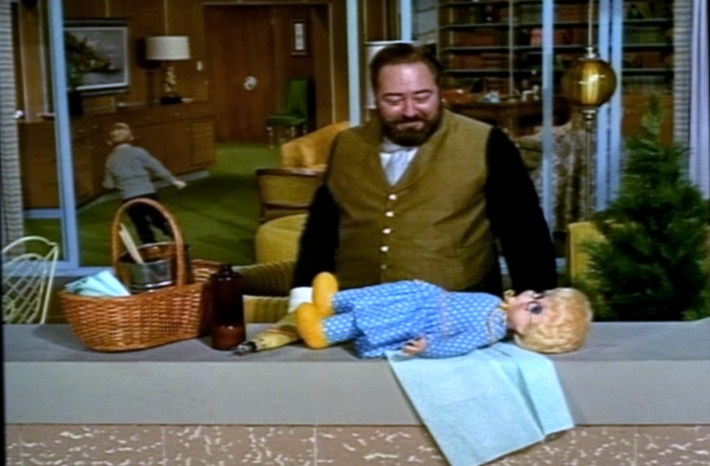
What could go wrong here?

Yeah. That.

Meanwhile, a related subplot finds Uncle Bill’s weekend plans to “sleep, play golf and do a little mild socializing” thwarted by conflict with a neighbor–a neighbor whose little girl suddenly owns a doll (Effie Boots) the spitting image of Mrs. Beasley.

Effie Boots’ owner is the spitting image of Pamelyn Ferdin.

A despondent Buffy, however, testifies that the doll isn’t hers.  The whole Davis family suffers along with Buffy.
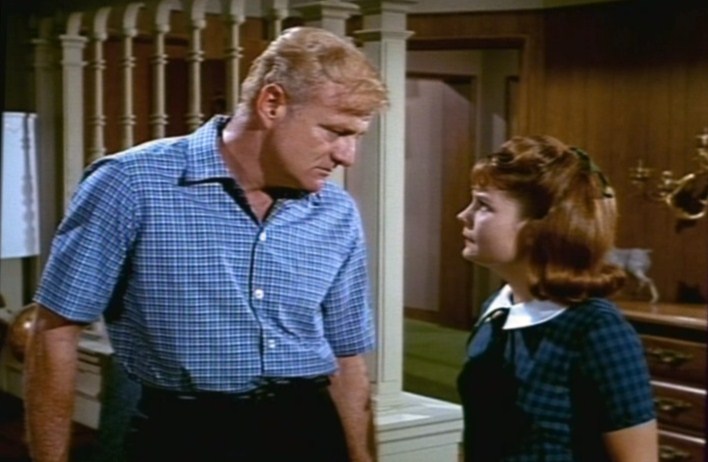
See the clothes these two are wearing while Cissy makes the scrunched-face-of-concern at Uncle BIll? Well, keep them in mind. We’ll get back to them later.

Jody offers to let Buffy sleep with his turtle. Awww.

A sweet sisterly moment. Double Awww.

When all seems lost, Uncle Bill and his girlfriend du jour find Buffy’s doll in the apartment building’s garbage cans.

“Competition is the lifeblood of free enterprise,” the ragpicker notes approvingly when he sees Bill and his date rifling through the trash. Aren’t ragpickers amusing?

The happy reunion.

Random Thoughts

It would take a cold heart to remain unmoved by Buffy’s suffering. As a Barbie collector, though, I enjoy the toy store scene the most: drool-worthy Mattel dolls as far as the eye can see. I don’t know if Mattel had released the Mrs. Beasley doll yet, but obviously the show had forged its relationship with the toy company.

The mid-1960s was a golden era in Barbie history. In this scene, you can see several “American Girl” Barbie dolls. These were only made for two years and are highly sought after today. The long-haired doll in the background is Barbie’s cousin Francie. The Barbie clothes of that era were especially glamorous. The doll in the foreground is wearing Fabulous Fashion. You can spot other dolls wearing Fashion Luncheon and Pan American Airways Stewardess. One price guide I own values the latter at $900 if it’s still in the box! The little dolls on the shelf above the saleslady are Barbie’s brother and sister, Tutti and Todd, along with their friend Chris. Mattel made a Buffy and Mrs. Beasley doll in that same size.

Guest Cast: George Nelson: Frank Maxwell. Diane: Joan Vohs. Clara: Ann McCrea. Saleslady: Cathleen Cordell. Melissa: Pamelyn Ferdin. Scotty: Karl Lukas. Ragpicker: Andy Albin. Maid: Pauline Drake. Pamelyn Ferdin is a familiar face, and voice, from the 1960s and ’70s. Among other roles, she played Edna on The Odd Couple and voiced Lucy in A Boy Named Charlie Brown and Fern in Charlotte’s Web. She also appeared (with Johnnie Whitaker) on Sigmund and the Seamonsters and was in the ’70s version of Lassie. On The Brady Bunch, she appeared in the episode where Jan sports a wig. She also played Francie in a 1972 made-for-TV version of A Tree Grows in Brooklyn. She would appear in three more episodes of Family Affair. Joan Vohs appeared in a second-season epidsode as Mrs. Scofield, then appeared in six third-season episodes as Miss Cummings. Andy Albin was a regular performer on Bob Newhart’s short-lived first series in 1961.

Continuity Notes: Cissy explains that after the death of her mother and father and separation from her siblings, Buffy had only Mrs. Beasley left as a friend.

Continuity error–Cissy and Uncle Bill are wearing the same clothes in this scene as they did in the “concerned conversation” scene above, but this scene takes place the next day.

Notable Quotes: “People you love always go away–I know.” Buffy

Well, that quote’s a bummer. So I will close instead with two random Buffy pictures. In Buffy’s happy scenes in this episode, Anissa Jones seems more animated than usual.

Anissa Jones cuteness.

I love that outfit, too. It reminds me of the Gymboree outfits I tried to get my daughter to wear when she was 4 and 5. (No dice.)

Today’s Bonus Feature

An article from Doll World, December 1996, about the small Buffy and Mrs. Beasley doll.

Read my whole Family Affair series!
Spin Again Sunday: Dr. Kildare Game

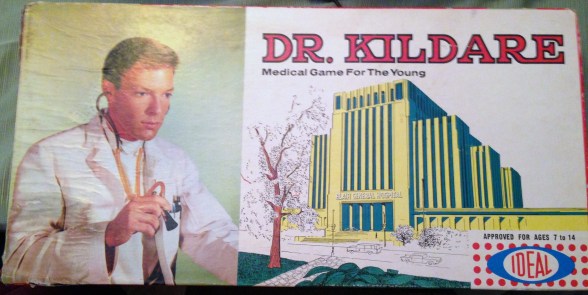
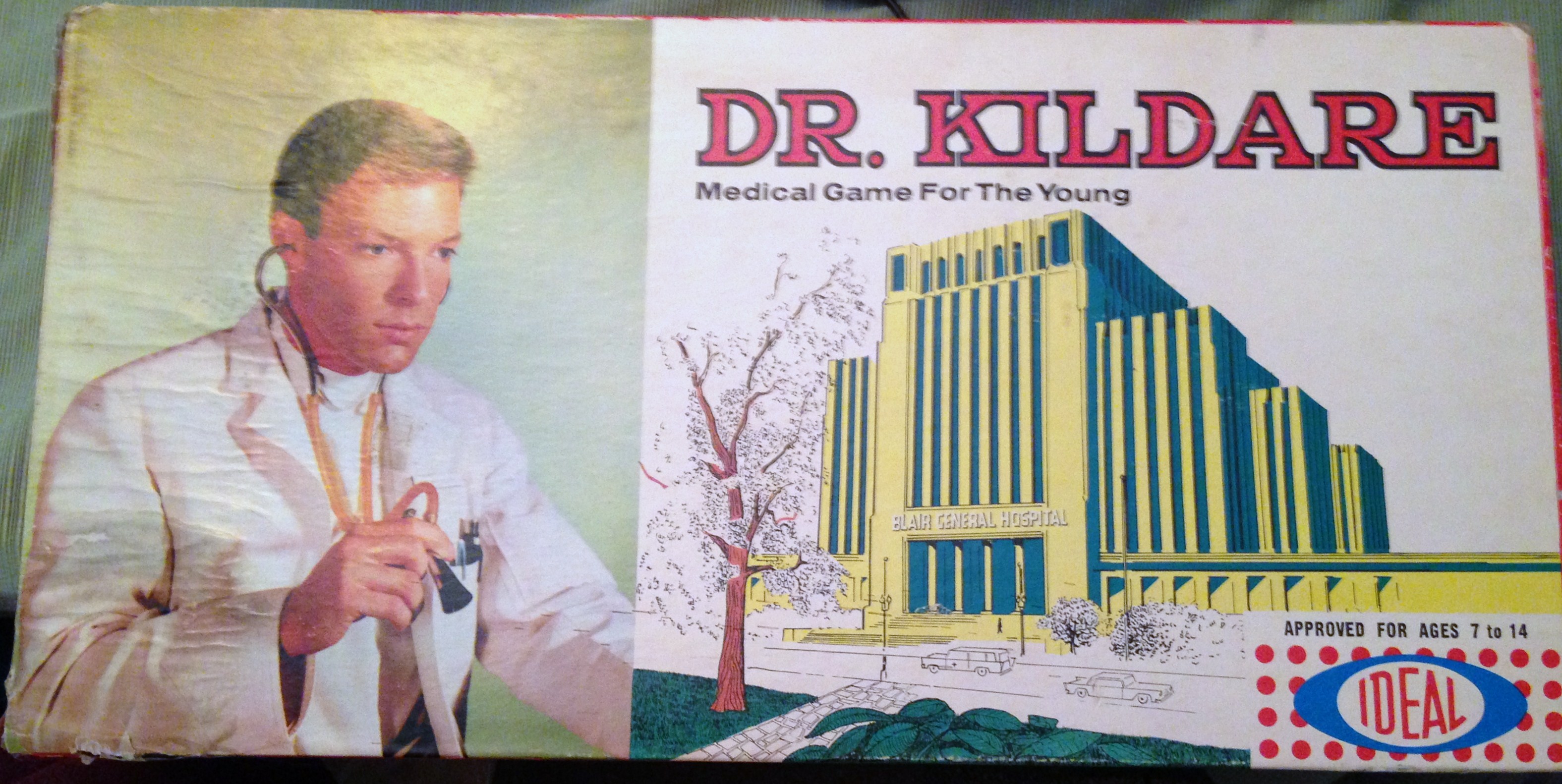
Dr. Kildare Game, Ideal, 1962

It’s time to take two aspirin and enjoy the latest installment in my series about vintage board games.

Today’s Game: Dr. Kildare

Copyright Date: 1962

Mystifying Subtitle: “Medical Game for the Young.” I wonder why they felt the need to specify that it was for the young.

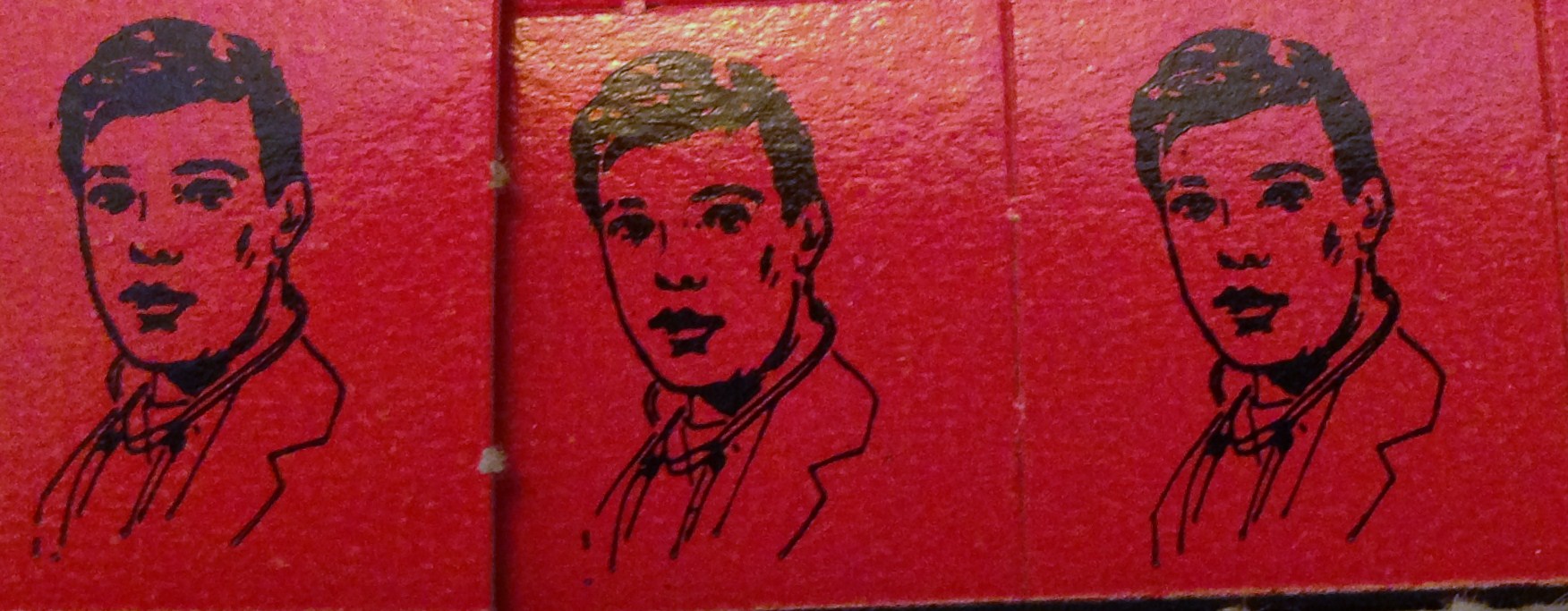
Game Box: I’m sure the draw for potential buyers was the large photo of dreamy Richard Chamberlain as Dr. Kildare, who is staring intently ahead and listening to an invisible person’s heartbeat.

The Analyzer

Recommend Ages: 7 to 14. Actually, it says “Approved for ages 7 to 14.” That’s a strangely officious way to put it.

Game Board: The board offers a cute representation of a hospital, with green corridors, patient rooms, an operating room, and more. The patients all seem happy, even the one traction.

Game Pieces: Dr. Kildare’s dreamy face again.

Game Play: Pretty cool. Players make their “rounds” through the hospital and diagnose their patients with the help of the “Analyzer.”  Patients’ conditions are written in code on diagnosis cards. I decoded two of them just for fun—nose bleed and sprained back.

Nice Touch: The instructions say that you can play the game by yourself.  I used to play board games against myself all the time—my brother was not really a board-game guy.

My Thoughts: I’ve never actually seen an episode of Dr. Kildare. It was a bit before my time. I saw The Thorn Birds at an impressionable age, though, so I can appreciate Richard Chamberlain’s charms. The game looks pretty entertaining—what kid doesn’t love decoding messages?

Another photo of Dr. McDreamy from the box insert. Okay, we get it, he’s handsome!

If you enjoyed this post, read the whole Spin Again Sunday series!

It Takes a (Fisher Price Play Family) Village

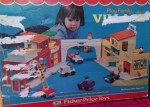
The gift I’d wished the hardest for in 1974–the Fisher Price Play Family Village.

My parents captured many Christmas morning photographs when I was young, but this one from 1974 is a little unusual. Most of our Christmas photos are candids taken in the midst of our present-opening frenzy. In this one, I’m pausing to pose in front of a half-unwrapped gift. The smile on my face shows how happy I was to uncover that gift–the Fisher Price Play Family Village.

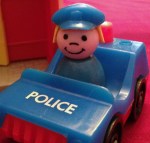
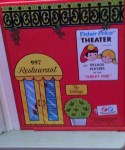
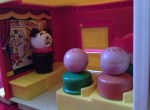
Fisher Price began producing the Village in 1973. At age 6, I longed for it as intensely as I would long for the Barbie Star Traveler a few years later. I’d loved Play Family toys since I was a toddler, and the Village was the ultimate play set, with a fire station, police station, dentist’s office, apartment, restaurant, theater, garage, and more.

I’ve been wanting to acquire a Village for years, but finding a complete one at a price I was willing to pay proved difficult. Finally, about a month ago, I was able to add this toy to my collection.

I wanted to share a few pictures of it, simply because its colorful lithography and smiling people make me happy. As much as I enjoy nostalgia, I try not to fall into the trap of pining for a simpler time. In 1974, our country was dealing with Watergate, continued involvement in Vietnam, and an oil embargo–things were anything but simple. But a toy like Play Family Village transports me to a time when my parents still stood between me and the outside world’s troubles, and daily life seemed almost as uncomplicated as a walk down Play Family Main Street.

Spin Again Sunday: Happy Days

Aaaaaayyyyyyyy. Ready for dating, drag racing, and drive-ins? Sure you are–you’re not some kind of a nerd are you?

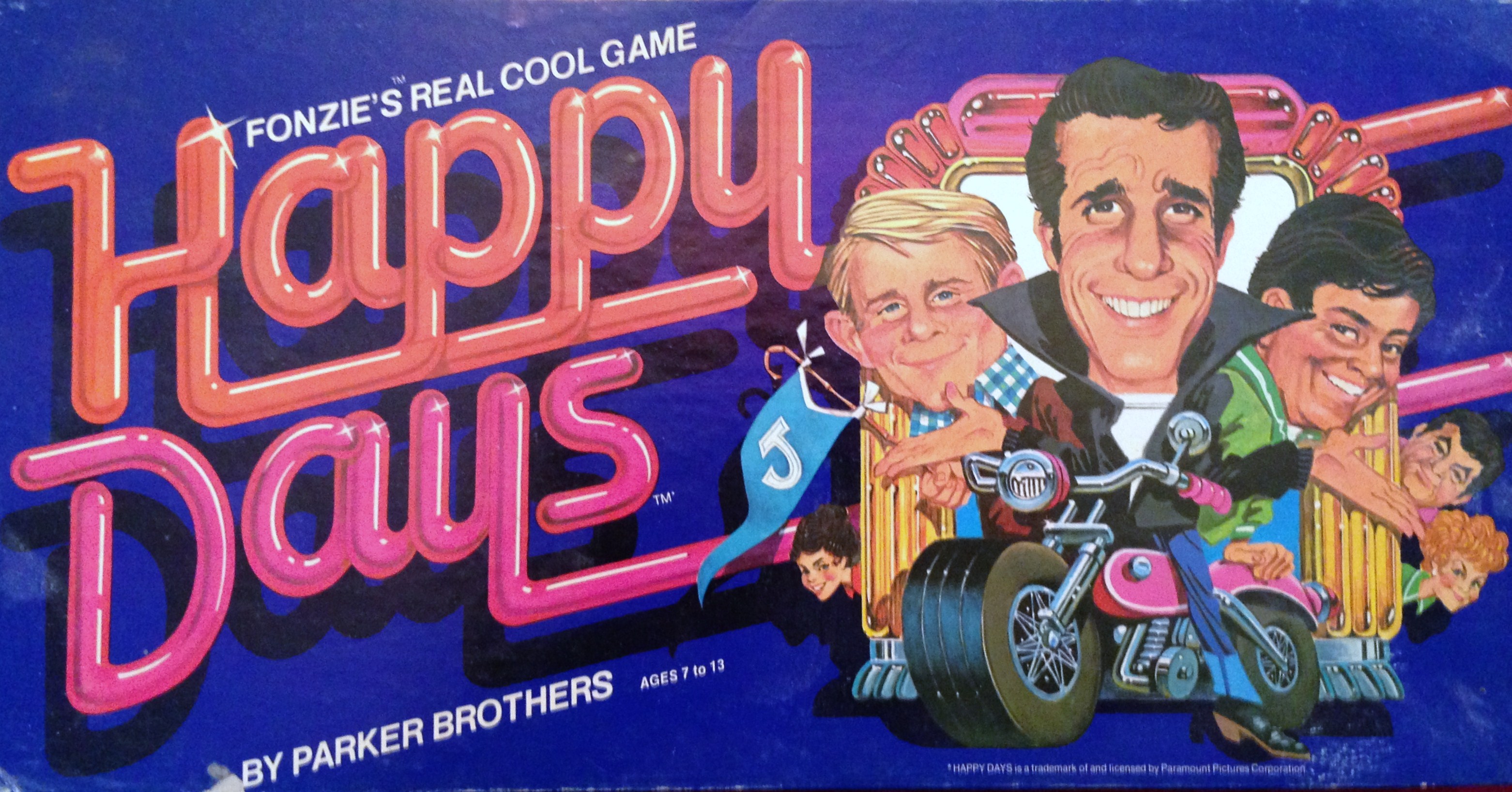
Today’s Game: Happy Days (“Fonzie’s Real Cool Game”)

Copyright Date: 1976.

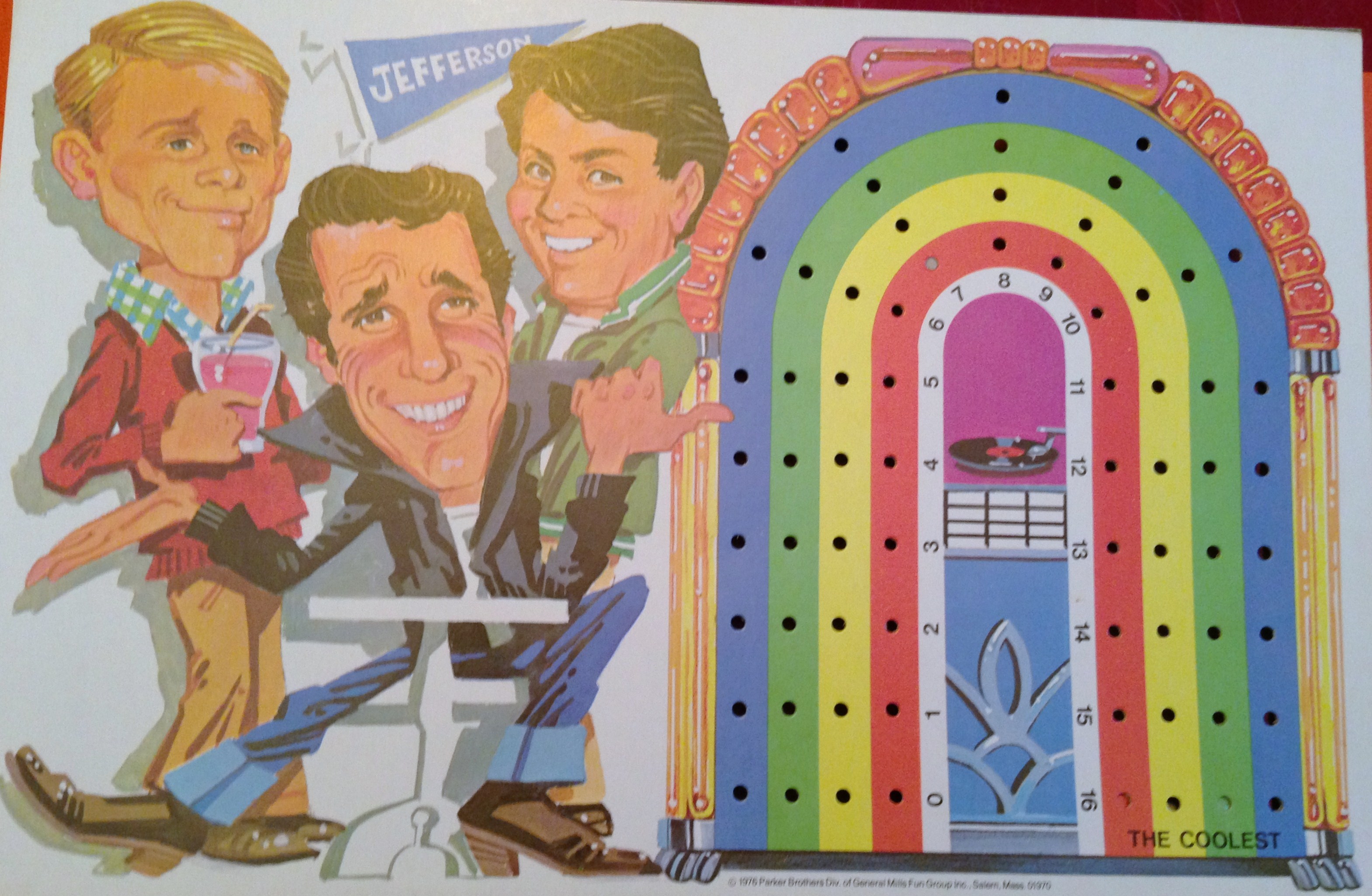
Game Box: The most striking features are neon-light-style lettering and cartoon caricatures of cast members. These caricatures are a cut above those on most games–they actually resemble their real life counterparts. Fonzie is front and center, of course, flanked by Richie and Potsie. The other Cunninghams are peeking around the jukebox. Ralph Malph is MIA.

Game Board: Colorful, if not grammatical–“Sumthin’ to do?” I do wonder why Fonzie is sitting on various houses in the corner spaces. The drag strip that cuts diagonally across the board is an original touch.

Bonus Feature: The game also includes a peg board with a rainbow-hued jukebox for tracking players’ cool points. Fonzie, Richie, and Potsie show up again here. Donny Most must have pissed off a Parker brother.

Recommended Ages: 7 to 13.

Game Play, As the Box Describes It:”See, it’s like spending time with the Fonz–you go on dates, challenge other players to drag races, or maybe just cruise down to Arnold’s. But beware, you can lose cool points as easily as you gain them. Hey, Nerd, don’t get caught hangin’ out at home. That would be uncool.”

My Thoughts: As innocent as this game is, I can’t imagine today’s parents going for it. I mean, drag racing is pretty dangerous. There are things called “score points” that you can only receive in combination with a date card–hmm. And talk about bullying–the game itself calls kids names!

Spin Again Sunday: Patty Duke Game

Would a girl lose her mind playing this game about cousins who are two of a kind? Probably not, but she might have fun.

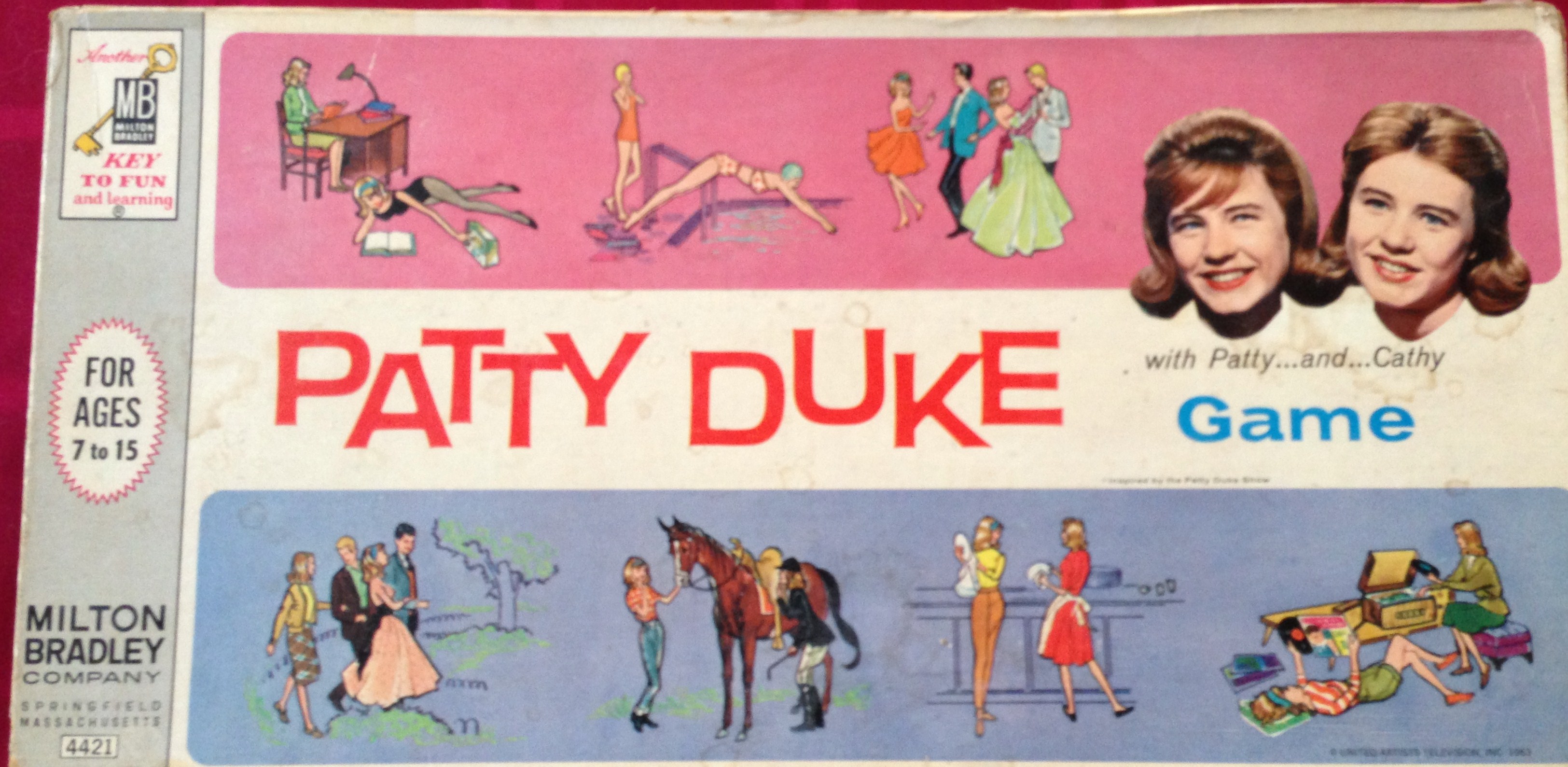
Today’s Game: Patty Duke Game (Tiny print on the box reads, “Inspired by the Patty Duke Show.” That’s pretty obvious—the game revolves around the show’s characters, Patty and Cathy. I wonder why they didn’t call it the Patty Duke Show Game?)

Copyright Date: 1964.

Recommended Ages: 7 to 15.

Game Box: Cute, with its pink-and-blue color scheme and floating Patty and Cathy heads.

Game Pieces: Instead of regular plastic pieces, this game uses red, blue, yellow, and green teenagers, two girls and two boys. Nice!
Game Board: Like the game box, the board features cartoon pictures of Patty and Cathy doing typical 1960s teenage activities—dancing, watching TV, dating, studying, helping with chores. Can you tell which girl is Patty and which one is Cathy? In case you forgot, their personalities are ever-so-slightly different.

Cathy hesitates. Patty wears a two-piece swimsuit and dives right in.

Cathy is actually studying. The radio is distracting Patty (who is wearing a leotard for no apparent reason).

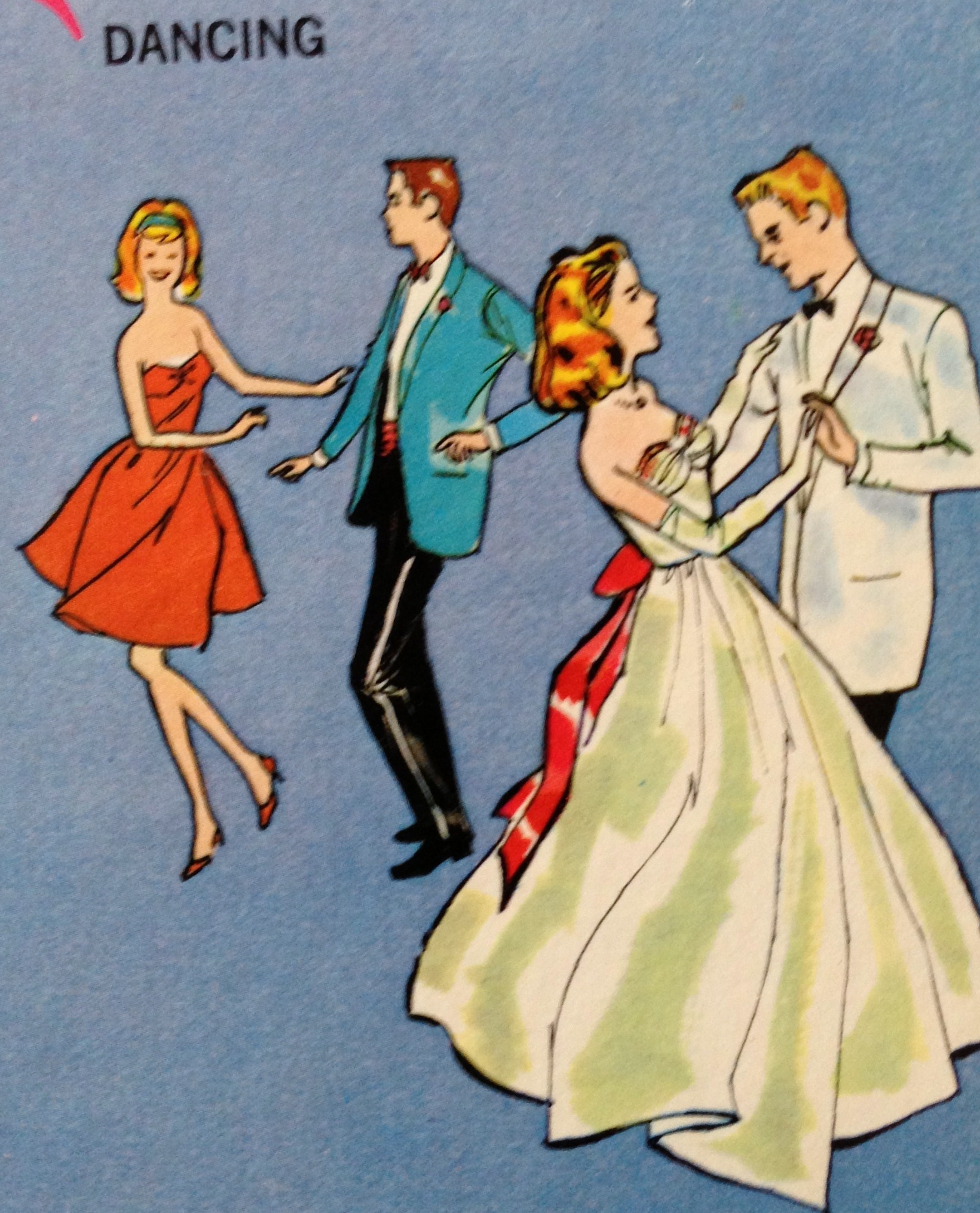
Patty is “losing control.” Cathy is dancing like a girl who “adores a minuet.”

If you enjoyed this entry, please read my previous Spin Again Sunday posts.

Spin Again Sunday: The Muppet Show (Le Jeu des Vedettes)

Because tomorrow is Jim Henson’s birthday, my weekly series on vintage board games has a Muppety flavor this week.

Today’s Game: The Muppet Show (Parker Brothers Board Game of the Stars, AKA Le Jeu des Vedettes, par Parker Brothers)

Copyright Date: 1979

Game Box: A colorful cartoon rendering of every Muppet imaginable. That’s why I bought this game for my daughter. She loves Janice, the Electric Mayhem’s female member, and it’s rare to find merchandise that includes Janice’s picture. Not only does this box feature Janice, but the game board does as well!

Most Interesting Feature: What I didn’t realize when I bought this game is that it was made in Canada and has a bilingual board–one side in French, one side in English. I actually felt a little peeved when I opened the box and found a French board. I only speak un peu de French and didn’t know how I would manage to play this with my daughter. When I flipped the board over and found the English side, I no longer felt peeved—just stupid for not noticing the French writing on the box.

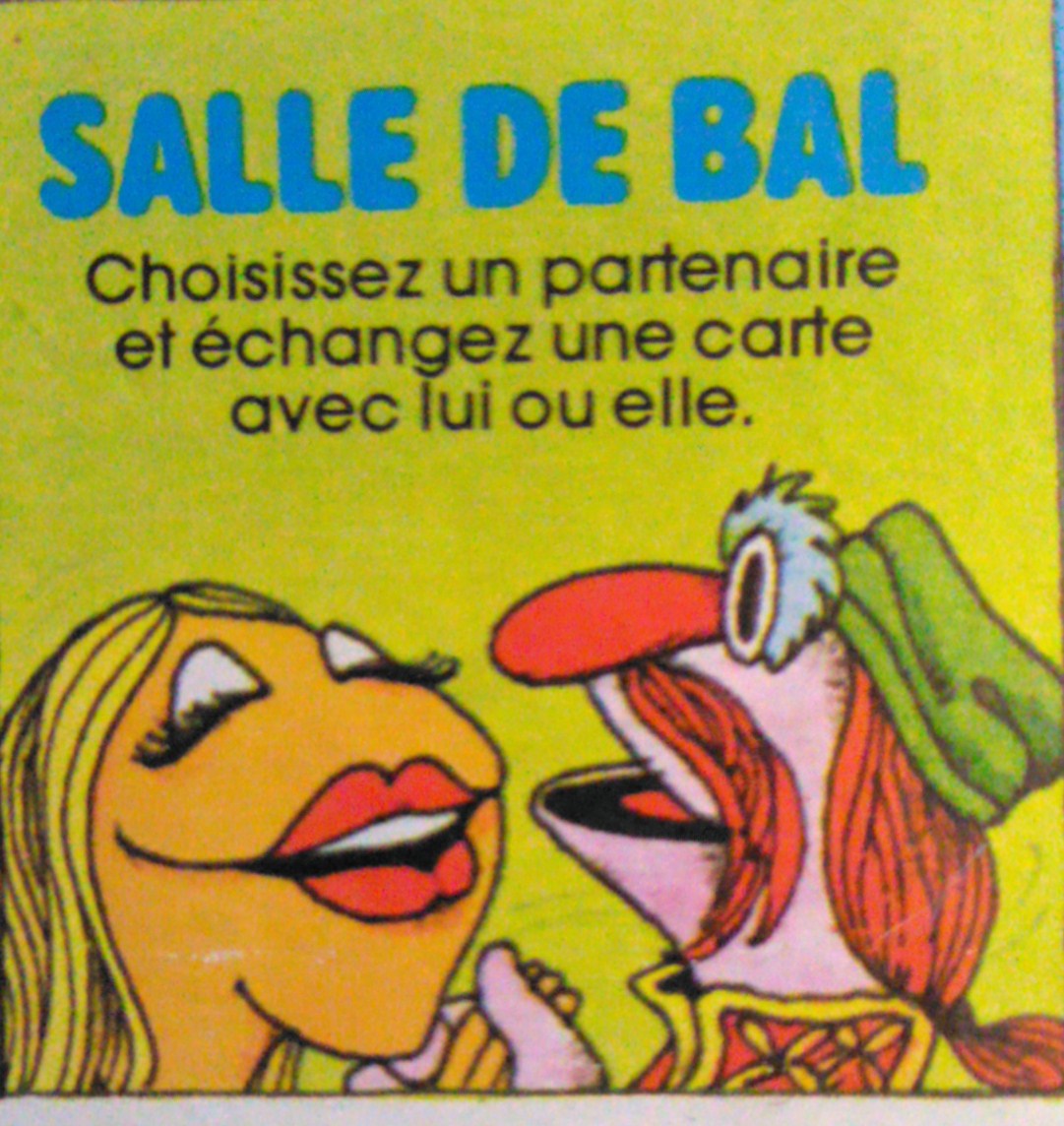
French game instructions.

Game Pieces: Rather lame. You know how some game pieces have a plastic base, into which you slide a cardboard picture? Well, that’s what this game has, but the cardboard pieces don’t display characters—just colors. There’s a yellow one, a red one, a green one, and a blue one. Why not just use regular colored-plastic markers?

Janice, yay!

Recommended Ages: 7 to 14.

Game Play: The game designers came up with a concept relates well to The Muppet Show and its characters. Players move around the board and try to collect cards representing three judges—Miss Piggy, Sweetums, and Fozzie. Once you have all three, you can “perform” for the judges. That involves picking one of six Sam the Eagle cards and hoping that it doesn’t match the number your opponent rolls on the die. If you don’t match Sam, you receive a star; seven stars win the game. The rules have a few wrinkles—such as allowing players to “upstage” each other—that keep it from getting too repetitive. Sam is one of my favorite Muppets, so I enjoy his role as censor here.

My Thoughts: I owned a different Muppet Show game when I was little, one that dated from 1977. I don’t remember much about that game, but I can endorse this one as fun for young Muppet fans.

Spin Again Sunday: Gomer Pyle

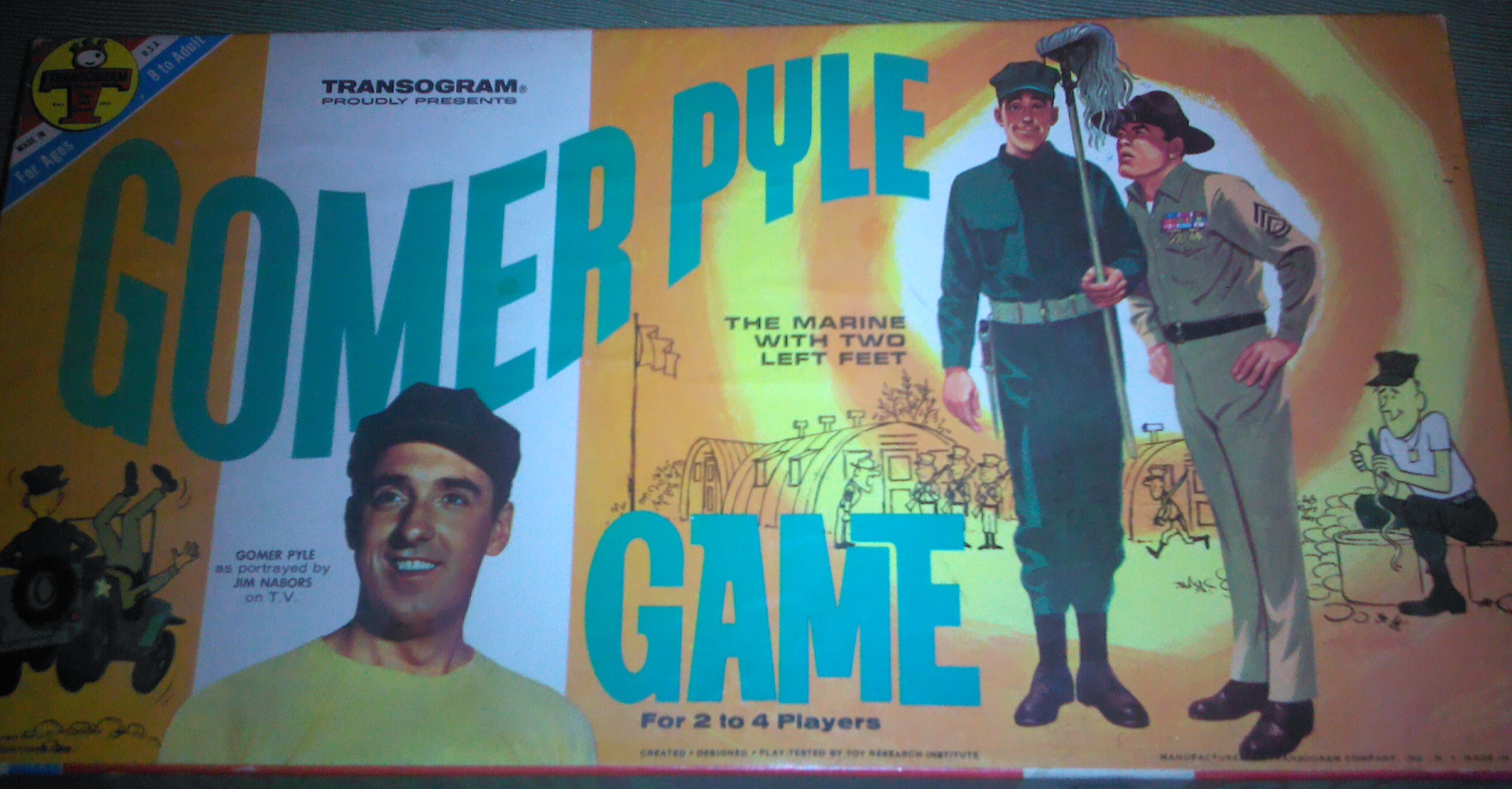
Gomer Pyle Game, 1964

Today’s Game: Gomer Pyle

Copyright Date: 1964 (I got that date from the book Spin Again by Rick Polizzi and Fred Schaefer. The box is undated.)

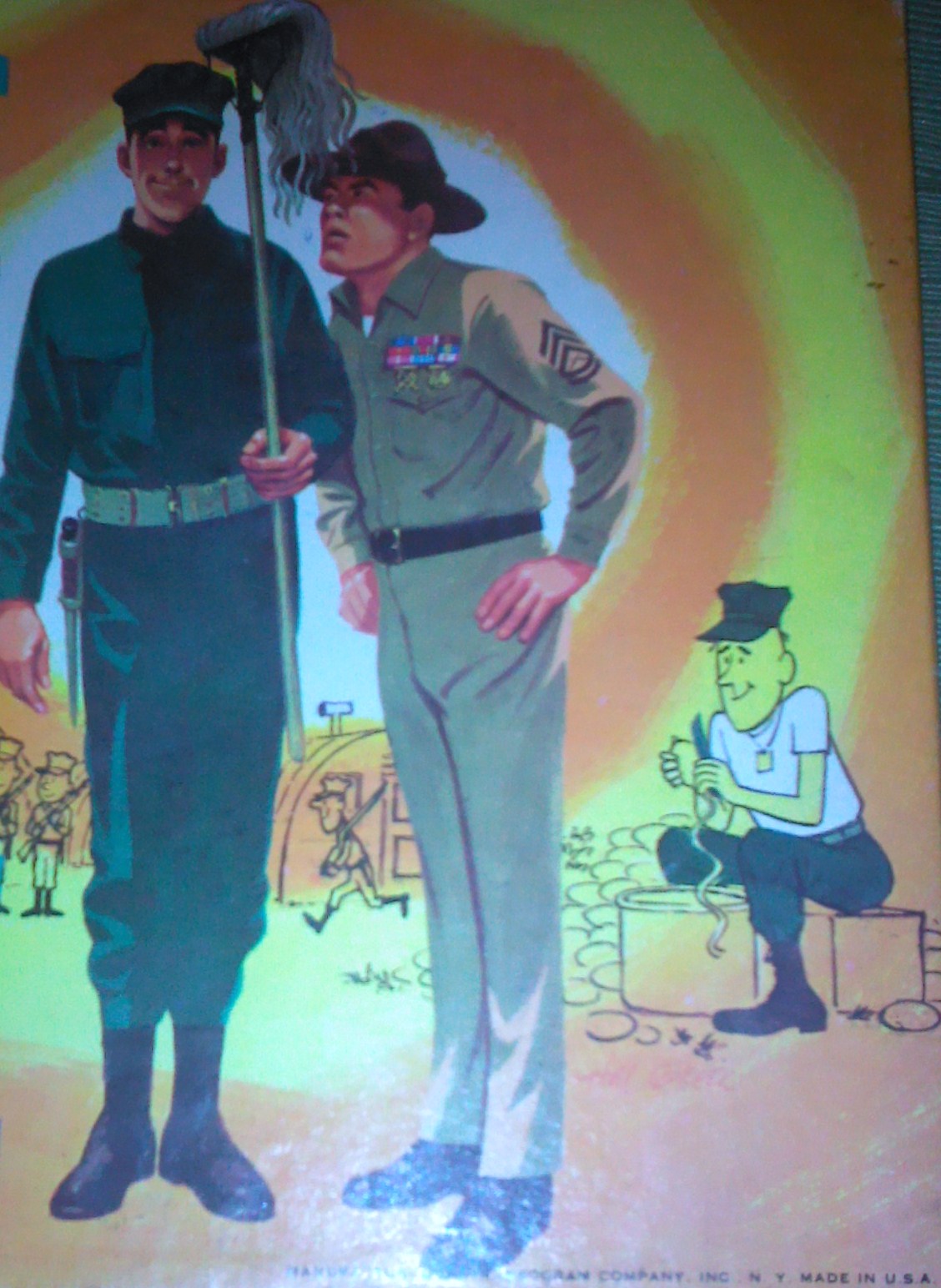
Game Board: Visually striking, with the marching Marines cutting a green swath across the mustard-yellow background, and red Sergeant Carter squares popping up regularly. The guy peeling potatoes seems to be smoking—that’s something you wouldn’t see on kids’ game today.

Game Board

Game Pieces: Brightly colored plastic pieces and cartoon cutouts of Pyle.

Recommended Ages: 8 to Adult.

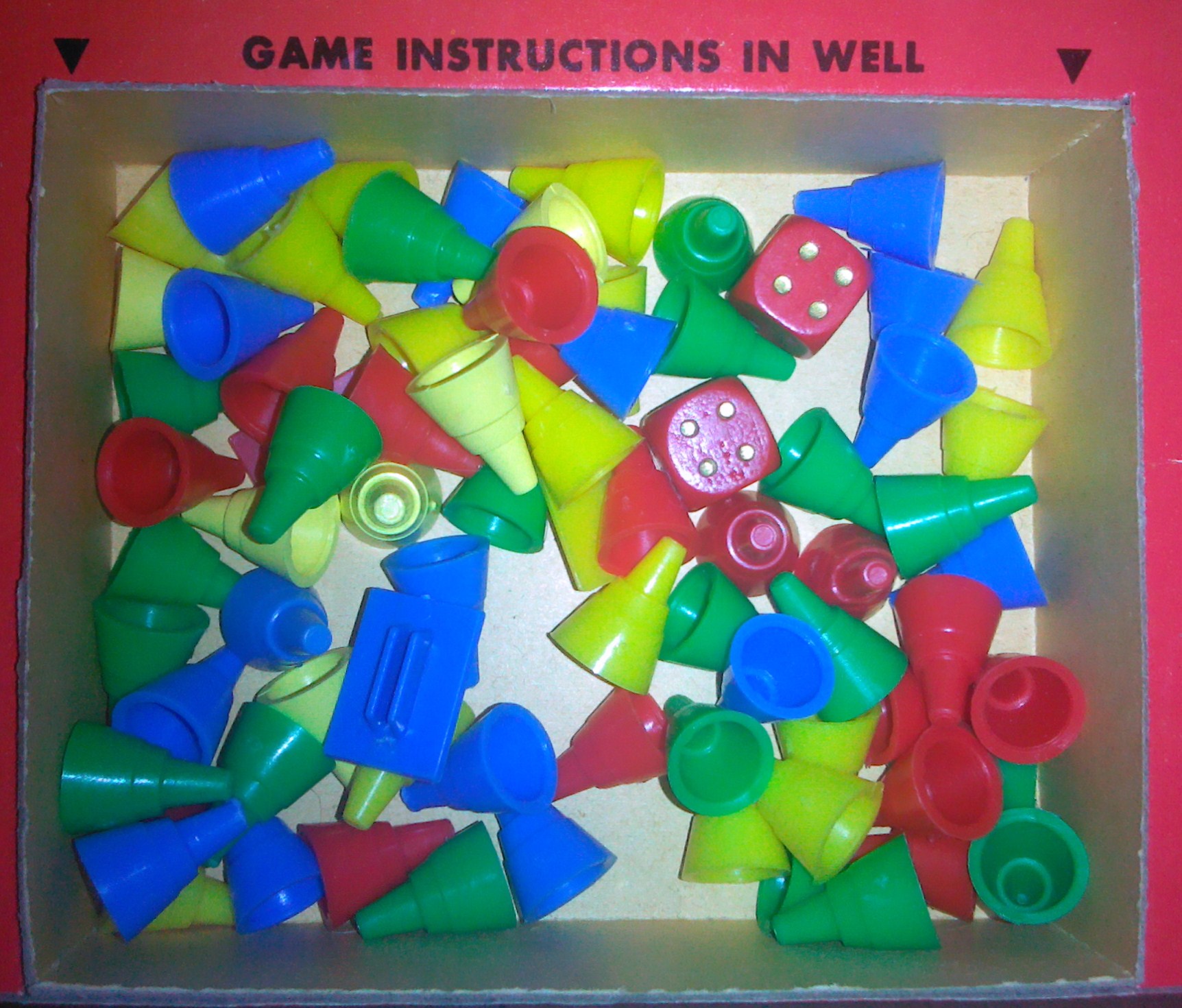
Game Play: No clue. See the well that holds the plastic pieces? See the words that say “Game instructions in well”? Well…not in my well. That’s one of the dangers of buying of vintage games—they’re often incomplete. Dice are included, so obviously Pyle has to move around the board. I’m going to assume that landing on Sergeant Carter’s head is a bad thing.

Game Designer: The box artwork is signed “Hal Greer.” I haven’t been able to find out anything about this artist. I’m guessing he’s not the same person as this Hal Greer.

A close up from the box lid–pretty nice artwork

About Transogram: Game manufacturer Transogram offered many games based on TV shows. As the Polizzi and Schaefer book says: “Transogram personified the close relationship that had developed between television and the toy industry, doing so with imaginative designs that were some of the best of the period.”

My Thoughts: I bought this game a few years ago for my husband, who was a big Gomer Pyle fan as a kid. It was never a

A close up from the game board. Is that Marine smoking?

favorite show of mine, but I would watch it occasionally when nothing else was on.  In fourth grade, our teachers would let us watch TV in the cold lunch room, and Gomer Pyle was our usual lunchtime fare. For that reason, I associate the show with salami and snack cakes.

Previous Entries in this Series:

Charlie’s Angels

Laverne & Shirley

H.R. Pufnstuf

Emily Post Popularity Game