Old-Time Radio Playlist: Edgar Allan Poe

Edgar Allan Poe

October seems like a good time to enter the eerie world of Edgar Allan Poe. Not only is Halloween approaching, but so is the anniversary of Poe’s death. He died on October 7, 1849, at age 40, from unknown causes.

Radio programs presented Poe’s stories often, and it’s easy to see why. They make exciting listening experiences, painting vivid images in listeners’ imagination.

For this playlist, I have tried to gather the widest number of Poe stories from the widest number of radio programs.

Dim the lights, sit back, and lose yourself in the strange world of Edgar Allan Poe.

“And puzzle they did, these French police, and with them the rest of the world.”

“Rue Morgue Mysteries”
Unsolved Mysteries
1949
About this Series: A syndicated 15-minute show, Unsolved Mysteries aired ostensibly true stories and posited solutions to historical mysteries.
Thoughts on this EpisodeUnsolved Mysteries treats Poe’s “The Murders in the Rue Morgue” as a fictionalized account of a true crime, and the show comes up with a different solution to that crime. Poe’s story, history’s first detective story, didn’t have any basis in fact, however. (He did base a later story, “The Mystery of Marie Roget” on a real New York murder.)
Read “The Murders in the Rue Morgue”

“Even after two days at sea, death did not destroy that waxen beauty.”

“The Oblong Box”
The Weird Circle
February 18, 1945
About this Series: Many radio series explored horror and suspense. One thing that differentiated The Weird Circle was its source material; it frequently presented “literary” horror stories, including several of Poe’s tales.
Thoughts on this Episode: This show adds a murderous twist to make Poe’s story even more twisted. It’s an enjoyable adaptation, although the acting gets overwrought at times.
Read “The Oblong Box”

“I determined then to even the score, to revenge the desecration of my name, of my family honor.”

“The Cask of Amontillado”
Hall of Fantasy
January 19, 1953
About this Series: This was another radio show dedicated to tales of suspense and the supernatural.
Thoughts on this Episode: We have no big name stars here, but this is a satisfying dramatization of Poe’s tale of revenge.
Read “The Cask of Amontillado”
“And so it happened, that at the end of a dull, dark, and soundless day in the middle of October, I found myself as the shades of evening drew on, within view of the grim and melancholy House of Usher”


“The Fall of the House of Usher”
Escape
October 22, 1947
About this Series: Escape was “radio’s greatest series of high adventure,” according to John Dunning’s On the Air. It ran from 1947 to 1954, a sister series to the longer-running Suspense.
Thoughts on this Episode: Paul Frees, who plays the narrator, was one of the most prolific voice actors of the 20th century. People unfamiliar with his radio career may know him as Boris Badenov, Burgermeister Meisterburger, or the host ghost in Disney’s Haunted Mansion attraction. His powerful, deep voice brings the dread and decay in Poe’s story vividly to life.
Read “The Fall of the House of Usher”

“You scream with the terror of it! You scream, and scream, and scream!”

“The Premature Burial”
CBS Radio Mystery Theater
January 6, 1975
About this Series: Although not exactly “old-time radio,” CBS Radio Mystery Theater represented the last major gasp of radio drama. The show ran on weeknights from 1974 to 1982. E.G. Marshall hosted, and radio veteran Himan Brown produced the program.
Thoughts on this Episode: Poe’s story barely qualifies as a story at all—it is mostly a rumination on the horror of being buried alive. And Poe sure can ruminate:
It may be asserted, without hesitation, that no event is so terribly well adapted to inspire the supremeness of bodily and of mental distress, as is burial before death. The unendurable oppression of the lungs- the stifling fumes from the damp earth–the clinging to the death garments–the rigid embrace of the narrow house–the blackness of the absolute Night–the silence like a sea that overwhelms–the unseen but palpable presence of the Conqueror Worm–these things, with the thoughts of the air and grass above, with memory of dear friends who would fly to save us if but informed of our fate, and with consciousness that of this fate they can never be informed–that our hopeless portion is that of the really dead–these considerations, I say, carry into the heart, which still palpitates, a degree of appalling and intolerable horror from which the most daring imagination must recoil.

This episode creates a 45-minute story from an incident that is only briefly described in Poe’s story. It does so pretty well, although I found the third act a bit weak. Keir Dullea, best known for his role in 2001: A Space Odyssey, stars in this episode (and many others in the series).

Read “The Premature Burial”

Other Old-Time Radio Playlists

Old-Time Radio Episode Spotlight: Those Magnificent Cats in their Flying Machines

“Clipper Home,” An American in England
December 22, 1942

Norman Corwin was one of the most important creative forces in radio’s golden age. He wrote, produced, and directed several prestigious, poetic shows celebrating American values. In December 1942, TIME wrote, “CBS’s Norman Corwin, top-flight U.S. radio dramatist, went to England last summer to try something that U.S. radio had not done before. He wanted to explain England to Americans by short-waving his dramatized observations of the English.”

This was a huge technical challenge in 1942, and not all the broadcasts from England aired successfully in the United States. After Corwin returned home in the fall, he produced four more episodes, including this final one.

Pyro, of Helensburgh, Scotland, flew on experimental bombing test missions in World War II. Source: WIRRALNEWS.co.uk

Recently, while listening to it, I became fascinated by a short incident near the end. The narrator, slowly making his way home from Great Britain to the United States, meets a U.S. flier in Brazil. With him, the flier carries his “mascot,” a gray kitten name Tiger. The flier says he brought the kitten from his home in New Hampshire and carries him along on all his flying missions.

As a passionate cat lover, I wanted to find out more about Tiger. Unfortunately, my research didn’t unearth any information about him, but I did learn about a flying World War II cat named Pyro. British photographer Bob Bird was working at the Marine Aircraft Experimental Establishment base in Helensburgh, Scotland, when he adopted a stray kitten. Pyro didn’t like it when his owner left to accompany flight crews on experimental bomb tests. Bird started taking Pyro along on the missions; together they survived a crash landing, and Pyro once helped protect Bird from frostbite. Last year, Pyro received a posthumous award for bravery from the United Kingdom’s People’s Dispensary for Sick Animals charity.

At the time of the award, Bob Bird’s son Robin said, “’We are really very proud of Pyro. He was the only flying cat in the Second World War—and any other war as far as we know.”

Even if “Tiger” didn’t really exist, Pyro wasn’t the only flying cat in World War II. The web site Purr ‘n’ Fur has fascinating and comprehensive pages about cats in wartime. You can read about a few flying cats (and even see a picture of a cat of in a military aircraft in flight). You can also learn about ships’ cats, which were much more numerous than flying cats.

To be honest, my first reaction to hearing about Tiger was annoyance that someone had put an animal in such a dangerous situation. I can’t begrudge soldiers and sailors for seeking comfort from a pet, though, and the cats I’ve read about took their “service” in stride. (Why do my cats fuss so much about a car ride to the vet’s?)

The entire series An American in England makes interesting listening for history buffs and Anglophiles, even though it is wordy and rather unsubtle in its propaganda. (This episode also has an uncomfortable segment in which the narrator wonders what’s going through “the simple tribal mind” of a West African native. That segment concludes, however, with hypothetical soldiers expressing sentiments like this: “Listen, I like bread. So does the next guy. I’d like to see everybody in the world get a piece of bread and a quart of milk a day. And that goes for Indians and Eskimos and Hottentots, too.”)

Joseph Julian plays the narrator, who represents Corwin’s viewpoint.

Final Fun Fact: Corwin, who died last fall at 101, once said, “Cats are designated friends.”

Other Old-Time Radio Entries:

Playlist: Till Death Do Us Part

Episode Spotlight: A Snapped-Worthy 1920s True Story

Episode Spotlight: CSI, 1940s Styl

Playlist: London Calling, Part 

Playlist: London Calling, Part 2

Old-Time Radio Playlist: Till Death Do Us Part (And That Might be Sooner Than You Think)

I put this playlist together after noticing how many old-time radio mystery shows had presented episodes titled “Till Death Do Us Part.”

“Till Death Do Us Part”


Suspense, December 15, 1942
“Just remember, I shall be waiting…out, in the dark and cold, where there is neither marriage, nor giving in marriage…I’ll be waiting, for my little pet to come and join me.”
Story: A professor, jealous of his wife’s love for another man, comes up with a clever plan to eliminate both his problems.
Writer: John Dickson Carr, well known Golden-Age mystery writer, who wrote many Suspense episodes.
Notable Cast Members: Peter Lorre, whose voice oozes creepiness, plays the murderous husband. The same year this episode aired, Lorre played one of his most memorable film roles: Ugarte in Casablanca.
About Suspense: Suspense billed itself, with ample justification, as “radio’s outstanding theater of thrills.” Extremely popular, it ran for 22 years (1940-1962). For much of that time, it attracted top Hollywood stars, who often got the chance to play roles that contrasted with their on-screen image. William Spier produced Suspense in its best years and, according to Dunning, “personally guided every aspect of the show, molding story, voice, sound effects, and music into audio masterpieces.”
Weapon of Choice: Aconite, also known as monkshood, a poison.
My Verdict: An entertainingly over-the-top performance by Lorre and a script with several good twists make this a must-listen.

“Till Death Do Us Part”


The Sealed Book, July 8, 1945
“Oh, no, I’ll never leave you, darling. Never, never, never.”
Story: A man is determined to escape his smothering wife—and she is determined to keep him.
About The Sealed Book: A cheesy mystery-horror show with a very cheesy opening sequence, The Sealed Book was a syndicated show that ran for six months in 1945.
Weapon of Choice: The sea.

My Verdict
: A so-bad-it’s-good kind of entertainment. By a few minutes in, you’ll want to kill Blanche, too.

Till Death Do Us Part”


Murder at Midnight, December 9, 1946
“One life has already paid for yours. And, quart for quart, your blood is worth no more than my family’s.”
Story: A newlywed husband is tormented by fantasies of killing his bride.
About Murder at Midnight: Similar in some ways to The Sealed Book, this was a syndicated show with a cheesy opening and ample organ flourishes. The quality is much higher, though. As Digital Deli Too writes, “Anton Leader, later famous for his Television work, directed the series. The writing staff was also top-notch, with names such as Max Erlich, Joe Ruscoll and Robert Newman, among others.”
Weapons of Choice: Strangulation, a gun.
My verdict: This story is clever and complex, and it uses Oscar Wilde’s “The Ballad of Reading Gaol” to eerie effect as a recurring motif. The actress playing the bride gives a good performance.

“Till Death Do Us Part”


Inner Sanctum Mysteries, October 27, 1947
“Oh, baby, how did we ever get into a mess like this?”

Story: Newlyweds are witnesses when a man murders a woman, and their honeymoon just gets better from there.
About Inner Sanctum Mysteries: This was the father of all campy-mystery-horror-with-cheesy-opening shows. Famous for its creaking-door sound effect and its punning host, Inner Sanctum Mysteries ran from 1941 to 1952.
Notable Cast Members: Everett Sloane and Mercedes McCambridge, two prolific radio performers. Sloane was a member of Orson Welles’ Mercury Theater and appeared in the films Citizen Kane and The Lady from Shanghai. Two years after this episode aired, McCambridge would play an Academy-Award-winning supporting role in All the King’s Men. Her movie career would also include providing the voice for The Exorcist’s demon.
Weapons of Choice: A gun, smothering (sort of).
My Verdict: Inner Sanctum has its fans, but it consistently underwhelms me. My mind kept wandering during this one, and the ending didn’t satisfy me.

“Till Death Do Us Part”


The Whistler, April 14, 1948
“He made a mistake–a bad one.”
Story: A shady art dealer meets up with the equally shady young wife of an ailing art collector. This won’t end well for anyone.
About The Whistler: A popular mystery-crime show, The Whistler ran for 13 years. It has similarities to the shows above, except that the episode’s central character is usually the bad guy, whom the narrator addresses directly and tauntingly.
Notable Cast Members: Gerald Mohr was another prolific radio actor whose most memorable role was Philip Marlowe. Doris Singleton would go on to play the recurring role of Carolyn Appleby on TV’s I Love Lucy.
Weapon of Choice: Sleeping pills (sort of).
My Verdict: The Whistler can be hit or miss. This wasn’t an outstanding episode, but it did keep me guessing. I always enjoy Gerald Mohr’s sexy, hard-boiled voice.

“Until Death Do Us Part”


Private Files of Rex Saunders
“It worked. It worked real good.”
Story: A casino owner’s second wife becomes convinced that her husband killed his first wife–and that she is about to be his second victim.
About Private Files of Rex Saunders: This private investigator show was a starring vehicle for Rex Harrison that aired during the summer of 1951. Himan Brown directed the series.
Notable Cast Members: Rex Harrison is best remembered as My Fair Lady‘s Henry Higgins, of course. Leon Janney, who plays the assistant, began his long theatrical career when he was still a child.
Weapons of Choice: Guns.
My Verdict: It’s fun to hear Harrison play a private investigator, and the story has some nice twists.

Old-Time Radio Episode Spotlight: A Snapped-Worthy 1920s True Story

Eve Rablen, the real-life model for Alma in this story. Newspaper crime reporters, showing the restraint they are known for, dubbed her “the Borgia of the Sierras.”

Calling All Cars, December 11, 1934

The story you are about to hear is true. Some of the names have been changed to protect the innocent.

Fortunately, producers didn’t bother to change the name of the town, the sheriff, or the star witness in this story, enabling us to uncover the details of a Snapped-worthy 1920s murder.

Calling All Cars, which aired from 1933 to 1939, was an early police procedural show that focused on real California cases.

Tuttletown is the setting for this episode, and Tuolumne County Sheriff J.H. Dambacher opens the story of what he calls his most interesting case.

First, we hear a crotchety old man scolding his son “Herb” for corresponding with a woman named “Alma”–a woman Herb met through “that there matrimonial agency,” as Pap puts it.

Pap is comically over-the-top with his objections, which include his son’s young age (26) and Alma’s previous marriage (“God-fearing people don’t get dee-vorced!”). Herb doesn’t listen, though. He marries Alma and moves her and her young son in with him and his father.

What could possibly go wrong?

In real life, Herb and Alma were Carroll and Eva Rablen, and the radio drama presents an accurate picture of what happens next. At a school-house dance on April 27, 1929, Eva froliced on the dance floor while her husband waited in the car outside.  At one point, she brought him a cup of coffee. Shortly thereafter, he cried out in pain, told his father that his coffee had tasted bitter, and died.

Sheriff Dambacher tell listeners that the killer was “the last person one would logically suspect.”

That might be true–if one had never encountered a crime story before.

The police investigation nailed Eva pretty quickly. The prosecutor later doubted that he’d ever see such a strong circumstantial-evidence case again. The evidence included:

Post-mortem testing that showed strychnine poisoning killed Carroll.

The discovery of a bottle containing traces of strychnine near the spot where Carroll died.

A druggist’s positive identification of Eva as the woman who’d purchased the strychnine from him a few days before the murder.

Forensic testing that found strychnine present on the coffee-stained dress of another dance-goer. While Eva was taking Carroll his coffee, she bumped into this other woman and spilled some coffee on her.

Prosecutors’ star witness would be Edward O. Heinrich, a forensic science pioneer who earned the nickname “the Wizard of Berkeley.”

Newspapers had a field day with “mail-order bride” murder story, and local interest reached such a pitch that Eva’s arraignment was held outdoors to accommodate crowds.

How could a newspaper make its murder coverage even more disturbing? By using this picture to illustrate Eva Rablen’s “juvenile-minded” nature.

Ultimately, her defense attorneys focused on Eva’s supposedly arrested mental development.

As one expert told the media: “The response of the ductless glands to situations varies with their congenital capacity and acquired susceptibility. In the ability of one endocrine system to inhibit another we have the germ of the unconscious. Hence the modus operandi of the repressions and the supressions, compensations and dissociations, which may unite to integrate, or refuse to integrate, and so disintegrate and deteriorate a personality.”

Well, that makes sense.

I won’t spoil the outcome of this case for you, but you can read more about the case’s resolution and what happened to Eva later in newspaper accounts.


Old Time Radio Episode Spotlight: CSI, 1940s Style

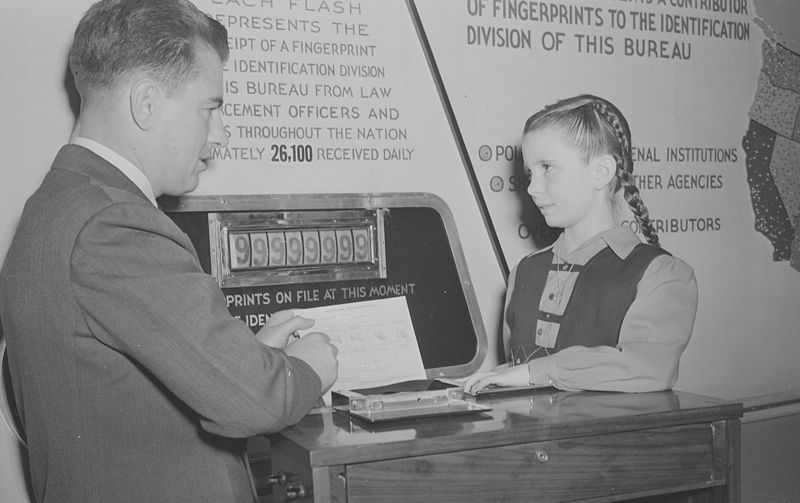
It’s always freaky when several of my interests collide. Crime, old-time radio, and classic movies–it all comes together in this photo of the FBI photographing Margaret O’Brien.

“The 91 million prints we have on file here at the FBI are the biggest man trap ever devised.”

Adventure Ahead, August 26, 1944

This is not a great radio show. In my experience, the cheese factor in old-time radio correlates directly with the number of organ flourishes a show contains. But this show’s subject–how the FBI lab helped police solve crimes in the 1940s–intrigues me.

Adventure Ahead was a Saturday morning show aimed at young boys. In this episode, a boy tours the FBI crime lab and learns how agents help solve crimes through blood and hair analysis, ballistics, and fingerprint identification.

(This show uses what TV Tropes calls the Little Jimmy trope: “Little Jimmy is a young character without any distinguishable traits other than complete ignorance related to the subject at hand. Most likely found in educational films, commercials, and public service announcements. Their only job is to represent the young and stupid viewers of the film who know nothing about common sense and would very well get into a car with a stranger offering candy unless some superhero or other fictional character comes along and tells them that it’s wrong. He’s typically young, white and freckled.” Here, our Little Jimmy is named Tommy.)

Because I live near America’s largest fingerprint database, I paid special attention to the information about FBI fingerprint files. After listening to the show, I couldn’t resist doing some research on the history of fingerprint identification and how the FBI collection has changed over the years.

Soon after J. Edgar Hoover became FBI director in 1924, the Bureau established an Identification Division.
Within nine years, it contained 5 million cards. By 1944, when this radio show aired, these numbers had soared to 91 million. Actress Margaret O’Brien provided the Bureau’s 100 millionth set of fingerprints two years later.

This radio show describes a fingerprint matching system that involved punched cards and “steel fingers.” The FBI first used computers to search fingerprint files in 1980, but didn’t establish a fully computerized system, the Integrated Automated Fingerprint Identification System, until 1999.

The FBI is now building a huge database of other biometric information, from iris scans to tattoos.

Old-Time Radio Playlist: London Calling, Part 2

I continue this week with the second part of my Olympics-inspired playlist.

“Confession”


Escape, December 31, 1947
“You are lost in a London fog, uncertain whether the figures looming around you are real or creatures of your imagination. And somewhere in the wet grayness lurks a murderer, from whom you must escape.”
Story: A Canadian soldier, shell-shocked from his World War II service, becomes disoriented on a foggy London evening and encounters a mysterious woman who soon ends up dead.
Based Upon: A short story by Algernon Blackwood, a prolific and influential author of horror fiction.
Notable Cast Members: Bill Conrad, one the best and most ubiquitous actors in old-time radio, plays the soldier. Fellow Generation Xers will remember Conrad best as TV’s Cannon and Jake from Jake and The Fatman. It can be hard, at first, to erase that visual from your mind as you listen to his radio work. His powerful performances soon engage your full attention, however. In my opinion, he did his finest work as Matt Dillon on radio’s Gunsmoke.
Peggy Webber, who plays the mysterious woman, will be familiar to viewers of TV’s Dragnet because she appeared in roughly a zillion episodes. She also worked as a writer, producer, and director in the early days of television, and she helped to found the California Artists Radio Theatre.
About Escape: Escape was “radio’s greatest series of high adventure,” according to John Dunning’s On the Air. It ran from 1947 to 1954, a sister series to the longer-running Suspense. Several things distinguish the two series. First, Suspense had bigger budgets and, thus, big-name guest stars, throughout most of its run. Those big budgets came from sponsors, which Escape didn’t have. This is a plus for the modern Escape listener—you don’t have to hear, or fast-forward through, grating commercials. (Yes, Autolite, I’m looking at you.) Escape tended to use more exotic settings than Suspense and dabbled more in the supernatural. Also, on Suspense things tended to end well; Escape often went for the darker ending. (I wonder how much sponsors, or the lack thereof, had to do with this.) Both series are excellent—they are in my top five favorite radio shows, and which one ranks higher just depends upon my mood.
My Verdict: This is a solid episode. A sense of dread slowly envelops the listener as the fog envelops Conrad’s character, and the ending is satisfyingly chilling.

“The Hands of Mr. Ottermole”


Suspense, December 2, 1948
“By all means, sergeant, let’s talk about…murder.”
Story: A journalist and a police sergeant talk about a serial strangler who’s menacing London. Since the script takes pains to avoid telling us the men’s names, it’s obvious one of them is the deadly Mr. Ottermole.
Based Upon: A short story of the same name by Thomas Burke, an author who specialized in portraying London and its working-class citizens. Burke published “The Hands of Mr. Ottermole” in 1931. According to Ellery Queen, “No finer crime story has ever been written, period.”
Notable Cast Members: Vincent Price and Claude Rains star in this episode. Price, of course, was made for creepy tales like this, but it’s Claude Rains who really shines.
About Suspense: Suspense billed itself, with ample justification, as “radio’s outstanding theater of thrills.” Extremely popular, it ran for 22 years (1940-1962). For much of that time, it attracted top Hollywood stars, who often got the chance to play roles that contrasted with their on-screen image. William Spier produced Suspense in its best years and, according to Dunning, “personally guided every aspect of the show, molding story, voice, sound effects, and music into audio masterpieces.”
My Verdict: Suspense is another of my top-five shows and an excellent introduction to old-time radio for new listeners. This episode is very good, with a script that keeps you guessing and an outstanding performance by Rains.
Final Fun Fact: Alfred Hitchcock Presents offered a TV adaptation of this story in 1957. You can watch it free via Hulu.

Disaster in London”


Top Secret, August 6, 1950
“I think I will never feel anything again, ever.”
Story: A double agent is collaborating on a scheme to poison the London water supply with deadly bacteria.
Notable Cast Members: Top Secret starred Ilona Massey, or “beautiful Ilona Massey,” as she’s billed here. Nope, I had never heard of her either. She was a Hungarian actress who had a brief movie and television career.
About Top Secret: This NBC spy drama ran for only four months in 1950.
My verdict: This show is interesting. Spies didn’t proliferate in old-time radio the way cowboys and detectives did. Massey’s female spy is not ditzy or dependent on the men surrounding her. She’s a classic spy—world-weary, but brutally efficient. As this episode opens, she’s seeing to it that an enemy agent meets his doom under an oncoming subway train! She shows compassion, however, for the mother of the story’s double agent. This is the first Top Secret episode I’ve heard, and I will definitely seek out more. (Unfortunately, the sound quality is poor.)

“Portrait of London”


The CBS Radio Workshop, July 20, 1956
“This is possibly one of the most lovely views. I thought it was good from Westminster Bridge, but I shall always now think that Big Ben has a very special one. I’m looking directly down on Westminster Bridge, over the Thames. I can see St. Paul’s, and it is the perfect time of day, the end of the day, and the sun is shining.”
About the Episode: Sarah Churchill, actress and daughter of Sir Winston Churchill, narrates a documentary-style tour of London. Her tour includes the London Zoo, where she visits a lion that the Lions Club of America donated to her father; Petticoat Lane Market, where a seller demonstrates small figures of Sir Winston that puff on cigars; a rainy rehearsal for Trooping the Colour; and a trip to the top of the tower that houses Big Ben.
About The CBS Radio Workshop: Coming at the end of the radio era, this was an experimental anthology program that wasn’t afraid to take chances. Dunning quotes CBS Vice President Howard Barnes as saying, “We’ll never get a sponsor anyway, so we might as well try anything.”
My Verdict: This is absolutely charming. The sound patterns and interviews with Londoners and tourists come together to paint a vivid picture of the city. Sarah Churchill was beset by personal problems during the 1950s, but she makes a warm and enthusiastic host here. I’m a lifelong Anglophile, but I’ve only had the privilege of visiting London once. This program made me long to go again.
Google-Worthy References: While visiting Big Ben, Churchill learned that pennies are placed on the clock’s pendulum to adjust its timekeeping for accuracy. I had to know if they still use pennies; they do, although some of the original pennies have been replaced by a five-pound coin that commemorates the 2012 Olympics.
Final Fun Facts: I tried to find out more about Rusty, the lion featured here, to no avail. Rota the lion, presented to Winston Churchill in 1943, is much more well known. Rota died in 1955, so Rusty–whom his keeper says is young–must have been a kind of replacement. (You can see Rota, stuffed, at the Lightner Museum in St. Augustine, Florida.)
My quest to research Rusty led me to some other interesting destinations. This fascinating article describes Churchill’s attempt to bring a platypus to England, and this vintage London Zoo map has wonderful graphics, including an image of Churchill walking his lion and his kangaroo.

Old-Time Radio Playlist: London Calling, Part 1

As a fan of old-time radio, I like to organize shows into topical playlists. The recent Olympic games inspired this list of London-themed episodes. (Part 2 of this playlist.)

“Journey for Margaret”


Screen Guild Theater, April 5, 1943
“A man can’t go on feeling forever. There’s a limit. By and by, he finds himself dead. That’s why I can’t get mad; I’m dead.”
Notable Cast Members: Robert Young, who shows off his fatherly side well before Father Knows Best appeared on radio and then TV, and 6-year-old Margaret O’Brien, recreating the movie role in which she made a name for herself, literally and figuratively. Four-year-old actor Billy Severn also appeared—it must have been terrifying for the director to rely upon such young children in a live radio drama. O’Brien does a great job, and Severn is adorable.
About Screen Guild Theater: This was one of several shows that condensed popular movies for radio audiences. At least the better-known Lux Radio Theater had 60 minutes to work with; 30 minute shows like Screen Guild Theater often leave only a sketchy outline of the movie plot. As John Dunning put it in The Encyclopedia of Old Time Radio, “Screen Guild always seemed like the quick economy tour, jerky and uneven, scenes knit together by thin thread and taxing a modern listener’s willingness to suspend disbelief.”
Story: A war-weary American journalist and his wife, in London during the Blitz, lose their unborn child and decide to adopt a traumatized war orphan.
Based Upon: The successful 1942 movie of the same name, in which Young and O’Brien also starred. The movie, in turn, was based upon the novel by journalist William L. White, and that was based on his true story of adopting a British war orphan. Life ran an interesting story on the “real Margaret” (not revealing that her name was actually Barbara), who would grow up to carry on her family’s journalistic legacy.
Google-worthy References: Ack-ack—Anti-aircraft guns.
Also, when the pregnant wife and her husband share a toast, she drinks milk. This surprised me and got me wondering how long doctors have been advising pregnant women to avoid alcohol. I didn’t find a definitive answer, but this history suggests alcohol’s potential harm has long been common knowledge.
My Verdict: These short movie adaptations work best when you haven’t seen the movie, which I haven’t in this case (although I want to now). As a radio story, it feels complete, and Robert Young and the children give enjoyable performances.

“Berkeley Square”
Everything for the Boys, February 8, 1944


Dangerously Yours, September 24, 1944


Hallmark Playhouse, March 3, 1949


“Out of what’s wrong with this world came a better time, and somehow the same will happen out of the struggles of my world.”
Based Upon
: The John L. Balderson play Berkeley Square, which was a hit when it opened in 1929. This time-travel romance was also a hit with old-time radio audiences, if you can judge by the number of shows that adapted it.
Story: Peter Standish longs to leave the 20th century behind. Obsessed with the diaries of an 18th century ancestor, he soon finds himself living his ancestor’s life. Complications arise when he falls in love with the sister of the woman his ancestor married.
Setting: Berkeley Square, a perennially fashionable London neighborhood.
Notable Cast Members: Ronald Colman plays Peter on Everything for the Boys, a wartime dramatic anthology. Greer Garson plays his love interest, Helen. Victor Jory stars in the Dangerously Yours episode. David Niven stars in the Hallmark Playhouse version.
About the Programs: Everything for the Boys ran for 21 weeks, with Colman hosting and starring in each episode and the legendary Arch Oboler writing and directing. Each episode ended with a short-wave call to fighting men overseas—this was a major technical challenge then and didn’t always work. The romantic anthology Dangerously Yours was also a short-lived 1944 show with a regular leading man—Victor Jory. After 16 episodes, it morphed into Vicks Matinee Theater. The high-toned Hallmark Playhouse presented Hollywood stars in literary adaptations.
My Verdict: Without having seen or read the play, I can’t say which version adapts it most faithfully. In all three versions, the time travel is abrupt and unexplained. The Everything for the Boys script adds an extra layer of resonance to the play by giving it an explicit World-War-II context. This makes it easier to see why Peter wants to escape the 20th century, why Helen is so horrified by her vision of the future (she sees men, women, and children being herded into open graves), and why Peter feels he must return to his own time and address its challenges.
Final Fun Facts: Oboler and Colman did not enjoy their collaboration. In fact, Dunning quotes Oboler as saying, “We hated each other’s guts.”
Also, Leslie Howard starred in the original Berkeley Square play and the 1933 movie version.

“It’s Always Tomorrow”


Words at War, January 2, 1945
“I’m gonna keep an eye on certain people here in England…and if they try to cheat us out of anything we’ve won in this war, then we’ll see if we can arrange another direct hit, especially for their benefit.”
Based Upon: It’s Always Tomorrow by Robert St. John, a journalist whose life spanned the 20th century and whose adventures spanned the globe. (He reminisces about his career in Studs Terkel’s Coming of Age—thanks, old-time radio, for making my to-be-read list even longer.)
Story: An American journalist assigned to London finds himself disgusted by out-of-touch, imperialist aristocrats. He falls in love with Polly, a bitter working-class woman, who refuses to support a war she thinks will benefit only the rich.
Notable Cast Members: Cathleen Cordell, who plays Polly, went on to have a long career as a character actress in television. I think William Quinn, who plays Dave, may be the same person as Bill Quinn, another prolific TV character actor.
About the Program: Words at War was a dramatic anthology that told timely stories from the world’s literal and figurative battlefronts. The New York Times called it “the boldest, hardest-hitting program” on the air.
My Verdict: Once you get past some heavy-handed British stereotypes, this is an interesting, nuanced story. Polly is a shockingly unpatriotic character by wartime radio standards. At one point, she even cries, “Let Germany win! Let Germany win!” Dave, playing devil’s advocate, tries to convince her that World War II is a “people’s war.” He interviews working people who are glad to make sacrifices and an aristocrat who is paying 97.5 percent of his income in taxes, but Polly remains unconvinced. When Dave loses his leg in a bombing, I thought sure the writers would give Polly a quick attitude change. She does agree to take Dave’s place in a war plant (where he’s begun working because his newspaper superiors banned him from writing about war’s effect on “the little people”). She stresses, however, that she’s making this choice based on love, not patriotism. A reviewer of St. John’s novel noted favorably that the book “makes a passionate plea for general understanding of the bitter hatred the common people in war-torn countries feel toward rulers who quit them ingloriously, shamefully, taking with them their loot and their foolish hides.” In the 1950s, author Robert St. John was blacklisted as a Communist, a label he disavowed. It’s sad but not surprising that his concern for the world’s common people would suggest Communism to 1950s red hunters.
Final Fun Fact: At one point, Dave and Polly visit a pub, where the crowd sings this song.