Family Affair Friday: Season 1, Episode 9, “A Matter for Experts,” 11/14/1966

I’m back this week with a full installment of my Family Affair Friday series.

Season 1, Episode 9, “A Matter for Experts,” 11/14/1966

Aired: 11/14/66. Teleplay by: Joseph Hoffman and John McGreevey. Story by: Joseph Hoffman. Directed by: William D. Russell.

Synopsis

The school vice principal, Miss Bryant, tells Uncle Bill that Buffy and Jody are completely dependent on each other and should be placed in separate classrooms. Uncle Bill resists at first, saying that being orphaned, separated for a year, and then shipped to a new home in strange city might be enough adjustment for the time being. Ya think?

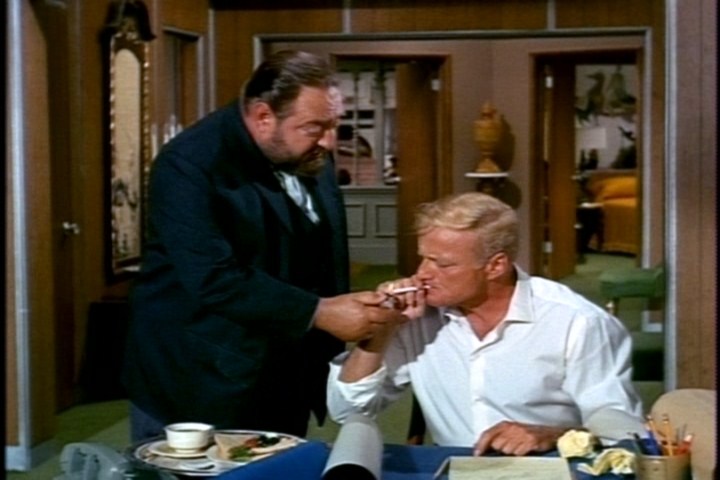
All the stress drives Uncle Bill to his cigarettes, and sets him to whining about the challenges of sudden parenthood.

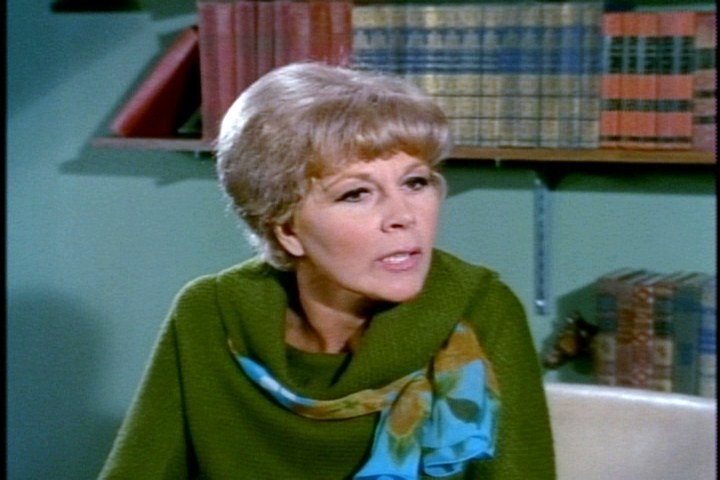
He takes the twins to child psychologist Edith Morse, who agrees that the twins need to develop individual interests.

If Dr. Morse was so smart, would she really choose the ugly Family Affair green for her office walls?

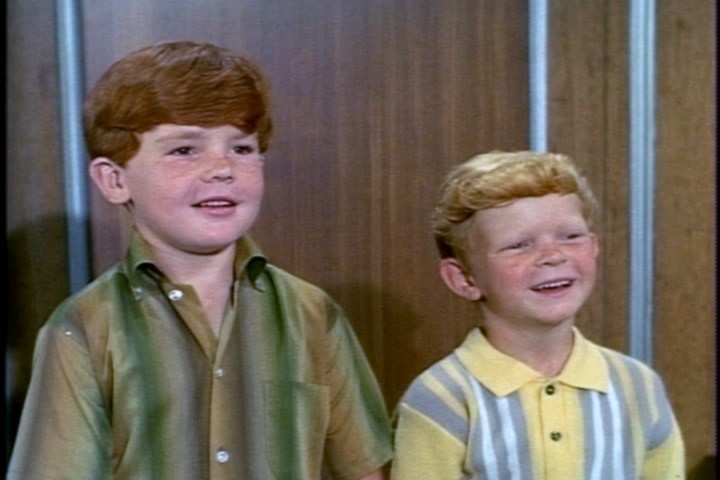
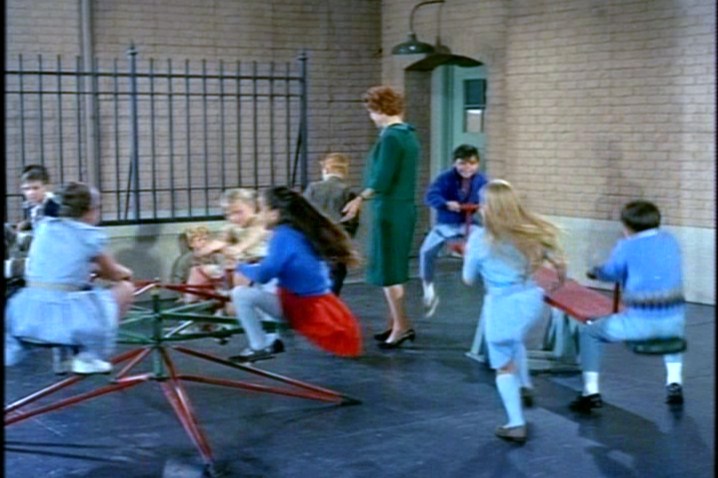
They are separated at school and shepherded into separate past-times, but they remain united in their imaginative play.

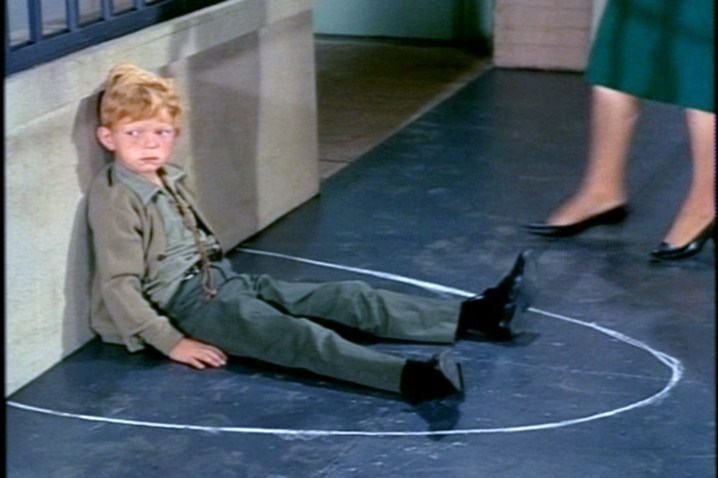
At recess, Jody pretends he’s traveling in a spaceship.

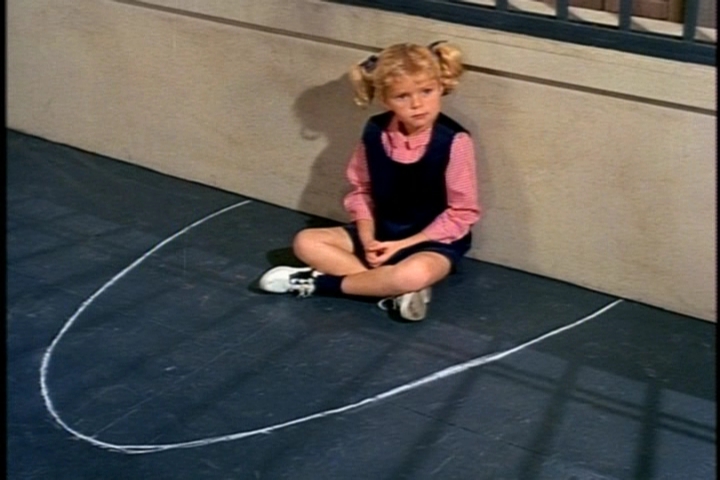
During her separate recess, Buffy pretends she’s part of ground control. Gender difference?

Jody does find a friend, Peter.

It’s surprising that Jody found a friend first. He’s usually portrayed as the less competent twin, in every way.

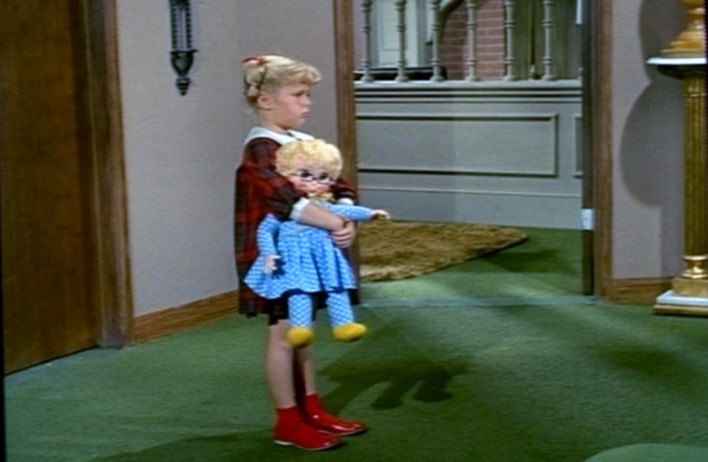
Buffy’s attempts at friendship fail, however, and she’s morose.

Buffy haz a sad.

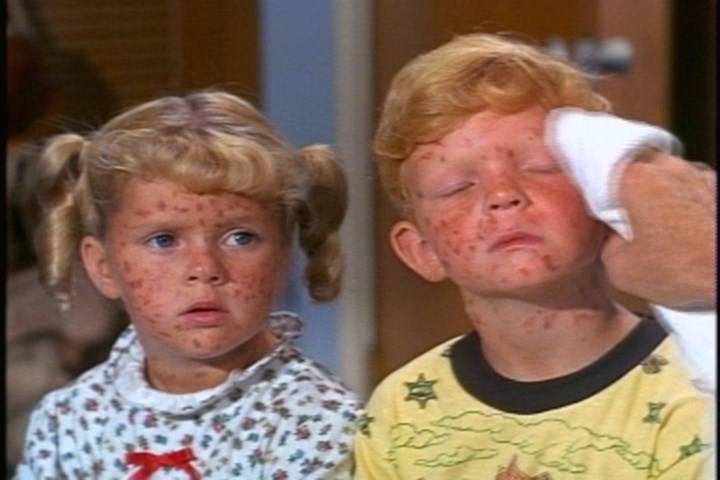
Finally, the kids concoct a case of the measles to avoid school altogether.

Busted!

Uncle Bill decides to trust his instincts and reunite them.

Random Thoughts

At the beginning of this episode, I was indignant at the experts who wanted to split up twins. By the end, Buffy’s complete inability to function without Jody did seem worrisome.

Guest Cast

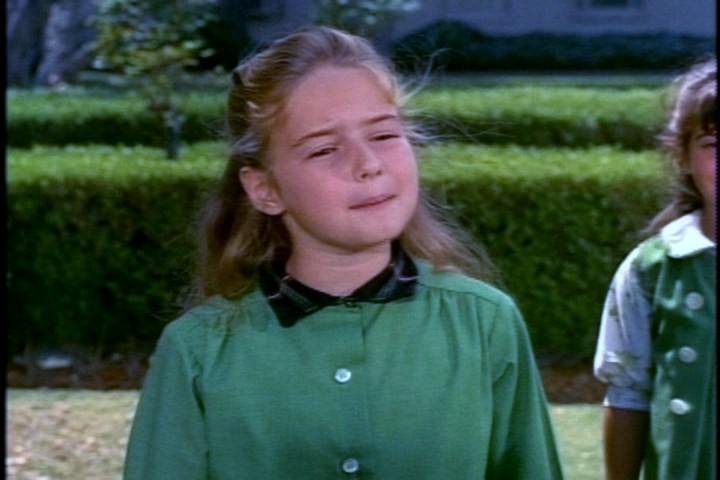
Miss Bryant: Sarah Selby. Dr. Edith Morse: Jean Engstrom. Barbara: Kym Karath. Peter: Randy Whipple. Mrs. Hughes: Susan Davis. Kym Karath was Gretl in The Sound of Music and Pattie-Cake in Spencer’s Mountain. On The Brady Bunch, she appeared as Kerry in “Cyrano de Brady.”

Kym Karath

She would appear on one more episode of Family Affair. Randy Whipple appeared in no less than 11 episodes. He also played one of Jerry Van Dyke’s kids in My Mother the Car.

Fun Facts

The twins attend PS 724. Cissy frequents The Gourmet Hamburger and doesn’t “dig” geometry. Buffy begins ballet lessons.

PS 724 has a really crappy playground.

Continuity Notes

Jody’s turtle gets another mention.

Extraordinary Event

Uncle Bill actually takes the kids to the park himself–twice!

Today’s Bonus Feature

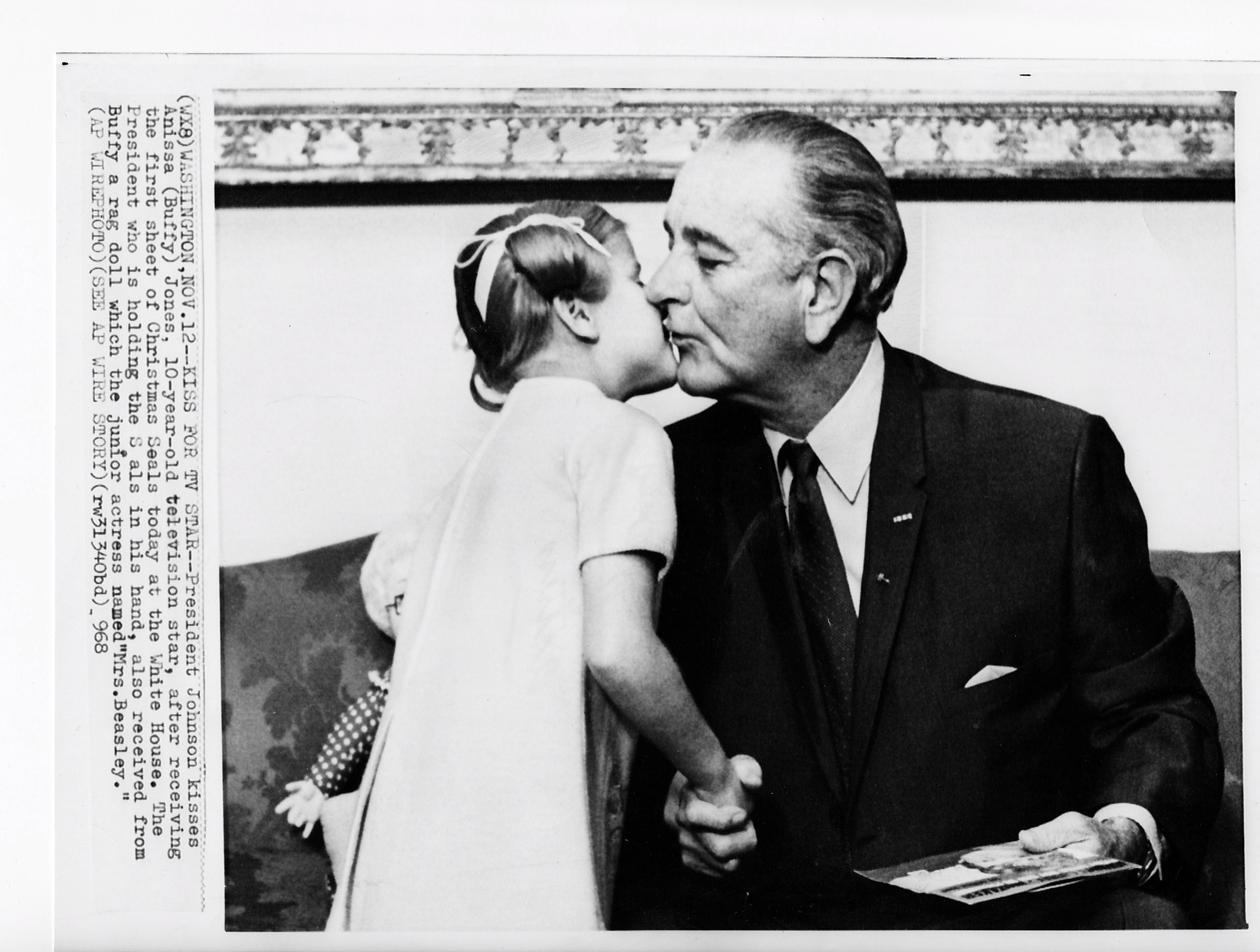
In honor of the U.S. presidential election this week, I present a photo that unites Family Affair and the American presidency. This Associated Press photo shows Anissa Jones getting up close and personal with President Lyndon B. Johnson during a Christmas Seals event on November 12, 1968. I can’t decide if this photo is sweet or creepy.

The caption reads: KISS FOR TV STAR–President Johnson kisses Anissa (Buffy) Jones, 10-year-old television star, after receiving the first sheet of Christmas Seals today at the White House. The President who is holding the Seals in his hand, also received from Buffy a rag doll which the junior actress named “Mrs. Beasley.”

Read the whole Family Affair Friday series.

Weird Words of Wisdom: Speak Softly and Carry a Hot Breakfast Edition

“It is not enough, if you want to be liked, if you want to be loved, to be merely good. You also have to fight for the good things you want. You have to compete with other girls. What’s more you have to make up your mind to win. Otherwise you’ll not have your pick of the best boys. You’ll only have what’s left over.”

Once Upon a Dream: A Personal Chat with All Teenagers, 1960
By Patti Page

About the Book: Patti Page opens up about her own weaknesses and insecurities as she tells young fans her Cinderella story–a story that transformed Clara Ann Fowler, “that shy, overfed, part Cherokee choir singer from Claremore, Oklahoma,” into a “Singing Rage.” (Although a Cinderella motif pervades the book, the title references a song from Walt Disney’s 1959 film Sleeping Beauty.)

As we’ve seen before in this series, celebrity-written advice books for teens proliferated in the 1950s and early 1960s. While I always wonder how much the celebrities actually “wrote,” I found this book’s voice consistent and believable.

About Patti Page: All I knew about Patti Page going into this book was that she sang “How Much is That Doggie in the Window?” and “The Tennessee Waltz.” The latter was one of the best-selling songs of all time, and Page was the top-selling female artist in the 1950s.

Her rags-to-riches story had a genuinely ragged start—she was the 10th of 11 children, and money was so scarce that she sometimes went to school barefoot. In this book, she tells a moving story about the time she wanted a Mickey Mouse watch so badly that she made one out of paper.

She made up her mind to escape poverty and began to plan for a career as a commercial artist. She took a job making posters at a Tulsa radio station, soon found herself performing on the air whenever they needed a girl singer, and was “discovered” when band manager Jack Rael passed through town and heard her voice on the radio.

To her teenage readers, Page presents herself as shy and insecure, with ongoing weight issues. She talks about a period in her life when she burst into tears after every performance, and she uses the language of psychoanalysis freely.

She writes a lot about her husband, choreographer Charles O’Curran, whom she married in 1956. She doesn’t mention that she had an earlier, short-lived marriage, or that she was O’Curran’s third wife (Betty Hutton was his second). Page and O’Curran would divorce in 1972.

I’ve chosen some of Page’s sillier-sounding statements to feature here, but this book actually gives plenty of good advice. She encourages girls to be themselves, to care about others, and to develop their minds. Though she has a typically 1950s obsession with “femininity,” she advises girls against playing dumb and against letting boys get in the way of their dreams. She even manages to talk about religion without sounding preachy.

Today, at 85, Page is still performing.

Quotes from Once Upon a Dream: Inner and Outer Beauty

“Charm is simply the art of being pleasing…charm is the magic wand that can transform an ugly duckling into a princess, or a shy quiet type into the belle of the ball.”

“The girl who thinks she can get by with an overweight figure by calling attention to her face is only fooling herself. Eventually people notice her figure too. In the same way, the gayest of hats will not make up for a shabby pair of shoes. A tight-fitting sweater is a poor substitute for a bad complexion. No matter how elaborately you do your hair, which may be your good feature, how long do you really think it will keep people from noticing your teeth, which may not be so good?”

Examples that prove personality is more important than beauty: Helen Hayes, Lynn Fontanne, Katharine Cornell, Mary Martin, Ethel Merman. (“True, they’re older now than when they first rose to fame on Broadway, but even in their youth they were never what we might call great beauties.”)

“Once a week…is usually enough to keep the average girl’s hair clean. Thursday or Friday night’s the best time to do it—so you’re all set to look your best for the week-end.” Ew. If I followed this schedule, even as a middle-aged woman, my scalp could help America achieve energy independence.

“If you’re young and healthy, your eyes have enough sparkle and fire without needing any ‘extra added attractions.’ Besides, if you’re an adolescent, you’re mysterious enough. Mascara and eye shadow would make you positively inscrutable.”

“It’s impossible to apply rouge so that it looks natural on tender young cheeks…If you feel you’ve absolutely no color at all, I’d rather you pinched your cheeks—as grandmother used to. After all, she got her man.”

“A lipstick should not only blend with your own coloring but with the color of your dress.”

“The more inconspicuous your clothes, the better. “You don’t want them to distract attention from you. (It is only older women who tend to wear startling colors and daring designs to make up for tired faces and bad figures.)” She’s starting to hurt my feelings now.

Getting Along with Boys

“If you can’t be empathetic, at least be observant, especially when it comes to boys. It’s not so hard to figure out what gives them pleasure and what makes their hair stand on end.”

“Very often, for women especially, conversational ability is only a talent for listening rather than for talking. Of all the women I know, the one I have most often heard described as a brilliant conversationalist scarcely says a world. But when she sits listening to a man, she looks at him as intently as though he were first man she had ever met, and as though speech were something he had just invented.”

“Passion is violence. It is loss of reason. It is a loss of control so complete that it’s too late to say yes, no, or maybe…So the only way to handle an invitation to passion is to say No! And make the reason for your no a moral one.”

“…at one time, a woman’s greatest pride before marriage was in her chastity. It was proof she was good and pure in heart. It meant she had something precious and rather wonderful to give to the one man of her choice. But to take away this pride in virtue and to joke, as some people do, about virginity is to cheapen something rather wonderful. To indulge in sex as a biological act, rather than an expression of love, is to strip a woman’s life of dignity, meaning, and fulfillment.”

“For all their teasing and loose talk, boys—and men, too—are really looking for a girl with the courage to have standards and the wisdom to say no. It’s true, if you say no, there’s a chance you’ll never see the young man again. But there’s an even greater chance he’ll ask you to marry him.”

“There are, so far as I know, only two types of males who don’t resent an aggressive female, and I don’t think you want either of them. One is the vain ladies’ man who waits for girls to call him. He appreciates each call. It’s a tribute, he feels, to his irresistible charms. But this type of man is incapable of love. He can love only himself. The second is the weakling type, with a domineering mother, who likes girls who take charge because they remind him of his mother.”

About the kind of girl who’s a pal to boys: “This type of girl, like most people on earth, eventually does get married. It isn’t necessarily a romantic marriage. In fact, it’s usually a sensible one. But it works because both husband and wife are comfortable.”

“If you will just remember that woman’s traditional role is to help a man make something of himself, you will realize that there is always the chance that you can help the drip of today become the man of the moment tomorrow.”

“When you’re shopping for a dress, do you like to have three to choose from or thirty? Well, it seems to me that choosing a husband is a much more vital decision. And how can a girl be sure she’s making the right choice if she only knows the three or four boys she’s gone steady with?”

“And necking, contrary to popular belief, is not a way to hold a boy—it’s a sure way to lose him. No boy values anything that is too easily won. What’s more, nothing remains static. Necking either develops into something more, after a while, or it dies. Either way, you stand a good chance of the boy’s losing interest in you.”

Marriage and Femininity

“My advice to you is to have a career—not instead of marriage but before it. A career is not only, in my opinion, your best preparation for marriage, but the most enjoyable way to pass the time until you’re over 21 and ready for marriage.”

“…your generation seems to know—at a much younger age than I ever did—that for a truly feminine woman, the only true answer to life is a marriage based on true love.”

On keeping her weight down: “…it’s no longer a matter of professional pride alone. Loving my husband, I have also learned what it means to be a woman. So it’s now a matter of personal pride—the pride of a woman who is loved—that I be as pleasing as I can to my husband. (And my husband just doesn’t happen to like overweight women.)”

“…many men in enumerating the qualities they expect of the ideal woman or the model wife say, ‘Above all she must have a soft voice.’”

An interesting quote, considering that she and her husband had both been married before: “Divorce takes a terrible emotional toll. Something that is sweet and lovely and trusting seems to vanish forever from your life. Sure, you can make a second, more sensible marriage, but it won’t be the romance the first one was when you had the thrill of sharing that first apartment, that first ice cube, maybe even that first baby.” First ice cube?

“…the only way to get a man to come home every night and want to stay there is simply to make your home the place where he enjoys himself the most.”

“I think you’ll find, when your married, that it isn’t nearly so important for you to be interesting as it is to make your husband feel that he’s interesting.”

“The main purpose of marriage, which some people forget, is not just to find someone to share a life with, it’s to raise children. This is why you were born, and why you used to play with dolls.”

“I read somewhere that 60 percent of American husbands get their own breakfasts while their wives stay in bed. To me, this is a sign of trouble…How can (a wife) expect her husband’s continued love if she won’t even get up when he does and see him off to work?”

If you enjoyed this post, take a look at the whole Weird Words of Wisdom series.

And, if you want to see Page in action, here is a 1956 episode of The Patti Page Show.

Family Affair Friday: TV Radio Show, November 1967

I’m on vacation this weekend, so I can’t bring you a complete installment of Family Affair Friday. Instead, I’m offering this cute photo feature on Anissa Jones and Johnny Whitaker from the November 1967 issue of TV Radio Show. (Does anyone recognize this amusement park? The signage looks pretty rinky-dink, even by 1967 standards.)

Old-Time Radio Playlist: Halloween, Part 2

Last week I presented some Halloween “treats” from the world of old-time radio—lighthearted holiday episodes. Today, I’m offering a few “tricks”—spooky Halloween episodes and a few classic horror stories.

Enjoy—and let me hear from you. What are your favorite old-time radio Halloween episodes? What’s your favorite show in the suspense or horror genre?

November 7, 1937
Columbia Workshop, The Horla

By early radio standards, this is a good adaptation of a creepy Guy de Maupassant story.

July 11, 1938
Mercury Theater, Dracula

This is faithful adaptation with a great cast: Martin Gabel (if you’ve seen What’s My Line? re-runs, you may remember him as Mr. Arlene Francis), Agnes Moorehead, and, of course, Orson Welles. The Mercury Theater’s actual Halloween episode, The War of the Worlds, might seem more appropriate for this playlist, but I wanted to choose something slightly less well known.

February 20, 1944
The Weird Circle, Frankenstein

Many radio shows adapted Mary Shelley’s story—I picked this version rather randomly. I’d love to hear opinions about the best radio Frankenstein.

October 27, 1947
Quiet Please, Don’t Tell Me About Halloween

“Marry in haste, repent at leisure” takes on new meaning when your spouse is immortal. This is an entertaining episode of Quiet, Please, a series of psychological horror stories that aired from 1947 to 1949. Wyllis Cooper created the show and wrote every episode—an amazing feat, in my opinion. Not every episode is brilliant, but they are all interesting. This episode has a bonus for me as a Guiding Light fan: Charita Bauer, who played Bert on GL, is the female lead.

January 10, 1948
Favorite Story, Dr. Jeckyll and Mr. Hyde

Ronald Colman hosted this series, which presented a classic story each week, supposedly picked by a celebrity. Colman tells us that Alfred Hitchcock picked this classic Robert Louis Stevenson story. Radio stalwart Bill Conrad gives powerful performance in the dual role.

October 31, 1948
Quiet Please, Calling All Souls

This episode has a good story, but the organ music grates—that’s one aspect of old-time radio I just don’t love.

October 31, 1949
Inner Sanctum Mysteries, A Corpse for Halloween

I’m not a big Inner Sanctum fan, and this story loses me a little. It does have compensations, however: Its Halloween setting, its tiger motif (I like anything cat-related), and its star—Larry Haines. As with Charita Bauer, I know Haines from the world of daytime TV drama; he played Stu on Search for Tomorrow for 35 years. He was also a prolific radio actor, and he gives a good performance here as a guy who’s cracking up.

March 14, 1951
NBC Short Story, The Lottery

Long before there was The Hunger Games, there was this classic Shirley Jackson story. No one faces any monsters here; the horror that unfolds is the horror that human beings can inflict on each other when they cling blindly to destructive traditions. Even when you know what’s coming, the end packs a huge punch. The music is appropriately haunting.

October 30, 1976
CBS Radio Mystery Theater, The Witches’ Sabbath

This story doesn’t reference Halloween, but its subject matter suits the holiday. Once again, we encounter Larry Haines as a man cracking under a strain—his performance is even better here than in the Inner Sanctum Mysteries episode above. The conversations between his character and the bartender amused me.

Enjoy more old-time radio playlists:

Halloween, Part 1

Edgar Allan Poe, Part 1

Edgar Allan Poe, Part 2

Spin Again Sunday: Addams Family Card Game

For this pre-Halloween edition of my series on vintage games, I bring you an altogether ooky diversion.

This Week’s Game: Addams Family Card Game, 1965

Recommended Ages: 7 to 15.

Game Play: While I usually focus on board games, this is a simple card game. Cards show pictures of Addams Family characters. Gomez, Morticia, and the children each appear on 11 cards. Six wild cards show Lurch and Uncle Fester. The game proceeds like the game War. The player who amasses all the cards wins.

As the instruction card puts it, “Each character has the power to TAKE another. Gomez TAKES Morticia…Morticia TAKES the Children…the Children TAKE Gomez. The Lurch and Uncle Fester (Wild) cards are most powerful; they TAKE any of the other cards.”

It’s certainly fitting that Gomez TAKES Morticia. Was there ever a more passionate married couple in the world of classic TV?

Family Affair Friday(ish): Season 1, Episode 8, Who’s Afraid of Nural Shpeni?, 11/7/1966

I apologize for my lateness in bringing you this installment of my weekly Family Affair series.

Season 1, Episode 8, “Who’s Afraid of Nural Shpeni?”

Written by: Cynthia Lindsay. Directed by: William D. Russell.

Synopsis

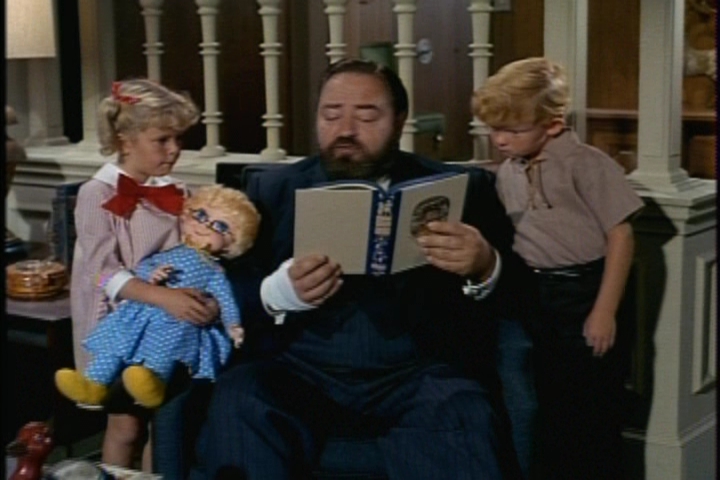
A Middle Eastern theme pervades this episode, which begins with French reading to the twins about Sinbad the Sailor.

Jody seems pretty excited about this story.

With Uncle Bill soon to return from a project in Beirut, French decides to brush up on his Lebanese culinary skills. But a trip to Fuad’s Middle Eastern Delicacies leads to cooking lessons from Nural Shpeni and then to her family’s demands that French marry her.

The prospective bride. French could do a lot worse.

Dr. Sarkis, an associate of Uncle Bill, reminds Nural’s brothers that the traditions they are relying upon to force French into marriage also demand a large dowry from them.

When Buffy and Jody open the door and see this group, they scream and run. It’s kind of funny, if politically incorrect.

French is thrilled when Nural finally announces she’d rather marry Officer Chamas, the local cop on the beat.

Vic Tayback as the cop. Hmm, Mr. French or Mel Sharples? Tough call.

Random Thoughts

This is the episode the Cleveland Amory mocked in his TV Guide review of Family Affair. It is pretty bad, actually. It’s always fun to see Mr. French in a state of extreme discomfort, however. And it has some other compensations.

Compensation 1: French using a hookah!

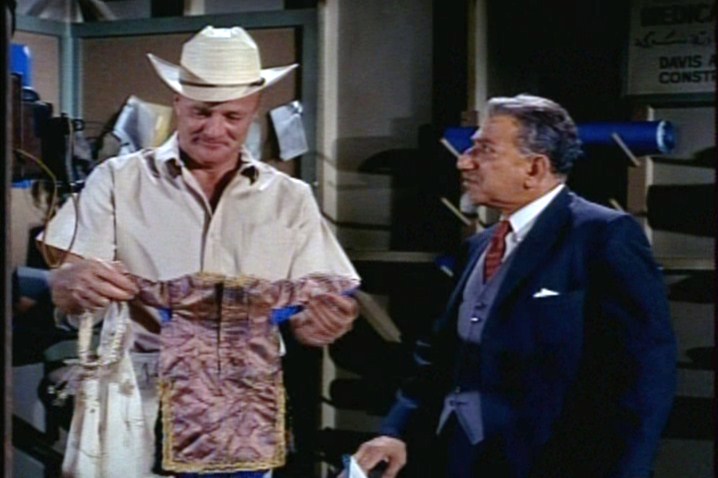
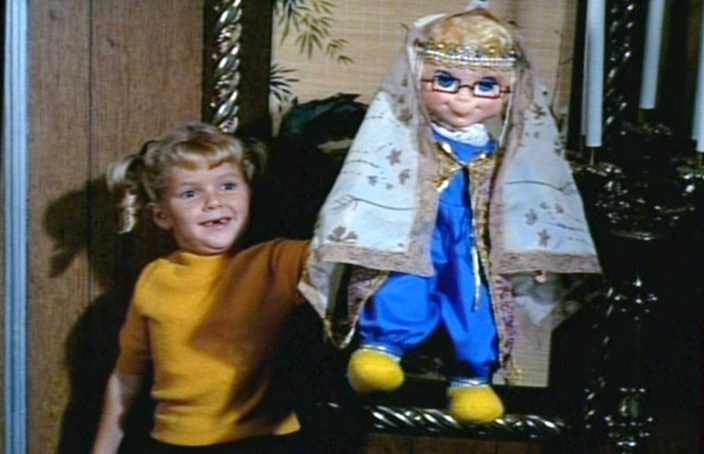
Compensation 2: Uncle Bill buys Mrs. Beasley this cute outfit in Lebanon.

Here she is later wearing the outfit.

Guest Cast

Fuad: Nestor Paiva. Nural: Magda Harout. Alam: Henry Corden. Mohad: Peter Manahos. Policeman Chamas: Vic Tayback. Old woman: Kay Koury. Dr. Sarkis: Abraham Sofaer. Most familiar is Vic Tayback, who played Mel in the 1974 movie Alice Doesn’t Live Here Anymore, as well as the subsequent TV series Alice. Nestor Paiva, who had a long career in movies, died before this episode aired. Magda Harout, on the other hand, is still alive and continued to act as recently as 2010, with an appearance on Fringe. Attention Seinfeld fans: she appeared as Stella in the 1991 episode “The Pen.” Henry Corden voiced many cartoon characters, including Fred Flintstone. He was Marcia’s boss, Mr. Haskell, in the ice cream parlor episode of The Brady Bunch.

Fun Facts

Mr. French speaks Arabic and once worked for the Shah of Morocco. Jody is five minutes older than Buffy.

Read my whole Family Affair series!

Today’s Bonus Feature

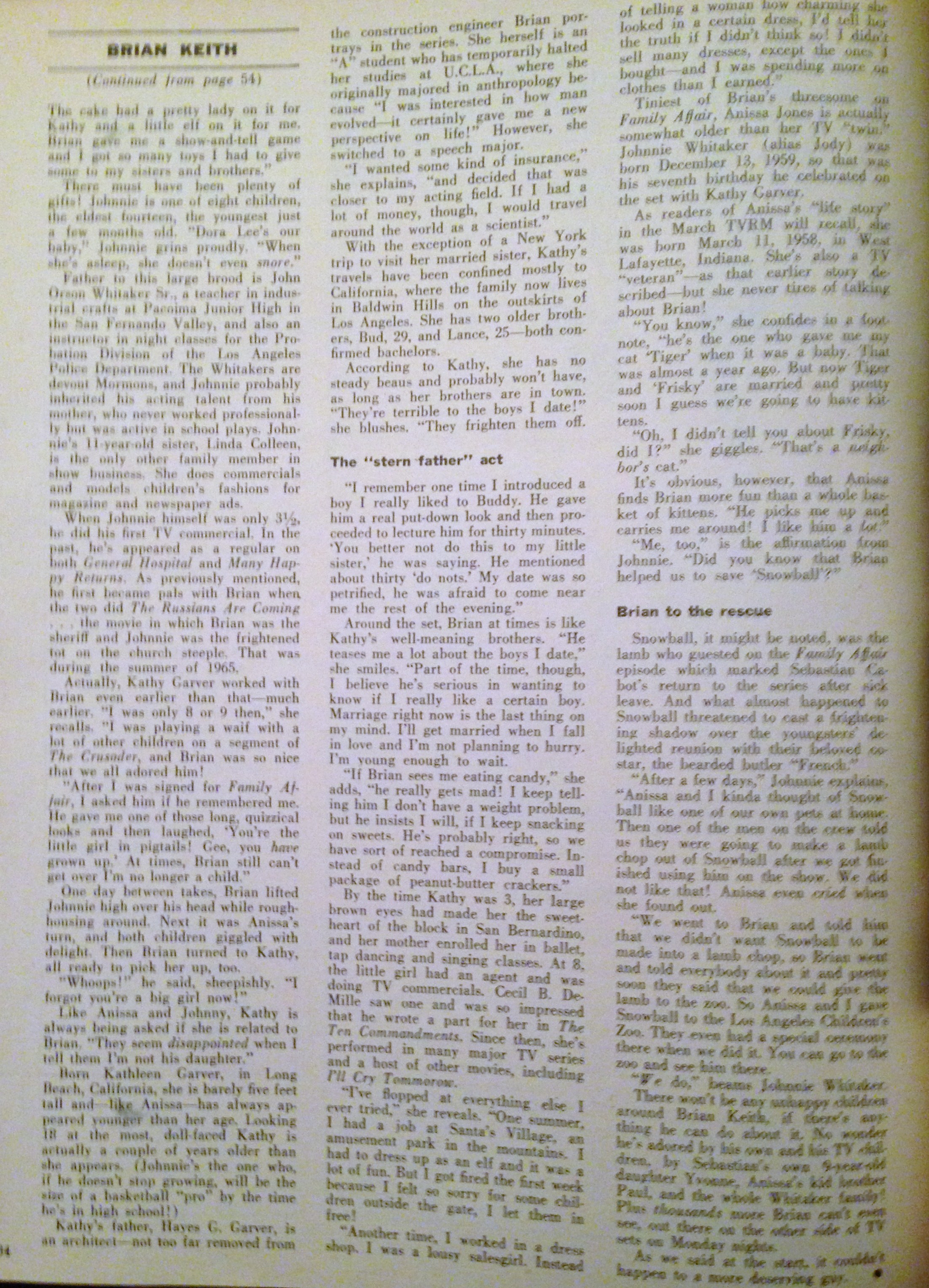
An article from TV Radio Mirror, July 1967. These fan magazine articles are not to be trusted completely, but the photos are nice. Here, you can see Johnny Whitaker’s real family.

Old-Time Radio Playlist: Halloween, Part 1

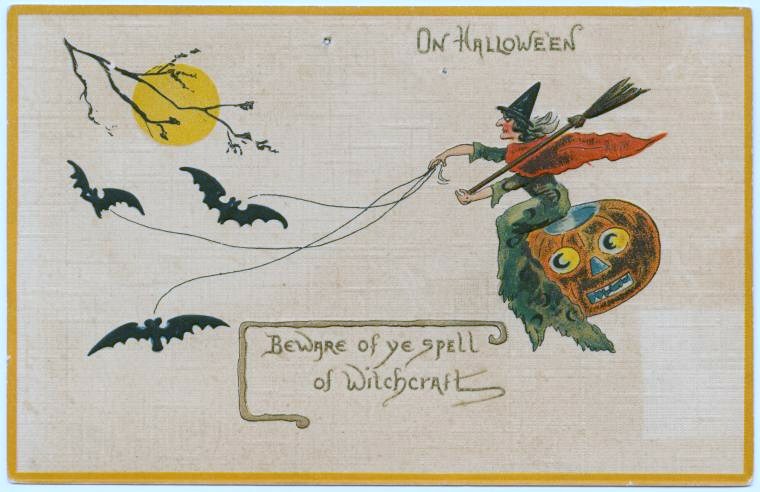
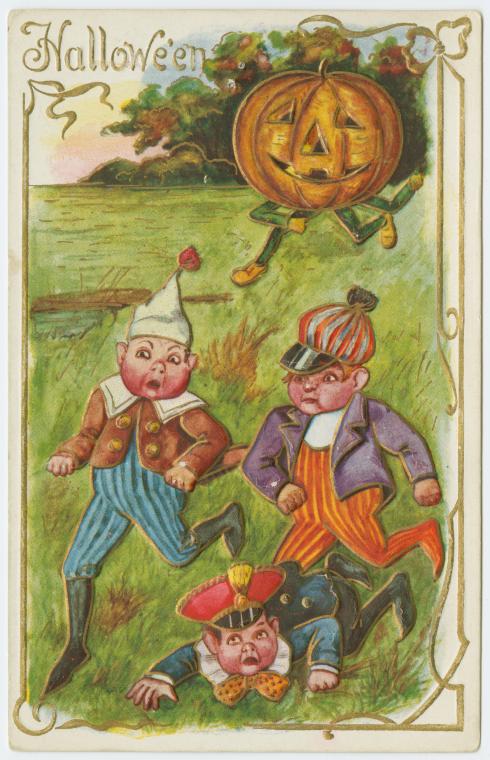
Vintage Halloween Postcard from The Public Domain Review

Today, I present a selection of Halloween treats–some lighthearted old-time radio episodes that capture an interesting period in the history of Halloween.

(On Tuesday, October 30, I’ll post some Halloween”tricks”–spooky holiday offerings and classic horror stories.)

European immigrants to the United States popularized Halloween celebrations in the late 19th century.

By the turn of the century, there was a move to downplay the scarier aspects of the holiday. According to History.com, “Halloween parties for both children and adults became the most common way to celebrate the day. Parties focused on games, foods of the season and festive costumes.”

By the 1920s and 1930s, pranks were a big part of the holiday, “often devolving into vandalism, physical assaults and sporadic acts of violence.”

Most of these radio shows date from the 1940s, when trick-or-treating was just beginning to transition into a community-sanctioned, kid-friendly activity. I’m guessing that’s why so many of the adults in these shows seem ambivalent about Halloween–looking back fondly on their own parties and pranks, but wary of letting their children participate in trick-or-treating.

Unknown Date
Air Castle, Halloween

Air Castle was a children’s show that ran in the late 1920s and early 1930s. It was entirely the work of Baron Keyes, who starred as the “Story Man” and provided voices and sound effects to represent various fanciful characters. This Halloween episode is cute!

October 19, 1933
Martha Meade Society Program, Halloween Parties

This cooking show provides a nice slice of 1930s life. From this and other radio shows, I’ve gleaned that doughnuts were a popular Halloween tradition in the early 20th century.

October 24, 1939
Fibber McGee and Molly, Halloween Party at Gildersleeve’s House

This would be a good starter episode for a new Fibber listener. It’s filled with typical wordplay and punning humor, and most of the classic supporting characters appear.

October 31, 1940
The Aldrich Family, Halloween Prank Backfires

Just about every episode of this family comedy involves a misunderstanding that snowballs out of control. These Halloween hi-jinx are typical.

November 2, 1941
Jack Benny, Halloween with Basil Rathbone

I’m in love with the Jack Benny Program. To really appreciate the series, you need to listen to a long run of consecutive episodes. Characterizations and jokes build from week to week. This is my favorite of several Halloween episodes–Jack annoying his Beverly Hills neighbors is always a win.

October 29, 1944
Edgar Bergen and Charlie McCarthy, Halloween

Guest star Orson Welles is quite amusing, especially when he ad-libs.

October 29, 1944
The Life of Riley, Haunted House   

Near the end, this takes a surprisingly sharp turn into patriotic messaging. You’ll have that sometimes in World-War-II-era programs.

October 31, 1944
Lum and Abner, Discuss Halloween Pranks

Lum and Abner has been growing on me lately, and this episode is a cute one.

November 1, 1946
Baby Snooks, Halloween

Fanny Brice’s mischievous Baby Snooks is a natural for Halloween pranks. This episode has a strong start, but a weak finish, in my opinion.

October 29, 1947
Philco Radio Time, Boris Karloff and Victor Moore

Boris Karloff was the go-to guest for variety-show Halloween episodes. Here, he’s the guest of Bing Crosby, and he and Bing actually sing together (along with comedian Victor Moore)!

October 31, 1948
Adventures of Ozzie and Harriet, The Haunted House       

I always found the TV version of Ozzie and Harriet bland, but the radio episodes I’ve listened to have been surprisingly chuckle-worthy.

October 31, 1948
Adventures of Sam Spade, The Fairly-Bright Caper    

I’m not a huge Sam Spade fan–ditzy Effie gets on my nerves–but this has a nice Halloween flavor.

Oct 31, 1948
Jack Benny, Trick or Treating with the Beavers

This is another good Halloween episode, with an inventive way of bringing the supporting cast into the story.

October 31, 1951
The Great Gildersleeve, Halloween and Gildy Finds a Lost Boy

I’m not the biggest Gildy fan, but this episode has great warmth.

November 7, 1951
The Halls of Ivy, Halloween

I really enjoy this series, which stars Ronald and Benita Colman. Having spent plenty of time in academia, I appreciate the college setting, and the Colmans are just charming.

Oct 29, 1953
Father Knows Best, Halloween Blues

Robert Young’s character is in preachy mode, and the end doesn’t work for me, but this is an interesting look at those changing Halloween customs.

Listen to more old-time radio!