Spin Again Sunday: Gomer Pyle

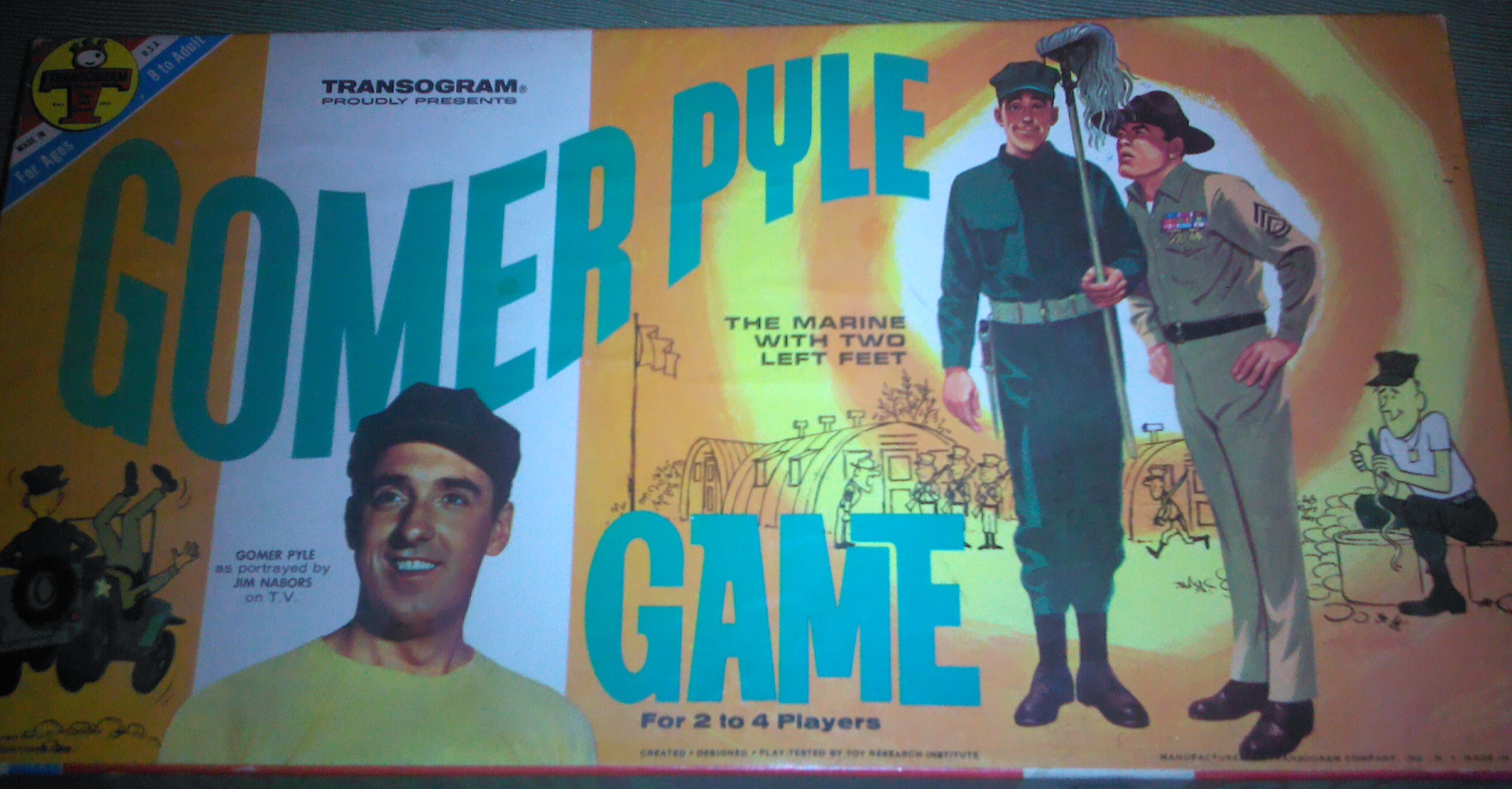
Gomer Pyle Game, 1964

Today’s Game: Gomer Pyle

Copyright Date: 1964 (I got that date from the book Spin Again by Rick Polizzi and Fred Schaefer. The box is undated.)

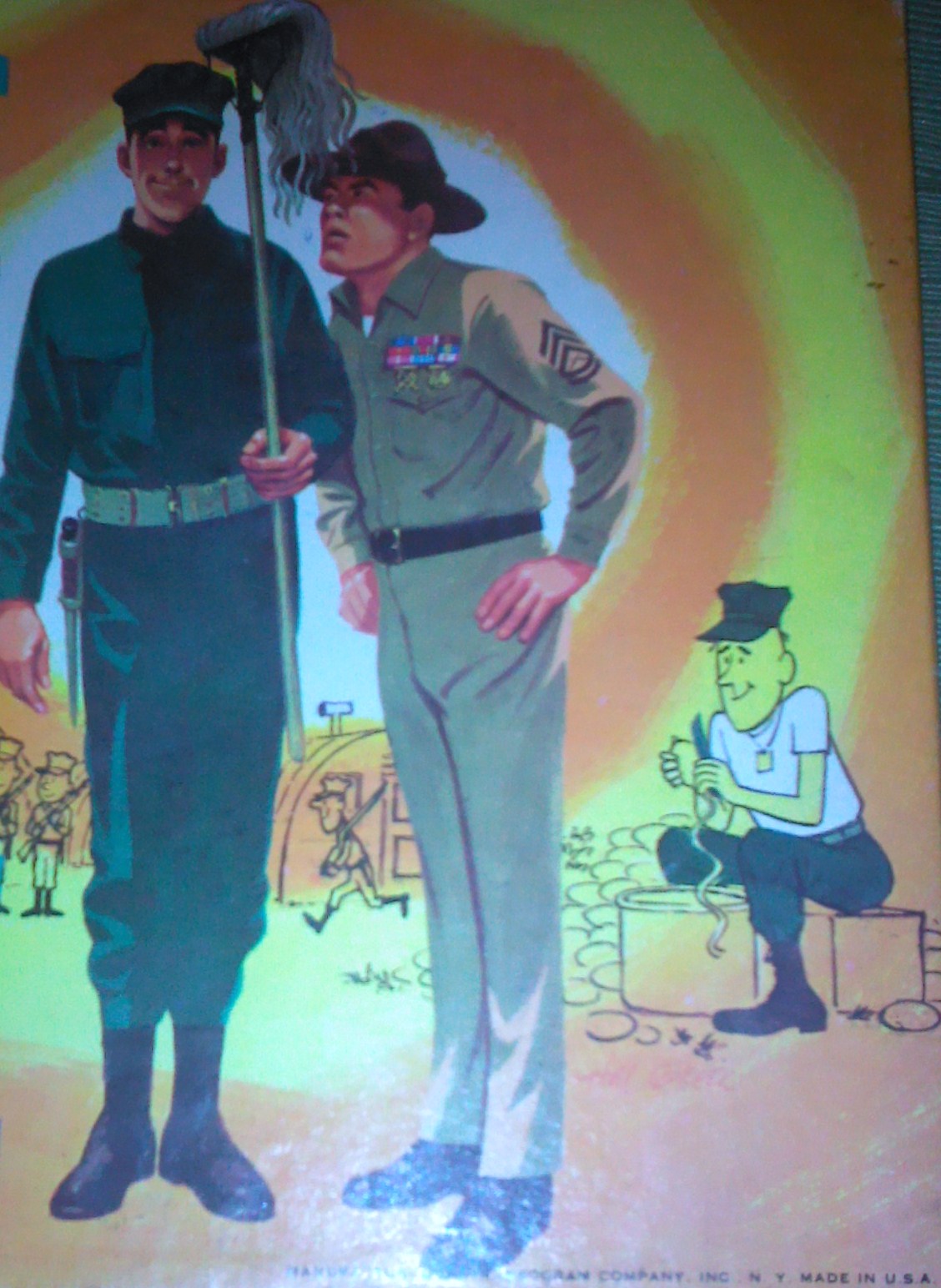
Game Board: Visually striking, with the marching Marines cutting a green swath across the mustard-yellow background, and red Sergeant Carter squares popping up regularly. The guy peeling potatoes seems to be smoking—that’s something you wouldn’t see on kids’ game today.

Game Board

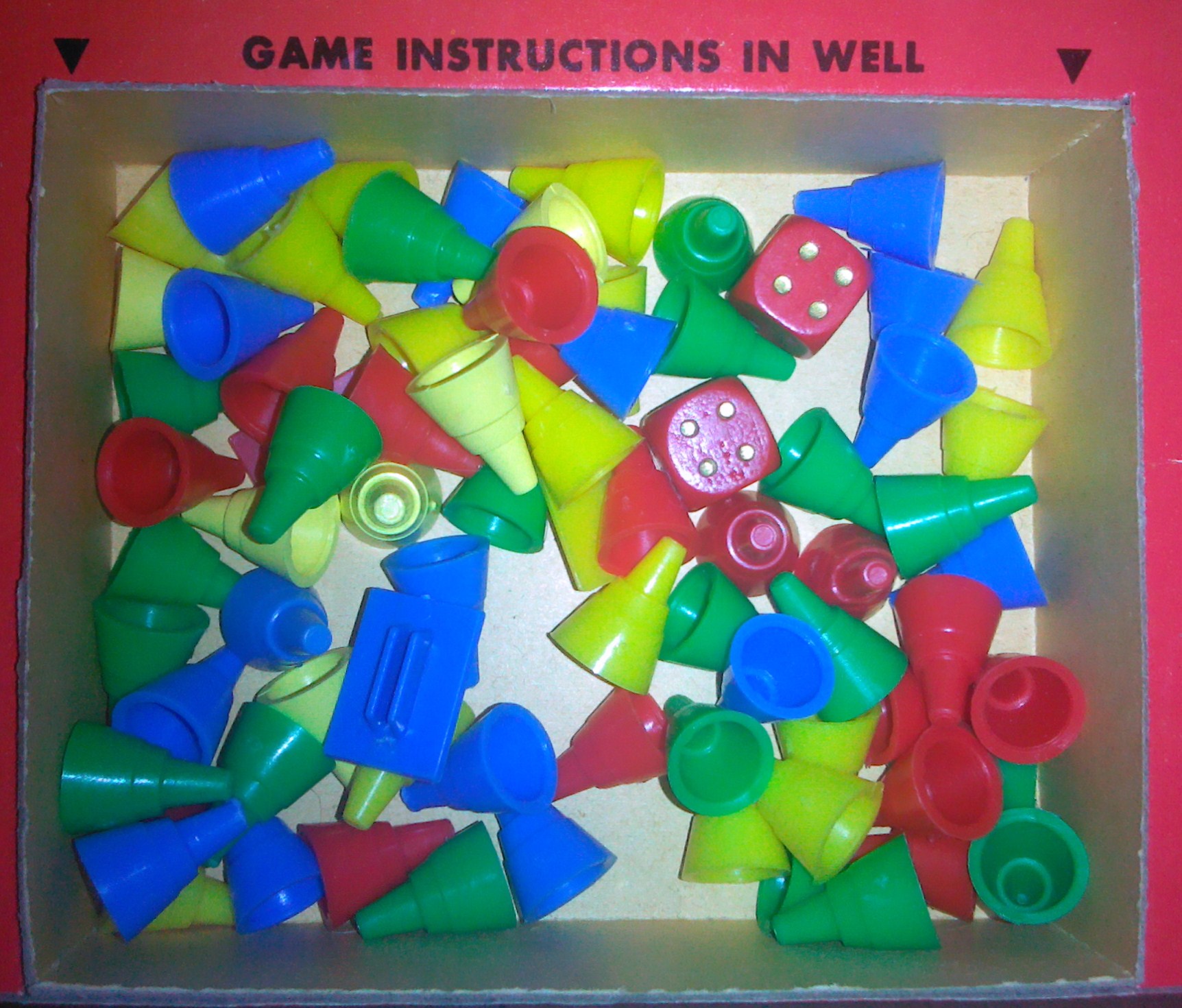
Game Pieces: Brightly colored plastic pieces and cartoon cutouts of Pyle.

Recommended Ages: 8 to Adult.

Game Play: No clue. See the well that holds the plastic pieces? See the words that say “Game instructions in well”? Well…not in my well. That’s one of the dangers of buying of vintage games—they’re often incomplete. Dice are included, so obviously Pyle has to move around the board. I’m going to assume that landing on Sergeant Carter’s head is a bad thing.

Game Designer: The box artwork is signed “Hal Greer.” I haven’t been able to find out anything about this artist. I’m guessing he’s not the same person as this Hal Greer.

A close up from the box lid–pretty nice artwork

About Transogram: Game manufacturer Transogram offered many games based on TV shows. As the Polizzi and Schaefer book says: “Transogram personified the close relationship that had developed between television and the toy industry, doing so with imaginative designs that were some of the best of the period.”

My Thoughts: I bought this game a few years ago for my husband, who was a big Gomer Pyle fan as a kid. It was never a

A close up from the game board. Is that Marine smoking?

favorite show of mine, but I would watch it occasionally when nothing else was on.  In fourth grade, our teachers would let us watch TV in the cold lunch room, and Gomer Pyle was our usual lunchtime fare. For that reason, I associate the show with salami and snack cakes.

Previous Entries in this Series:

Charlie’s Angels

Laverne & Shirley

H.R. Pufnstuf

Emily Post Popularity Game

Family Affair Friday: Episode 2, Jody and Cissy, 9/19/66

This is part of my weekly series about the classic CBS sitcom Family Affair

Episode 2, Jody and Cissy, 9/19/66.
Written by: Edmund Hartmann and Henry Garson. Directed by: William D. Russell.

Synopsis

When Uncle Bill calls home from Peru, he is surprised to learn that Cissy has joined the household. Upon his return, he make plans to send her back to Indiana. Overhearing him, Cissy pretends she wants to go. When she says she thinks it’s foolish, at her age, to “believe in the magic of people loving and caring,” Uncle Bill feels guilty and decides she should stay.

Real subtle, Cissy.

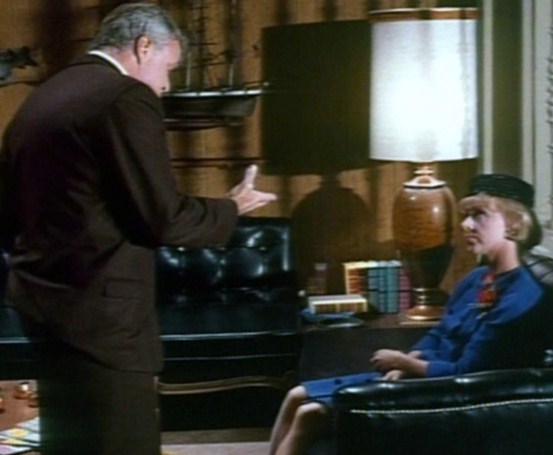
Fashion Note: Cissy wears a cute suit in this scene.

This almost leads to another departure–that of French, who believes the three children require a housekeeper/nanny (“a middle-aged, well upholstered, kindly and experience” housekeeper/nanny). When Buffy slips her beloved Mrs. Beasley in French’s suitcase to keep him company, French is touched and returns to the Davis household.

Real subtle, Buffy.

Seriously, these girls have man-management skills that would make Enid Haupt proud. Well, I guess an orphan’s gotta do what an orphan’s gotta do.

Random Thoughts

Buffy and Jody are adorable again–I especially like Buffy’s description of slippers as “hairy shoes.”

So much awww…..

I also like that the kids’ emotional troubles haven’t instantly disappeared. Jody has a nightmare and cries out for his mother, while Buffy mentions crying at night while Uncle Bill was gone. I’m glad that Uncle Bill relents and lets Jody sleep with him after the nightmare.

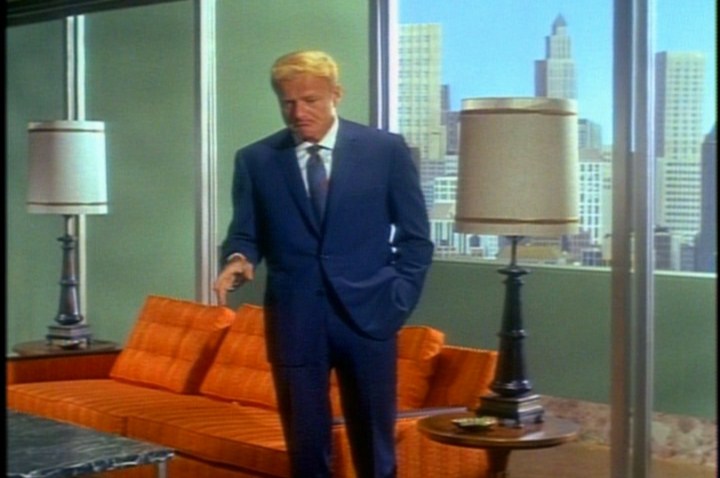
This green paint shows up everywhere on Family Affair. It goes especially well with the orange couch in Uncle Bill’s office. Speaking of color, what’s up with his hair.

Continuity Nod: Buffy mentions that Mrs. Beasley now has glasses. Actually, the doll’s whole face has changed since the pilot–thank goodness.

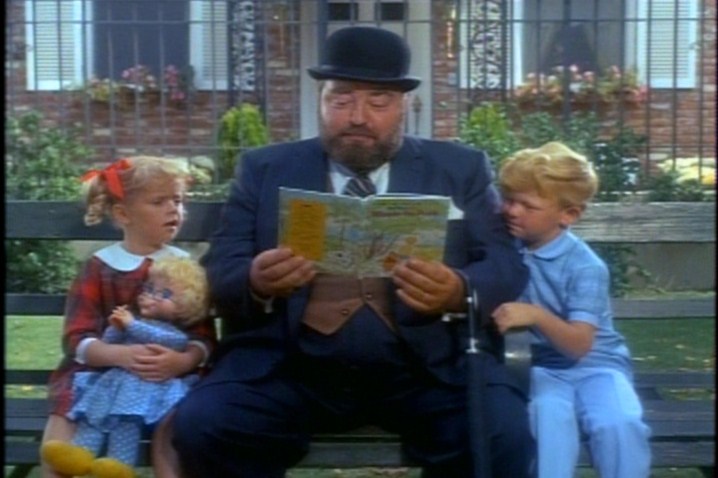
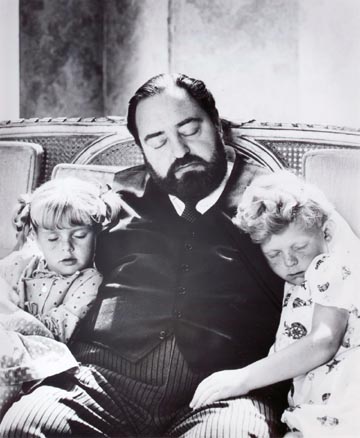
Real-Life Shout Out: Mr. French reads Winnie the Pooh to Buffy and Jody. Sebastian Cabot narrated several animated Winnie the Pooh stories, starting the same year this episode was made, 1966.

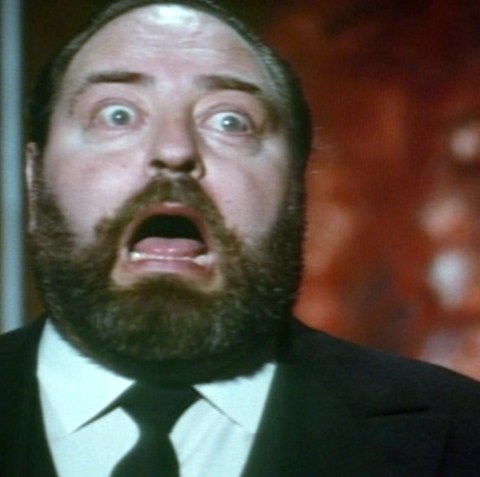
The perfect person to read Winnie the Pooh.

Guest Cast:

Hardcastle: Noel Drayton.

Miss Lee: Betty Lynn.  She played Thelma Lou on The Andy Griffith Show. She would return three times as Uncle Bill’s secretary.

Radio Operator: James Victor.

Fun Facts: Uncle Bill has done some big game hunting. Jody doesn’t care for baths, at least those given by women. Uncle Bill smokes. Jody has a turtle. Cissy is 15. Uncle Bill’s secretary, Miss Lee, makes her first appearance.

Vintage Sitcom Cliche: The bouncy instrumental “teenage music” Cissy plays.

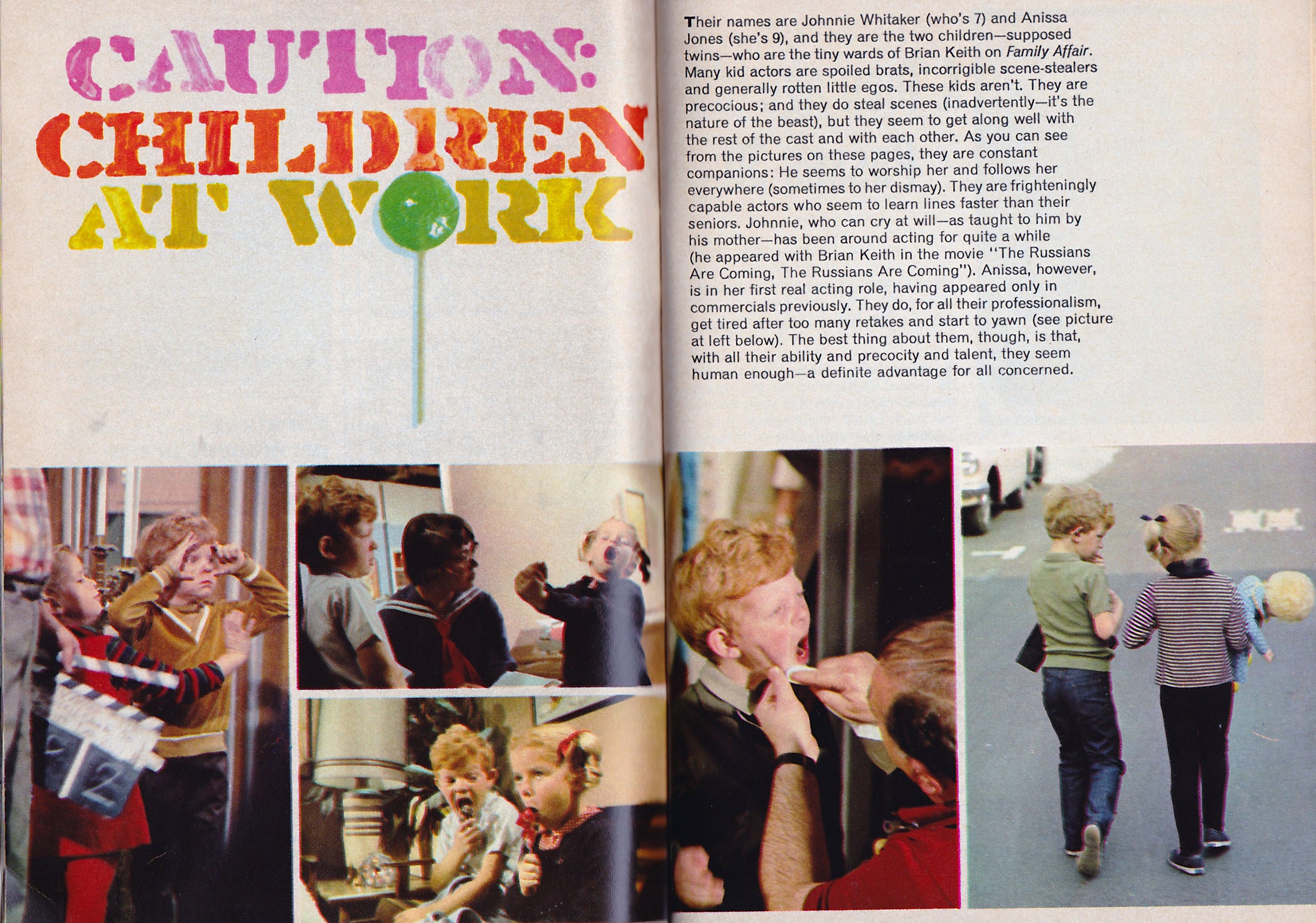
This Week’s Bonus Feature: A photo story about Johnny Whitaker and Anissa Jones on the Family Affair set, from TV Guide, June 24, 1967.

TV Guide, June 24, 1967

Other Entries in this Series

Weird Words of Wisdom: Twin Sister Smackdown Edition

…or, Whose Vintage Advice to Teens is Weirder—Ann’s or Abby’s?

Dear Teen-Ager by Abigail Van Buren, 1959

Ann Landers Talks to Teen-Agers About Sex, 1963

“Just as ‘liquor is quiquor’ is a way to a neat little plot in the cemetery, it can also be a jet liner to sextra headaches.”—Abby

“You wouldn’t take a diamond and platinum brooch to try to pry open a jar of pickles with it, would you? Using sex in the wrong way adds up to the same thing.”—Ann

About the Authors: Identical twins Pauline and Esther Friedman, the children of Jewish immigrants, were inseparable as children. As Morningside College co-eds, they collaborated on an advice column for the school paper. They married in a double wedding. And they built matching careers—Esther became Ann Landers in 1955 at the Chicago Sun-Times; Pauline because the San Francisco Chronicle’s Dear Abby three months later.  Both their columns were hits in syndication. Ann Landers eventually reached 90 million readers, and Abby reached 80 million by 1995. Pauline’s daughter Jeanne Phillips started co-writing Dear Abby with her mother in 1987 and took over all writing duties by 2002, after Pauline was diagnosed with Alzheimer’s disease. That was also the year Esther died, bringing the Ann Landers column an end.

The Ann-Abby Feud: Understandably, Esther resented Pauline’s decision to start a rival advice column. The sisters went through a period of estrangement that included the publication dates for both these books. In 2005, Esther’s daughter, Margo Howard, published a collection of letters she’d received from her mother through the years.  Complaints about “Popo” (Pauline’s family nickname) figure prominently. “I can’t cut her out of my life completely, no matter how loony she gets,” one letter from 1981 reads. “She is too much a part of me, but I must myself protect against her in some way. She is too unpredictable—and destructive.”  

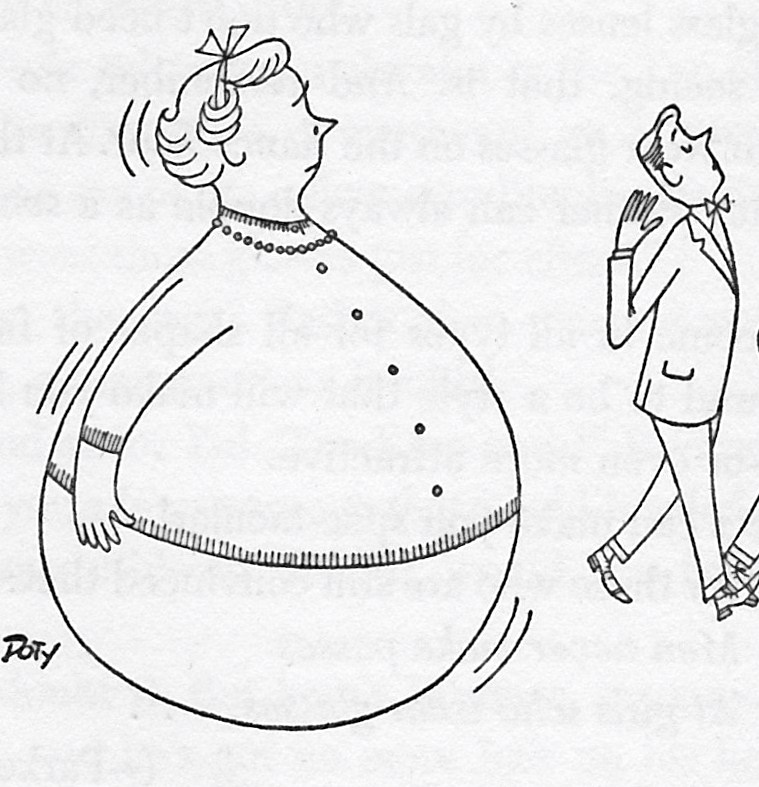
From Abby’s book, a sensitive illustration of the problems facing overweight teens

About the Books: The books’ titles reflect their differing focuses. Abby’s book covers various teen topics, from dating to dealing with teachers, from grooming to smoking. Ann’s book takes dead aim at the sex stuff. (That’s probably what most teens skipped to in comprehensive advice books, anyway.)

Changes in society probably influenced the difference in focus. Although only four years separated the books, those four years saw rapid changes in sexual mores. “The pill” became available for contraceptive use in 1960, and by 1963, America was on the cusp of sexual revolution. Of girls who turned 15 between 1954 and 1963, 48 percent had premarital sex before age 20. For girls who turned 15 between 1964 and 1973, the figure rose to 65 percent (Source: The Alan Guttmacher Institute).  

Differences in Tone: Abby’s writing style is much cutesier, and her book includes cutesy illustrations, as well. Ann can get a bit sassy, but mostly adopts a down-to-earth style. This reflects a real difference in their early advice-giving styles. As Time wrote in 1957, “Abby’s replies are slicker, quicker, and flipper.”

Examples of this style in Dear Teen-Ager include:

“If you’re under 18 there are more reasons for not going steady than Elvis can shake a hip at.”

“Men who are older tend to be bolder.”

“Troubles are like photographs. They are developed in dark places.”

Contrast that with a typical piece of advice from Ann’s book:

“Housework, particularly floor-scrubbing, is not only great for the female figure, but it’s good for the soul. And it will help take the edge off your sex appetite. Cooking, baking, and sewing will prepare you for homemaking. Energy siphoned off into these constructive channels will leave less energy for preoccupation with erotic fantasies.”

Abby would have probably said, “Keep scrubbing the floor, and you’ll be lusty nevermore”….or something.

A Shared Moose Obsession? Abby’s book includes one of her most famous lines: “Girls need to ‘prove their love’ through illicit sex relations like a moose needs a hatrack.”

Ann’s book reprints a letter from a girl with a loser boyfriend, and Ann’s response concludes, “You need this infant like a moose needs a hat rack.”

I don’t know which sister used the expression first, but it didn’t originate with either of them. Jack Benny made the phrase a running joke on his radio show in 1947.

The Double Standard: Abby took the double standard for male and female behavior for granted in 1959, while Ann rejected it in 1963.

Abby: “When a decent boy gets serious about someone, and thinks of marrying someone…that someone will be someone he respects. All boys aren’t angels, but most of them are looking for one.”

Ann: “No man should insist on a white-flower girl unless he is able to bring to the marriage the same credentials of purity.”

Homosexuality: Abby doesn’t mention homosexuality at all, but Ann devotes a whole chapter to it. This distinguishes her book from the other teen advice books I have from this period—few go beyond advising teens to seek professional help if they don’t develop an attraction to the opposite sex.

Ann sounds genuinely distressed by the mail she receives from desperate gay young people. “About 70 percent of the letters come from boys,” she writes. “Most of the boys who write are tortured with guilt and self-hatred. They live on the razor’s edge, terrified that someone may learn they aren’t ‘like everybody else’…Many who write are so ashamed of their physical desires for members of their own sex that they speak of suicide.”

She accepts the psychiatric wisdom of the time that labeled homosexuality as a mental disorder, but she does encourage heterosexual teens to be understanding toward their gay peers, who are “twisted and sick, through no fault of their own.”

Abby’s and Ann’s approaches to homosexuality in their respective books carried over into their newspaper columns. Abby mostly ignored the subject, and Ann stuck by her belief that homosexuality was a disorder until 1992, nearly two decades after the American Psychiatric Association stopped labeling it as one.

Ann’s Most WTF Comment about Homosexuality: “Some Lesbians who despise men enjoy arousing a male’s sexual appetite and then punishing him with rejection.”

Abby’s Least Helpful Advice: “…if everybody picks on you—well—don’t look now, but maybe something’s wrong with you!” (During my many years as a bullying victim, this would have cut me like a knife.)

Abby’s Most Surprising Advice, Which Follows Many Chapters Stressing Inner Beauty and the Need for Self-Acceptance: “Now maybe you’re one of those girls who were slightly short-changed above the equator. Hundreds of girls have written to me asking if it’s dishonest to get a little outside help (okay, ‘falsies!’) to put them out in front. To this I say, ‘Buy all the attachments you need!’”

On Smoking and Drinking: Both sisters advise against teenage drinking. Ann describes the decision she made at a young age—and maintained throughout her life—to abstain from alcohol. Interestingly, her daughter Margo writes that “I was considered ‘sophisticated’ even as a high school girl. I smoke and I drank scotch on the rocks.”

Ann has little to say about smoking; Abby raises several objections, which don’t include health effects. She even pulls out another double standard: “Even when a fellow happens to be a smoker himself, he prefers a girl who doesn’t smoke. It cheapens her appearance. It clouds the illusion of sweetness.”

Abby’s Most Ironic-in-Hindsight Use of a Celebrity to Make a Temperance Point: “Did Mickey Mantle tell Casey Stengel it’s old-fashioned to forbid smoking, drinking or late hours during baseball season? Of course not.”

Other Abby Quotes:

“A nice girl does not hand out a kiss—or kisses—on the first date, no matter how much she digs the boy. If he’s worth liking, he’ll respect you for it. Boys, hold your fire.”

“The bobby-soxer herself, Miss Junior Miss…is endowed by a mysterious but obviously prudent Nature with more slowly excitable sex responses.”

On handling a “mad lover” (21st century translation: a potential date rapist): “In an extreme case, where physical duress is involved, meet force with force. A right uppercut is unladylike, so you’d best settle for a stereophonic slap in lover boy’s fresh face…When he recovers from his chagrin, your best line is a brusque “Home James!” He won’t trouble you again.”

Other Ann Quotes:

“A girl who is called a make-out by her friends would do well to take stock of herself.”

“What am I saying? That a girl can be nice even though she goes all the way? Yes. The girl can be nice—but the girl is not very bright.”

Overall, I think Abby gets the Weirdness Trophy.

Other Entries in this Series

Weird Words of Wisdom: Prettily Bewildered Edition

Weird Words of Wisdom: Spanking New Edition

Weird Words of Wisdom: Chaperoned Edition

Weird Words of Wisdom: TMI, Dick Clark! Edition
Family Affair Friday: Episode 1, Buffy (Pilot), 9/12/66

This is the first in a weekly series reviewing episodes of the classic CBS sitcom Family Affair

Episode 1, Buffy (Pilot), 9/12/66
Written by: Edmund Hartmann. Directed by: James Sheldon.

Synopsis

Successful construction engineer Bill Davis resides in what his gentleman’s gentleman French refers to as “the quiet, monastic atmosphere of the bachelor apartment.” (“Monastic” is a bit ironic–Bill’s calendar shows him dating four women in less than a week.) As we meet him, he is returning from work in India that was successful enough to land him on the cover of World magazine.

Slowest. News week. Ever.

Without warning, Fran Higer arrives from Terre Haute, Ind., with Bill’s young niece, Buffy. Buffy’s parents were killed in an “accident,” presumably a car accident, about a year before. Bill was in Turkey at the time, and Buffy and her siblings were separated and placed with various relatives in Terre Haute. Fran wants Buffy to live with Bill because the child–defiant and unemotional–can’t get along with Mr. Higer. Believing that his bachelor status and frequent travels make him unsuitable as a father figure, Bill resists.

Buffy arrives.

Meanwhile, French is appalled at having to perform such duties as serving milk and cookies and escorting Buffy to the bathroom. He calls her “a little clot,” and she responds by biting his leg.

French, bitten. Well, he sort of had it coming.

Bill gently reprimands Buffy and tries to make her see that living with him would not be ideal for her. “Why don’t you want me to live with you?” she asks flatly. During this conversation, Fran slips out and leaves Buffy behind. The next morning, Buffy overhears Bill telling French that he is sending her back to Terre Haute. Buffy spends the day with French in the park, where French faces teasing from a group of nannies who believe he has joined their ranks.

French: “I am no one’s nanny.”

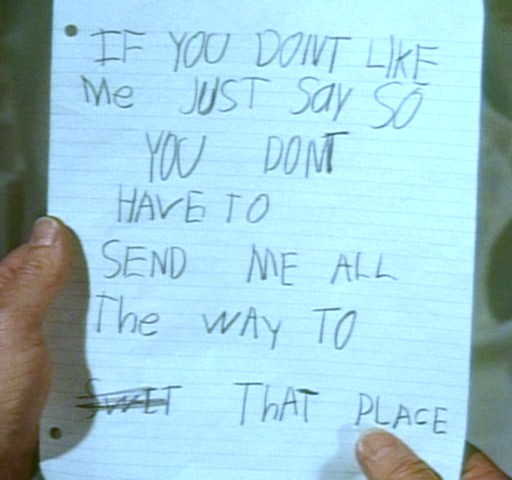
At the suggestion of his partner, Ted Gaynor, Bill decides to send Buffy to school in Switzerland rather than back to Terre Haute. When he tells Buffy, she is characteristically unresponsive, but in her room she cries and writes a farewell note.

Awww.

Years of nanny experience help French’s friend Miss Faversham lead French to Buffy’s hiding place in the basement. When Uncle Bill realizes how upset she is, he tells her she can stay. “Grown-ups always tell you things like that at night to make you go to sleep. It’s all different in the morning,” she replies. Uncle Bill assures her that he’s telling the truth and tells her that he loves her. For the first time, Buffy smiles and stops her curt “Yes, sir,” “No, sir,” answers.

Awww times 10.

Soon Uncle Bill must leave for Peru. Just as he’s leaving, Buffy’s twin Jody arrives with another relative, who thought the twins should be together. After Bill departs, the twins’ teenage sister Cissy shows up, leaving an exasperated French to remark, “Good heavens, I am a nanny.”

Awww to the infinite power.

Random Thoughts

This is a good pilot that sets up the show’s situation with equal parts comedy and pathos. Tiny Anissa Jones and Johnnie Whitaker are at their most adorable. Jones’ portrayal is mostly deadpan, but that’s appropriate for Buffy’s mental state.

Buffy’s apparently suffered some harsh treatment in her prior home, considering her remark about being stuck in a closet as punishment and her cynicism about adults’ sincerity. Fran’s behavior here–dumping Buffy at the apartment and sneaking out–is pretty disgusting. I guess a charitable interpretation is that she knew Buffy and Uncle Bill would be better off together, and that Bill would come around in time. Mr. Higer sounds like a real jerk–what kind of person can’t be patient with a recently orphaned child?

The oh-so-sensitive Aunt Fran. By the way, the books in Uncle Bill’s den seem to be of the Reader’s Digest condensed variety. I know he’s a busy man, but really.

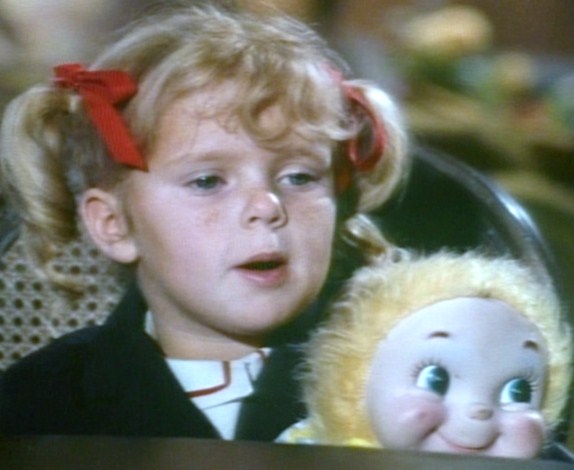
The pilot version of Mrs. Beasley lacks glasses and has a creepier face than the one used throughout the series.

Mrs. Beasley 1.0

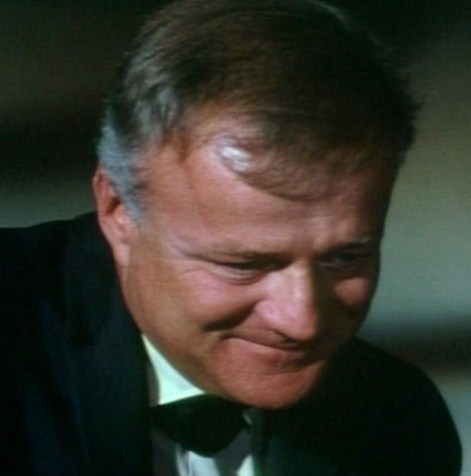
Brian Keith and Sebastian Cabot are both wonderful in this episode. Keith exudes warmth in his emotional scene with Buffy, and Cabot conveys  wonderful disgust with the whole idea of child care.

Notable Quotes

French: “May I ask, madam, what is a Buffy?”

Buffy: “Mrs. Beasley is not a doll. Mrs. Beasley is my friend.”

French, shortly after Buffy arrives, regarding Uncle Bill’s date: “Miss  Larrabee fled, sir.”

French: “Back home, in civilization, we have infancy and manhood–nothing in between.”

An exchange between Buffy and Jody about Mr. French:

Jody: Who’s he?

Buffy: He’s the maid.

Jody: Does he like kids?

Buffy: I don’t think so.

Jody: Could he run fast?

Buffy: No.

Jody: (After a thoughtful pause) Okay, I’ll stay.

Guest Cast

Ted Gaynor: Philip Ober. Among Ober’s many guest appearances were two on I Love Lucy–not surprising since he was once married to Vivian Vance. He appeared twice on Sebastian Cabot’s early 1960s series Checkmate (which is available on DVD–wow). He also appeared in many movies, including North by Northwest and From Here to Eternity.

Fran Higer: Louise Latham, who would return twice as Aunt Fran. Latham’s career spanned from Perry Mason and Gunsmoke in the ’50s to CHiPs and The Waltons in the ’70s, Designing Women and Hunter in the ’80s; E.R. in the ’90s; and The X-Files in 2000. Her first movie role was as the title character’s mother in Hitchcock’s Marnie.

Miss Faversham: Heather Angel. She appeared in many movies, including That Hamilton Woman and Suspicion. She also did voices in Disney’s Alice in Wonderland and Peter Pan. Her Family Affair role would be a recurring one.

Miss Larrabee: Lisa Seagram.

Miss Hodges: Sandra Wirth.

Bess Melville: Barbara Perry.

Miss Ponsonby: Nora Marlowe.

Mrs. Grayson: Shirley O’Hara.

Critical Reaction

Critics didn’t exactly embrace Family Affair. Though I like the show, I find this snarky Cleveland Amory review from the December 24, 1966 TV Guide pretty amusing.

Final Fun Facts

Uncle Bill is not fond of ballet. Bill’s business partner is Ted Gaynor.

Where to Watch

The whole pilot episode is available on Youtube. Here is part one:

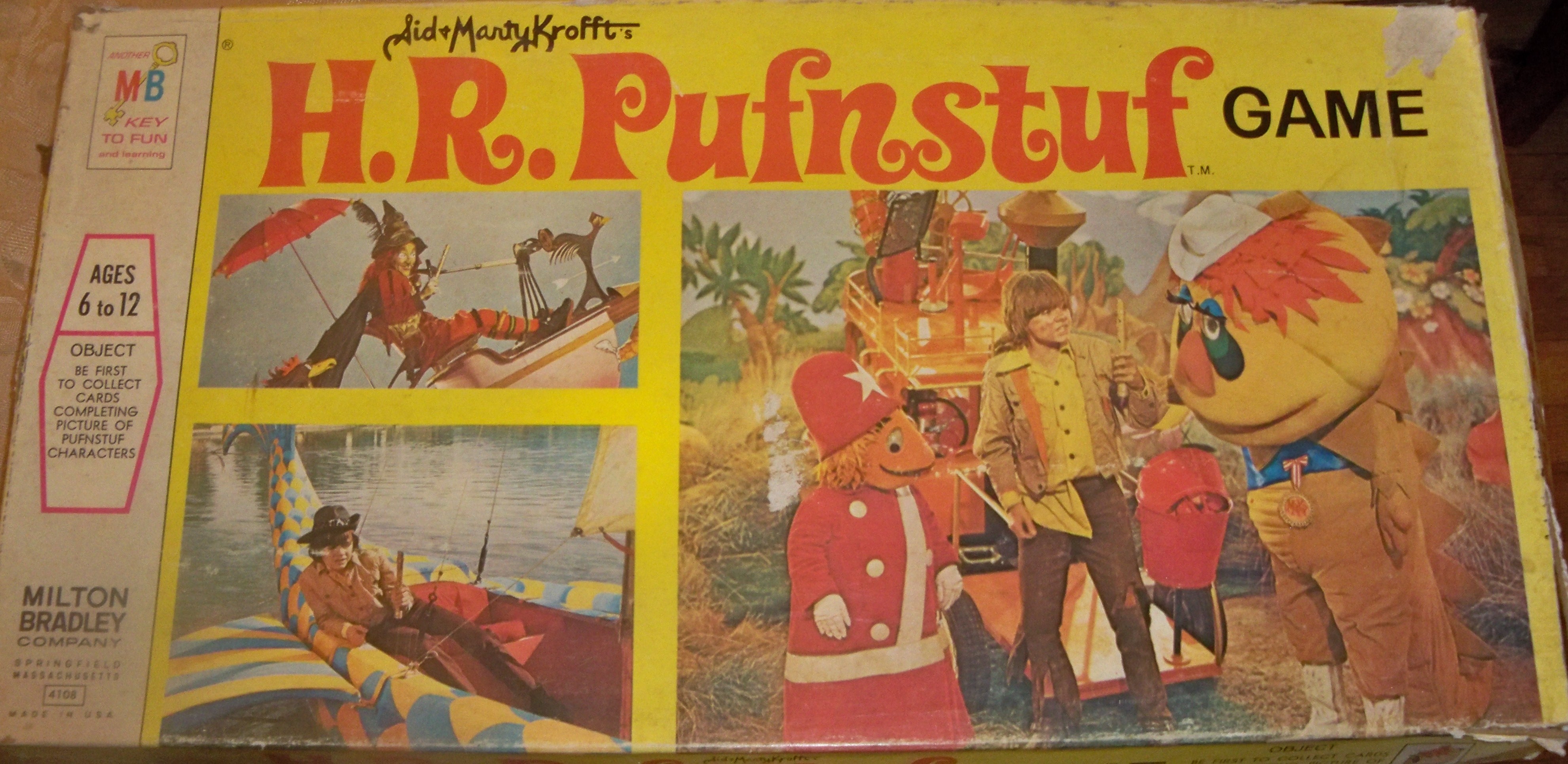
Spin Again Sunday: H.R. Pufnstuf

Another week, another cardboard-and-plastic journey to the past.

Today’s Game: H.R. Pufnstuf Game

Copyright Date: 1971

Object: Be first to collect cards completing picture of PufnStuf characters.

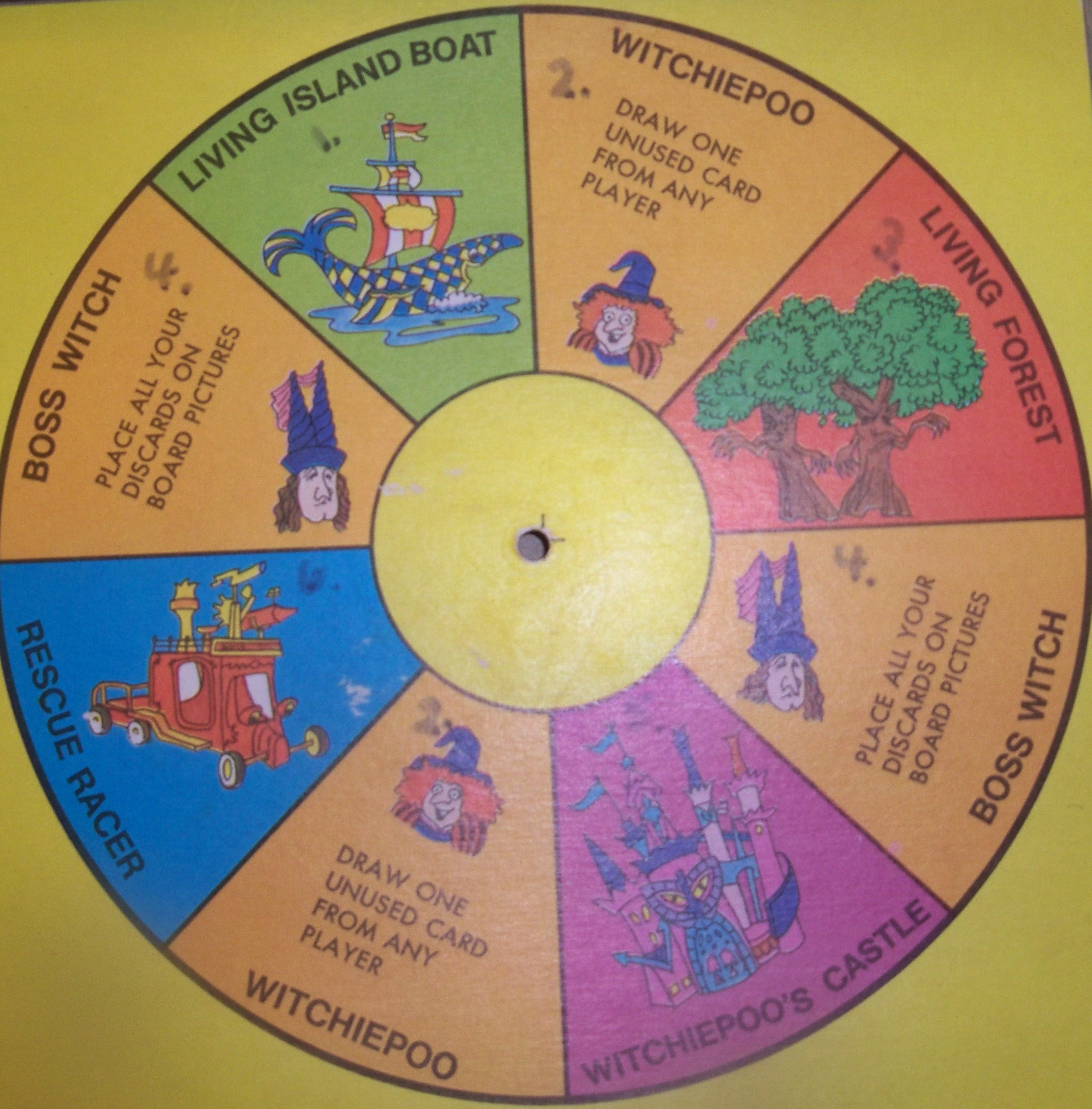
Game Board: Colorful and cartoony, though the cartoon likenesses leave a lot to be desired.

Game Pieces: None. Cards and a spinner are all you need to play this game.

Recommended Ages: 6-12. The game box, with its full-color photos, might have attracted kids throughout that age range, but the graphics inside scream little kid.

Game Play: The board is really superfluous in this game; players don’t move around it. They just spin and collect cards and try to complete a puzzle. (It’s nice that Freddy the Flute gets his own puzzle; on the show, he just squeaked “Jimmy” and got stolen a lot.

Personal Notes: I never had this game as a child—I would’ve been too young to play it in 1971. I did watch H.R. Pufnstuf, though, and still have the disturbing, hallucinatory memories to prove it.

About the Show: H.R. Pufnstuf premiered on September 6, 1969, as part of NBC’s Saturday morning lineup. Popular with kids, it aired for two years on NBC, one year on ABC, and two and a half years in widespread syndication—an amazing feat considering that Sid and Marty Krofft only produced 17 episodes.

Final Fun Fact: Jack Wild, who starred as Jimmy, got to keep one of the original Freddy the Flutes as a souvenir after the show wrapped, according to the book Pufnstuf and Other Stuff.

Previous Entries in this Series:

Charlie’s Angels

Laverne & Shirley

Dreaming of Family Affair

Something I’d seen on TV as a child haunted my memory for years.

It involved a perky teenage girl beginning her service as a hospital volunteer. In her starched candy-striper uniform, she was the picture of efficiency. During her first day on the job, however, she made a terrible mistake. An old woman patient begged the girl for a glass of water, and the girl gave it to her. She didn’t know that the woman was on her way into surgery and barred from drinking food and water. The old woman’s doctor became furious with the girl because her mistake could have cost the old woman her life.

Many years later, I saw this show again. My husband, who watched with me, had never seen it before but had heard my description. Well, the show wasn’t quite the way I remembered it. The old woman’s begging and the doctor’s reaction weren’t nearly as dramatic on film as they were in my memory. My husband still teases me about this incident when I share other childhood memories.

In my defense, CBS showed Family Affair in daytime reruns from September 1970 to January 1973, so I was no more than four when I watched Cissy Davis’ stint as a candy striper.

But that scene and others made a vivid—if inaccurate—impression on my young mind, and gave Family Affair a special place in my heart.

Too young for the show’s 1966-1971 primetime run, I discovered it in those daytime reruns. After that, it pretty much disappeared until TV Land aired it in the 1990s.

Revisiting the show then was like encountering an old friend. I enjoyed it so much that in the late ‘90s and early aughts I ran a comprehensive Family Affair web site.

(Kathy Garver left an approving message on my guestbook!)

Since that site is lost in the mists of time and the wreckage of Geocities, I am declaring Fridays Family Affair days on Embarrassing Treasures.  Starting next week, I’ll take a fresh look at one episode each week and share images from my large collection of Family Affair memorabilia.

Why do I like Family Affair so much?

1.      A strange poignancy permeates the show and makes it stand out from similar shows. Unlike every other classic TV sitcom whose premise involved dead parents (My Three Sons, The Brady Bunch, The Partridge Family, and many more), Family Affair showed kids who remembered and missed their parents occasionally—not just in the first episode or even the first season.

2.      Brian Keith is my favorite on-screen father figure ever. Whenever his paternal love radiates through his ruggedly masculine persona, I melt. This happens often in Family Affair, but my favorite Brian Keith dad moment comes in Disney’s 1961 The Parent Trap. Check out the scene that begins at 4:00, when he realizes he’s seeing his daughter Sharon for the first time since she was a baby.

When Keith died in 1997, Entertainment Weekly called him an underrated actor—I wholeheartedly agree.

3.      Mrs. Beasley! What sitcom ever had a product tie-in like this one?  Her old-lady look is unique in the world of dolls and straddles the line between cute and creepy. Episodes where Mrs. Beasley gets lost are always great.

4.      The setting is exotic. Sure, it’s just New York City. But to small-town kids like me, a city childhood did seem exotic. Buffy and Jody lived in a high-rise apartment building and had a terrace. They played in Central Park. A British butler was their babysitter.

Buffy, Mr. French, and Jody

5.      Mr. French! Sebastian Cabot’s chagrined portrayal of Mr. French, forced to take on a nanny role he never sought, cuts the show’s saccharine level and provides some genuine humor.

6.      Buffy and Jody. The names alone are fun to say. (As a young child, I thought “Buffy and Jody” was the show’s title.) Anissa Jones and Johnnie Whitaker are genuinely adorable in the early seasons, although they later faced the curse common to sitcom kids—a mandate to continue being little and adorable long after it was possible or desirable.

7.      That jaunty Frank De Vol theme song and the kaleidoscopic opening effect that mesmerized me as a child (and reminded me of my grandma’s bingo markers). My memory never failed me where that was concerned.

Weird Words of Wisdom: Chaperoned Edition

“The question of chaperons will surely come up. It’s a fact that most teen-agers prefer to go to a party that’s chaperoned.”

Party Perfect by Gay Head, 1959 (3rd printing, 1962)

Yes, the author’s name is Gay Head. My “Top Searches” should be interesting this week.

About the Book: Dust off your records and start pressing your suit— we’re going to party like it’s 1959! This slim Scholastic volume is filled with party-planning tips, from entertainment (“No evening’s program of games is complete without a relay race”) to wardrobe (“Dress up in your best date dress and tell your girl friends to do the same. Jacket and tie for the boys. After all, part of the fun of a party is being dressed right for the occasion. You’ll all enjoy yourselves more if you do.”)

Sample Party Themes:

  • A United Nations get-together. You assign each guest a country, and they dress accordingly: “A girl can look like a Mexican senorita by wearing a colorful, full cotton skirt, a pretty blouse, and hoop earrings. To be a gaucho, a boy might wear dark trousers, a colorful shirt, and a cumberbund.”
  • A space party: “By Jupiter—be the first one in your crowd to give an out-of-this-world party! This is not as mad as it sounds. The day will come when travel to outer space will be as everyday as going for a spin in the family car.”

Sample Refreshments:

  • For New Year’s Eve, hot buttered soup, made with eight cans of condensed tomato soup and seasoned with lemon juice, cinnamon, and cloves. “Serve hot with a pat of butter floated on the top.”
  • For Valentine’s Day, tuna tomatoes. Combine two cans of chunk-style tuna with a can of cream of mushroom soup. Season with salt and pepper. Use mixture as filling for eight hollowed-out tomatoes, and bake at 350 degrees for 30 minutes.
  • For a space party, deviled ham missiles. Spread deviled ham on half a hot dog bun. Slice a cheese wedge in half lengthwise and insert it at one end of the bun. Insert two carrot sticks at the other end. Top with other half of bun.

Sample Party Games Titles That Sound More Interesting Than the Games Actually Are: Bottoms Up, Scrambled Anatomy, Elopement, Murder.

About the Author: I would love to share a complete biography of Gay Head that included her childhood at Newport, her lively debutante days, and her marriage to a shipping magnate. Alas, Miss Head never existed. The Library of Congress entry for this book suggests that Gay Head was a pseudonym for Margaret Hauser. I can’t find any information about Hauser, except that she edited Scholastic’s Co-Ed Magazine from the 1950s through at least 1970. She also wrote articles under the Gay Head pseudonym for Scholastic magazine in the late 1930s and early 1940s.

Interestingly, though, Hauser was not the only Gay Head. On October 21, 2002, USA Today published an interview with Ruth Imler Langhinrichs. “From 1948 to 1952,” the article states, “Langhinrichs used the pseudonym Gay Head to answer teens’ questions in a column in Scholastic magazine called ‘Boy Dates Girl.’”

It seems that Gay Head must have been a in-house pseudonym, used by various Scholastic writers. The occasion for Langhinrichs’ interview was the release of Steve Coulter’s short film The Etiquette Man, based on the book Boy Dates Girl, a compilation of Gay Head columns. Boy Dates Girl was first published in 1937, with updated printings through the mid-1960s.

Langhinrichs, at least, looks back fondly on her Gay Head days, according to USA Today: “Her years as Gay Head were happy times, she says. They helped her become an editor for teens at Ladies’ Home Journal, where she wrote a column titled Sub-Deb — as in not-quite-a-debutante. Langhinrichs still collects lore on social civility and manners. She works two days a week as a writing coach at Indiana’s Purdue University.”

To the delight of bloggers everywhere, “Gay Head” wrote several other teen advice books, including You’re Asking Me? and Hi There, High School.

We’ll be seeing more of her in future weeks.

Previous entries in this series

Weird Words of Wisdom: Prettily Bewildered Edition

Weird Words of Wisdom: Spanking New Edition