As Halloween approaches, I present more old-time radio versions of Poe stories to entertain you on chilly nights. In this and Part 1 of my Poe playlist, I’ve tried to represent a large range of Poe stories and radio programs.
“The Tell-Tale Heart”
Columbia Workshop
July 11, 1937
“The tell-tale-heart effect, which you heard, was an actual human heartbeat, amplified more than 10 billion times.”—Announcer, Columbia Workshop
NBC Presents: Short Story
“My senses sharpen. Every second makes them sharper. I can hear the rhythmic beating of the old man’s heart…the beating of his heart.”
1951 (Unaired)
About These Series: Columbia Workshop was an early radio series that experimented with the new medium’s narrative possibilities. In dramatic radio’s dying days, NBC Presents: Short Story dramatized work by some of the world’s greatest writers. Try to imagine a major TV network airing series like these now (at its own cost—neither of these shows had a sponsor). Columbia Workshop aired on CBS for eight years, but the NBC program didn’t fare as well. According to The Digital Deli Too, the network pre-empted it frequently and ultimately left 11 episodes, including this one, unaired.
Thoughts on These Episodes: Though the sound quality is better on the NBC Presents episode, I prefer the Columbia Workshop version. The voices the NBC protagonist hears—and his reaction to them—become almost comical. In contrast, the voices that cry out from the wind and the rain and walls in the CBS version are eerily effective. The police are none too swift, though. Sample exchange:
Murderer: “You’re laughing at me! You’re torturing me! You’re making believe that you don’t hear so that I’ll confess!”
Policeman: “My dear young man, you’re working yourself into a frenzy. I think we better leave you to yourself.”
“Tonight is the end of the house of Metzengerstein!”
Thoughts on This Episode: This episode does a good job capturing the story’s creepy atmosphere. Castles, curses, horses, fire—what more do you need for an exciting half hour?
“The wind was screaming through the sails like an insane witch on a broomstick.”
About This Series: Many radio series explored horror and suspense. One thing that differentiated The Weird Circle was its source material; it frequently presented “literary” horror stories, including several of Poe’s tales.
Thoughts on This Episode: I’ve tried to read Poe’s Narrative of Arthur Gordon Pym of Nantucket, his only novel-length work, but just can’t plow through it. I think I’m allergic to nautical adventures. I’ve read enough, though, to know that this adaptation takes major liberties with the story. It also abandons the 19th century setting for a modern one. Phrases like “The captain’s nuts!” and “Awww, shut up!” jar in a Poe story. I would still rather listen to this than try to read the novel again, though.
“Minutes…hours…days… Who can say how long it was? It might have been many days before that hideous blade swept so closely as to fan me with its acrid breath.”
About This Series: Suspense billed itself, with ample justification, as “radio’s outstanding theater of thrills.” Extremely popular, it ran for 22 years (1940-1962). For much of that time, it attracted top Hollywood stars, who often got the chance to play roles that contrasted with their on-screen image. By 1957, the show’s star power was diminishing, but it was still presenting outstanding radio drama.
Thoughts on This Episode: Vincent Price and Edgar Allan Poe—an unbeatable combination! I think this is my favorite Poe story—it’s exciting and has a merciful lack of beautiful dead women. It needs little elaboration to succeed as a radio drama, and Vincent Price (who would star in the Roger Corman film version of The Pit and the Pendulum four years later) gives a good performance.
About This Series: Although not exactly “old-time radio,” CBS Radio Mystery Theater represented the last major gasp of network radio drama. The show ran on weeknights from 1974 to 1982. E.G. Marshall hosted, and radio veteran Himan Brown produced the program.
Thoughts on This Episode: CBS Radio Mystery Theater presented an entire week of Poe stories in January 1975. With about 45 minutes to fill in each episode (not counting commercials), the program had to expand on Poe’s shorter stories.
“Berenice” sticks with the outline of Poe’s story but adds a love triangle and lets us meet Berenice for ourselves; in Poe’s story, we only see her through the narrator’s disordered vision. (The most interesting part of the short story, to me, is Poe’s detailed description of Egaeus’ mental illness. I wondered how modern professionals would diagnose him and found this interesting paper suggesting he was schizophrenic.) The story doesn’t benefit from these additions, but the ending still packs a punch.
Thoughts on This Episode: CBSRMT transports Poe’s plague story to the apocalyptic future that is 1996 (hee) and turns it into an ecological morality play. The morality is confusing, though—I’m a liberal, card-carrying Sierra Club member, and even I don’t understand how the rich capitalist is making the world’s situation worse by protecting his family from the red death. The episode lacks the lurid atmosphere that illuminates Poe’s story, but it’s entertaining as a window into 1970s concerns.
“Never wear slacks on a date, unless it’s a rugged outdoor picnic or an evening at an amusement park. Otherwise, I think slacks are an insult to a boy.”
For Every Young Heart, 1963
By Connie Francis
About the Book: We’ve encountered celebrity advice books before in this series, but Connie Francis is both our first female celebrity author. Of course, one always has to wonder how much “authoring” these celebrities did. Francis’ book feels more authentic than most. Her advice—both the good stuff and the weird stuff—feels specific and individual. Knowing little about Francis when I picked up this book, I quickly formed a clear mental image of her—tough, smart, moody, romantic, and ambivalent about her parents’ influence in her life.
About the Author: I’m always happy to write about an author who’s still alive. Connie Francis is a survivor, in every sense of the word. As a teenager, she appeared on a TV variety show called Startime Kids, and she received much criticism about her looks and weight during those years. Her recording career was slow to take off, and she was on the verge of giving up when American Bandstand made Who’s Sorry Now? her first hit in 1958. (She had brains to fall back on—she received a scholarship to New York University and was planning to study medicine.) And as an adult, she would endure many tragedies (which I don’t want to write about here, lest it ruin the mood for laughing at her fashion, beauty, and dating tips.)
Okay, Then—Let’s Start With Hair Care: “Going to the beauty parlor is an art in itself. Some ladies lean back, close their eyes, and snooze. Others read movie magazines or daydream. This is okay if you’re over forty and have money. But it’s not for you…Sit up and take notice.”
“Wash your hair with regular shampoo, rinse thoroughly, then soak with beer just before setting. It adds tremendous body to fine or limp hair.” (Note: You have to leave the beer, open, outside the refrigerator for two or three days prior to use.)
On Teasing Your Hair: “This is one of the most useful tricks a girl can learn. It involves back-combing the hair from underneath, which adds body, so that with very little curl you can make your hair look like something special. Right this minute, my hair needs setting, but if I had to go out unexpectedly I could whip it into a definite bouffant style by teasing, hold it with hair spray and breeze out for the evening with perfect confidence.”
On Washing Your Hair, Um, Frequently?: “My hair is very oily, so every three days it gets washed.”
On Fashion: “The little black dress or navy suit is the backbone of my wardrobe. I have five or six basic outfits that can go anywhere, from the office in the morning to dinner at the Stork Club and dancing at the Peppermint Lounge at night. The only change I need is a scarf or a piece of jewelry.
On Fashion for Petite Girls: “So instead of buying three strands, you buy one. Instead of the big chalk beads, you buy little ones. And if everything you wear is small, like you, you’ll have a larger overall appearance. Stay away from medium or heavy patterns, circular designs, and two-tone outfits. Verticals give you height. Solid colors, small all-over patterns, and lightweight, clingy fabrics are most flattering.”
On Makeup: “Dark minimizes, light accentuates…For instance, my nose is too wide, so I always use a darker makeup on its sides than on the rest of my face.”
On Lipstick: “For most women, this is a good rule: Darker by night, lighter by day, and always coordinated with the color of your outfit.”
On Brows: “The outer line of the eyebrow should end a 45-degree angle from the tip of your nose.”
On Eyeliner: “This is the most valuable cosmetic I ever found. After experimenting with many kinds, I think black pancake makeup is ideal.”
Getting Along with Boys
“…from the age of nine or ten, (a girl is) more alive, happier, and more of a person with a male around. It doesn’t matter how old he is—nine or ten like herself, twenty-two or eight-five, married or single. All he has to be is male.”
How 11-Year-Old Connie Learned “a New, Improved Formula for Getting Along with Men”: At a Halloween party, she encountered a boy named Eugene who had been picking on her at school:
“And then—whether it was the costume or the lipstick or the fact that I really did feel like a gypsy princess for one wonderful night—a strange thing happened. A lovely, soft, feminine feeling crept over me, transforming the glare to an angel’s smile. Instinctively, I minced forward, lowered my eyes shyly and cooed, “Hel-loo…”
“G-g-gosh!” Eugene breathed, “you look pretty!” “Oh,” I said coyly, “do you really think so?” Half an hour later, there I sat, perched on a cold radiator, collecting kisses from the stag line—and now it was the other girls turn to glare!”
Connie’s First Real Date: A showing of should It Should Happen to You with Judy Holliday and Jack Lemmon, and a second feature of Francis Joins the WACS with Donald O’Connor. (She got so disgusted with her date’s loud guffaws that she stormed out of the theater and went home. If he was laughing at Francis Joins the WACS, I can understand her reaction.)
Telling Tales on Herself: That is one of several unflattering stories Connie tells about herself. Others include the times Connie:
• Beat up a fellow seventh-grade girl
• Got into a shoving match with an overweight male classmate on her first day of high school
• Threw a cup of coffee across the room and stormed out the studio after recording Who’s Sorry Now?
Dating Don’ts
“There are certain places a girl should never go alone, or even with another girl—certain hangouts, bowling alleys, bars, and other places where boys tend to gather and girls don’t.”
“Don’t ever stand near a bar and talk. Never drink at a bar, even if you’re drinking ginger ale.”
“Most people can tell right away who’s a lady, just by the way she talks. And the quickest way to lower yourself in the eyes of anyone—a boy, especially, is to use even one unladylike word.”
“Every man likes a woman to allow him to be a man. Unfortunately, some women, especially in the United States, don’t allow men to be men. They do everything for themselves, because they’re always trying to prove how independent they are.”
“A woman who doesn’t expect the little courtesies isn’t a lady, and a man who doesn’t perform them isn’t a gentleman…I think an unmannerly man is 95 percent the woman’s fault.”
On Sharing Expenses on a Date: “Out. Not under any circumstances should a woman touch one nickel of her own money on a date, unless she’s stranded 50 miles from home and her date needs 15 cents for a subway token. But why get in such a silly fix, anyway?”
“A girl who goes out deliberately to get picked up lives dangerously. And most boys will assume that she’s what she probably is.”
Dating Dos
“Of course, the best way for a girl to be interesting to a boy is to be interested in him. I’ve sat through many an evening not knowing what on earth my date was talking about, but just nodding and smiling and looking at him very, very intently, and occasionally putting in a word of my own like ‘Really!’ or ‘My goodness!’—and he’s walked away thinking ‘Gee, what a brilliant conversation we had!’”
“Anyhow, not only does a kiss on the first date not compromise a girl’s reputation, but nowadays a boy expects it. That doesn’t make it right, of course, but it doesn’t make it wrong, either. A girl knows instinctively the kind of boy she can trust and the kind she can’t. She can sense when a boy respects her, and if a date doesn’t have any real feeling of warmth and friendship for you, he doesn’t deserve a kiss—or a second date, either.”
“The one unfailing way to let a boy know you like him is this: Tell him. I believe letting a boy know in a very lighthearted, casual way that won’t embarrass either of us…When we’re standing in line for a movie or waiting to get into a restaurant, I’ll say: ‘Know something? I like you,’ very casually, then change the subject.”
“As far as necking is concerned, there’s nothing wrong with it in moderation, if there’s a warm, respectful feeling between two people.”
Suggested questions to get dates to open up: “Are you a lonely person? Are you Happy? If you had 48 hours to yourself, what would you like to do most?”
Putting on the Brakes
“If a boy really loves you as much as he says, he’ll want to put a ring on your finger.”
“A girl can become sexually aroused just as quickly and irrationally as any boy. She wasn’t born with any handy ‘monitor’ that automatically helps her put on the brakes, but she has to develop one in her mind in order to protect her self-respect and reputation.”
(Connie wasn’t just talking the talk about chastity. In 1984, she told People Magazine that when she married her first husband, at age 26, it was because “because I wanted to have sex.” That marriage only lasted three months.)
With the Above Said, the Most Racy-Sounding Passage in the Book, if Taken Out of Context: “I finally had to force myself to have fun. I went to Europe and Las Vegas and forced myself to date one boy after another. I kept dating until I found the feelings I had for one or two boys weren’t so fantastic after all. I found, in fact, that I could feel just as happy and have just as good a time with 25 others.”
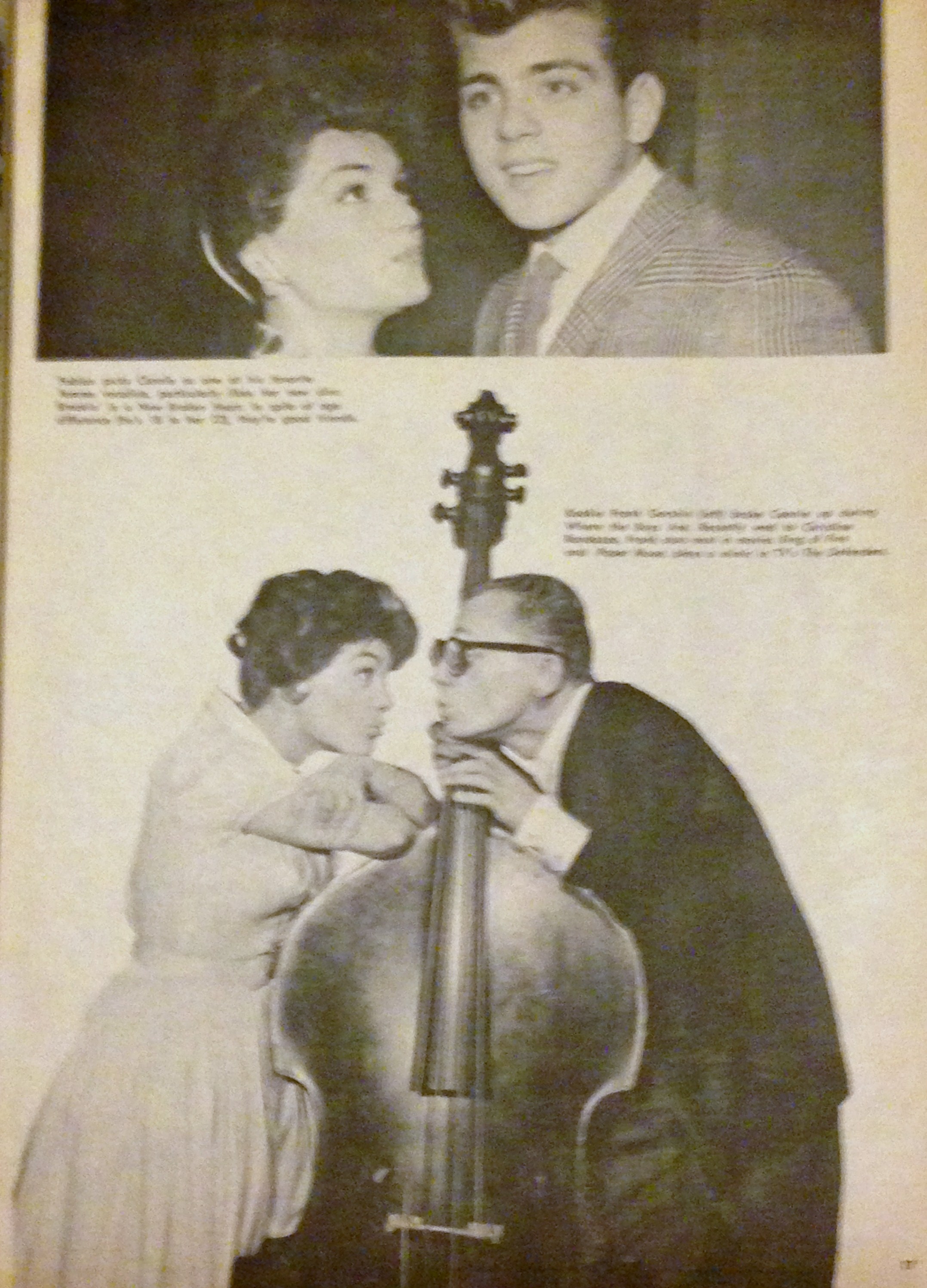
Connie’s First Real Love (Bobby Darin?): “I was in love in my teens, and at the time it was the most important thing in the world to me. Every day, because I was in love and my parents didn’t approve, there was an argument at home. School became secondary. My singing became unimportant compared to my feelings for this boy. The day was happy or sad depending on what he said to me or what I said to him, or what my parents said or didn’t say about him or me or us. Then, when we did break up, it took me just as long or longer to get over it.”
(Connie): He wasn’t just strict — he was a vigilante with every boy I had a milkshake with. I was not allowed to date in high school or go to the prom, and even in college he had a problem.
(Musto): Is it true he broke up you and Bobby Darin?
Connie: With a gun. He learned Bobby and I were starting to elope one night. We were 18, 19. I was doing the Jackie Gleason show and Bobby and I were cuddling in a corner. He barged through the rehearsal room of the Sullivan Theater with a gun in his pocket and a fierce determination to obliterate Bobby once and for all. One of the biggest regrets of my life is I didn’t marry Bobby.
In For Every Young Heart, some of Francis’ ambivalence toward her parents comes through. She describes how she taught herself shorthand because her mother was always snooping in her diary. She also talks about how she learned a confusing version of “the facts of life” in a whispered conversation with a girlfriend because her parents never told her anything.
“Every child has a right to know about life,” she asserts. “The day a youngster asks his first question about sex is the day he deserves an answer.”
Connie’s Ideal Husband: “He shouldn’t be overemotional, yet he must be very affectionate, responsive and warm. His laugh shouldn’t be so loud that everybody turns around to look, but he has to have a wonderful sense of humor. He has to be subtle and self-contained—the type who can say two words and I’ll understand; a man who can look at me across the room, and every look will mean something. Oh, yes, and he has to be very smart, alert, witty. He has to know he’s the boss without saying, ‘Listen here, I’m the boss.’ He can’t shout at me, but he’ll know just how to tell me what to do, because every woman loves to be ordered around the right way.”
Hmm. You start to get an inkling about why none of her four marriages lasted longer than five years.
More Wisdom from For Every Young Heart:
“The opinion that smoking is a drag—on your health, most of all—is pretty modern these days. Every day, new data piles up pointing to possible links between cigarettes and lung cancer.”
“If a boy has never been in a bar or never tried to drink or smoke by the time he’s out of his teens, he would be very unusual. These are things most boys have to experience in order to feel grown up and manly.”
“The only time a boy may have a feeling of responsibility for himself and girl is when he’s deeply in love, when he has a true feeling of respect for her, and when he’s far-sighted enough to think of the future, including the day they’ll want to get married with a fresh, wholesome start toward life together. But 99 percent of the time, the boy doesn’t feel this way, and that means the girl has to.”
“A girl must always have the kind of reputation that will make a boy very, very proud to take her home and introduce her to his mother.”
“…there’s just one reason for going steady, and that’s as a prelude to engagement.”
“Not only does a wife have to be a mother, friend, advisor, and scrubwoman—she must also never let her husband feel that it’s a great burden for her.”
“In my teens, I used to think it was the most important thing in the world for a woman to be tremendously independent. But I know now that no matter how independent you are, if you really love a man, nine times out of ten his wishes are more important than yours.”
“I will want nothing less than a big wedding, in a pretty church, with all my family and all my friends there to share it. That’s a girl’s one big day, and anybody who says you’re not entitled to it because it’s corny is not going to make the greatest or most understanding husband.”
October seems like a good time to enter the eerie world of Edgar Allan Poe. Not only is Halloween approaching, but so is the anniversary of Poe’s death. He died on October 7, 1849, at age 40, from unknown causes.
Radio programs presented Poe’s stories often, and it’s easy to see why. They make exciting listening experiences, painting vivid images in listeners’ imagination.
For this playlist, I have tried to gather the widest number of Poe stories from the widest number of radio programs.
Dim the lights, sit back, and lose yourself in the strange world of Edgar Allan Poe.
“And puzzle they did, these French police, and with them the rest of the world.”
“Rue Morgue Mysteries” Unsolved Mysteries 1949 About this Series: A syndicated 15-minute show, Unsolved Mysteries aired ostensibly true stories and posited solutions to historical mysteries. Thoughts on this Episode: Unsolved Mysteries treats Poe’s “The Murders in the Rue Morgue” as a fictionalized account of a true crime, and the show comes up with a different solution to that crime. Poe’s story, history’s first detective story, didn’t have any basis in fact, however. (He did base a later story, “The Mystery of Marie Roget” on a real New York murder.)
Read “The Murders in the Rue Morgue”
“Even after two days at sea, death did not destroy that waxen beauty.”
“The Oblong Box” The Weird Circle February 18, 1945 About this Series: Many radio series explored horror and suspense. One thing that differentiated The Weird Circle was its source material; it frequently presented “literary” horror stories, including several of Poe’s tales. Thoughts on this Episode: This show adds a murderous twist to make Poe’s story even more twisted. It’s an enjoyable adaptation, although the acting gets overwrought at times.
Read “The Oblong Box”
“I determined then to even the score, to revenge the desecration of my name, of my family honor.”
“The Cask of Amontillado” Hall of Fantasy January 19, 1953 About this Series: This was another radio show dedicated to tales of suspense and the supernatural. Thoughts on this Episode: We have no big name stars here, but this is a satisfying dramatization of Poe’s tale of revenge.
Read “The Cask of Amontillado”
“And so it happened, that at the end of a dull, dark, and soundless day in the middle of October, I found myself as the shades of evening drew on, within view of the grim and melancholy House of Usher”
“The Fall of the House of Usher” Escape
October 22, 1947 About this Series: Escape was “radio’s greatest series of high adventure,” according to John Dunning’s On the Air. It ran from 1947 to 1954, a sister series to the longer-running Suspense. Thoughts on this Episode: Paul Frees, who plays the narrator, was one of the most prolific voice actors of the 20th century. People unfamiliar with his radio career may know him as Boris Badenov, Burgermeister Meisterburger, or the host ghost in Disney’s Haunted Mansion attraction. His powerful, deep voice brings the dread and decay in Poe’s story vividly to life.
Read “The Fall of the House of Usher”
“You scream with the terror of it! You scream, and scream, and scream!”
“The Premature Burial” CBS Radio Mystery Theater January 6, 1975 About this Series: Although not exactly “old-time radio,” CBS Radio Mystery Theater represented the last major gasp of radio drama. The show ran on weeknights from 1974 to 1982. E.G. Marshall hosted, and radio veteran Himan Brown produced the program. Thoughts on this Episode: Poe’s story barely qualifies as a story at all—it is mostly a rumination on the horror of being buried alive. And Poe sure can ruminate: It may be asserted, without hesitation, that no event is so terribly well adapted to inspire the supremeness of bodily and of mental distress, as is burial before death. The unendurable oppression of the lungs- the stifling fumes from the damp earth–the clinging to the death garments–the rigid embrace of the narrow house–the blackness of the absolute Night–the silence like a sea that overwhelms–the unseen but palpable presence of the Conqueror Worm–these things, with the thoughts of the air and grass above, with memory of dear friends who would fly to save us if but informed of our fate, and with consciousness that of this fate they can never be informed–that our hopeless portion is that of the really dead–these considerations, I say, carry into the heart, which still palpitates, a degree of appalling and intolerable horror from which the most daring imagination must recoil.
This episode creates a 45-minute story from an incident that is only briefly described in Poe’s story. It does so pretty well, although I found the third act a bit weak. Keir Dullea, best known for his role in 2001: A Space Odyssey, stars in this episode (and many others in the series).
I put this playlist together after noticing how many old-time radio mystery shows had presented episodes titled “Till Death Do Us Part.”
“Till Death Do Us Part”
Suspense, December 15, 1942
“Just remember, I shall be waiting…out, in the dark and cold, where there is neither marriage, nor giving in marriage…I’ll be waiting, for my little pet to come and join me.” Story: A professor, jealous of his wife’s love for another man, comes up with a clever plan to eliminate both his problems. Writer: John Dickson Carr, well known Golden-Age mystery writer, who wrote many Suspense episodes. Notable Cast Members: Peter Lorre, whose voice oozes creepiness, plays the murderous husband. The same year this episode aired, Lorre played one of his most memorable film roles: Ugarte in Casablanca. About Suspense: Suspense billed itself, with ample justification, as “radio’s outstanding theater of thrills.” Extremely popular, it ran for 22 years (1940-1962). For much of that time, it attracted top Hollywood stars, who often got the chance to play roles that contrasted with their on-screen image. William Spier produced Suspense in its best years and, according to Dunning, “personally guided every aspect of the show, molding story, voice, sound effects, and music into audio masterpieces.” Weapon of Choice: Aconite, also known as monkshood, a poison. My Verdict: An entertainingly over-the-top performance by Lorre and a script with several good twists make this a must-listen.
“Till Death Do Us Part”
The Sealed Book, July 8, 1945
“Oh, no, I’ll never leave you, darling. Never, never, never.” Story: A man is determined to escape his smothering wife—and she is determined to keep him. About The Sealed Book: A cheesy mystery-horror show with a very cheesy opening sequence, The Sealed Book was a syndicated show that ran for six months in 1945. Weapon of Choice: The sea. My Verdict: A so-bad-it’s-good kind of entertainment. By a few minutes in, you’ll want to kill Blanche, too.
“Till Death Do Us Part”
Murder at Midnight, December 9, 1946
“One life has already paid for yours. And, quart for quart, your blood is worth no more than my family’s.” Story: A newlywed husband is tormented by fantasies of killing his bride. About Murder at Midnight: Similar in some ways to The Sealed Book, this was a syndicated show with a cheesy opening and ample organ flourishes. The quality is much higher, though. As Digital Deli Too writes, “Anton Leader, later famous for his Television work, directed the series. The writing staff was also top-notch, with names such as Max Erlich, Joe Ruscoll and Robert Newman, among others.” Weapons of Choice: Strangulation, a gun. My verdict: This story is clever and complex, and it uses Oscar Wilde’s “The Ballad of Reading Gaol” to eerie effect as a recurring motif. The actress playing the bride gives a good performance.
“Till Death Do Us Part”
Inner Sanctum Mysteries, October 27, 1947 “Oh, baby, how did we ever get into a mess like this?” Story: Newlyweds are witnesses when a man murders a woman, and their honeymoon just gets better from there. About Inner Sanctum Mysteries: This was the father of all campy-mystery-horror-with-cheesy-opening shows. Famous for its creaking-door sound effect and its punning host, Inner Sanctum Mysteries ran from 1941 to 1952. Notable Cast Members: Everett Sloane and Mercedes McCambridge, two prolific radio performers. Sloane was a member of Orson Welles’ Mercury Theater and appeared in the films Citizen Kane and The Lady from Shanghai. Two years after this episode aired, McCambridge would play an Academy-Award-winning supporting role in All the King’s Men. Her movie career would also include providing the voice for The Exorcist’s demon. Weapons of Choice: A gun, smothering (sort of). My Verdict: Inner Sanctum has its fans, but it consistently underwhelms me. My mind kept wandering during this one, and the ending didn’t satisfy me.
“Till Death Do Us Part”
The Whistler, April 14, 1948
“He made a mistake–a bad one.” Story: A shady art dealer meets up with the equally shady young wife of an ailing art collector. This won’t end well for anyone. About The Whistler: A popular mystery-crime show, The Whistler ran for 13 years. It has similarities to the shows above, except that the episode’s central character is usually the bad guy, whom the narrator addresses directly and tauntingly. Notable Cast Members: Gerald Mohr was another prolific radio actor whose most memorable role was Philip Marlowe. Doris Singleton would go on to play the recurring role of Carolyn Appleby on TV’s I Love Lucy. Weapon of Choice: Sleeping pills (sort of). My Verdict: The Whistler can be hit or miss. This wasn’t an outstanding episode, but it did keep me guessing. I always enjoy Gerald Mohr’s sexy, hard-boiled voice.
“Until Death Do Us Part”
Private Files of Rex Saunders “It worked. It worked real good.” Story: A casino owner’s second wife becomes convinced that her husband killed his first wife–and that she is about to be his second victim. About Private Files of Rex Saunders: This private investigator show was a starring vehicle for Rex Harrison that aired during the summer of 1951. Himan Brown directed the series. Notable Cast Members: Rex Harrison is best remembered as My Fair Lady‘s Henry Higgins, of course. Leon Janney, who plays the assistant, began his long theatrical career when he was still a child. Weapons of Choice: Guns. My Verdict: It’s fun to hear Harrison play a private investigator, and the story has some nice twists.
…or, Whose Vintage Advice to Teens is Weirder—Ann’s or Abby’s?
Dear Teen-Ager by Abigail Van Buren, 1959
Ann Landers Talks to Teen-Agers About Sex, 1963
“Just as ‘liquor is quiquor’ is a way to a neat little plot in the cemetery, it can also be a jet liner to sextra headaches.”—Abby
“You wouldn’t take a diamond and platinum brooch to try to pry open a jar of pickles with it, would you? Using sex in the wrong way adds up to the same thing.”—Ann
About the Authors: Identical twins Pauline and Esther Friedman, the children of Jewish immigrants, were inseparable as children. As Morningside College co-eds, they collaborated on an advice column for the school paper. They married in a double wedding. And they built matching careers—Esther became Ann Landers in 1955 at the Chicago Sun-Times; Pauline because the San Francisco Chronicle’s Dear Abby three months later. Both their columns were hits in syndication. Ann Landers eventually reached 90 million readers, and Abby reached 80 million by 1995. Pauline’s daughter Jeanne Phillips started co-writing Dear Abby with her mother in 1987 and took over all writing duties by 2002, after Pauline was diagnosed with Alzheimer’s disease. That was also the year Esther died, bringing the Ann Landers column an end.
The Ann-Abby Feud: Understandably, Esther resented Pauline’s decision to start a rival advice column. The sisters went through a period of estrangement that included the publication dates for both these books. In 2005, Esther’s daughter, Margo Howard, published a collection of letters she’d received from her mother through the years. Complaints about “Popo” (Pauline’s family nickname) figure prominently. “I can’t cut her out of my life completely, no matter how loony she gets,” one letter from 1981 reads. “She is too much a part of me, but I must myself protect against her in some way. She is too unpredictable—and destructive.”
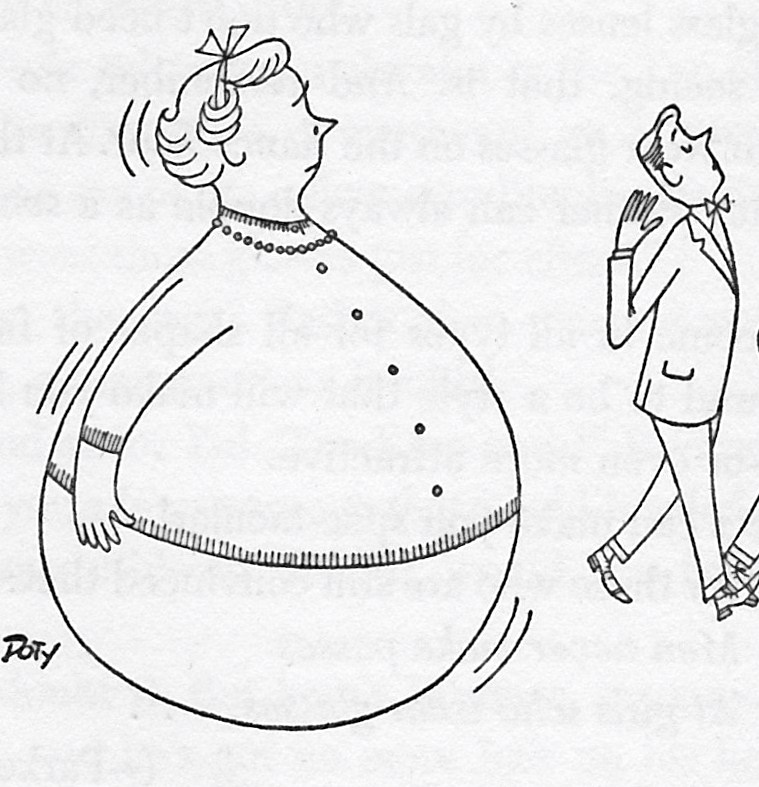
From Abby’s book, a sensitive illustration of the problems facing overweight teens
About the Books: The books’ titles reflect their differing focuses. Abby’s book covers various teen topics, from dating to dealing with teachers, from grooming to smoking. Ann’s book takes dead aim at the sex stuff. (That’s probably what most teens skipped to in comprehensive advice books, anyway.)
Changes in society probably influenced the difference in focus. Although only four years separated the books, those four years saw rapid changes in sexual mores. “The pill” became available for contraceptive use in 1960, and by 1963, America was on the cusp of sexual revolution. Of girls who turned 15 between 1954 and 1963, 48 percent had premarital sex before age 20. For girls who turned 15 between 1964 and 1973, the figure rose to 65 percent (Source: The Alan Guttmacher Institute).
Differences in Tone: Abby’s writing style is much cutesier, and her book includes cutesy illustrations, as well. Ann can get a bit sassy, but mostly adopts a down-to-earth style. This reflects a real difference in their early advice-giving styles. As Time wrote in 1957, “Abby’s replies are slicker, quicker, and flipper.”
Examples of this style in Dear Teen-Ager include:
“If you’re under 18 there are more reasons for not going steady than Elvis can shake a hip at.”
“Men who are older tend to be bolder.”
“Troubles are like photographs. They are developed in dark places.”
Contrast that with a typical piece of advice from Ann’s book:
“Housework, particularly floor-scrubbing, is not only great for the female figure, but it’s good for the soul. And it will help take the edge off your sex appetite. Cooking, baking, and sewing will prepare you for homemaking. Energy siphoned off into these constructive channels will leave less energy for preoccupation with erotic fantasies.”
Abby would have probably said, “Keep scrubbing the floor, and you’ll be lusty nevermore”….or something.
A Shared Moose Obsession? Abby’s book includes one of her most famous lines: “Girls need to ‘prove their love’ through illicit sex relations like a moose needs a hatrack.”
Ann’s book reprints a letter from a girl with a loser boyfriend, and Ann’s response concludes, “You need this infant like a moose needs a hat rack.”
I don’t know which sister used the expression first, but it didn’t originate with either of them. Jack Benny made the phrase a running joke on his radio show in 1947.
The Double Standard: Abby took the double standard for male and female behavior for granted in 1959, while Ann rejected it in 1963.
Abby: “When a decent boy gets serious about someone, and thinks of marrying someone…that someone will be someone he respects. All boys aren’t angels, but most of them are looking for one.”
Ann: “No man should insist on a white-flower girl unless he is able to bring to the marriage the same credentials of purity.”
Homosexuality: Abby doesn’t mention homosexuality at all, but Ann devotes a whole chapter to it. This distinguishes her book from the other teen advice books I have from this period—few go beyond advising teens to seek professional help if they don’t develop an attraction to the opposite sex.
Ann sounds genuinely distressed by the mail she receives from desperate gay young people. “About 70 percent of the letters come from boys,” she writes. “Most of the boys who write are tortured with guilt and self-hatred. They live on the razor’s edge, terrified that someone may learn they aren’t ‘like everybody else’…Many who write are so ashamed of their physical desires for members of their own sex that they speak of suicide.”
She accepts the psychiatric wisdom of the time that labeled homosexuality as a mental disorder, but she does encourage heterosexual teens to be understanding toward their gay peers, who are “twisted and sick, through no fault of their own.”
Abby’s and Ann’s approaches to homosexuality in their respective books carried over into their newspaper columns. Abby mostly ignored the subject, and Ann stuck by her belief that homosexuality was a disorder until 1992, nearly two decades after the American Psychiatric Association stopped labeling it as one.
Ann’s Most WTF Comment about Homosexuality: “Some Lesbians who despise men enjoy arousing a male’s sexual appetite and then punishing him with rejection.”
Abby’s Least Helpful Advice: “…if everybody picks on you—well—don’t look now, but maybe something’s wrong with you!” (During my many years as a bullying victim, this would have cut me like a knife.)
Abby’s Most Surprising Advice, Which Follows Many Chapters Stressing Inner Beauty and the Need for Self-Acceptance: “Now maybe you’re one of those girls who were slightly short-changed above the equator. Hundreds of girls have written to me asking if it’s dishonest to get a little outside help (okay, ‘falsies!’) to put them out in front. To this I say, ‘Buy all the attachments you need!’”
On Smoking and Drinking: Both sisters advise against teenage drinking. Ann describes the decision she made at a young age—and maintained throughout her life—to abstain from alcohol. Interestingly, her daughter Margo writes that “I was considered ‘sophisticated’ even as a high school girl. I smoke and I drank scotch on the rocks.”
Ann has little to say about smoking; Abby raises several objections, which don’t include health effects. She even pulls out another double standard: “Even when a fellow happens to be a smoker himself, he prefers a girl who doesn’t smoke. It cheapens her appearance. It clouds the illusion of sweetness.”
Abby’s Most Ironic-in-Hindsight Use of a Celebrity to Make a Temperance Point: “Did Mickey Mantle tell Casey Stengel it’s old-fashioned to forbid smoking, drinking or late hours during baseball season? Of course not.”
Other Abby Quotes:
“A nice girl does not hand out a kiss—or kisses—on the first date, no matter how much she digs the boy. If he’s worth liking, he’ll respect you for it. Boys, hold your fire.”
“The bobby-soxer herself, Miss Junior Miss…is endowed by a mysterious but obviously prudent Nature with more slowly excitable sex responses.”
On handling a “mad lover” (21st century translation: a potential date rapist): “In an extreme case, where physical duress is involved, meet force with force. A right uppercut is unladylike, so you’d best settle for a stereophonic slap in lover boy’s fresh face…When he recovers from his chagrin, your best line is a brusque “Home James!” He won’t trouble you again.”
Other Ann Quotes:
“A girl who is called a make-out by her friends would do well to take stock of herself.”
“What am I saying? That a girl can be nice even though she goes all the way? Yes. The girl can be nice—but the girl is not very bright.”
“At certain times each month you feel listless, bored or even completely knocked out. A physical change is making its presence known through menstruation. With the beginning of these days of monthly bleeding, some girls may be hit by attacks of cramps, headaches and even upset stomach. Strange, isn’t it? And frightening at first, until you begin to understand that this is part of life’s process for continuing itself. Your body will supply a son or daughter to build the world of the future.”
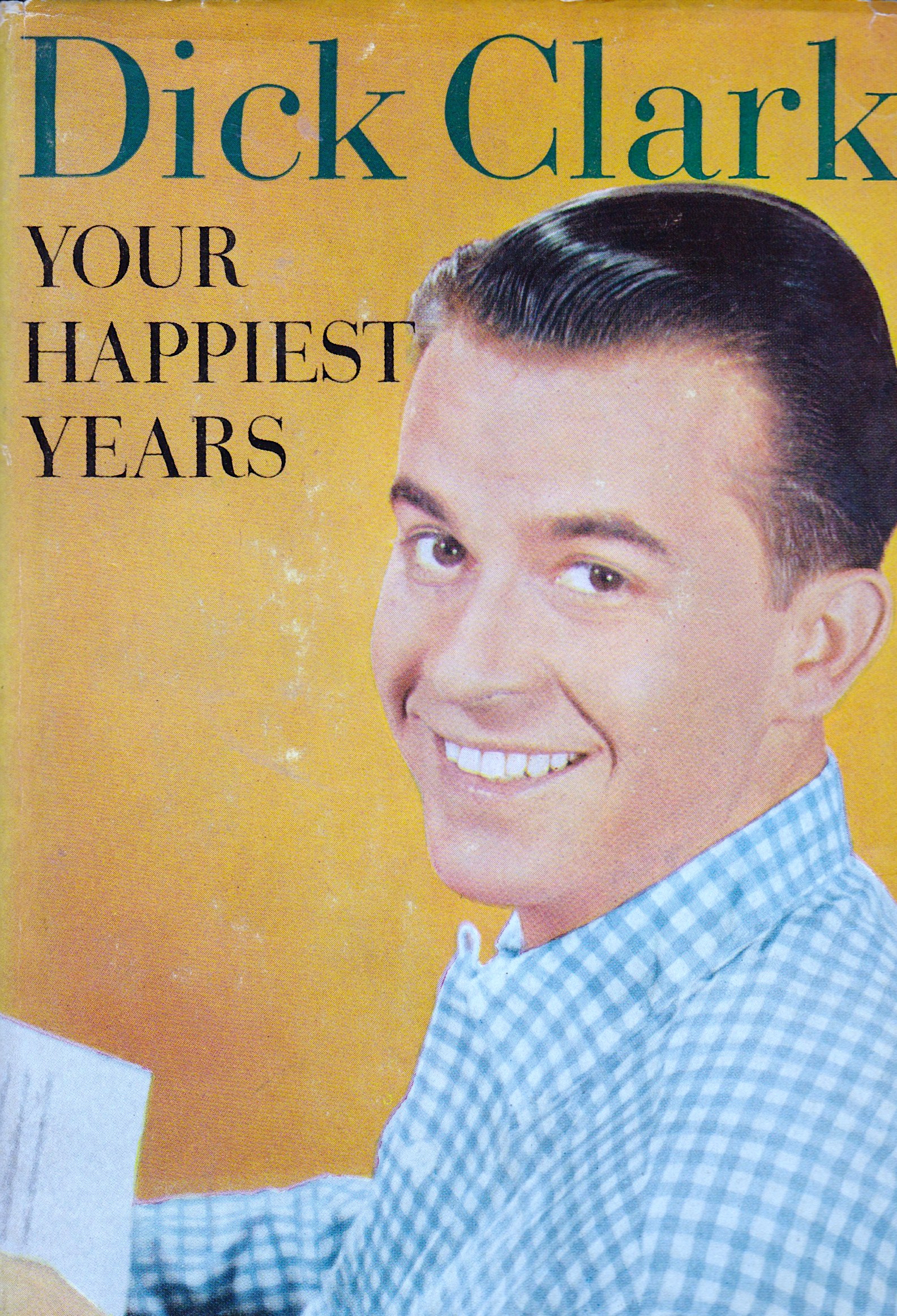
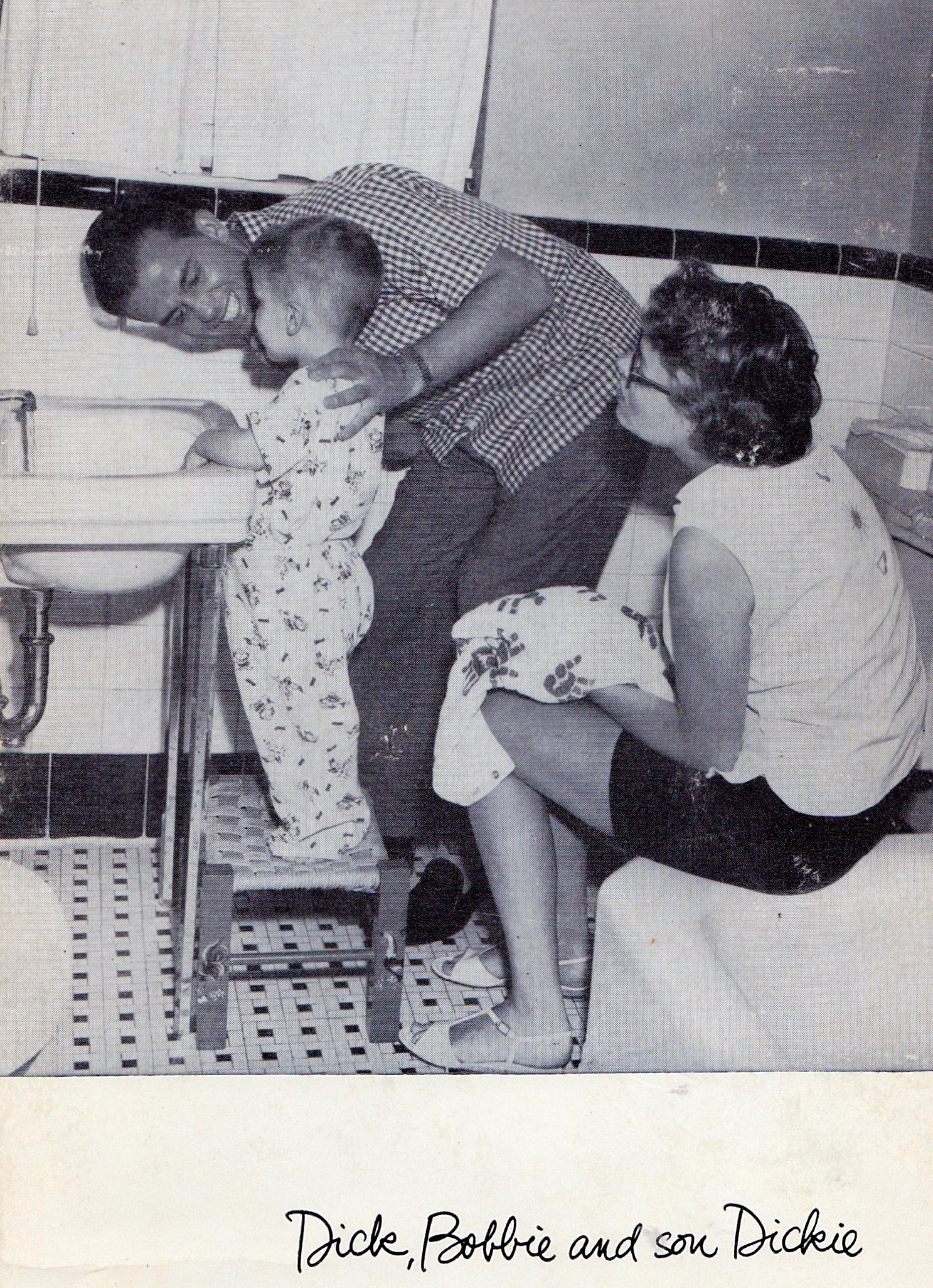
Your Happiest Years by Dick Clark, 1959
About the Book: Do any adults actually remember adolescence as their “happiest years?” This book by television personality Dick Clark, who would later be called “the world’s oldest teenager,” falls into that strange 1950s genre we have encountered here before—a volume of teenage advice authored by an adult celebrity. Can you imagine buying your young daughter a book in which Ryan Seacrest explains how her body will soon burst into womanhood?
Of course, when it comes to these celebrity books, it’s questionable who really authored them. Pat Boone’s book had a ring of authenticity, but this one is a pretty generic collection of 1950s wisdom for teenagers. It offers sensible advice on dealing with friends and family, while urging strict adherence to gender roles.
About the Author: American Bandstand premiered nationally in 1957. The show “did as much as anyone or anything to advance the influence of teenagers and rock ‘n’ roll on American culture,” according to the New York Times. An immediate hit, it would run until 1989. In its early years, the Times wrote, teenagers saw Clark as “their music-savvy older brother.”
Dick’s marriage to high-school sweetheart Bobbie gave his teenage romance advice some credibility. Unfortunately, Dick and Bobbie divorced only two years after the publication of Your Happiest Years.
Clark was also a shrewd businessman, who never shied from a money-making opportunity.
”I get enormous pleasure and excitement sitting in on conferences with accountants, tax experts and lawyers,” he told the Times in 1961. It’s not surprising that he would lend at least his name to this book. Now, it is a bit surprising that he also “authored” a book for adults about bowling (scroll about 3/4 of the way down the page).
Clark wasn’t experiencing one of his happiest years in 1959. As the U.S. House Subcommittee on Legislative Oversight investigated payola in the music industry, Clark’s network bosses took pre-emptive action. As Time wrote on November 30, 1959, “ABC confronted him with a significant decision: he must get rid of his outside music interests or else quit TV…Faced with the ABC ultimatum, Clark decided to ‘divest’ himself of his interests in various music firms.” Clark denied any involvement in payola.
Celebrity Names This Book Drops: Connie Francis, Solly Hemus, Mickey Mantle, Dinah Shore.
Cautionary Tales Clark Offers:
A boy who failed to overcome his shyness with girls at the appropriate age and reached the age of 19 without ever being kissed.
A young ladies’ man who grew into a lonely adult when girls tired of his “gay-blade routine.”
A sickly boy who resisted his parents’ curfew and came down with tuberculosis.
A girl who stayed out all night, causing her worried father to head out looking for her. In his exhausted state, he crashed his car and emerged permanently crippled.
More Quotes from Your Happiest Years
“Once you’ve stepped out and found you can have a good time with girls, you are free to call any of them you know and ask for a date. They can say no, but at least you can ask. You don’t even have to feel self-conscious about it if one turns you down—you can dial another. A girl can’t do this—or certainly should not.”
“The sweaters and blouses that once flopped about you, to the despair of your mother and father, who wanted their little girl to look neat, are starting to fit snugly around your chest. Your breasts are undergoing a change as you grow into young womanhood. So are your hips, which broaden as they prepare for the function nature has marked out for you as a woman: the bearing of children.”
“It’s fine to be ‘one of the boys’ at certain ages. The teen age isn’t one of those times. The sports you played together when you were nine or ten belong only to him around thirteen or fourteen. You can know about them. In fact you should be able to talk about them—but let him star at them. You be there to cheer and he’ll notice and appreciate that.”
“A young woman should begin in her teens learning the things that keep a home running smoothly. She can watch how her mother cooks and bakes. There are also many opportunities for a daughter to observe how Mother handles Dad when he’s had a tough day at work. Mom can always use some help around the house, with dishes, cleaning, cooking, and a million other things a girl should know to qualify for that band of gold.”
On menstruation: “Accept it as you accept other signs of developing femininity and attractive womanhood. Although it may give you some discomfort and even embarrassment at first, it is a mark of special favor for you as a woman.”
Why teenage boys shouldn’t avoid dating in favor of hanging out with the guys: “A pinball machine may be a lot of fun when you’re seventeen, but at twenty-two it’s no date for a dance, and it won’t sew up those ripped shirts, when you’re thirty.”
Escape, December 31, 1947
“You are lost in a London fog, uncertain whether the figures looming around you are real or creatures of your imagination. And somewhere in the wet grayness lurks a murderer, from whom you must escape.” Story: A Canadian soldier, shell-shocked from his World War II service, becomes disoriented on a foggy London evening and encounters a mysterious woman who soon ends up dead. Based Upon: A short story by Algernon Blackwood, a prolific and influential author of horror fiction. Notable Cast Members: Bill Conrad, one the best and most ubiquitous actors in old-time radio, plays the soldier. Fellow Generation Xers will remember Conrad best as TV’s Cannon and Jake from Jake and The Fatman. It can be hard, at first, to erase that visual from your mind as you listen to his radio work. His powerful performances soon engage your full attention, however. In my opinion, he did his finest work as Matt Dillon on radio’s Gunsmoke. Peggy Webber, who plays the mysterious woman, will be familiar to viewers of TV’s Dragnet because she appeared in roughly a zillion episodes. She also worked as a writer, producer, and director in the early days of television, and she helped to found the California Artists Radio Theatre. About Escape: Escape was “radio’s greatest series of high adventure,” according to John Dunning’s On the Air. It ran from 1947 to 1954, a sister series to the longer-running Suspense. Several things distinguish the two series. First, Suspense had bigger budgets and, thus, big-name guest stars, throughout most of its run. Those big budgets came from sponsors, which Escape didn’t have. This is a plus for the modern Escape listener—you don’t have to hear, or fast-forward through, grating commercials. (Yes, Autolite, I’m looking at you.) Escape tended to use more exotic settings than Suspense and dabbled more in the supernatural. Also, on Suspense things tended to end well; Escape often went for the darker ending. (I wonder how much sponsors, or the lack thereof, had to do with this.) Both series are excellent—they are in my top five favorite radio shows, and which one ranks higher just depends upon my mood. My Verdict: This is a solid episode. A sense of dread slowly envelops the listener as the fog envelops Conrad’s character, and the ending is satisfyingly chilling.
“The Hands of Mr. Ottermole”
Suspense, December 2, 1948
“By all means, sergeant, let’s talk about…murder.” Story: A journalist and a police sergeant talk about a serial strangler who’s menacing London. Since the script takes pains to avoid telling us the men’s names, it’s obvious one of them is the deadly Mr. Ottermole. Based Upon: A short story of the same name by Thomas Burke, an author who specialized in portraying London and its working-class citizens. Burke published “The Hands of Mr. Ottermole” in 1931. According to Ellery Queen, “No finer crime story has ever been written, period.” Notable Cast Members: Vincent Price and Claude Rains star in this episode. Price, of course, was made for creepy tales like this, but it’s Claude Rains who really shines. About Suspense: Suspense billed itself, with ample justification, as “radio’s outstanding theater of thrills.” Extremely popular, it ran for 22 years (1940-1962). For much of that time, it attracted top Hollywood stars, who often got the chance to play roles that contrasted with their on-screen image. William Spier produced Suspense in its best years and, according to Dunning, “personally guided every aspect of the show, molding story, voice, sound effects, and music into audio masterpieces.” My Verdict: Suspense is another of my top-five shows and an excellent introduction to old-time radio for new listeners. This episode is very good, with a script that keeps you guessing and an outstanding performance by Rains. Final Fun Fact: Alfred Hitchcock Presents offered a TV adaptation of this story in 1957. You can watch it free via Hulu.
“Disaster in London”
Top Secret, August 6, 1950
“I think I will never feel anything again, ever.” Story: A double agent is collaborating on a scheme to poison the London water supply with deadly bacteria. Notable Cast Members: Top Secret starred Ilona Massey, or “beautiful Ilona Massey,” as she’s billed here. Nope, I had never heard of her either. She was a Hungarian actress who had a brief movie and television career. About Top Secret: This NBC spy drama ran for only four months in 1950. My verdict: This show is interesting. Spies didn’t proliferate in old-time radio the way cowboys and detectives did. Massey’s female spy is not ditzy or dependent on the men surrounding her. She’s a classic spy—world-weary, but brutally efficient. As this episode opens, she’s seeing to it that an enemy agent meets his doom under an oncoming subway train! She shows compassion, however, for the mother of the story’s double agent. This is the first Top Secret episode I’ve heard, and I will definitely seek out more. (Unfortunately, the sound quality is poor.)
“Portrait of London”
The CBS Radio Workshop, July 20, 1956
“This is possibly one of the most lovely views. I thought it was good from Westminster Bridge, but I shall always now think that Big Ben has a very special one. I’m looking directly down on Westminster Bridge, over the Thames. I can see St. Paul’s, and it is the perfect time of day, the end of the day, and the sun is shining.” About the Episode: Sarah Churchill, actress and daughter of Sir Winston Churchill, narrates a documentary-style tour of London. Her tour includes the London Zoo, where she visits a lion that the Lions Club of America donated to her father; Petticoat Lane Market, where a seller demonstrates small figures of Sir Winston that puff on cigars; a rainy rehearsal for Trooping the Colour; and a trip to the top of the tower that houses Big Ben. About The CBS Radio Workshop: Coming at the end of the radio era, this was an experimental anthology program that wasn’t afraid to take chances. Dunning quotes CBS Vice President Howard Barnes as saying, “We’ll never get a sponsor anyway, so we might as well try anything.” My Verdict: This is absolutely charming. The sound patterns and interviews with Londoners and tourists come together to paint a vivid picture of the city. Sarah Churchill was beset by personal problems during the 1950s, but she makes a warm and enthusiastic host here. I’m a lifelong Anglophile, but I’ve only had the privilege of visiting London once. This program made me long to go again. Google-Worthy References: While visiting Big Ben, Churchill learned that pennies are placed on the clock’s pendulum to adjust its timekeeping for accuracy. I had to know if they still use pennies; they do, although some of the original pennies have been replaced by a five-pound coin that commemorates the 2012 Olympics. Final Fun Facts: I tried to find out more about Rusty, the lion featured here, to no avail. Rota the lion, presented to Winston Churchill in 1943, is much more well known. Rota died in 1955, so Rusty–whom his keeper says is young–must have been a kind of replacement. (You can see Rota, stuffed, at the Lightner Museum in St. Augustine, Florida.)
My quest to research Rusty led me to some other interesting destinations. This fascinating article describes Churchill’s attempt to bring a platypus to England, and this vintage London Zoo map has wonderful graphics, including an image of Churchill walking his lion and his kangaroo.
 As Halloween approaches, I present more old-time radio versions of Poe stories to entertain you on chilly nights. In this and Part 1 of my Poe playlist, I’ve tried to represent a large range of Poe stories and radio programs.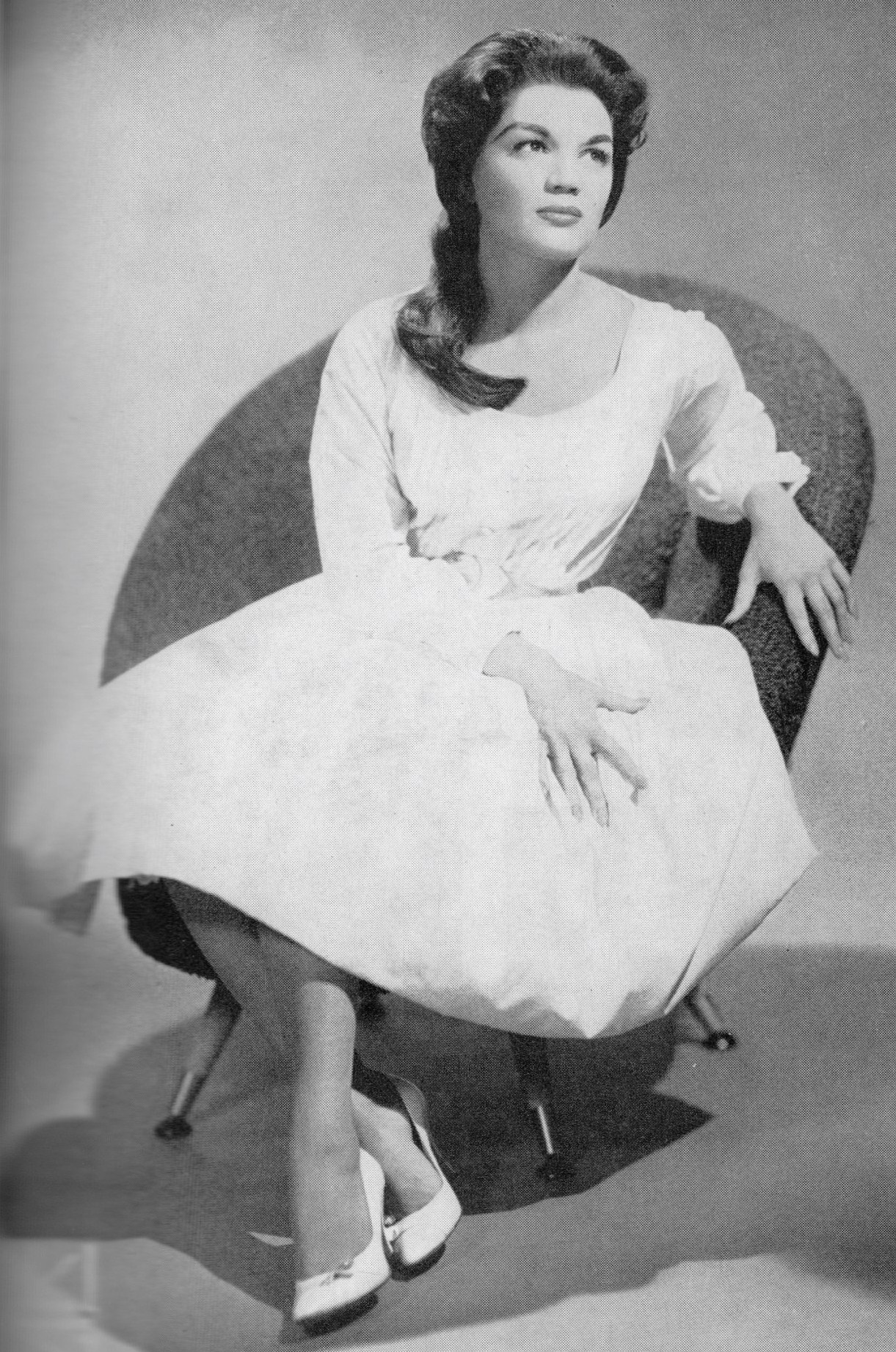





 Embarrassing Treasures