Weird Words of Wisdom: TMI, Dick Clark! Edition

“At certain times each month you feel listless, bored or even completely knocked out. A physical change is making its presence known through menstruation. With the beginning of these days of monthly bleeding, some girls may be hit by attacks of cramps, headaches and even upset stomach. Strange, isn’t it? And frightening at first, until you begin to understand that this is part of life’s process for continuing itself. Your body will supply a son or daughter to build the world of the future.”

Your Happiest Years by Dick Clark, 1959
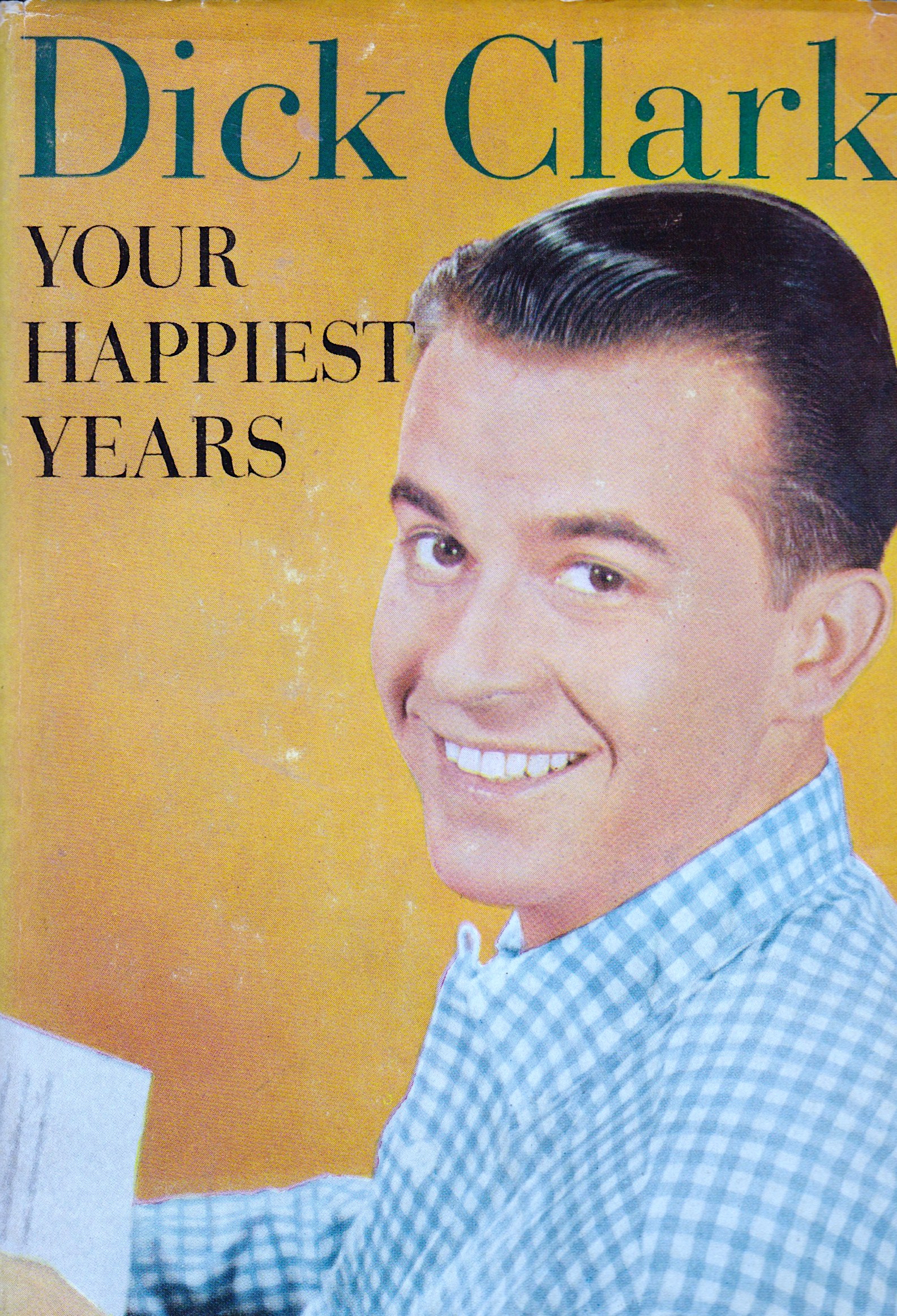
About the Book: Do any adults actually remember adolescence as their “happiest years?” This book by television personality Dick Clark, who would later be called “the world’s oldest teenager,” falls into that strange 1950s genre we have encountered here before—a volume of teenage advice authored by an adult celebrity. Can you imagine buying your young daughter a book in which Ryan Seacrest explains how her body will soon burst into womanhood?

Of course, when it comes to these celebrity books, it’s questionable who really authored them. Pat Boone’s book had a ring of authenticity, but this one is a pretty generic collection of 1950s wisdom for teenagers. It offers sensible advice on dealing with friends and family, while urging strict adherence to gender roles.

About the Author:  American Bandstand premiered nationally in 1957. The show “did as much as anyone or anything to advance the influence of teenagers and rock ‘n’ roll on American culture,” according to the New York Times. An immediate hit, it would run until 1989. In its early years, the Times wrote, teenagers saw Clark as “their music-savvy older brother.”
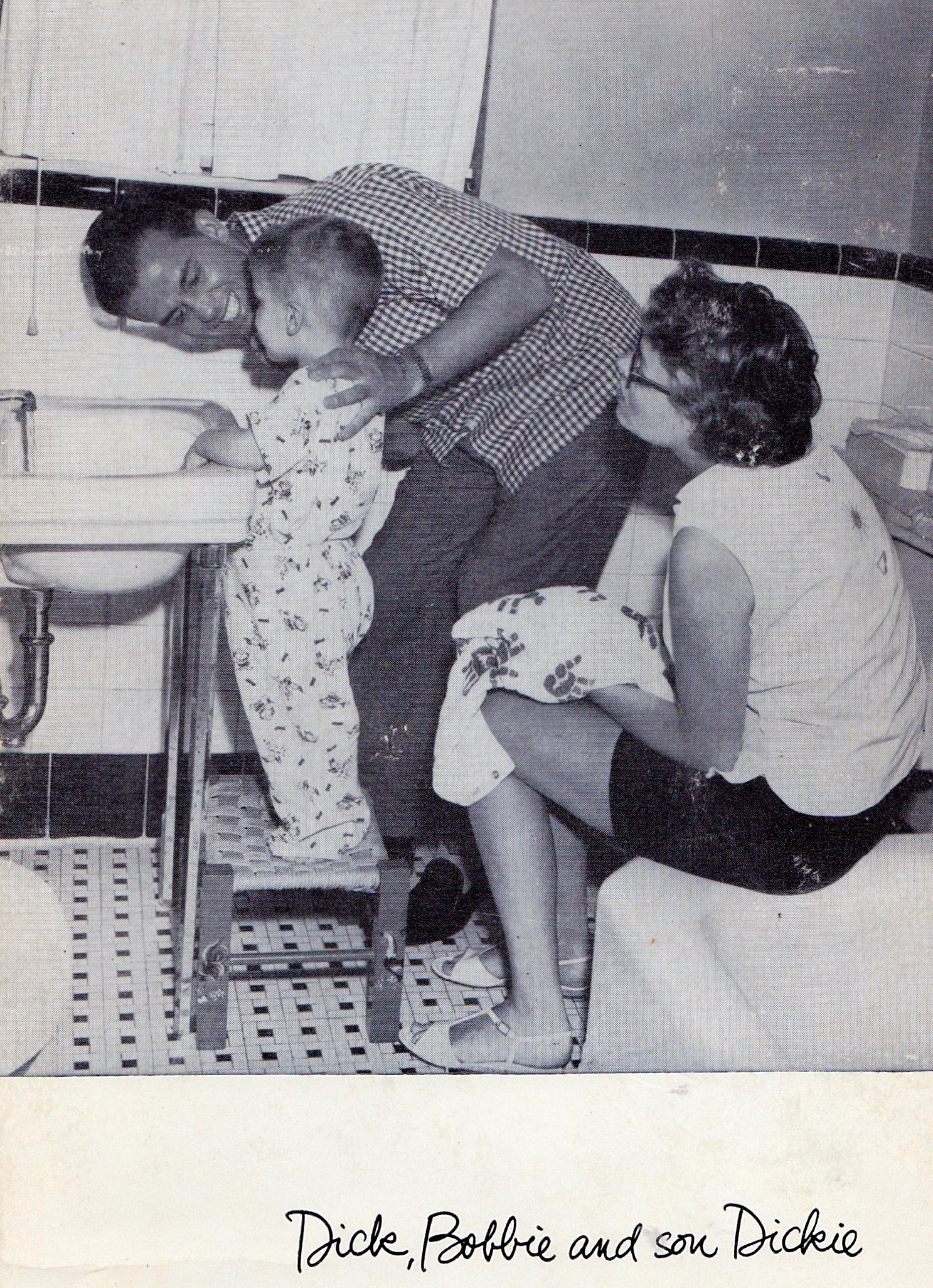
Dick’s marriage to high-school sweetheart Bobbie gave his teenage romance advice some credibility. Unfortunately, Dick and Bobbie divorced only two years after the publication of Your Happiest Years.

Clark was also a shrewd businessman, who never shied from a money-making opportunity.

”I get enormous pleasure and excitement sitting in on conferences with accountants, tax experts and lawyers,” he told the Times in 1961. It’s not surprising that he would lend at least his name to this book. Now, it is a bit surprising that he also “authored” a book for adults about bowling (scroll about 3/4 of the way down the page).

Clark wasn’t experiencing one of his happiest years in 1959. As the U.S. House Subcommittee on Legislative Oversight investigated payola in the music industry, Clark’s network bosses took pre-emptive action. As Time wrote on November 30, 1959, “ABC confronted him with a significant decision: he must get rid of his outside music interests or else quit TV…Faced with the ABC ultimatum, Clark decided to ‘divest’ himself of his interests in various music firms.” Clark denied any involvement in payola.

Celebrity Names This Book Drops: Connie Francis, Solly Hemus, Mickey Mantle, Dinah Shore.

Cautionary Tales Clark Offers:

  •         A boy who failed to overcome his shyness with girls at the appropriate age and reached the age of 19 without ever being kissed.
  •         A young ladies’ man who grew into a lonely adult when girls tired of his “gay-blade routine.”
  •         A sickly boy who resisted his parents’ curfew and came down with tuberculosis.
  •            A girl who stayed out all night, causing her worried father to head out looking for her. In his exhausted state, he crashed his car and emerged permanently crippled.

More Quotes from Your Happiest Years

“Once you’ve stepped out and found you can have a good time with girls, you are free to call any of them you know and ask for a date. They can say no, but at least you can ask. You don’t even have to feel self-conscious about it if one turns you down—you can dial another. A girl can’t do this—or certainly should not.”

“The sweaters and blouses that once flopped about you, to the despair of your mother and father, who wanted their little girl to look neat, are starting to fit snugly around your chest. Your breasts are undergoing a change as you grow into young womanhood. So are your hips, which broaden as they prepare for the function nature has marked out for you as a woman: the bearing of children.”

“It’s fine to be ‘one of the boys’ at certain ages. The teen age isn’t one of those times. The sports you played together when you were nine or ten belong only to him around thirteen or fourteen. You can know about them. In fact you should be able to talk about them—but let him star at them. You be there to cheer and he’ll notice and appreciate that.”

“A young woman should begin in her teens learning the things that keep a home running smoothly. She can watch how her mother cooks and bakes. There are also many opportunities for a daughter to observe how Mother handles Dad when he’s had a tough day at work. Mom can always use some help around the house, with dishes, cleaning, cooking, and a million other things a girl should know to qualify for that band of gold.”

On menstruation: “Accept it as you accept other signs of developing femininity and attractive womanhood. Although it may give you some discomfort and even embarrassment at first, it is a mark of special favor for you as a woman.”

Why teenage boys shouldn’t avoid dating in favor of hanging out with the guys: “A pinball machine may be a lot of fun when you’re seventeen, but at twenty-two it’s no date for a dance, and it won’t sew up those ripped shirts, when you’re thirty.”

Previous entries in this series

Weird Words of Wisdom: Prettily Bewildered Edition

Weird Words of Wisdom: Spanking New Edition

Weird Words of Wisdom: Chaperoned Edition

A Love Affair with Words: His Girl Friday

My husband balked at re-watching my favorite movie with me this weekend.

 “How can you not love this?” I asked, a few minutes into the film.

“It’s just so much…talking!” he sputtered.

His Girl Friday is, indeed, all talk. Its characters talk so much, so quickly, that their words overlap, ringing out into a musical counterpoint.  

Words attracted me to His Girl Friday the first time I encountered the movie, during my teenage years. As I flipped channels, this exchange captured my attention:

 Walter: This other fellow–I’m sorry that I didn’t get a chance to see him. I’m more or less particular about whom my wife marries. Where is he?

Hildy: Oh, he”s right on the job, waiting for me out there.

Walter. Hmm…Do you mind if I meet him?

Hildy: Oh, no, Walter. It wouldn’t do any good, really.

Walter: Now, you’re not afraid are you?

Hildy: Afraid? Of course not!

Walter: Then, come on! Let’s see this paragon. Is he as good as you say?

Hildy: He’s better!

Walter: Well, then, what does he want with you?

The Front Page, a 1928 Broadway hit written by Ben Hecht and Charles MacArthur, is His Girl Friday’s source. In the play, star reporter Hildy Johnson wants to escape the seedy world of journalism by marrying and finding “respectable” work. His managing editor, Walter Burns, thwarts him at every turn as the two collaborate on a bombshell story—a prison break by condemned murderer Earl Williams.

In His Girl Friday, Director Howard Hawks transforms Hildy Johnson into a woman, a change that raises the stakes considerably. Hildy’s choice between journalism and respectability is also a choice between a career and a traditional feminine role, and a choice between two very different men—her insurance-salesman fiancé Bruce Baldwin and her ex-husband, Walter Burns.

Two kinds of people populate His Girl Friday’s world. The journalists make up one group—a fast-talking, irreverent group. Walter Burns is this group’s apotheosis; nothing matters to him except the power and pleasure he derives from words. On the other hand, we have earnest people like Bruce; Earl Williams and his friend Molly Malloy; and prospective “city sealer” Joe Pettibone, who blows the lid off the mayor’s plan to execute a mentally ill man. These people speak slowly, mean what they say, and become lost in the journalists’ layered ironies and wise cracks.

Rosalind Russell’s Hildy operates well within both groups. Adopting a hushed interview style, she elicits Earl’s story. Showing sympathy that her male counterparts lack, she wins Molly’s trust. Admiring goodness and simplicity, she works to protect Bruce from Walter’s machinations.

In the end, though, Hildy can’t escape Walter and the lure of word craft. Words are weapons in their sparring, but also bind them in moments of shared delight that Bruce can’t comprehend. (Consider his delayed reaction, in the restaurant scene, when Hildy sees through Walter’s lies about another reporter. Bruce’s confusion produces contempt in Walter and embarrassment in Hildy.)

As James Walters wrote in the Journal of Film and Video:

“The film makes clear Hildy and Walter’s delight in controlling language, their near-delirium in playing together with the pace, tone, and rhythm of words. Their fluent use of language connects them with a world in which the ability to use words dictates a person’s status and in which, as in Molly’s case, an inability signals a person’s collapse…Indeed, there is a truthfulness in their shared vocal rhythms and patterns, as though their profound affinity emerges naturally and unavoidably whenever they are together.”

Choosing Walter’s world means giving up a lot, from little courtesies accorded to ladies, to society’s respect, to hopes of home and family and “a halfway-normal life.” For Hildy, however, giving up the mental exercise that Walter and writing provide would be a more bitter sacrifice.

His Girl Friday influenced my own choices, propelling me toward journalism school and a writing career. One day, in my college newspaper offices, the managing editor mentioned a Cary Grant movie she’d watched the night before.

“Have you ever seen His Girl Friday?” I asked.

 My reserved editor suddenly turned gushy: “Isn’t she great?!”

Hildy became a heroine ahead of her time when she announced, “I’m no suburban bridge player. I’m a newspaper man.”

Final Fun Facts: Hawks pioneered the overlapping dialog style that distinguishes His Girl Friday, but Grant and Russell made some delightful contributions to the script as well. Grant’s ad-libs include Walter’s description of Bruce as looking like “you know, that fellow in the movies…Ralph Bellamy.” Rosalind Russell, in her autobiography Life is a Banquet, described her secret hiring of a comedy writer to punch up the script. He added such bits as her murmured “slap happy” and her hand-signal-of-warning, both in the restaurant scene.

Note: His Girl Friday is available for streaming, free, at Hulu, and for free downloading and streaming at Internet Archive.

Play Family Matters

When I was about four, I walked with my mom to a nearby store. I can still remember walking home, up a hill, carrying a large box, and bursting with excitement. For no special reason at all, my mom had bought me the Fisher Price Play Family School that day.

Play Family toys were among my favorites. Besides the School, I had the House and the Houseboat. When I was five, Santa brought me the wonderful Play Family Village, which included a firehouse, dental office, theater, post office, police station, barber shop, garage, restaurant, and telephone booth.

I don’t have any of my old Fisher Price toys, but my husband has picked up some vintage structures at flea markets and yard sales. My daughter, who is nine, still enjoys playing with them now and then. Today, she set up a Play Family city around the living room rug.

Here’s how our little people spent Labor Day.

This slideshow requires JavaScript.

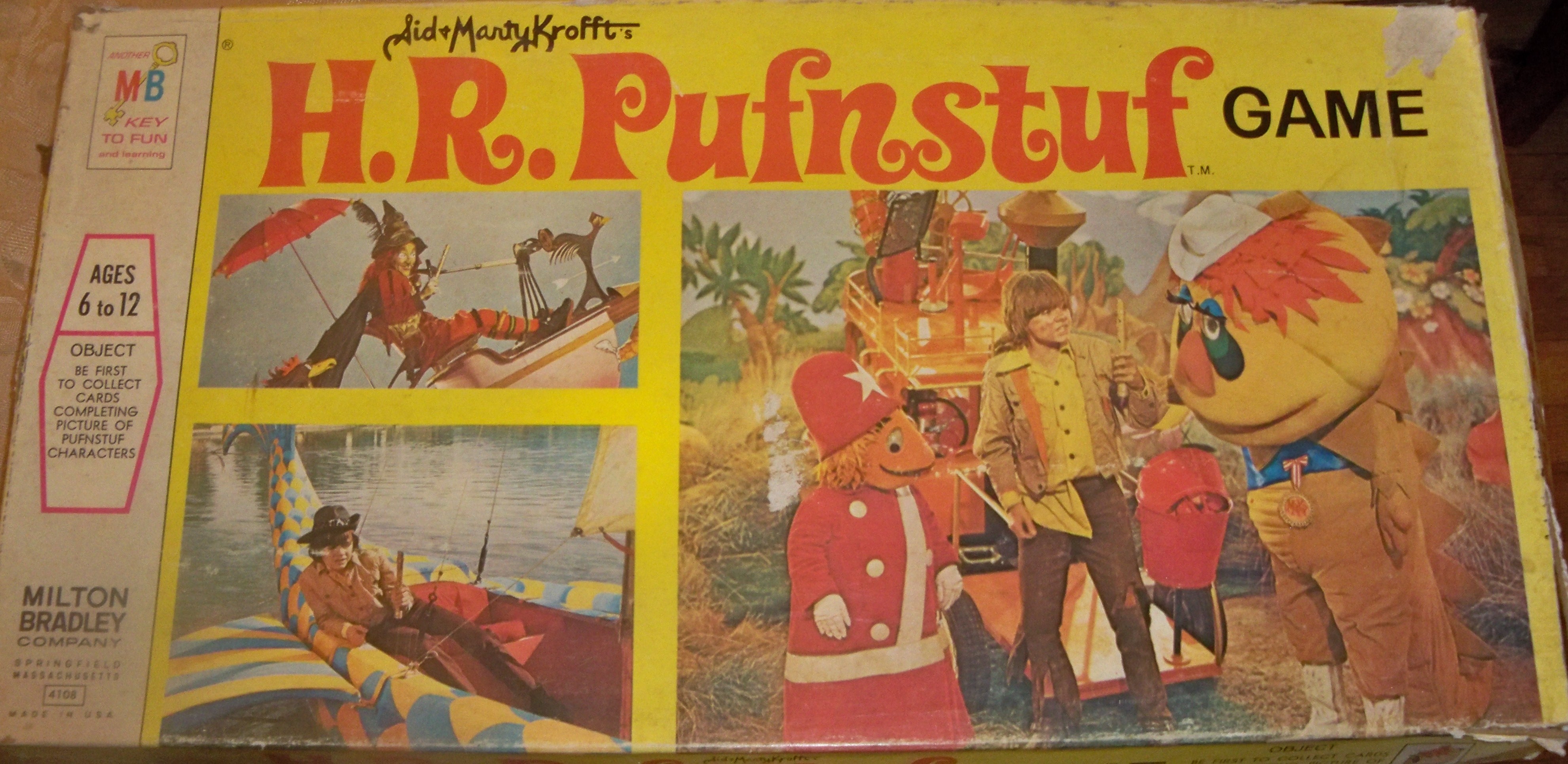
Spin Again Sunday: H.R. Pufnstuf

Another week, another cardboard-and-plastic journey to the past.

Today’s Game: H.R. Pufnstuf Game

Copyright Date: 1971

Object: Be first to collect cards completing picture of PufnStuf characters.

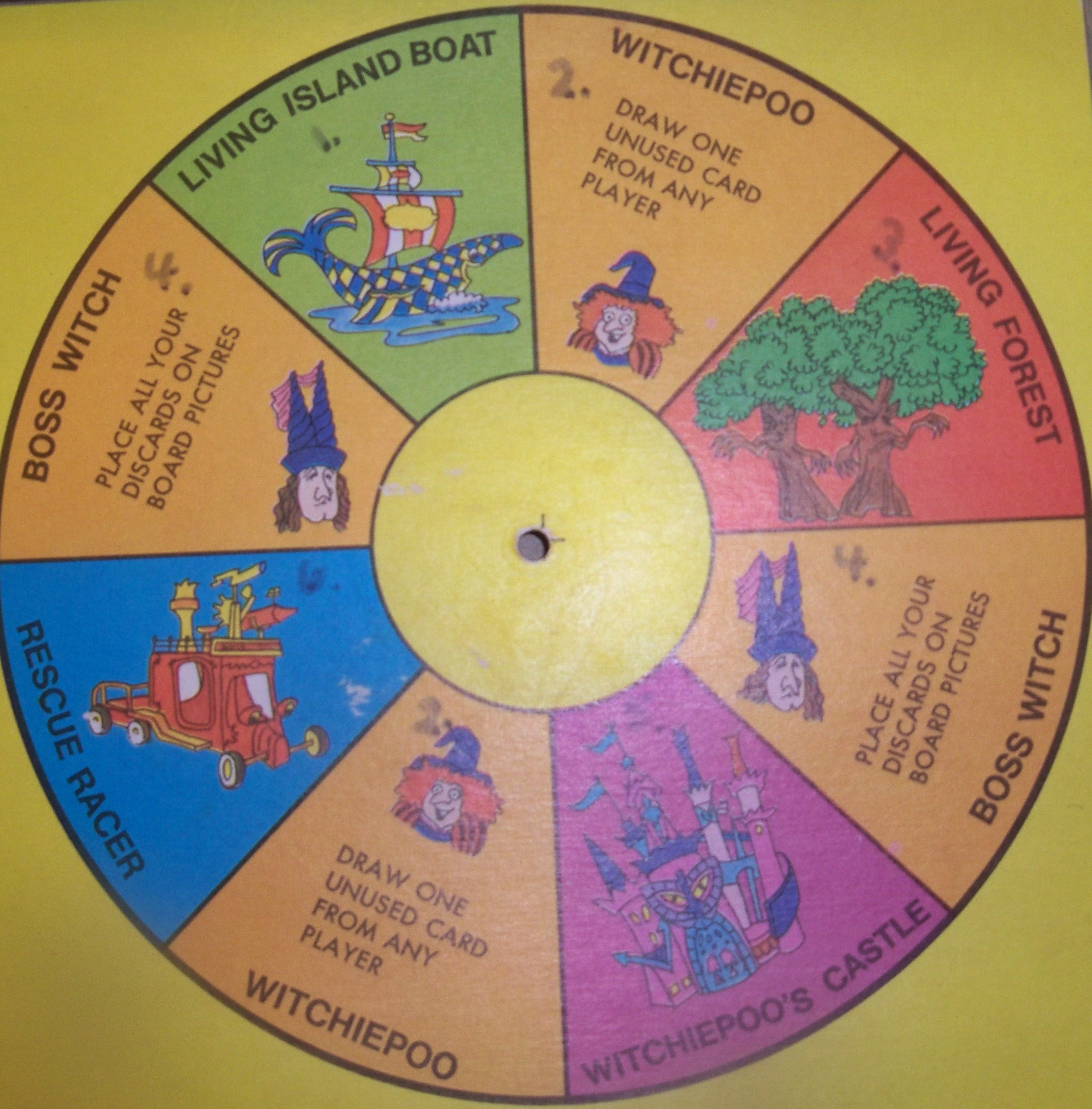
Game Board: Colorful and cartoony, though the cartoon likenesses leave a lot to be desired.

Game Pieces: None. Cards and a spinner are all you need to play this game.

Recommended Ages: 6-12. The game box, with its full-color photos, might have attracted kids throughout that age range, but the graphics inside scream little kid.

Game Play: The board is really superfluous in this game; players don’t move around it. They just spin and collect cards and try to complete a puzzle. (It’s nice that Freddy the Flute gets his own puzzle; on the show, he just squeaked “Jimmy” and got stolen a lot.

Personal Notes: I never had this game as a child—I would’ve been too young to play it in 1971. I did watch H.R. Pufnstuf, though, and still have the disturbing, hallucinatory memories to prove it.

About the Show: H.R. Pufnstuf premiered on September 6, 1969, as part of NBC’s Saturday morning lineup. Popular with kids, it aired for two years on NBC, one year on ABC, and two and a half years in widespread syndication—an amazing feat considering that Sid and Marty Krofft only produced 17 episodes.

Final Fun Fact: Jack Wild, who starred as Jimmy, got to keep one of the original Freddy the Flutes as a souvenir after the show wrapped, according to the book Pufnstuf and Other Stuff.

Previous Entries in this Series:

Charlie’s Angels

Laverne & Shirley