Weird Words of Wisdom: Twin Sister Smackdown Edition

…or, Whose Vintage Advice to Teens is Weirder—Ann’s or Abby’s?

Dear Teen-Ager by Abigail Van Buren, 1959

Ann Landers Talks to Teen-Agers About Sex, 1963

“Just as ‘liquor is quiquor’ is a way to a neat little plot in the cemetery, it can also be a jet liner to sextra headaches.”—Abby

“You wouldn’t take a diamond and platinum brooch to try to pry open a jar of pickles with it, would you? Using sex in the wrong way adds up to the same thing.”—Ann

About the Authors: Identical twins Pauline and Esther Friedman, the children of Jewish immigrants, were inseparable as children. As Morningside College co-eds, they collaborated on an advice column for the school paper. They married in a double wedding. And they built matching careers—Esther became Ann Landers in 1955 at the Chicago Sun-Times; Pauline because the San Francisco Chronicle’s Dear Abby three months later.  Both their columns were hits in syndication. Ann Landers eventually reached 90 million readers, and Abby reached 80 million by 1995. Pauline’s daughter Jeanne Phillips started co-writing Dear Abby with her mother in 1987 and took over all writing duties by 2002, after Pauline was diagnosed with Alzheimer’s disease. That was also the year Esther died, bringing the Ann Landers column an end.

The Ann-Abby Feud: Understandably, Esther resented Pauline’s decision to start a rival advice column. The sisters went through a period of estrangement that included the publication dates for both these books. In 2005, Esther’s daughter, Margo Howard, published a collection of letters she’d received from her mother through the years.  Complaints about “Popo” (Pauline’s family nickname) figure prominently. “I can’t cut her out of my life completely, no matter how loony she gets,” one letter from 1981 reads. “She is too much a part of me, but I must myself protect against her in some way. She is too unpredictable—and destructive.”  
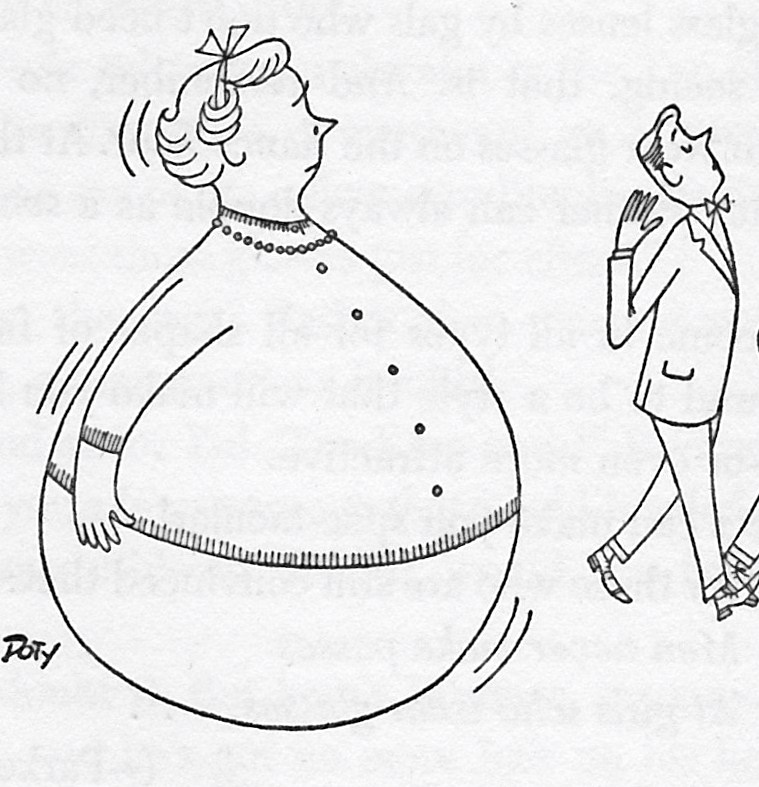
From Abby’s book, a sensitive illustration of the problems facing overweight teens

About the Books: The books’ titles reflect their differing focuses. Abby’s book covers various teen topics, from dating to dealing with teachers, from grooming to smoking. Ann’s book takes dead aim at the sex stuff. (That’s probably what most teens skipped to in comprehensive advice books, anyway.)

Changes in society probably influenced the difference in focus. Although only four years separated the books, those four years saw rapid changes in sexual mores. “The pill” became available for contraceptive use in 1960, and by 1963, America was on the cusp of sexual revolution. Of girls who turned 15 between 1954 and 1963, 48 percent had premarital sex before age 20. For girls who turned 15 between 1964 and 1973, the figure rose to 65 percent (Source: The Alan Guttmacher Institute).  

Differences in Tone: Abby’s writing style is much cutesier, and her book includes cutesy illustrations, as well. Ann can get a bit sassy, but mostly adopts a down-to-earth style. This reflects a real difference in their early advice-giving styles. As Time wrote in 1957, “Abby’s replies are slicker, quicker, and flipper.”

Examples of this style in Dear Teen-Ager include:

“If you’re under 18 there are more reasons for not going steady than Elvis can shake a hip at.”

“Men who are older tend to be bolder.”

“Troubles are like photographs. They are developed in dark places.”

Contrast that with a typical piece of advice from Ann’s book:

“Housework, particularly floor-scrubbing, is not only great for the female figure, but it’s good for the soul. And it will help take the edge off your sex appetite. Cooking, baking, and sewing will prepare you for homemaking. Energy siphoned off into these constructive channels will leave less energy for preoccupation with erotic fantasies.”

Abby would have probably said, “Keep scrubbing the floor, and you’ll be lusty nevermore”….or something.

A Shared Moose Obsession? Abby’s book includes one of her most famous lines: “Girls need to ‘prove their love’ through illicit sex relations like a moose needs a hatrack.”

Ann’s book reprints a letter from a girl with a loser boyfriend, and Ann’s response concludes, “You need this infant like a moose needs a hat rack.”

I don’t know which sister used the expression first, but it didn’t originate with either of them. Jack Benny made the phrase a running joke on his radio show in 1947.

The Double Standard: Abby took the double standard for male and female behavior for granted in 1959, while Ann rejected it in 1963.

Abby: “When a decent boy gets serious about someone, and thinks of marrying someone…that someone will be someone he respects. All boys aren’t angels, but most of them are looking for one.”

Ann: “No man should insist on a white-flower girl unless he is able to bring to the marriage the same credentials of purity.”

Homosexuality: Abby doesn’t mention homosexuality at all, but Ann devotes a whole chapter to it. This distinguishes her book from the other teen advice books I have from this period—few go beyond advising teens to seek professional help if they don’t develop an attraction to the opposite sex.

Ann sounds genuinely distressed by the mail she receives from desperate gay young people. “About 70 percent of the letters come from boys,” she writes. “Most of the boys who write are tortured with guilt and self-hatred. They live on the razor’s edge, terrified that someone may learn they aren’t ‘like everybody else’…Many who write are so ashamed of their physical desires for members of their own sex that they speak of suicide.”

She accepts the psychiatric wisdom of the time that labeled homosexuality as a mental disorder, but she does encourage heterosexual teens to be understanding toward their gay peers, who are “twisted and sick, through no fault of their own.”

Abby’s and Ann’s approaches to homosexuality in their respective books carried over into their newspaper columns. Abby mostly ignored the subject, and Ann stuck by her belief that homosexuality was a disorder until 1992, nearly two decades after the American Psychiatric Association stopped labeling it as one.

Ann’s Most WTF Comment about Homosexuality: “Some Lesbians who despise men enjoy arousing a male’s sexual appetite and then punishing him with rejection.”

Abby’s Least Helpful Advice: “…if everybody picks on you—well—don’t look now, but maybe something’s wrong with you!” (During my many years as a bullying victim, this would have cut me like a knife.)

Abby’s Most Surprising Advice, Which Follows Many Chapters Stressing Inner Beauty and the Need for Self-Acceptance: “Now maybe you’re one of those girls who were slightly short-changed above the equator. Hundreds of girls have written to me asking if it’s dishonest to get a little outside help (okay, ‘falsies!’) to put them out in front. To this I say, ‘Buy all the attachments you need!’”

On Smoking and Drinking: Both sisters advise against teenage drinking. Ann describes the decision she made at a young age—and maintained throughout her life—to abstain from alcohol. Interestingly, her daughter Margo writes that “I was considered ‘sophisticated’ even as a high school girl. I smoke and I drank scotch on the rocks.”

Ann has little to say about smoking; Abby raises several objections, which don’t include health effects. She even pulls out another double standard: “Even when a fellow happens to be a smoker himself, he prefers a girl who doesn’t smoke. It cheapens her appearance. It clouds the illusion of sweetness.”

Abby’s Most Ironic-in-Hindsight Use of a Celebrity to Make a Temperance Point: “Did Mickey Mantle tell Casey Stengel it’s old-fashioned to forbid smoking, drinking or late hours during baseball season? Of course not.”

Other Abby Quotes:

“A nice girl does not hand out a kiss—or kisses—on the first date, no matter how much she digs the boy. If he’s worth liking, he’ll respect you for it. Boys, hold your fire.”

“The bobby-soxer herself, Miss Junior Miss…is endowed by a mysterious but obviously prudent Nature with more slowly excitable sex responses.”

On handling a “mad lover” (21st century translation: a potential date rapist): “In an extreme case, where physical duress is involved, meet force with force. A right uppercut is unladylike, so you’d best settle for a stereophonic slap in lover boy’s fresh face…When he recovers from his chagrin, your best line is a brusque “Home James!” He won’t trouble you again.”

Other Ann Quotes:

“A girl who is called a make-out by her friends would do well to take stock of herself.”

“What am I saying? That a girl can be nice even though she goes all the way? Yes. The girl can be nice—but the girl is not very bright.”

Overall, I think Abby gets the Weirdness Trophy.

Other Entries in this Series

Weird Words of Wisdom: Prettily Bewildered Edition

Weird Words of Wisdom: Spanking New Edition

Weird Words of Wisdom: Chaperoned Edition

Weird Words of Wisdom: TMI, Dick Clark! Edition

Weird Words of Wisdom: TMI, Dick Clark! Edition
“At certain times each month you feel listless, bored or even completely knocked out. A physical change is making its presence known through menstruation. With the beginning of these days of monthly bleeding, some girls may be hit by attacks of cramps, headaches and even upset stomach. Strange, isn’t it? And frightening at first, until you begin to understand that this is part of life’s process for continuing itself. Your body will supply a son or daughter to build the world of the future.”

Your Happiest Years by Dick Clark, 1959

About the Book: Do any adults actually remember adolescence as their “happiest years?” This book by television personality Dick Clark, who would later be called “the world’s oldest teenager,” falls into that strange 1950s genre we have encountered here before—a volume of teenage advice authored by an adult celebrity. Can you imagine buying your young daughter a book in which Ryan Seacrest explains how her body will soon burst into womanhood?

Of course, when it comes to these celebrity books, it’s questionable who really authored them. Pat Boone’s book had a ring of authenticity, but this one is a pretty generic collection of 1950s wisdom for teenagers. It offers sensible advice on dealing with friends and family, while urging strict adherence to gender roles.

About the Author:  American Bandstand premiered nationally in 1957. The show “did as much as anyone or anything to advance the influence of teenagers and rock ‘n’ roll on American culture,” according to the New York Times. An immediate hit, it would run until 1989. In its early years, the Times wrote, teenagers saw Clark as “their music-savvy older brother.”

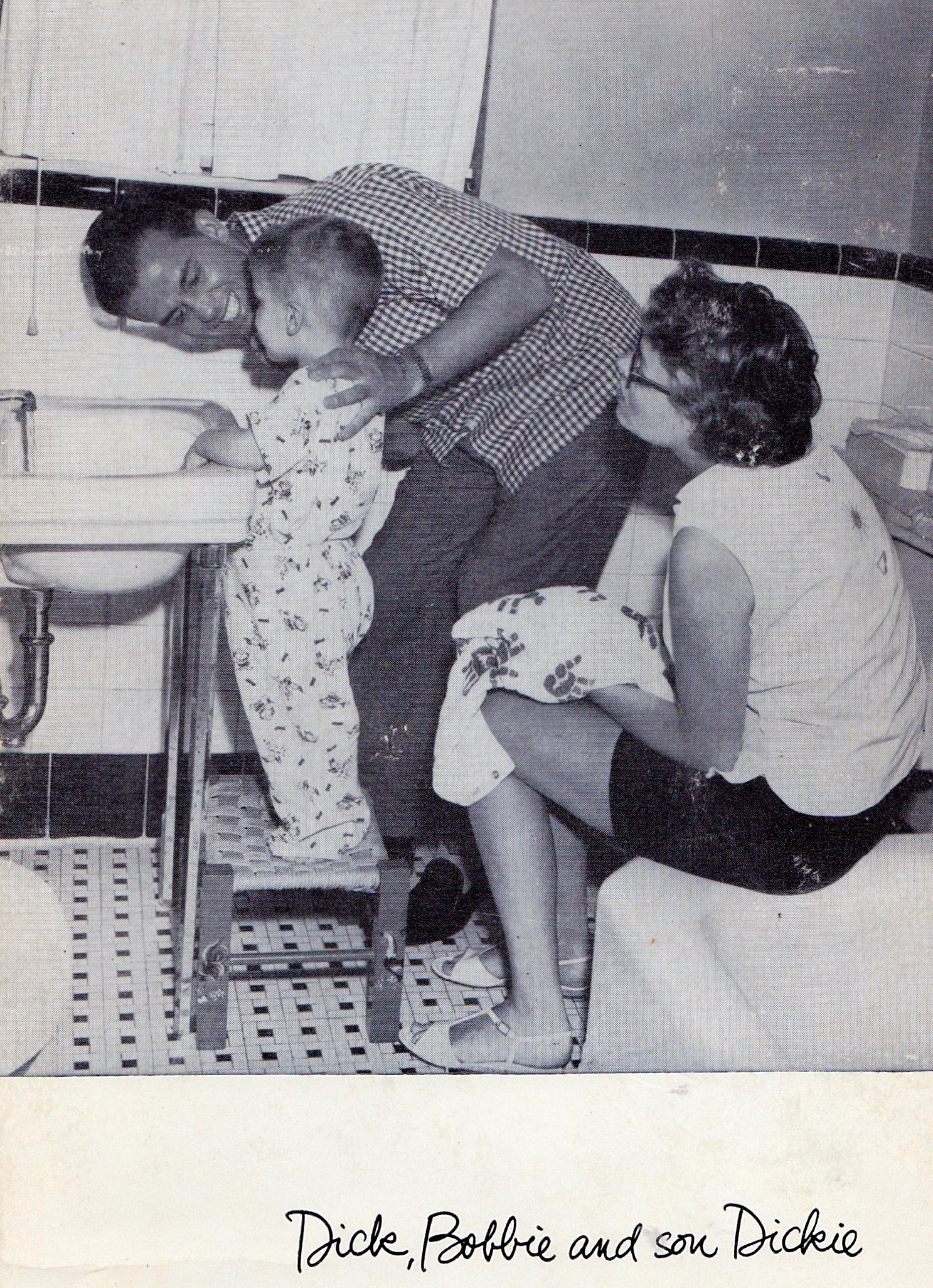
Dick’s marriage to high-school sweetheart Bobbie gave his teenage romance advice some credibility. Unfortunately, Dick and Bobbie divorced only two years after the publication of Your Happiest Years.

Clark was also a shrewd businessman, who never shied from a money-making opportunity.

”I get enormous pleasure and excitement sitting in on conferences with accountants, tax experts and lawyers,” he told the Times in 1961. It’s not surprising that he would lend at least his name to this book. Now, it is a bit surprising that he also “authored” a book for adults about bowling (scroll about 3/4 of the way down the page).

Clark wasn’t experiencing one of his happiest years in 1959. As the U.S. House Subcommittee on Legislative Oversight investigated payola in the music industry, Clark’s network bosses took pre-emptive action. As Time wrote on November 30, 1959, “ABC confronted him with a significant decision: he must get rid of his outside music interests or else quit TV…Faced with the ABC ultimatum, Clark decided to ‘divest’ himself of his interests in various music firms.” Clark denied any involvement in payola.

Celebrity Names This Book Drops: Connie Francis, Solly Hemus, Mickey Mantle, Dinah Shore.

Cautionary Tales Clark Offers:

  •         A boy who failed to overcome his shyness with girls at the appropriate age and reached the age of 19 without ever being kissed.
  •         A young ladies’ man who grew into a lonely adult when girls tired of his “gay-blade routine.”
  •         A sickly boy who resisted his parents’ curfew and came down with tuberculosis.
  •            A girl who stayed out all night, causing her worried father to head out looking for her. In his exhausted state, he crashed his car and emerged permanently crippled.

More Quotes from Your Happiest Years

“Once you’ve stepped out and found you can have a good time with girls, you are free to call any of them you know and ask for a date. They can say no, but at least you can ask. You don’t even have to feel self-conscious about it if one turns you down—you can dial another. A girl can’t do this—or certainly should not.”

“The sweaters and blouses that once flopped about you, to the despair of your mother and father, who wanted their little girl to look neat, are starting to fit snugly around your chest. Your breasts are undergoing a change as you grow into young womanhood. So are your hips, which broaden as they prepare for the function nature has marked out for you as a woman: the bearing of children.”

“It’s fine to be ‘one of the boys’ at certain ages. The teen age isn’t one of those times. The sports you played together when you were nine or ten belong only to him around thirteen or fourteen. You can know about them. In fact you should be able to talk about them—but let him star at them. You be there to cheer and he’ll notice and appreciate that.”

“A young woman should begin in her teens learning the things that keep a home running smoothly. She can watch how her mother cooks and bakes. There are also many opportunities for a daughter to observe how Mother handles Dad when he’s had a tough day at work. Mom can always use some help around the house, with dishes, cleaning, cooking, and a million other things a girl should know to qualify for that band of gold.”

On menstruation: “Accept it as you accept other signs of developing femininity and attractive womanhood. Although it may give you some discomfort and even embarrassment at first, it is a mark of special favor for you as a woman.”

Why teenage boys shouldn’t avoid dating in favor of hanging out with the guys: “A pinball machine may be a lot of fun when you’re seventeen, but at twenty-two it’s no date for a dance, and it won’t sew up those ripped shirts, when you’re thirty.”

Previous entries in this series

Weird Words of Wisdom: Prettily Bewildered Edition

Weird Words of Wisdom: Spanking New Edition

Weird Words of Wisdom: Chaperoned Edition

Weird Words of Wisdom: Chaperoned Edition

“The question of chaperons will surely come up. It’s a fact that most teen-agers prefer to go to a party that’s chaperoned.”

Party Perfect by Gay Head, 1959 (3rd printing, 1962)

Yes, the author’s name is Gay Head. My “Top Searches” should be interesting this week.

About the Book: Dust off your records and start pressing your suit— we’re going to party like it’s 1959! This slim Scholastic volume is filled with party-planning tips, from entertainment (“No evening’s program of games is complete without a relay race”) to wardrobe (“Dress up in your best date dress and tell your girl friends to do the same. Jacket and tie for the boys. After all, part of the fun of a party is being dressed right for the occasion. You’ll all enjoy yourselves more if you do.”)

Sample Party Themes:

  • A United Nations get-together. You assign each guest a country, and they dress accordingly: “A girl can look like a Mexican senorita by wearing a colorful, full cotton skirt, a pretty blouse, and hoop earrings. To be a gaucho, a boy might wear dark trousers, a colorful shirt, and a cumberbund.”
  • A space party: “By Jupiter—be the first one in your crowd to give an out-of-this-world party! This is not as mad as it sounds. The day will come when travel to outer space will be as everyday as going for a spin in the family car.”

Sample Refreshments:

  • For New Year’s Eve, hot buttered soup, made with eight cans of condensed tomato soup and seasoned with lemon juice, cinnamon, and cloves. “Serve hot with a pat of butter floated on the top.”
  • For Valentine’s Day, tuna tomatoes. Combine two cans of chunk-style tuna with a can of cream of mushroom soup. Season with salt and pepper. Use mixture as filling for eight hollowed-out tomatoes, and bake at 350 degrees for 30 minutes.
  • For a space party, deviled ham missiles. Spread deviled ham on half a hot dog bun. Slice a cheese wedge in half lengthwise and insert it at one end of the bun. Insert two carrot sticks at the other end. Top with other half of bun.

Sample Party Games Titles That Sound More Interesting Than the Games Actually Are: Bottoms Up, Scrambled Anatomy, Elopement, Murder.

About the Author: I would love to share a complete biography of Gay Head that included her childhood at Newport, her lively debutante days, and her marriage to a shipping magnate. Alas, Miss Head never existed. The Library of Congress entry for this book suggests that Gay Head was a pseudonym for Margaret Hauser. I can’t find any information about Hauser, except that she edited Scholastic’s Co-Ed Magazine from the 1950s through at least 1970. She also wrote articles under the Gay Head pseudonym for Scholastic magazine in the late 1930s and early 1940s.

Interestingly, though, Hauser was not the only Gay Head. On October 21, 2002, USA Today published an interview with Ruth Imler Langhinrichs. “From 1948 to 1952,” the article states, “Langhinrichs used the pseudonym Gay Head to answer teens’ questions in a column in Scholastic magazine called ‘Boy Dates Girl.’”

It seems that Gay Head must have been a in-house pseudonym, used by various Scholastic writers. The occasion for Langhinrichs’ interview was the release of Steve Coulter’s short film The Etiquette Man, based on the book Boy Dates Girl, a compilation of Gay Head columns. Boy Dates Girl was first published in 1937, with updated printings through the mid-1960s.

Langhinrichs, at least, looks back fondly on her Gay Head days, according to USA Today: “Her years as Gay Head were happy times, she says. They helped her become an editor for teens at Ladies’ Home Journal, where she wrote a column titled Sub-Deb — as in not-quite-a-debutante. Langhinrichs still collects lore on social civility and manners. She works two days a week as a writing coach at Indiana’s Purdue University.”

To the delight of bloggers everywhere, “Gay Head” wrote several other teen advice books, including You’re Asking Me? and Hi There, High School.

We’ll be seeing more of her in future weeks.

Previous entries in this series

Weird Words of Wisdom: Prettily Bewildered Edition

Weird Words of Wisdom: Spanking New Edition

Weird Words of Wisdom: Spanking New Edition

“Kissing for fun is like playing with a beautiful candle in a room full of dynamite!”

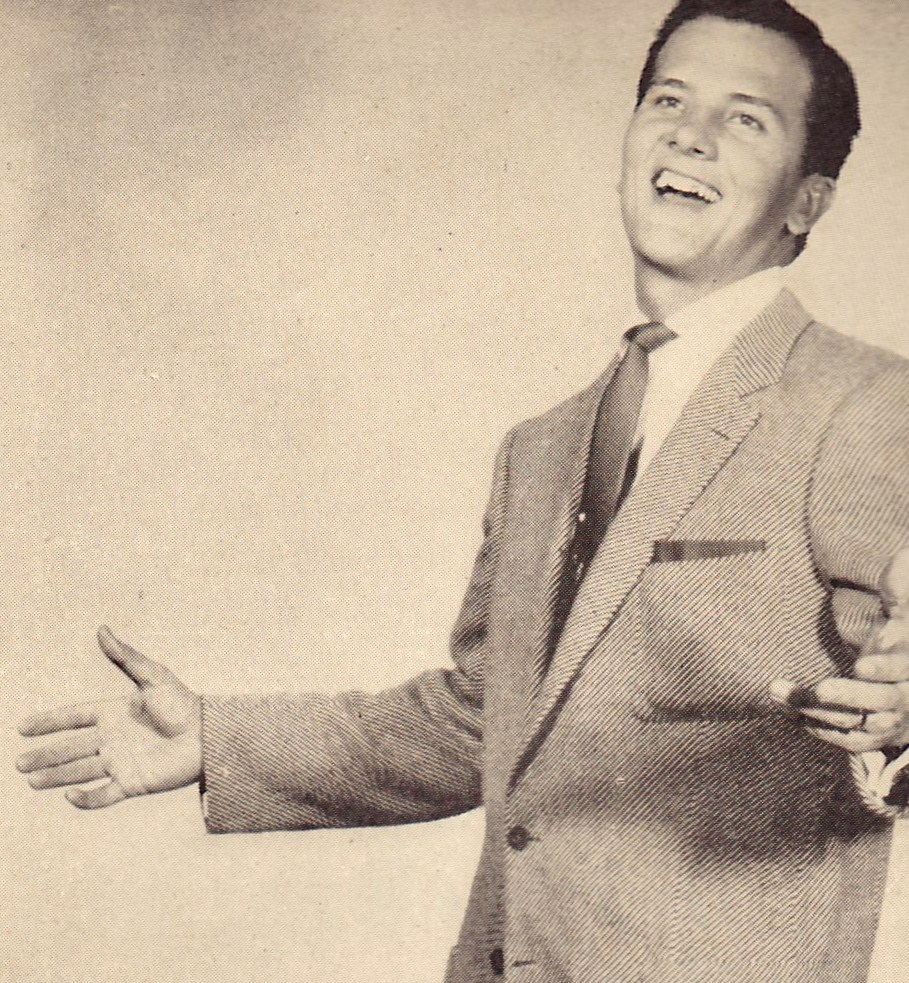
‘Twixt Twelve and Twenty by Pat Boone, 1958

Would you let your teenage daughter take advice from this man?

About the Author: If you’re like me, and you know little about Pat Boone besides the fact that he’s Debby’s father, you may be surprised to learn just how popular he was in the 1950s. With 38 Top 40 hits, he was second only to Elvis in chart dominance. He also had his own TV show, The Pat Boone-Chevy Showroom, and starred in 15 feature films.

Boone has put his conservative Christian beliefs into practice throughout his career, avoiding sponsors and material that he considered offensive. His most controversial career move came in 1997, with his tongue-in-cheek foray into heavy metal.

Considering his conservative background, one shouldn’t find it surprising that Boone is a Republican political activist today—but it is disappointing to see he is a birther.

When ‘Twixt Twelve and Twenty was published, Boone and his wife Shirley had been married for five years and were raising four daughters.  

About the Book: If it seems strange today that teens would turn to a young married celebrity for advice on surviving adolescence, the phenomenon was common in the 1950s. ‘Twixt Twelve and Twenty was one of the most popular books of its kind—in fact, according to the Washington Post, it was 1958’s second-highest selling nonfiction book.

While a ghostwriter probably contributed to this book, it displays a convincingly folksy Booneishness. Words and phrases like “chillun,” “’taint true,” and “lil ol’ teenager” appear frequently. Boone’s evangelical Christian beliefs pervade the book, which according to Time, he promoted at Church of Christ congregations nationwide. Parents who share his beliefs would probably find much to like in this book, even today.

While he avoids details on sex, Boone urges teens to stick to innocent “April love,” until they are truly ready for “May” (a serious, steady relationship) and “June” (marriage). He doesn’t go the full Duggar by condemning teen dating and kissing entirely.

Basically, Boone recommends being yourself, developing good habits, practicing the Golden Rule, and resisting the urge to grow up too fast—things that even a secular-minded, liberal parent like myself can get behind.

The Boone Family Spanking Situation: The book hits its one really weird note on the issue of corporal punishment:

“And of course there are spankings—and spankings. There is the delayed spanking that sets in when you’re too old to go across Mama’s knee and have to wait until you get home and lean over the bathtub. There is the angry spanking and the loving spanking. My mother never gave ‘loving’ spankings. I wouldn’t know what they were. But hers weren’t angry either; they were intelligent and they were just.”

Boone informs readers that his mother delivered these spankings with a sewing machine belt, and didn’t stop her “lean over the bathtub” spankings until he was seventeen (and only then, apparently, because her inability to make him cry frustrated her).

Now, I don’t believe in spanking at all, but surely even most spanking advocates would find that a bit excessive. Even more shocking is the way this carried over into the next generation, as the Washington Post described in a 1978 Debby Boone profile:

Perhaps the man she is still closest to is her father. Both say that their stormy battles during Debby’s teens have made them even closer now. For Debby the turning point was in Japan; for Pat it was in Columbus, Ohio, two years ago when the family appeared at the state fair. They all thought it was going to be their last show together.

“We all were in an emotional state,” he recalls. “Debby (who was 19 then) had left the room to go and get candy; and was gone for a half-hour. I was worried about her and went to find her. She was in the lobby talking to some musicians, but was upset that I embarrassed her in front of them. It was a trivial matter really, but when we got back to the room I thought she was pretty sassy. One thing led to another and suddenly I threw her over on the bed and spanked her in front of her mother and her sisters.”

Afterwards, feeling chagrined and guilty, the father apologized to his family and led them all in prayer. “But there were no hugs and kisses that night,” he remembers. The next day on the plane, he heard Debby laughingly tell the girls about the black and blue marks on her bottom. “I found there were tears in my eyes,” he says, “for I realize Debby had let me off the hook. Overnight, she had forgiven me for being out of line.”

Spanking your 19-year-old daughter? At the risk of Pat Boone considering me unladylike: WTF?

Original Owner: My copy belonged to a girl named Carol Sue, whose parents inscribed it to her and gave it to her as a 12th birthday gift.

Final Fun Fact: Twixt Twelve and Twenty is also the name of a 1959 Pat Boone hit.

Other Quotes from ‘Twixt Twelve and Twenty:

“Popularity—‘manifest approval of the people in general’—can be a good, sound thing, but it can also be a personality freak or a snow job. Adolf Hitler was the most popular man in Germany for quite a spell.”

“It doesn’t make sense to me that girls who want to be as pretty as possible, who intend to be feeding and caring for a whole family day after tomorrow, don’t know how to feed and care for themselves today. Yet magazine articles, dietitians, beauticians, high school principals, all sigh over the high percentage of poor physical care and poor nutrition among teenagers, even in top economic areas.”

 “Take my first steady…She was a very pretty girl, a wonderful singer, much in demand. But she put too much strain on young love. She let me see her in her curlers.”

“(Shirley) has the kind of beauty I admire. A neatness, a freshness and cleanness, as well as pretty features. Her physical attractiveness is the quiet, decent kind that a man looks for in a wife.”

“Sometimes, girls, if you let your husband boss the project a little, he’ll wind up doing the work quite efficiently. Because, you see, it’s his corporation.”

“Bad language is a dead giveaway that the user is covering up ignorance (he doesn’t know what he’s talking about) or is pretty lazy (he knows, but he won’t take the trouble to say it). Or, worst of all, that he thinks it’s smart!”

Also on swearing—“We’ll assume ladies never develop the above mentioned habit—I hope—I hope!!”

Previous Entries in this Series

 Weird Words of Wisdom: Prettily Bewildered Edition


Weird Words of Wisdom: Prettily Bewildered Edition

“We all say marriage is a partnership and, for the most part, we mean it in the sense of sharing the fun, the joys, the responsibilities, the highs and lows of any family’s life. But just as there can be only one skipper to a boat, one driver to a car, or one president of a company, so there can be only one head of a happy house—and that is, by law, by taxes, by census, and by woman’s intuition, the husband. It’s a pleasant thought to remember that if a man’s home is his castle, he must be the lord and master; and you, therefore, are the chatelaine, the mistress of the castle and keeper of the keys to a very happy existence as a wedded wife.”

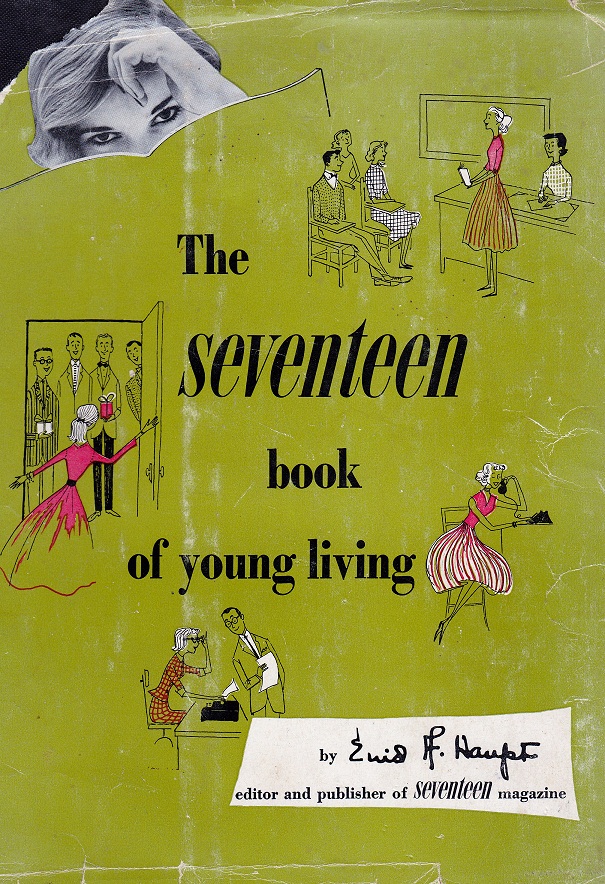
The Seventeen Book of Young Living by Enid Haupt, 1959

About the Book: This book, purchased at a library book sale two decades ago, started me collecting advice manuals aimed at teenagers. I wasn’t so far past my own teenage years then, and the book’s quaint advice on dating, friendship, fashion, and school amused and sometimes charmed me. As I added more advice books to my collection, I became fascinated by what the books reveal about the past. Reading what a given era’s adults felt young people should know tells you a lot what a society valued.

(Reading what previous owners wrote or left in these books can be interesting, too. The previous owner of my book recorded her first name as “Twinkle.” This suggests she was a careful student, indeed, of The Seventeen Book of Young Living.)

This book strives to introduce budding Betty Drapers to gracious living, mid-century style, from party planning to the art of conversation (“Books, plays, and movies are always welcome subjects”); from bedroom decorating to managing men (she recommends that a girl develop “a very feminine ability to look prettily bewildered and helpless while plotting and achieving a goal she thinks is really important.”)

More than many such books, this one encourages girls to develop their minds as well as their manners. The author recommends exploring the arts and expresses unusual ardor when the subject turns to books.

Haupt, who edited and published Seventeen for 15 years beginning in 1955, strove for an elevating tone. She accepted the editorship from her brother, legendary publisher Walter H. Annenberg.  “I knew nothing about running a magazine,” she told the New York Times in 1992, “but my brother said, ‘You can bring culture to the average working person who has not had your advantages.’ ”

I used to laugh at the back-cover photo of Haupt, all prim and pearled—and her Times obit’s revelation that she led Seventeen “from a pink swiveled throne in a large office dominated by pink curtains and pink flowers” supports my initial impression of her.

Actually, Haupt exuded true graciousness. She donated much of her publishing-dynasty fortune to worthwhile causes, including Memorial Sloan-Kettering Cancer Center, the New York Public Library, and the Metropolitan Museum of Art. Her love of gardening inspired her largest philanthropic gifts, including $34 million to the New York Botanical Garden in the Bronx.

(“Nature is my religion” was apparently one of her favorite sayings—and to that I say, “Amen!”)

“I suppose I have an exaggerated sense of the beauty of the world, rather than the ugliness,” Haupt told the Times.

In The Seventeen Book of Young Living, Haupt does avoid most controversial subjects. Even for the era, her treatment of sex is vague: “The major responsibility for any romance disintegrating into an affair—that can only lead to reproaches—is the girl’s. Your chances of causing the boy you love, or yourself, anything but unhappiness are fairly slim if you fail to conform to the generally approved standards of behavior.”

On at least one issue, however, she takes a firm stand—she spends an entire chapter trying to squelch prejudice in her young readers.

Final Fun Fact: Haupt, who died at age 99 in 2005, lived for many years in a penthouse at 740 Park Avenue. Author Michael Gross wrote an entire book about that address, home to what he calls the “world’s richest apartment building.”  Haupt’s penthouse, which she bought for $350,000 in 1967, sold for $27.5 million in 2006, according to the Times.

Other Quotes from The Seventeen Book of Young Living:

“In dealing with any male, the art of saving face is essential. Traditionally, he is the head of the family, the dominant partner, the man in the situation. Even on those occasions when you both know his decision is wrong, more often than not you will be wise to go along with his decision—temporarily—until you can find a face-saving solution.”

“If you’ve ever watched your brother’s grimaces when he’s been haunted by telephone calls from a love-smitten young lady, you would better understand the embarrassment the boy suffers and the blow you are dealing your relationship by being aggressive.”

“Flirting is probably inevitable at youth, because at this age it’s almost second nature for a bright pretty girl to sparkle at the men and boys she meets.”

“If you are going out with one boy on an exclusive basis, the temptation to offer to share expenses for movies, tennis balls, and so on will be very great. Resist it…trying to pay your way can only be awkward and damaging to you both.”

“Prejudice shows up in many ways, all indicating flaws in the structure of a personality. It indicates ignorance, fear of new things, inability to meet the challenge of the unknown.”

“You, the young in spirit and in years, have no place in your hearts for prejudice against anybody or anything. It’s a big world you’re going out into, and you need an open mind and an open heart to take advantage of the all the friendships, knowledge, and beauty that await you.”

“The better born and bred a person is, the less prejudiced he is.”