“A day of thanksgiving belongs to no one people and no one land, but is in the hearts of all people of all nations who love and understand, and who face each today with courage and each tomorrow with unbounded faith.”–Paul Henreid in “Home for Thanksgiving,” Family Theater, November 27, 1947.
About This Episode: This is a heart-warming story about a former German prisoner of war returning to his battle-scarred hometown with his pregnant American bride. Paul Henreid’s performance transcends the sometimes stilted dialogue. (Joan Leslie’s performance, not so much.) Google-worthy Reference: UNRAA, the United Nations Relief and Rehabilitation Administration, an international effort to bring relief to war victims.
To everyone celebrating Thanksgiving today, best wishes for a warm and wonderful holiday. I’d like to offer my own thanks to those who’ve become regular readers of this blog since I started it in August. It’s great fun sharing my embarrassing treasures with you!
U.S. President Harry Truman meets Thanksgiving dinner. (Apparently, the practice of “pardoning” the ceremonial White House turkey didn’t start until 1989.) Source: Public Domain Review
Enjoy—and let me hear from you. What are your favorite old-time radio Halloween episodes? What’s your favorite show in the suspense or horror genre?
November 7, 1937 Columbia Workshop, The Horla
By early radio standards, this is a good adaptation of a creepy Guy de Maupassant story.
July 11, 1938 Mercury Theater, Dracula
This is faithful adaptation with a great cast: Martin Gabel (if you’ve seen What’s My Line? re-runs, you may remember him as Mr. Arlene Francis), Agnes Moorehead, and, of course, Orson Welles. The Mercury Theater’s actual Halloween episode, The War of the Worlds, might seem more appropriate for this playlist, but I wanted to choose something slightly less well known.
February 20, 1944 The Weird Circle, Frankenstein
Many radio shows adapted Mary Shelley’s story—I picked this version rather randomly. I’d love to hear opinions about the best radio Frankenstein.
October 27, 1947 Quiet Please, Don’t Tell Me About Halloween
“Marry in haste, repent at leisure” takes on new meaning when your spouse is immortal. This is an entertaining episode of Quiet, Please, a series of psychological horror stories that aired from 1947 to 1949. Wyllis Cooper created the show and wrote every episode—an amazing feat, in my opinion. Not every episode is brilliant, but they are all interesting. This episode has a bonus for me as a Guiding Light fan: Charita Bauer, who played Bert on GL, is the female lead.
January 10, 1948 Favorite Story, Dr. Jeckyll and Mr. Hyde
Ronald Colman hosted this series, which presented a classic story each week, supposedly picked by a celebrity. Colman tells us that Alfred Hitchcock picked this classic Robert Louis Stevenson story. Radio stalwart Bill Conrad gives powerful performance in the dual role.
October 31, 1948 Quiet Please, Calling All Souls
This episode has a good story, but the organ music grates—that’s one aspect of old-time radio I just don’t love.
October 31, 1949 Inner Sanctum Mysteries, A Corpse for Halloween
I’m not a big Inner Sanctum fan, and this story loses me a little. It does have compensations, however: Its Halloween setting, its tiger motif (I like anything cat-related), and its star—Larry Haines. As with Charita Bauer, I know Haines from the world of daytime TV drama; he played Stu on Search for Tomorrow for 35 years. He was also a prolific radio actor, and he gives a good performance here as a guy who’s cracking up.
March 14, 1951 NBC Short Story, The Lottery
Long before there was The Hunger Games, there was this classic Shirley Jackson story. No one faces any monsters here; the horror that unfolds is the horror that human beings can inflict on each other when they cling blindly to destructive traditions. Even when you know what’s coming, the end packs a huge punch. The music is appropriately haunting.
October 30, 1976 CBS Radio Mystery Theater, The Witches’ Sabbath
This story doesn’t reference Halloween, but its subject matter suits the holiday. Once again, we encounter Larry Haines as a man cracking under a strain—his performance is even better here than in the Inner Sanctum Mysteries episode above. The conversations between his character and the bartender amused me.
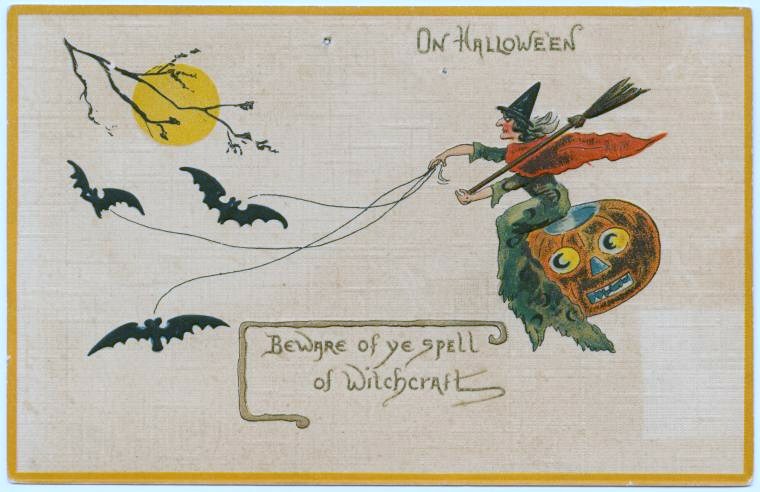
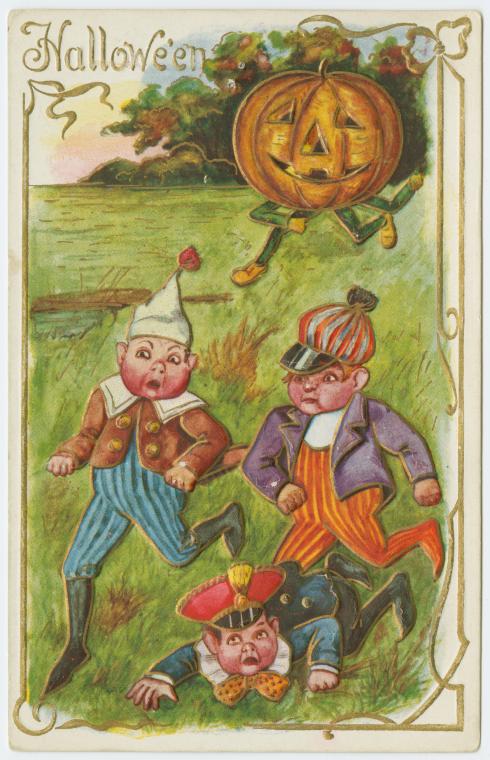
Vintage Halloween Postcard from The Public Domain Review
Today, I present a selection of Halloween treats–some lighthearted old-time radio episodes that capture an interesting period in the history of Halloween.
(On Tuesday, October 30, I’ll post some Halloween”tricks”–spooky holiday offerings and classic horror stories.)
European immigrants to the United States popularized Halloween celebrations in the late 19th century.
By the turn of the century, there was a move to downplay the scarier aspects of the holiday. According to History.com, “Halloween parties for both children and adults became the most common way to celebrate the day. Parties focused on games, foods of the season and festive costumes.”
By the 1920s and 1930s, pranks were a big part of the holiday, “often devolving into vandalism, physical assaults and sporadic acts of violence.”
Most of these radio shows date from the 1940s, when trick-or-treating was just beginning to transition into a community-sanctioned, kid-friendly activity. I’m guessing that’s why so many of the adults in these shows seem ambivalent about Halloween–looking back fondly on their own parties and pranks, but wary of letting their children participate in trick-or-treating.
Unknown Date Air Castle, Halloween
Air Castle was a children’s show that ran in the late 1920s and early 1930s. It was entirely the work of Baron Keyes, who starred as the “Story Man” and provided voices and sound effects to represent various fanciful characters. This Halloween episode is cute!
October 19, 1933 Martha Meade Society Program, Halloween Parties
This cooking show provides a nice slice of 1930s life. From this and other radio shows, I’ve gleaned that doughnuts were a popular Halloween tradition in the early 20th century.
October 24, 1939 Fibber McGee and Molly, Halloween Party at Gildersleeve’s House
This would be a good starter episode for a new Fibber listener. It’s filled with typical wordplay and punning humor, and most of the classic supporting characters appear.
October 31, 1940 The Aldrich Family, Halloween Prank Backfires
Just about every episode of this family comedy involves a misunderstanding that snowballs out of control. These Halloween hi-jinx are typical.
November 2, 1941 Jack Benny, Halloween with Basil Rathbone
I’m in love with the Jack Benny Program. To really appreciate the series, you need to listen to a long run of consecutive episodes. Characterizations and jokes build from week to week. This is my favorite of several Halloween episodes–Jack annoying his Beverly Hills neighbors is always a win.
October 29, 1944 Edgar Bergen and Charlie McCarthy, Halloween
Guest star Orson Welles is quite amusing, especially when he ad-libs.
October 29, 1944 The Life of Riley, Haunted House
Near the end, this takes a surprisingly sharp turn into patriotic messaging. You’ll have that sometimes in World-War-II-era programs.
October 31, 1944 Lum and Abner, Discuss Halloween Pranks
Lum and Abner has been growing on me lately, and this episode is a cute one.
November 1, 1946 Baby Snooks, Halloween
Fanny Brice’s mischievous Baby Snooks is a natural for Halloween pranks. This episode has a strong start, but a weak finish, in my opinion.
October 29, 1947 Philco Radio Time, Boris Karloff and Victor Moore
Boris Karloff was the go-to guest for variety-show Halloween episodes. Here, he’s the guest of Bing Crosby, and he and Bing actually sing together (along with comedian Victor Moore)!
October 31, 1948 Adventures of Ozzie and Harriet, The Haunted House
I always found the TV version of Ozzie and Harriet bland, but the radio episodes I’ve listened to have been surprisingly chuckle-worthy.
October 31, 1948 Adventures of Sam Spade, The Fairly-Bright Caper
I’m not a huge Sam Spade fan–ditzy Effie gets on my nerves–but this has a nice Halloween flavor.
Oct 31, 1948 Jack Benny, Trick or Treating with the Beavers
This is another good Halloween episode, with an inventive way of bringing the supporting cast into the story.
October 31, 1951 The Great Gildersleeve, Halloween and Gildy Finds a Lost Boy
I’m not the biggest Gildy fan, but this episode has great warmth.
November 7, 1951 The Halls of Ivy, Halloween
I really enjoy this series, which stars Ronald and Benita Colman. Having spent plenty of time in academia, I appreciate the college setting, and the Colmans are just charming.
Oct 29, 1953 Father Knows Best, Halloween Blues
Robert Young’s character is in preachy mode, and the end doesn’t work for me, but this is an interesting look at those changing Halloween customs.
Because my husband’s birthday is approaching, I’ve chosen The Planet of the Apes Game for this week’s installment of my vintage board game series.
My husband loves The Planet of the Apes and all its sequels. I, on the other hand, have always had an aversion to monkey-and-ape-based entertainment. I may have inherited this from my grandmother, who cringed whenever a chimp appeared on a TV sitcom (an all-too-common occurrence in the ’70s), or I may have developed it after a series of gorilla-related nightmares at age 3 (a Playskool Zoo started it all, but that’s a blog entry for another day).
Through marriage to an ape fan, I’ve managed to overcome my prejudices–at least to the extent of buying him ape memorabilia like this.
Today’s Game: Planet of the Apes
Copyright Date: 1974
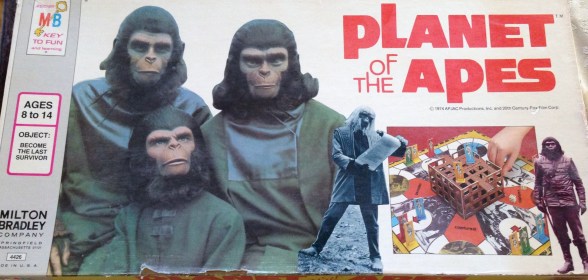
Game Box: Pretty appealing to a Planet of the Apes fan, I suppose. All the major apes are represented. I’m not sure why Dr. Zaius is in black and white when everyone else is in color.
Recommend Ages: 8 to 14.
Game Board: Simple, with lots of photos from the movie. The unique part is the cage that stands in the center.
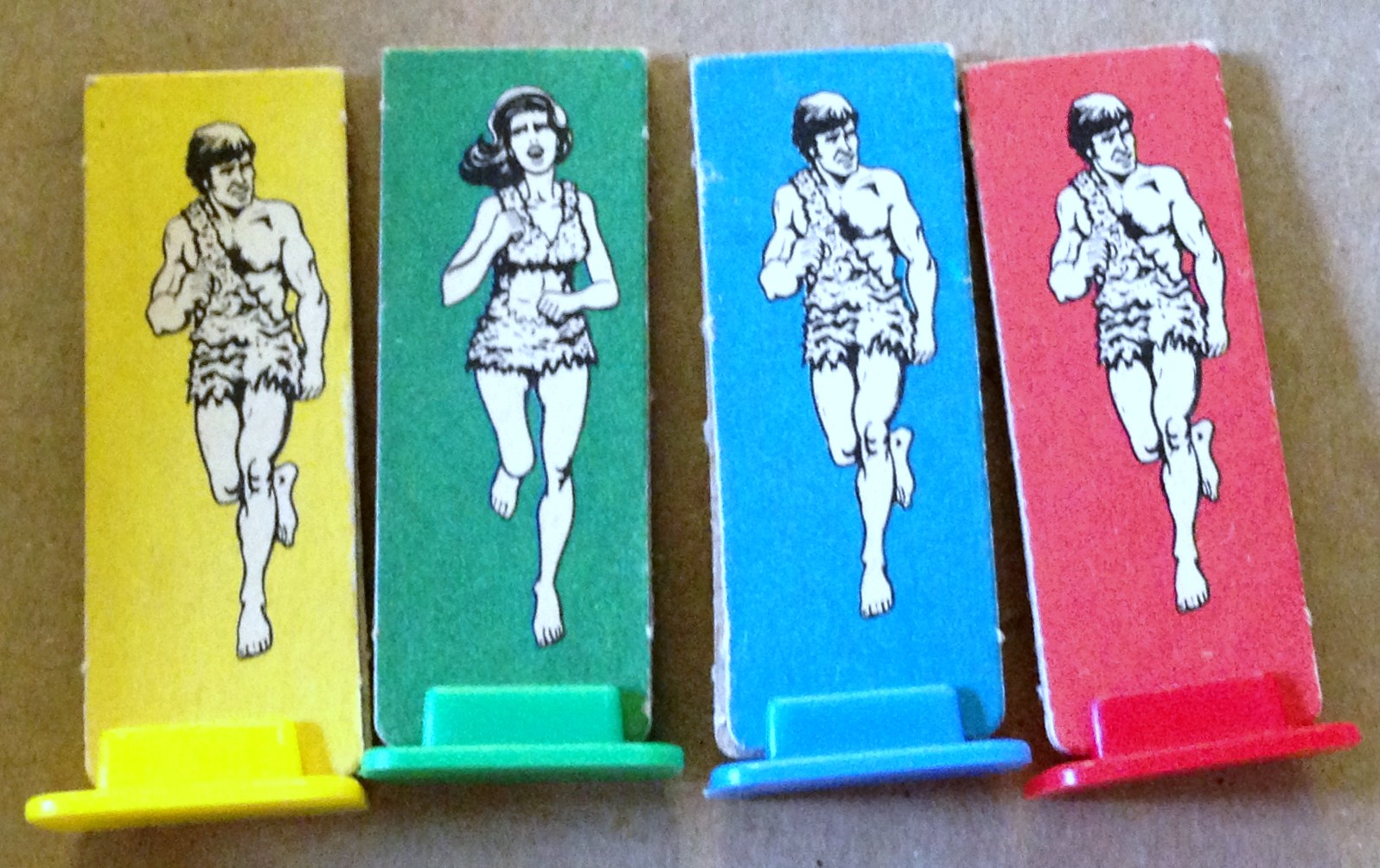
Game Pieces: Generic-looking male and female humans. At least we get front and back views.
Game Play: Each player gets four humans. You move them along the path until they land on a “Captured” space. Then you have to place your human atop the cage and let your opponent turn the cage’s knob. If the human falls in, he or she is captured. If not, they’re safe—for the moment.
Cage Fail: My cage is missing some key parts, so it doesn’t function. You can see how should work from this box closeup.
Object: “Become the last survivor.” Very cool object, my opinion. My husband kind of over-identifies with the movie’s apes, though. I think he’d rather see all his humans caged.
Today’s Bonus Feature: With my own stance on apes softening, I’ve developed an affinity for ape-themed old-time radio episodes. At least in those, you don’t have to see the apes. Sometime in November, I plan to post a whole playlist of ape episodes, but for now please enjoy this delightful example.
“Ape Song,” Murder at Midnight, March 31, 1947
“You treated me like an animal, Cecily–now an animal will treat you the way you deserve!”
Murder at Midnight has become a guilty pleasure of mine. It’s cheesy, but in a very entertaining way. This episode had me smiling all the way through.
October seems like a good time to enter the eerie world of Edgar Allan Poe. Not only is Halloween approaching, but so is the anniversary of Poe’s death. He died on October 7, 1849, at age 40, from unknown causes.
Radio programs presented Poe’s stories often, and it’s easy to see why. They make exciting listening experiences, painting vivid images in listeners’ imagination.
For this playlist, I have tried to gather the widest number of Poe stories from the widest number of radio programs.
Dim the lights, sit back, and lose yourself in the strange world of Edgar Allan Poe.
“And puzzle they did, these French police, and with them the rest of the world.”
“Rue Morgue Mysteries” Unsolved Mysteries 1949 About this Series: A syndicated 15-minute show, Unsolved Mysteries aired ostensibly true stories and posited solutions to historical mysteries. Thoughts on this Episode: Unsolved Mysteries treats Poe’s “The Murders in the Rue Morgue” as a fictionalized account of a true crime, and the show comes up with a different solution to that crime. Poe’s story, history’s first detective story, didn’t have any basis in fact, however. (He did base a later story, “The Mystery of Marie Roget” on a real New York murder.)
Read “The Murders in the Rue Morgue”
“Even after two days at sea, death did not destroy that waxen beauty.”
“The Oblong Box” The Weird Circle February 18, 1945 About this Series: Many radio series explored horror and suspense. One thing that differentiated The Weird Circle was its source material; it frequently presented “literary” horror stories, including several of Poe’s tales. Thoughts on this Episode: This show adds a murderous twist to make Poe’s story even more twisted. It’s an enjoyable adaptation, although the acting gets overwrought at times.
Read “The Oblong Box”
“I determined then to even the score, to revenge the desecration of my name, of my family honor.”
“The Cask of Amontillado” Hall of Fantasy January 19, 1953 About this Series: This was another radio show dedicated to tales of suspense and the supernatural. Thoughts on this Episode: We have no big name stars here, but this is a satisfying dramatization of Poe’s tale of revenge.
Read “The Cask of Amontillado”
“And so it happened, that at the end of a dull, dark, and soundless day in the middle of October, I found myself as the shades of evening drew on, within view of the grim and melancholy House of Usher”
“The Fall of the House of Usher” Escape
October 22, 1947 About this Series: Escape was “radio’s greatest series of high adventure,” according to John Dunning’s On the Air. It ran from 1947 to 1954, a sister series to the longer-running Suspense. Thoughts on this Episode: Paul Frees, who plays the narrator, was one of the most prolific voice actors of the 20th century. People unfamiliar with his radio career may know him as Boris Badenov, Burgermeister Meisterburger, or the host ghost in Disney’s Haunted Mansion attraction. His powerful, deep voice brings the dread and decay in Poe’s story vividly to life.
Read “The Fall of the House of Usher”
“You scream with the terror of it! You scream, and scream, and scream!”
“The Premature Burial” CBS Radio Mystery Theater January 6, 1975 About this Series: Although not exactly “old-time radio,” CBS Radio Mystery Theater represented the last major gasp of radio drama. The show ran on weeknights from 1974 to 1982. E.G. Marshall hosted, and radio veteran Himan Brown produced the program. Thoughts on this Episode: Poe’s story barely qualifies as a story at all—it is mostly a rumination on the horror of being buried alive. And Poe sure can ruminate: It may be asserted, without hesitation, that no event is so terribly well adapted to inspire the supremeness of bodily and of mental distress, as is burial before death. The unendurable oppression of the lungs- the stifling fumes from the damp earth–the clinging to the death garments–the rigid embrace of the narrow house–the blackness of the absolute Night–the silence like a sea that overwhelms–the unseen but palpable presence of the Conqueror Worm–these things, with the thoughts of the air and grass above, with memory of dear friends who would fly to save us if but informed of our fate, and with consciousness that of this fate they can never be informed–that our hopeless portion is that of the really dead–these considerations, I say, carry into the heart, which still palpitates, a degree of appalling and intolerable horror from which the most daring imagination must recoil.
This episode creates a 45-minute story from an incident that is only briefly described in Poe’s story. It does so pretty well, although I found the third act a bit weak. Keir Dullea, best known for his role in 2001: A Space Odyssey, stars in this episode (and many others in the series).
“Clipper Home,” An American in England
December 22, 1942
Norman Corwin was one of the most important creative forces in radio’s golden age. He wrote, produced, and directed several prestigious, poetic shows celebrating American values. In December 1942, TIME wrote, “CBS’s Norman Corwin, top-flight U.S. radio dramatist, went to England last summer to try something that U.S. radio had not done before. He wanted to explain England to Americans by short-waving his dramatized observations of the English.”
This was a huge technical challenge in 1942, and not all the broadcasts from England aired successfully in the United States. After Corwin returned home in the fall, he produced four more episodes, including this final one.
Pyro, of Helensburgh, Scotland, flew on experimental bombing test missions in World War II. Source: WIRRALNEWS.co.uk
Recently, while listening to it, I became fascinated by a short incident near the end. The narrator, slowly making his way home from Great Britain to the United States, meets a U.S. flier in Brazil. With him, the flier carries his “mascot,” a gray kitten name Tiger. The flier says he brought the kitten from his home in New Hampshire and carries him along on all his flying missions.
As a passionate cat lover, I wanted to find out more about Tiger. Unfortunately, my research didn’t unearth any information about him, but I did learn about a flying World War II cat named Pyro. British photographer Bob Bird was working at the Marine Aircraft Experimental Establishment base in Helensburgh, Scotland, when he adopted a stray kitten. Pyro didn’t like it when his owner left to accompany flight crews on experimental bomb tests. Bird started taking Pyro along on the missions; together they survived a crash landing, and Pyro once helped protect Bird from frostbite. Last year, Pyro received a posthumous award for bravery from the United Kingdom’s People’s Dispensary for Sick Animals charity.
At the time of the award, Bob Bird’s son Robin said, “’We are really very proud of Pyro. He was the only flying cat in the Second World War—and any other war as far as we know.”
Even if “Tiger” didn’t really exist, Pyro wasn’t the only flying cat in World War II. The web site Purr ‘n’ Fur has fascinating and comprehensive pages about cats in wartime. You can read about a few flying cats (and even see a picture of a cat of in a military aircraft in flight). You can also learn about ships’ cats, which were much more numerous than flying cats.
To be honest, my first reaction to hearing about Tiger was annoyance that someone had put an animal in such a dangerous situation. I can’t begrudge soldiers and sailors for seeking comfort from a pet, though, and the cats I’ve read about took their “service” in stride. (Why do my cats fuss so much about a car ride to the vet’s?)
The entire series An American in England makes interesting listening for history buffs and Anglophiles, even though it is wordy and rather unsubtle in its propaganda. (This episode also has an uncomfortable segment in which the narrator wonders what’s going through “the simple tribal mind” of a West African native. That segment concludes, however, with hypothetical soldiers expressing sentiments like this: “Listen, I like bread. So does the next guy. I’d like to see everybody in the world get a piece of bread and a quart of milk a day. And that goes for Indians and Eskimos and Hottentots, too.”)
Joseph Julian plays the narrator, who represents Corwin’s viewpoint.
Final Fun Fact: Corwin, who died last fall at 101, once said, “Cats are designated friends.”
I put this playlist together after noticing how many old-time radio mystery shows had presented episodes titled “Till Death Do Us Part.”
“Till Death Do Us Part”
Suspense, December 15, 1942
“Just remember, I shall be waiting…out, in the dark and cold, where there is neither marriage, nor giving in marriage…I’ll be waiting, for my little pet to come and join me.” Story: A professor, jealous of his wife’s love for another man, comes up with a clever plan to eliminate both his problems. Writer: John Dickson Carr, well known Golden-Age mystery writer, who wrote many Suspense episodes. Notable Cast Members: Peter Lorre, whose voice oozes creepiness, plays the murderous husband. The same year this episode aired, Lorre played one of his most memorable film roles: Ugarte in Casablanca. About Suspense: Suspense billed itself, with ample justification, as “radio’s outstanding theater of thrills.” Extremely popular, it ran for 22 years (1940-1962). For much of that time, it attracted top Hollywood stars, who often got the chance to play roles that contrasted with their on-screen image. William Spier produced Suspense in its best years and, according to Dunning, “personally guided every aspect of the show, molding story, voice, sound effects, and music into audio masterpieces.” Weapon of Choice: Aconite, also known as monkshood, a poison. My Verdict: An entertainingly over-the-top performance by Lorre and a script with several good twists make this a must-listen.
“Till Death Do Us Part”
The Sealed Book, July 8, 1945
“Oh, no, I’ll never leave you, darling. Never, never, never.” Story: A man is determined to escape his smothering wife—and she is determined to keep him. About The Sealed Book: A cheesy mystery-horror show with a very cheesy opening sequence, The Sealed Book was a syndicated show that ran for six months in 1945. Weapon of Choice: The sea. My Verdict: A so-bad-it’s-good kind of entertainment. By a few minutes in, you’ll want to kill Blanche, too.
“Till Death Do Us Part”
Murder at Midnight, December 9, 1946
“One life has already paid for yours. And, quart for quart, your blood is worth no more than my family’s.” Story: A newlywed husband is tormented by fantasies of killing his bride. About Murder at Midnight: Similar in some ways to The Sealed Book, this was a syndicated show with a cheesy opening and ample organ flourishes. The quality is much higher, though. As Digital Deli Too writes, “Anton Leader, later famous for his Television work, directed the series. The writing staff was also top-notch, with names such as Max Erlich, Joe Ruscoll and Robert Newman, among others.” Weapons of Choice: Strangulation, a gun. My verdict: This story is clever and complex, and it uses Oscar Wilde’s “The Ballad of Reading Gaol” to eerie effect as a recurring motif. The actress playing the bride gives a good performance.
“Till Death Do Us Part”
Inner Sanctum Mysteries, October 27, 1947 “Oh, baby, how did we ever get into a mess like this?” Story: Newlyweds are witnesses when a man murders a woman, and their honeymoon just gets better from there. About Inner Sanctum Mysteries: This was the father of all campy-mystery-horror-with-cheesy-opening shows. Famous for its creaking-door sound effect and its punning host, Inner Sanctum Mysteries ran from 1941 to 1952. Notable Cast Members: Everett Sloane and Mercedes McCambridge, two prolific radio performers. Sloane was a member of Orson Welles’ Mercury Theater and appeared in the films Citizen Kane and The Lady from Shanghai. Two years after this episode aired, McCambridge would play an Academy-Award-winning supporting role in All the King’s Men. Her movie career would also include providing the voice for The Exorcist’s demon. Weapons of Choice: A gun, smothering (sort of). My Verdict: Inner Sanctum has its fans, but it consistently underwhelms me. My mind kept wandering during this one, and the ending didn’t satisfy me.
“Till Death Do Us Part”
The Whistler, April 14, 1948
“He made a mistake–a bad one.” Story: A shady art dealer meets up with the equally shady young wife of an ailing art collector. This won’t end well for anyone. About The Whistler: A popular mystery-crime show, The Whistler ran for 13 years. It has similarities to the shows above, except that the episode’s central character is usually the bad guy, whom the narrator addresses directly and tauntingly. Notable Cast Members: Gerald Mohr was another prolific radio actor whose most memorable role was Philip Marlowe. Doris Singleton would go on to play the recurring role of Carolyn Appleby on TV’s I Love Lucy. Weapon of Choice: Sleeping pills (sort of). My Verdict: The Whistler can be hit or miss. This wasn’t an outstanding episode, but it did keep me guessing. I always enjoy Gerald Mohr’s sexy, hard-boiled voice.
“Until Death Do Us Part”
Private Files of Rex Saunders “It worked. It worked real good.” Story: A casino owner’s second wife becomes convinced that her husband killed his first wife–and that she is about to be his second victim. About Private Files of Rex Saunders: This private investigator show was a starring vehicle for Rex Harrison that aired during the summer of 1951. Himan Brown directed the series. Notable Cast Members: Rex Harrison is best remembered as My Fair Lady‘s Henry Higgins, of course. Leon Janney, who plays the assistant, began his long theatrical career when he was still a child. Weapons of Choice: Guns. My Verdict: It’s fun to hear Harrison play a private investigator, and the story has some nice twists.




 Embarrassing Treasures