When I was about four, I walked with my mom to a nearby store. I can still remember walking home, up a hill, carrying a large box, and bursting with excitement. For no special reason at all, my mom had bought me the Fisher Price Play Family School that day.
Play Family toys were among my favorites. Besides the School, I had the House and the Houseboat. When I was five, Santa brought me the wonderful Play Family Village, which included a firehouse, dental office, theater, post office, police station, barber shop, garage, restaurant, and telephone booth.
I don’t have any of my old Fisher Price toys, but my husband has picked up some vintage structures at flea markets and yard sales. My daughter, who is nine, still enjoys playing with them now and then. Today, she set up a Play Family city around the living room rug.
Another week, another cardboard-and-plastic journey to the past.
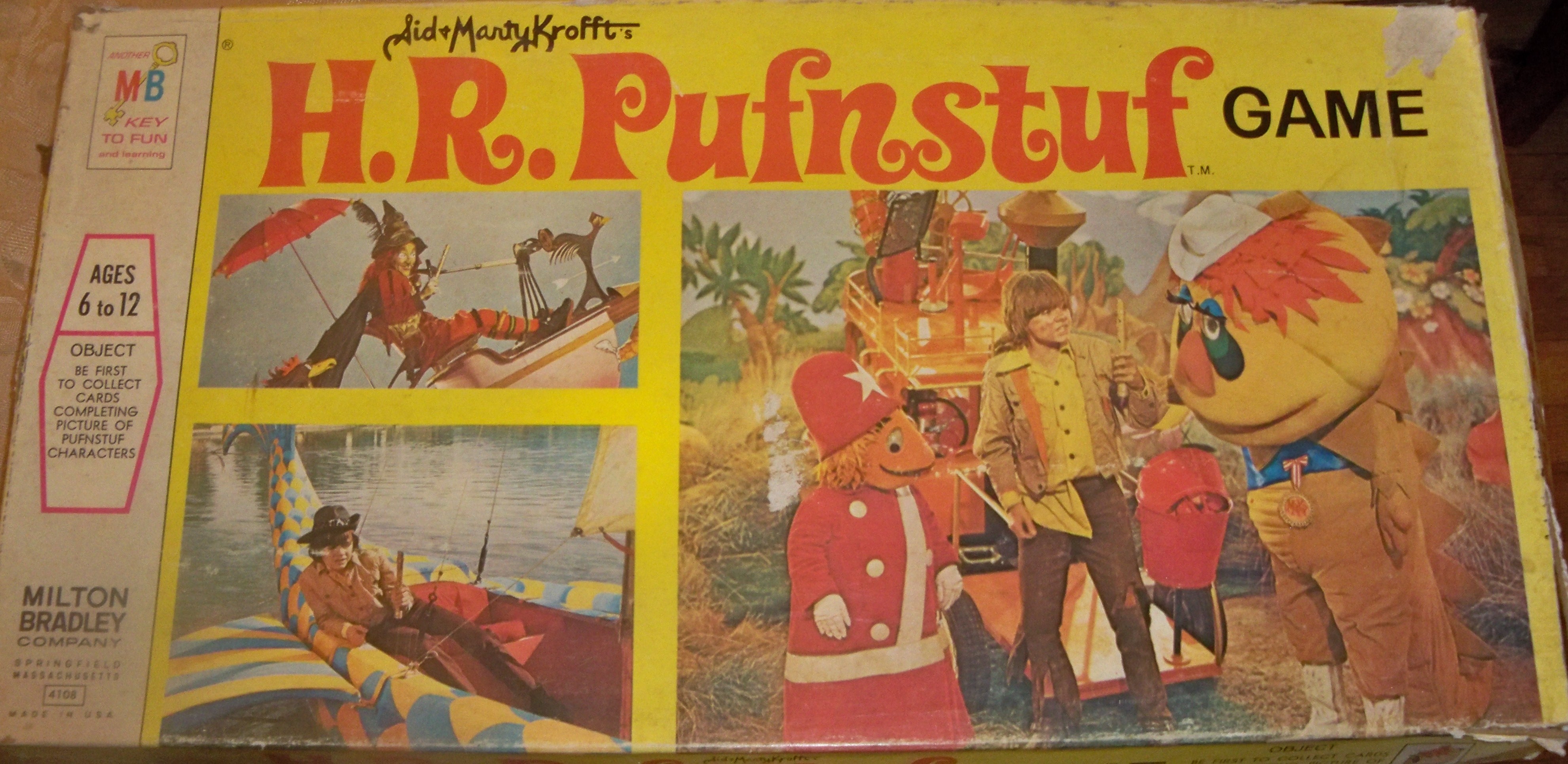
Today’s Game: H.R. Pufnstuf Game
Copyright Date: 1971
Object: Be first to collect cards completing picture of PufnStuf characters.
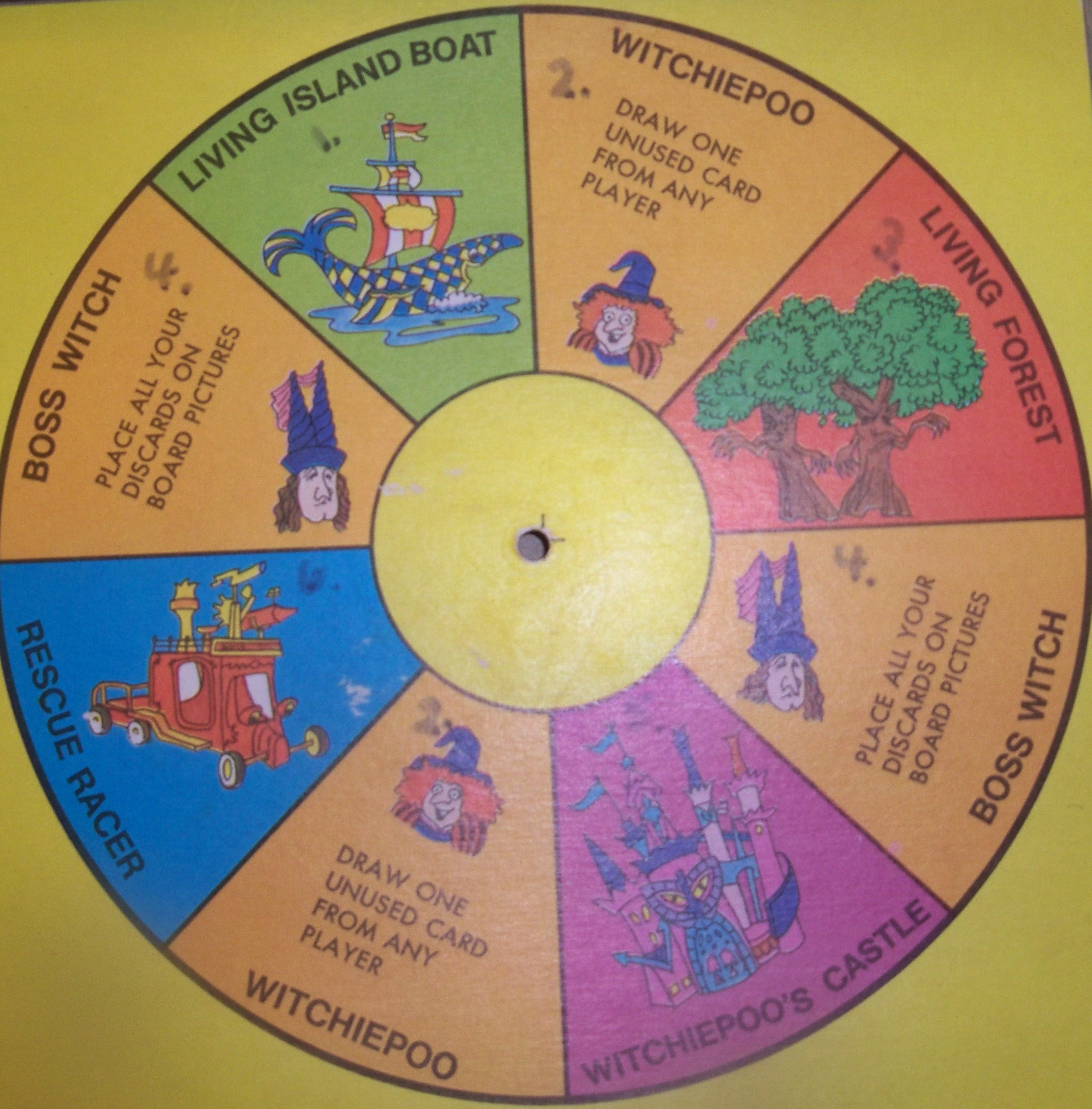
Game Board: Colorful and cartoony, though the cartoon likenesses leave a lot to be desired.
Game Pieces: None. Cards and a spinner are all you need to play this game.
Recommended Ages: 6-12. The game box, with its full-color photos, might have attracted kids throughout that age range, but the graphics inside scream little kid.
Game Play: The board is really superfluous in this game; players don’t move around it. They just spin and collect cards and try to complete a puzzle. (It’s nice that Freddy the Flute gets his own puzzle; on the show, he just squeaked “Jimmy” and got stolen a lot.
Personal Notes: I never had this game as a child—I would’ve been too young to play it in 1971. I did watch H.R. Pufnstuf, though, and still have the disturbing, hallucinatory memories to prove it.
About the Show: H.R. Pufnstuf premiered on September 6, 1969, as part of NBC’s Saturday morning lineup. Popular with kids, it aired for two years on NBC, one year on ABC, and two and a half years in widespread syndication—an amazing feat considering that Sid and Marty Krofft only produced 17 episodes.
Final Fun Fact: Jack Wild, who starred as Jimmy, got to keep one of the original Freddy the Flutes as a souvenir after the show wrapped, according to the book Pufnstuf and Other Stuff.
Something I’d seen on TV as a child haunted my memory for years.
It involved a perky teenage girl beginning her service as a hospital volunteer. In her starched candy-striper uniform, she was the picture of efficiency. During her first day on the job, however, she made a terrible mistake. An old woman patient begged the girl for a glass of water, and the girl gave it to her. She didn’t know that the woman was on her way into surgery and barred from drinking food and water. The old woman’s doctor became furious with the girl because her mistake could have cost the old woman her life.
Many years later, I saw this show again. My husband, who watched with me, had never seen it before but had heard my description. Well, the show wasn’t quite the way I remembered it. The old woman’s begging and the doctor’s reaction weren’t nearly as dramatic on film as they were in my memory. My husband still teases me about this incident when I share other childhood memories.
In my defense, CBS showed Family Affair in daytime reruns from September 1970 to January 1973, so I was no more than four when I watched Cissy Davis’ stint as a candy striper.
But that scene and others made a vivid—if inaccurate—impression on my young mind, and gave Family Affair a special place in my heart.
Too young for the show’s 1966-1971 primetime run, I discovered it in those daytime reruns. After that, it pretty much disappeared until TV Land aired it in the 1990s.
Revisiting the show then was like encountering an old friend. I enjoyed it so much that in the late ‘90s and early aughts I ran a comprehensive Family Affair web site.
(Kathy Garver left an approving message on my guestbook!)
Since that site is lost in the mists of time and the wreckage of Geocities, I am declaring Fridays Family Affair days on Embarrassing Treasures. Starting next week, I’ll take a fresh look at one episode each week and share images from my large collection of Family Affair memorabilia.
Why do I like Family Affair so much?
1. A strange poignancy permeates the show and makes it stand out from similar shows. Unlike every other classic TV sitcom whose premise involved dead parents (My Three Sons, The Brady Bunch, The Partridge Family, and many more), Family Affair showed kids who remembered and missed their parents occasionally—not just in the first episode or even the first season.
2. Brian Keith is my favorite on-screen father figure ever. Whenever his paternal love radiates through his ruggedly masculine persona, I melt. This happens often in Family Affair, but my favorite Brian Keith dad moment comes in Disney’s 1961 The Parent Trap. Check out the scene that begins at 4:00, when he realizes he’s seeing his daughter Sharon for the first time since she was a baby.
When Keith died in 1997, Entertainment Weekly called him an underrated actor—I wholeheartedly agree.
3. Mrs. Beasley! What sitcom ever had a product tie-in like this one? Her old-lady look is unique in the world of dolls and straddles the line between cute and creepy. Episodes where Mrs. Beasley gets lost are always great.
4. The setting is exotic. Sure, it’s just New York City. But to small-town kids like me, a city childhood did seem exotic. Buffy and Jody lived in a high-rise apartment building and had a terrace. They played in Central Park. A British butler was their babysitter.
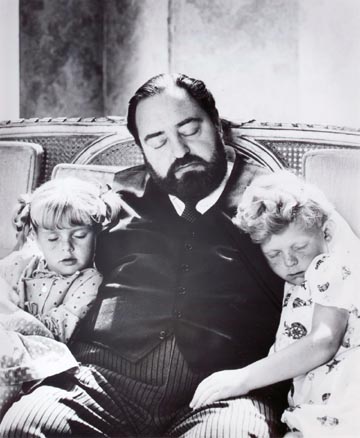
Buffy, Mr. French, and Jody
5. Mr. French! Sebastian Cabot’s chagrined portrayal of Mr. French, forced to take on a nanny role he never sought, cuts the show’s saccharine level and provides some genuine humor.
6. Buffy and Jody. The names alone are fun to say. (As a young child, I thought “Buffy and Jody” was the show’s title.) Anissa Jones and Johnnie Whitaker are genuinely adorable in the early seasons, although they later faced the curse common to sitcom kids—a mandate to continue being little and adorable long after it was possible or desirable.
7. That jaunty Frank De Vol theme song and the kaleidoscopic opening effect that mesmerized me as a child (and reminded me of my grandma’s bingo markers). My memory never failed me where that was concerned.
Escape, December 31, 1947
“You are lost in a London fog, uncertain whether the figures looming around you are real or creatures of your imagination. And somewhere in the wet grayness lurks a murderer, from whom you must escape.” Story: A Canadian soldier, shell-shocked from his World War II service, becomes disoriented on a foggy London evening and encounters a mysterious woman who soon ends up dead. Based Upon: A short story by Algernon Blackwood, a prolific and influential author of horror fiction. Notable Cast Members: Bill Conrad, one the best and most ubiquitous actors in old-time radio, plays the soldier. Fellow Generation Xers will remember Conrad best as TV’s Cannon and Jake from Jake and The Fatman. It can be hard, at first, to erase that visual from your mind as you listen to his radio work. His powerful performances soon engage your full attention, however. In my opinion, he did his finest work as Matt Dillon on radio’s Gunsmoke. Peggy Webber, who plays the mysterious woman, will be familiar to viewers of TV’s Dragnet because she appeared in roughly a zillion episodes. She also worked as a writer, producer, and director in the early days of television, and she helped to found the California Artists Radio Theatre. About Escape: Escape was “radio’s greatest series of high adventure,” according to John Dunning’s On the Air. It ran from 1947 to 1954, a sister series to the longer-running Suspense. Several things distinguish the two series. First, Suspense had bigger budgets and, thus, big-name guest stars, throughout most of its run. Those big budgets came from sponsors, which Escape didn’t have. This is a plus for the modern Escape listener—you don’t have to hear, or fast-forward through, grating commercials. (Yes, Autolite, I’m looking at you.) Escape tended to use more exotic settings than Suspense and dabbled more in the supernatural. Also, on Suspense things tended to end well; Escape often went for the darker ending. (I wonder how much sponsors, or the lack thereof, had to do with this.) Both series are excellent—they are in my top five favorite radio shows, and which one ranks higher just depends upon my mood. My Verdict: This is a solid episode. A sense of dread slowly envelops the listener as the fog envelops Conrad’s character, and the ending is satisfyingly chilling.
“The Hands of Mr. Ottermole”
Suspense, December 2, 1948
“By all means, sergeant, let’s talk about…murder.” Story: A journalist and a police sergeant talk about a serial strangler who’s menacing London. Since the script takes pains to avoid telling us the men’s names, it’s obvious one of them is the deadly Mr. Ottermole. Based Upon: A short story of the same name by Thomas Burke, an author who specialized in portraying London and its working-class citizens. Burke published “The Hands of Mr. Ottermole” in 1931. According to Ellery Queen, “No finer crime story has ever been written, period.” Notable Cast Members: Vincent Price and Claude Rains star in this episode. Price, of course, was made for creepy tales like this, but it’s Claude Rains who really shines. About Suspense: Suspense billed itself, with ample justification, as “radio’s outstanding theater of thrills.” Extremely popular, it ran for 22 years (1940-1962). For much of that time, it attracted top Hollywood stars, who often got the chance to play roles that contrasted with their on-screen image. William Spier produced Suspense in its best years and, according to Dunning, “personally guided every aspect of the show, molding story, voice, sound effects, and music into audio masterpieces.” My Verdict: Suspense is another of my top-five shows and an excellent introduction to old-time radio for new listeners. This episode is very good, with a script that keeps you guessing and an outstanding performance by Rains. Final Fun Fact: Alfred Hitchcock Presents offered a TV adaptation of this story in 1957. You can watch it free via Hulu.
“Disaster in London”
Top Secret, August 6, 1950
“I think I will never feel anything again, ever.” Story: A double agent is collaborating on a scheme to poison the London water supply with deadly bacteria. Notable Cast Members: Top Secret starred Ilona Massey, or “beautiful Ilona Massey,” as she’s billed here. Nope, I had never heard of her either. She was a Hungarian actress who had a brief movie and television career. About Top Secret: This NBC spy drama ran for only four months in 1950. My verdict: This show is interesting. Spies didn’t proliferate in old-time radio the way cowboys and detectives did. Massey’s female spy is not ditzy or dependent on the men surrounding her. She’s a classic spy—world-weary, but brutally efficient. As this episode opens, she’s seeing to it that an enemy agent meets his doom under an oncoming subway train! She shows compassion, however, for the mother of the story’s double agent. This is the first Top Secret episode I’ve heard, and I will definitely seek out more. (Unfortunately, the sound quality is poor.)
“Portrait of London”
The CBS Radio Workshop, July 20, 1956
“This is possibly one of the most lovely views. I thought it was good from Westminster Bridge, but I shall always now think that Big Ben has a very special one. I’m looking directly down on Westminster Bridge, over the Thames. I can see St. Paul’s, and it is the perfect time of day, the end of the day, and the sun is shining.” About the Episode: Sarah Churchill, actress and daughter of Sir Winston Churchill, narrates a documentary-style tour of London. Her tour includes the London Zoo, where she visits a lion that the Lions Club of America donated to her father; Petticoat Lane Market, where a seller demonstrates small figures of Sir Winston that puff on cigars; a rainy rehearsal for Trooping the Colour; and a trip to the top of the tower that houses Big Ben. About The CBS Radio Workshop: Coming at the end of the radio era, this was an experimental anthology program that wasn’t afraid to take chances. Dunning quotes CBS Vice President Howard Barnes as saying, “We’ll never get a sponsor anyway, so we might as well try anything.” My Verdict: This is absolutely charming. The sound patterns and interviews with Londoners and tourists come together to paint a vivid picture of the city. Sarah Churchill was beset by personal problems during the 1950s, but she makes a warm and enthusiastic host here. I’m a lifelong Anglophile, but I’ve only had the privilege of visiting London once. This program made me long to go again. Google-Worthy References: While visiting Big Ben, Churchill learned that pennies are placed on the clock’s pendulum to adjust its timekeeping for accuracy. I had to know if they still use pennies; they do, although some of the original pennies have been replaced by a five-pound coin that commemorates the 2012 Olympics. Final Fun Facts: I tried to find out more about Rusty, the lion featured here, to no avail. Rota the lion, presented to Winston Churchill in 1943, is much more well known. Rota died in 1955, so Rusty–whom his keeper says is young–must have been a kind of replacement. (You can see Rota, stuffed, at the Lightner Museum in St. Augustine, Florida.)
My quest to research Rusty led me to some other interesting destinations. This fascinating article describes Churchill’s attempt to bring a platypus to England, and this vintage London Zoo map has wonderful graphics, including an image of Churchill walking his lion and his kangaroo.
“The question of chaperons will surely come up. It’s a fact that most teen-agers prefer to go to a party that’s chaperoned.”
Party Perfect by Gay Head, 1959 (3rd printing, 1962)
Yes, the author’s name is Gay Head. My “Top Searches” should be interesting this week.
About the Book: Dust off your records and start pressing your suit— we’re going to party like it’s 1959! This slim Scholastic volume is filled with party-planning tips, from entertainment (“No evening’s program of games is complete without a relay race”) to wardrobe (“Dress up in your best date dress and tell your girl friends to do the same. Jacket and tie for the boys. After all, part of the fun of a party is being dressed right for the occasion. You’ll all enjoy yourselves more if you do.”)
Sample Party Themes:
A United Nations get-together. You assign each guest a country, and they dress accordingly: “A girl can look like a Mexican senorita by wearing a colorful, full cotton skirt, a pretty blouse, and hoop earrings. To be a gaucho, a boy might wear dark trousers, a colorful shirt, and a cumberbund.”
A space party: “By Jupiter—be the first one in your crowd to give an out-of-this-world party! This is not as mad as it sounds. The day will come when travel to outer space will be as everyday as going for a spin in the family car.”
Sample Refreshments:
For New Year’s Eve, hot buttered soup, made with eight cans of condensed tomato soup and seasoned with lemon juice, cinnamon, and cloves. “Serve hot with a pat of butter floated on the top.”
For Valentine’s Day, tuna tomatoes. Combine two cans of chunk-style tuna with a can of cream of mushroom soup. Season with salt and pepper. Use mixture as filling for eight hollowed-out tomatoes, and bake at 350 degrees for 30 minutes.
For a space party, deviled ham missiles. Spread deviled ham on half a hot dog bun. Slice a cheese wedge in half lengthwise and insert it at one end of the bun. Insert two carrot sticks at the other end. Top with other half of bun.
Sample Party Games Titles That Sound More Interesting Than the Games Actually Are: Bottoms Up, Scrambled Anatomy, Elopement, Murder.
About the Author: I would love to share a complete biography of Gay Head that included her childhood at Newport, her lively debutante days, and her marriage to a shipping magnate. Alas, Miss Head never existed. The Library of Congress entry for this book suggests that Gay Head was a pseudonym for Margaret Hauser. I can’t find any information about Hauser, except that she edited Scholastic’s Co-Ed Magazine from the 1950s through at least 1970. She also wrote articles under the Gay Head pseudonym for Scholastic magazine in the late 1930s and early 1940s.
Interestingly, though, Hauser was not the only Gay Head. On October 21, 2002, USA Today published an interview with Ruth Imler Langhinrichs. “From 1948 to 1952,” the article states, “Langhinrichs used the pseudonym Gay Head to answer teens’ questions in a column in Scholastic magazine called ‘Boy Dates Girl.’”
It seems that Gay Head must have been a in-house pseudonym, used by various Scholastic writers. The occasion for Langhinrichs’ interview was the release of Steve Coulter’s short film The Etiquette Man, based on the book Boy Dates Girl, a compilation of Gay Head columns. Boy Dates Girl was first published in 1937, with updated printings through the mid-1960s.
Langhinrichs, at least, looks back fondly on her Gay Head days, according to USA Today: “Her years as Gay Head were happy times, she says. They helped her become an editor for teens at Ladies’ Home Journal, where she wrote a column titled Sub-Deb — as in not-quite-a-debutante. Langhinrichs still collects lore on social civility and manners. She works two days a week as a writing coach at Indiana’s Purdue University.”
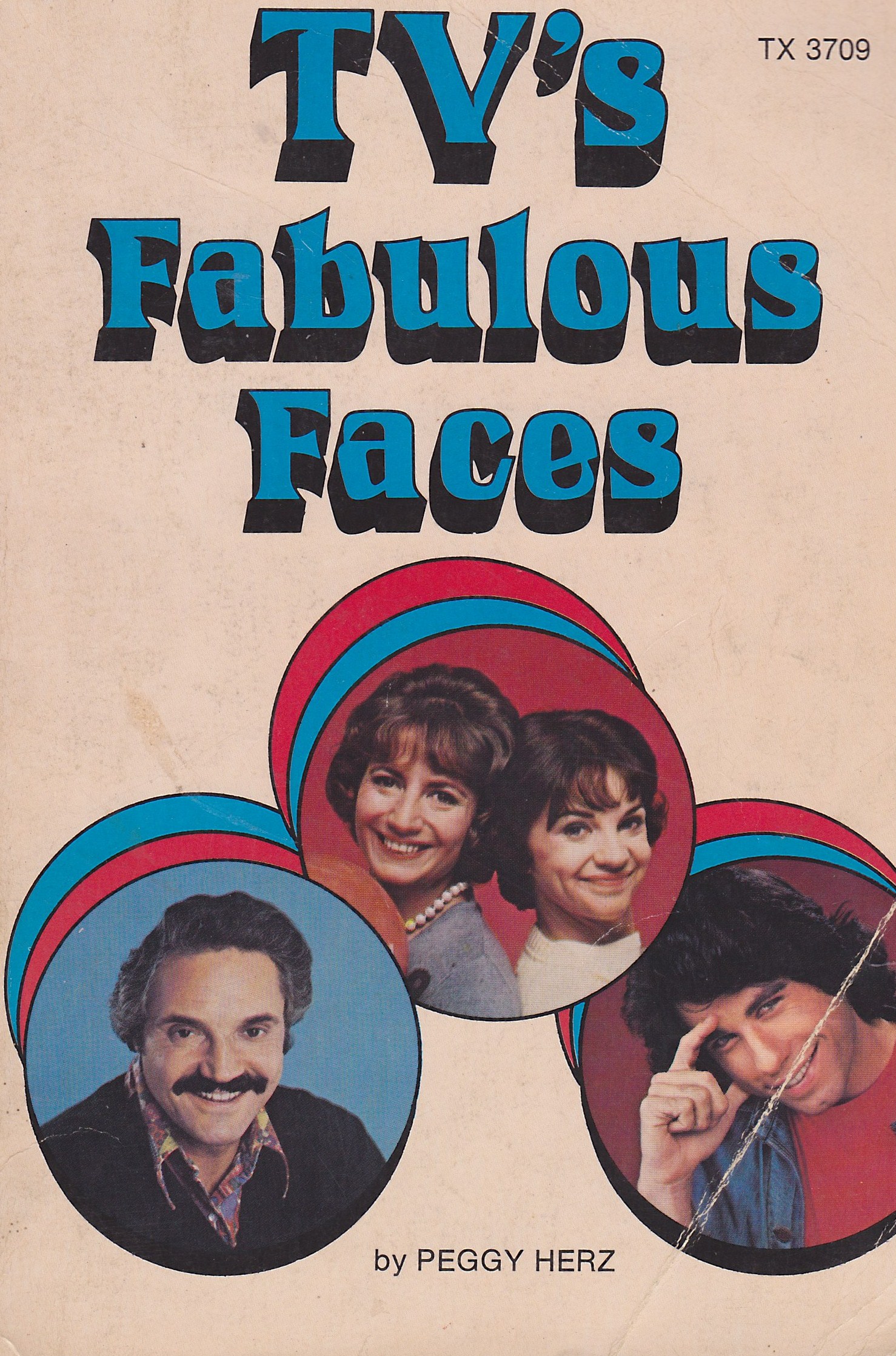
I wonder who decided to put Hal Linden on the cover of a kids’ book called TV’s Fabulous Faces. I mean, Donny and Marie have a chapter in here!
In tribute to Ron Palillo, who passed away August 14, I present this excerpt from TV’s Fabulous Faces, a 1977 Scholastic Book Club title:
“When the show first came on the air, some viewers thought Horshack was retarded. ‘That made me very angry,’ Ron said. ‘People pinned that label on Horshack because he is young. If you act that way when you’re older, they just say you’re a little slow.’
“Ron Shook his head in disgust. ‘At first, Horshack would only talk when Barbarino said, ‘You may talk now.’ That’s going on in schools today. It always has! Retarded? Go to schools and see the kids! Many of them are crying out for attention and that’s not because they are retarded! They are asking for help!’
Let us venture again into the world of vintage board games.
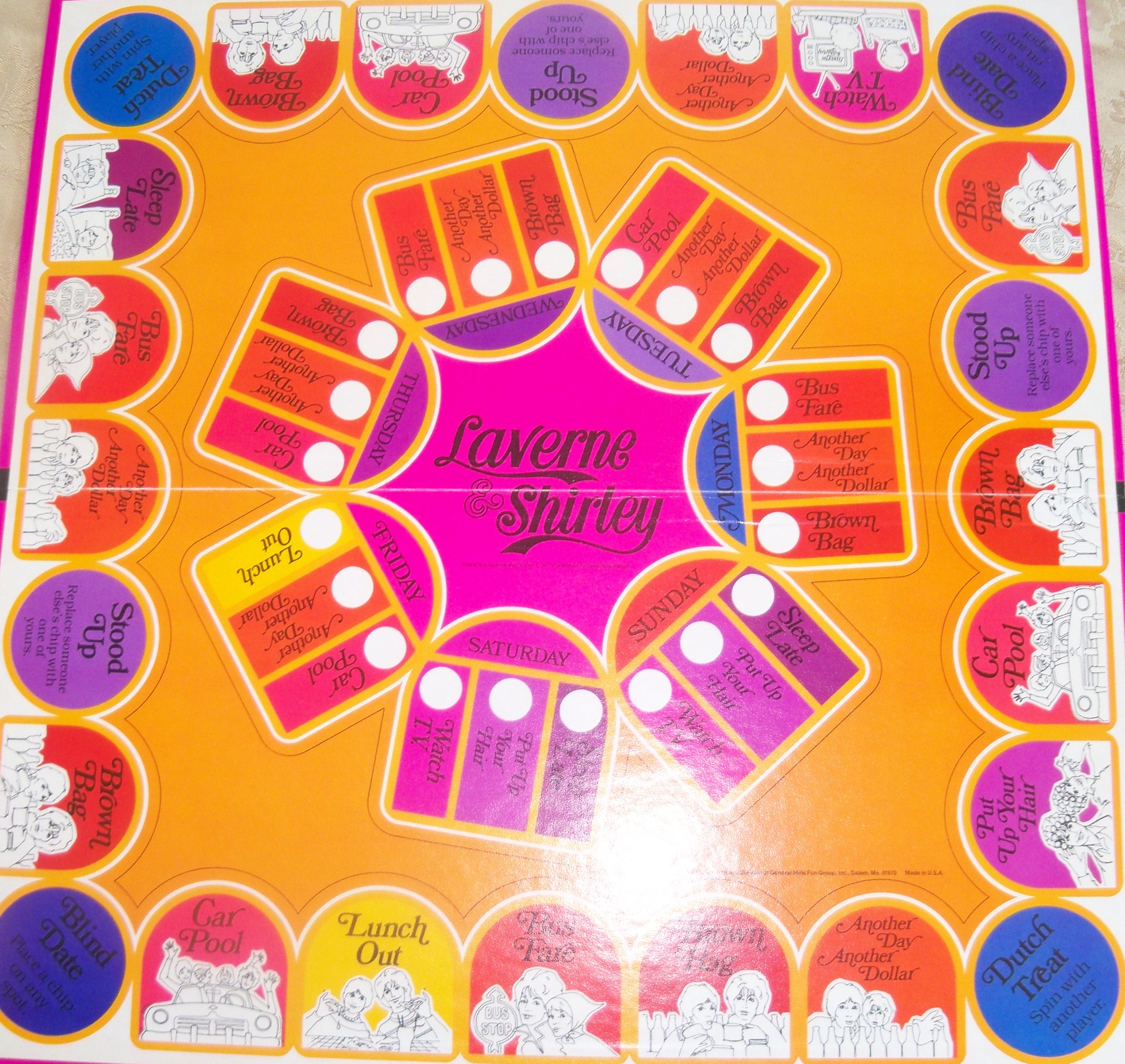
Today’s Game: Laverne & Shirley
Copyright Date: 1977
Object: “Make all your dreams come true.” (In this game, all your dreams must involve dating. She who dates the most, wins.)
Game Board: Colorful, but the Laverne and Shirley caricatures are drab. Perhaps they complement the drab vision of blue collar life this game portrays—an endless round of rent paying, hair washing, TV viewing, bus riding, and brown-bag lunching.
Game Pieces: Standard plastic pegs. The most interesting game element is your “diary,” which you strive to fill up with dating minutes.
Recommended Ages: 8-14. Manufacturers often put an upper age limit of 13 or 14 on these TV show games. I don’t what their reasoning was, but I can imagine parents using it to their advantage: “I’d love to play Laverne & Shirley with you, Lisa, but rules are rules.”
Personal Notes: Did you ever see something and know you’ve seen it before, long ago? That’s how I felt looking at this game board, though I’m pretty sure I never owned the game. I must have played it at a friend’s house.
About the Show: Laverne & Shirley premiered in January 1976. I remember watching the first episode and finding it hilarious. The rest of America agreed, quickly propelling the show to number one. I was 7; I don’t know what the rest of America’s excuse was.
Final Fun Fact: According to The Complete Directory to Prime Time Network and Cable Shows, “Critics called (the show) TV junk food; ABC program chief Fred Silverman responded by comparing it to the classic satire of the 17th century French playwright Moliere.”





 Embarrassing Treasures