Weird Words of Wisdom: Speak Softly and Carry a Hot Breakfast Edition

“It is not enough, if you want to be liked, if you want to be loved, to be merely good. You also have to fight for the good things you want. You have to compete with other girls. What’s more you have to make up your mind to win. Otherwise you’ll not have your pick of the best boys. You’ll only have what’s left over.”

Once Upon a Dream: A Personal Chat with All Teenagers, 1960
By Patti Page

About the Book: Patti Page opens up about her own weaknesses and insecurities as she tells young fans her Cinderella story–a story that transformed Clara Ann Fowler, “that shy, overfed, part Cherokee choir singer from Claremore, Oklahoma,” into a “Singing Rage.” (Although a Cinderella motif pervades the book, the title references a song from Walt Disney’s 1959 film Sleeping Beauty.)

As we’ve seen before in this series, celebrity-written advice books for teens proliferated in the 1950s and early 1960s. While I always wonder how much the celebrities actually “wrote,” I found this book’s voice consistent and believable.

About Patti Page: All I knew about Patti Page going into this book was that she sang “How Much is That Doggie in the Window?” and “The Tennessee Waltz.” The latter was one of the best-selling songs of all time, and Page was the top-selling female artist in the 1950s.

Her rags-to-riches story had a genuinely ragged start—she was the 10th of 11 children, and money was so scarce that she sometimes went to school barefoot. In this book, she tells a moving story about the time she wanted a Mickey Mouse watch so badly that she made one out of paper.

She made up her mind to escape poverty and began to plan for a career as a commercial artist. She took a job making posters at a Tulsa radio station, soon found herself performing on the air whenever they needed a girl singer, and was “discovered” when band manager Jack Rael passed through town and heard her voice on the radio.

To her teenage readers, Page presents herself as shy and insecure, with ongoing weight issues. She talks about a period in her life when she burst into tears after every performance, and she uses the language of psychoanalysis freely.

She writes a lot about her husband, choreographer Charles O’Curran, whom she married in 1956. She doesn’t mention that she had an earlier, short-lived marriage, or that she was O’Curran’s third wife (Betty Hutton was his second). Page and O’Curran would divorce in 1972.

I’ve chosen some of Page’s sillier-sounding statements to feature here, but this book actually gives plenty of good advice. She encourages girls to be themselves, to care about others, and to develop their minds. Though she has a typically 1950s obsession with “femininity,” she advises girls against playing dumb and against letting boys get in the way of their dreams. She even manages to talk about religion without sounding preachy.

Today, at 85, Page is still performing.

Quotes from Once Upon a Dream: Inner and Outer Beauty

“Charm is simply the art of being pleasing…charm is the magic wand that can transform an ugly duckling into a princess, or a shy quiet type into the belle of the ball.”

“The girl who thinks she can get by with an overweight figure by calling attention to her face is only fooling herself. Eventually people notice her figure too. In the same way, the gayest of hats will not make up for a shabby pair of shoes. A tight-fitting sweater is a poor substitute for a bad complexion. No matter how elaborately you do your hair, which may be your good feature, how long do you really think it will keep people from noticing your teeth, which may not be so good?”

Examples that prove personality is more important than beauty: Helen Hayes, Lynn Fontanne, Katharine Cornell, Mary Martin, Ethel Merman. (“True, they’re older now than when they first rose to fame on Broadway, but even in their youth they were never what we might call great beauties.”)

“Once a week…is usually enough to keep the average girl’s hair clean. Thursday or Friday night’s the best time to do it—so you’re all set to look your best for the week-end.” Ew. If I followed this schedule, even as a middle-aged woman, my scalp could help America achieve energy independence.

“If you’re young and healthy, your eyes have enough sparkle and fire without needing any ‘extra added attractions.’ Besides, if you’re an adolescent, you’re mysterious enough. Mascara and eye shadow would make you positively inscrutable.”

“It’s impossible to apply rouge so that it looks natural on tender young cheeks…If you feel you’ve absolutely no color at all, I’d rather you pinched your cheeks—as grandmother used to. After all, she got her man.”

“A lipstick should not only blend with your own coloring but with the color of your dress.”

“The more inconspicuous your clothes, the better. “You don’t want them to distract attention from you. (It is only older women who tend to wear startling colors and daring designs to make up for tired faces and bad figures.)” She’s starting to hurt my feelings now.

Getting Along with Boys

“If you can’t be empathetic, at least be observant, especially when it comes to boys. It’s not so hard to figure out what gives them pleasure and what makes their hair stand on end.”

“Very often, for women especially, conversational ability is only a talent for listening rather than for talking. Of all the women I know, the one I have most often heard described as a brilliant conversationalist scarcely says a world. But when she sits listening to a man, she looks at him as intently as though he were first man she had ever met, and as though speech were something he had just invented.”

“Passion is violence. It is loss of reason. It is a loss of control so complete that it’s too late to say yes, no, or maybe…So the only way to handle an invitation to passion is to say No! And make the reason for your no a moral one.”

“…at one time, a woman’s greatest pride before marriage was in her chastity. It was proof she was good and pure in heart. It meant she had something precious and rather wonderful to give to the one man of her choice. But to take away this pride in virtue and to joke, as some people do, about virginity is to cheapen something rather wonderful. To indulge in sex as a biological act, rather than an expression of love, is to strip a woman’s life of dignity, meaning, and fulfillment.”

“For all their teasing and loose talk, boys—and men, too—are really looking for a girl with the courage to have standards and the wisdom to say no. It’s true, if you say no, there’s a chance you’ll never see the young man again. But there’s an even greater chance he’ll ask you to marry him.”

“There are, so far as I know, only two types of males who don’t resent an aggressive female, and I don’t think you want either of them. One is the vain ladies’ man who waits for girls to call him. He appreciates each call. It’s a tribute, he feels, to his irresistible charms. But this type of man is incapable of love. He can love only himself. The second is the weakling type, with a domineering mother, who likes girls who take charge because they remind him of his mother.”

About the kind of girl who’s a pal to boys: “This type of girl, like most people on earth, eventually does get married. It isn’t necessarily a romantic marriage. In fact, it’s usually a sensible one. But it works because both husband and wife are comfortable.”

“If you will just remember that woman’s traditional role is to help a man make something of himself, you will realize that there is always the chance that you can help the drip of today become the man of the moment tomorrow.”

“When you’re shopping for a dress, do you like to have three to choose from or thirty? Well, it seems to me that choosing a husband is a much more vital decision. And how can a girl be sure she’s making the right choice if she only knows the three or four boys she’s gone steady with?”

“And necking, contrary to popular belief, is not a way to hold a boy—it’s a sure way to lose him. No boy values anything that is too easily won. What’s more, nothing remains static. Necking either develops into something more, after a while, or it dies. Either way, you stand a good chance of the boy’s losing interest in you.”

Marriage and Femininity

“My advice to you is to have a career—not instead of marriage but before it. A career is not only, in my opinion, your best preparation for marriage, but the most enjoyable way to pass the time until you’re over 21 and ready for marriage.”

“…your generation seems to know—at a much younger age than I ever did—that for a truly feminine woman, the only true answer to life is a marriage based on true love.”

On keeping her weight down: “…it’s no longer a matter of professional pride alone. Loving my husband, I have also learned what it means to be a woman. So it’s now a matter of personal pride—the pride of a woman who is loved—that I be as pleasing as I can to my husband. (And my husband just doesn’t happen to like overweight women.)”

“…many men in enumerating the qualities they expect of the ideal woman or the model wife say, ‘Above all she must have a soft voice.’”

An interesting quote, considering that she and her husband had both been married before: “Divorce takes a terrible emotional toll. Something that is sweet and lovely and trusting seems to vanish forever from your life. Sure, you can make a second, more sensible marriage, but it won’t be the romance the first one was when you had the thrill of sharing that first apartment, that first ice cube, maybe even that first baby.” First ice cube?

“…the only way to get a man to come home every night and want to stay there is simply to make your home the place where he enjoys himself the most.”

“I think you’ll find, when your married, that it isn’t nearly so important for you to be interesting as it is to make your husband feel that he’s interesting.”

“The main purpose of marriage, which some people forget, is not just to find someone to share a life with, it’s to raise children. This is why you were born, and why you used to play with dolls.”

“I read somewhere that 60 percent of American husbands get their own breakfasts while their wives stay in bed. To me, this is a sign of trouble…How can (a wife) expect her husband’s continued love if she won’t even get up when he does and see him off to work?”

If you enjoyed this post, take a look at the whole Weird Words of Wisdom series.

And, if you want to see Page in action, here is a 1956 episode of The Patti Page Show.

Family Affair Friday: TV Radio Show, November 1967

I’m on vacation this weekend, so I can’t bring you a complete installment of Family Affair Friday. Instead, I’m offering this cute photo feature on Anissa Jones and Johnny Whitaker from the November 1967 issue of TV Radio Show. (Does anyone recognize this amusement park? The signage looks pretty rinky-dink, even by 1967 standards.)
Spin Again Sunday: Addams Family Card Game

For this pre-Halloween edition of my series on vintage games, I bring you an altogether ooky diversion.

This Week’s Game: Addams Family Card Game, 1965

Recommended Ages: 7 to 15.

Game Play: While I usually focus on board games, this is a simple card game. Cards show pictures of Addams Family characters. Gomez, Morticia, and the children each appear on 11 cards. Six wild cards show Lurch and Uncle Fester. The game proceeds like the game War. The player who amasses all the cards wins.

As the instruction card puts it, “Each character has the power to TAKE another. Gomez TAKES Morticia…Morticia TAKES the Children…the Children TAKE Gomez. The Lurch and Uncle Fester (Wild) cards are most powerful; they TAKE any of the other cards.”

It’s certainly fitting that Gomez TAKES Morticia. Was there ever a more passionate married couple in the world of classic TV?

http://www.youtube.com/watch?v=iW7mawvhnFg

Family Affair Friday(ish): Season 1, Episode 8, Who’s Afraid of Nural Shpeni?, 11/7/1966

I apologize for my lateness in bringing you this installment of my weekly Family Affair series.

Season 1, Episode 8, “Who’s Afraid of Nural Shpeni?”

Written by: Cynthia Lindsay. Directed by: William D. Russell.

Synopsis

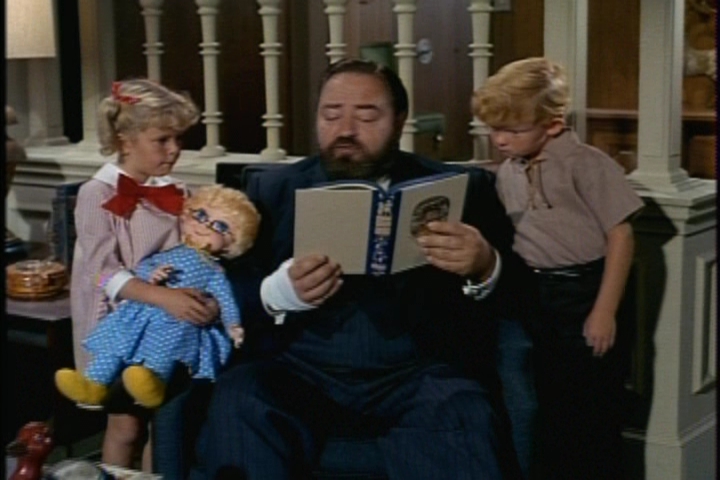
A Middle Eastern theme pervades this episode, which begins with French reading to the twins about Sinbad the Sailor.

Jody seems pretty excited about this story.

With Uncle Bill soon to return from a project in Beirut, French decides to brush up on his Lebanese culinary skills. But a trip to Fuad’s Middle Eastern Delicacies leads to cooking lessons from Nural Shpeni and then to her family’s demands that French marry her.

The prospective bride. French could do a lot worse.

Dr. Sarkis, an associate of Uncle Bill, reminds Nural’s brothers that the traditions they are relying upon to force French into marriage also demand a large dowry from them.

When Buffy and Jody open the door and see this group, they scream and run. It’s kind of funny, if politically incorrect.

French is thrilled when Nural finally announces she’d rather marry Officer Chamas, the local cop on the beat.

Vic Tayback as the cop. Hmm, Mr. French or Mel Sharples? Tough call.

Random Thoughts

This is the episode the Cleveland Amory mocked in his TV Guide review of Family Affair. It is pretty bad, actually. It’s always fun to see Mr. French in a state of extreme discomfort, however. And it has some other compensations.

Compensation 1: French using a hookah!

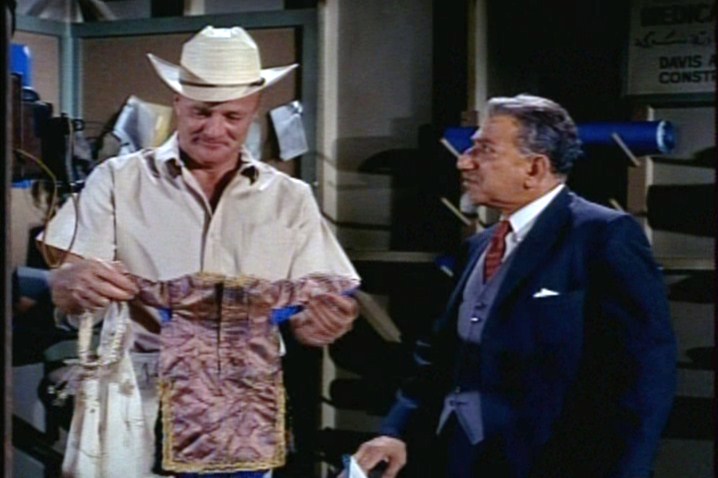
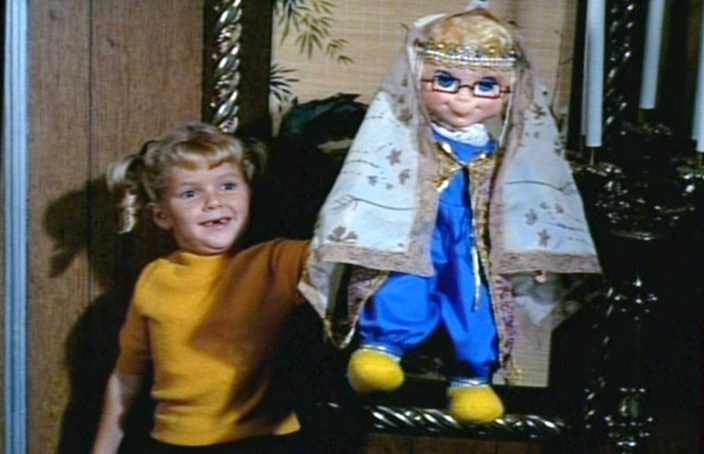
Compensation 2: Uncle Bill buys Mrs. Beasley this cute outfit in Lebanon.

Here she is later wearing the outfit.

Guest Cast

Fuad: Nestor Paiva. Nural: Magda Harout. Alam: Henry Corden. Mohad: Peter Manahos. Policeman Chamas: Vic Tayback. Old woman: Kay Koury. Dr. Sarkis: Abraham Sofaer. Most familiar is Vic Tayback, who played Mel in the 1974 movie Alice Doesn’t Live Here Anymore, as well as the subsequent TV series Alice. Nestor Paiva, who had a long career in movies, died before this episode aired. Magda Harout, on the other hand, is still alive and continued to act as recently as 2010, with an appearance on Fringe. Attention Seinfeld fans: she appeared as Stella in the 1991 episode “The Pen.” Henry Corden voiced many cartoon characters, including Fred Flintstone. He was Marcia’s boss, Mr. Haskell, in the ice cream parlor episode of The Brady Bunch.

Fun Facts

Mr. French speaks Arabic and once worked for the Shah of Morocco. Jody is five minutes older than Buffy.

Read my whole Family Affair series!

Today’s Bonus Feature

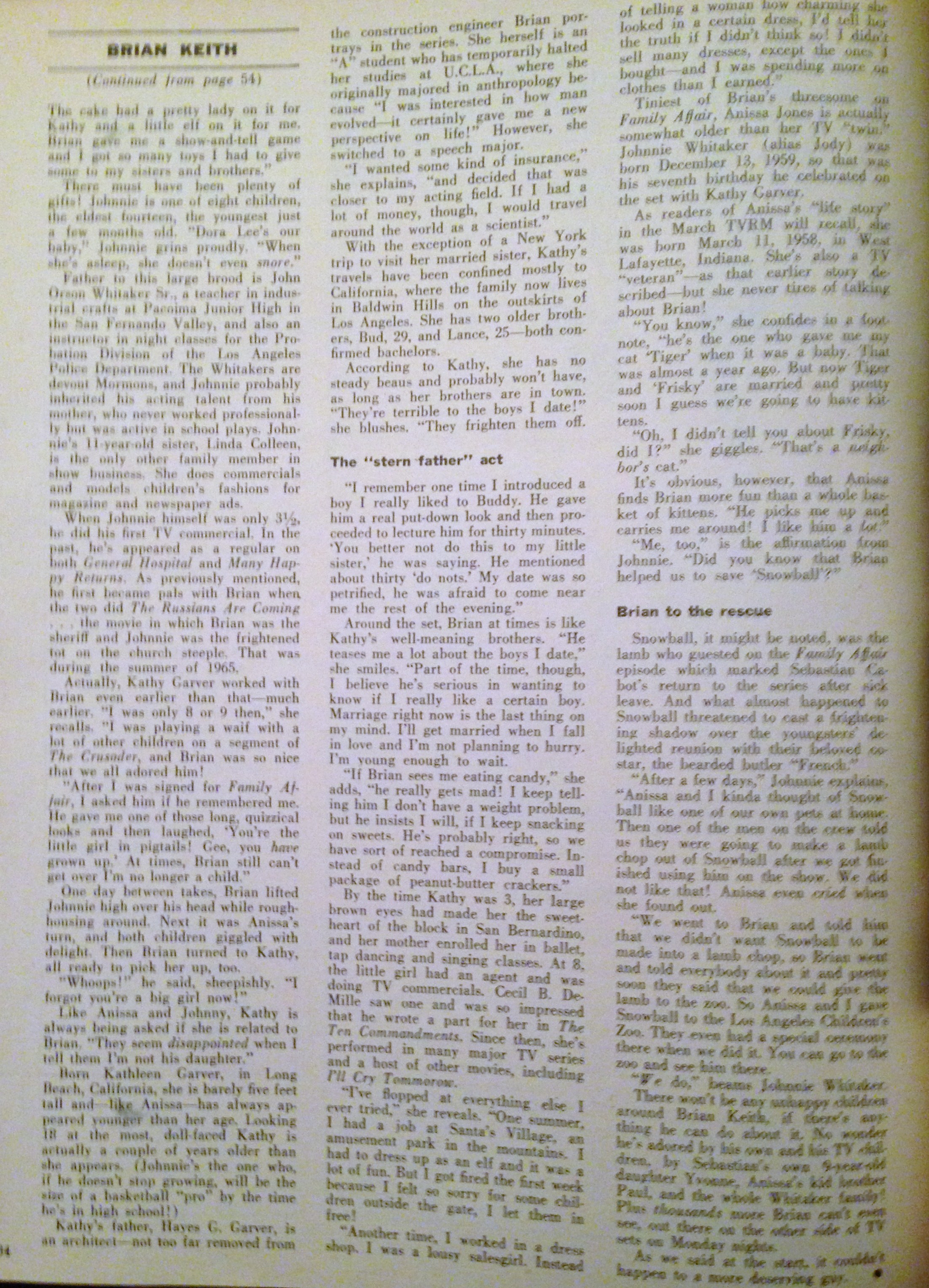
An article from TV Radio Mirror, July 1967. These fan magazine articles are not to be trusted completely, but the photos are nice. Here, you can see Johnny Whitaker’s real family.

Weird Words of Wisdom: The 5 Types of People Who Go All the Way Edition

“Just how advisable is it for a farm girl to date a city boy? The chief concern here seems to be her ability to handle a date who is more sophisticated than she is. The old story of the traveling salesman and the farmer’s daughter has some basis in the tendency of certain urban males to try to exploit the presumably more naïve country girl.”

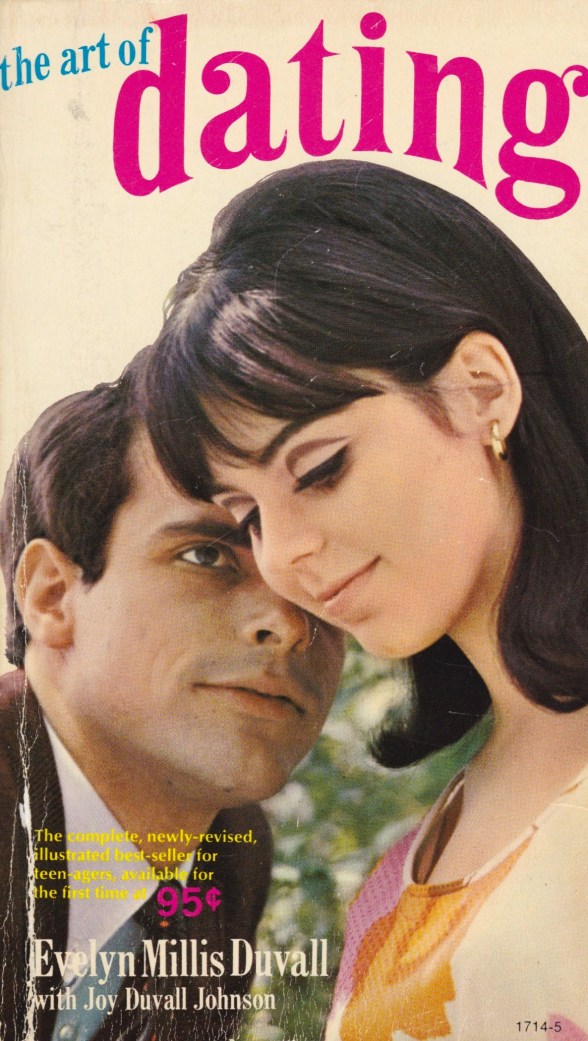
The Art of Dating, 1967 (1969 printing) By Evelyn Millis Duvall with Joy Duvall Johnson

About the Authors: Evelyn Millis Duvall, according to this book’s back cover, was “known nationally and internationally as a top-ranking authority on sex and family life education.” She was no intellectual slouch—she earned a Ph.D. in Human Development from the University of Chicago, and she was a Fellow of the American Sociological Association, which sounds impressive. Her earlier book The Facts of Life and Love for Teenagers went through many printings in the 1950s and 1960s. Her daughter, Joy Duvall Johnson, assisted her in writing this book. She was a University of Chicago graduate, too, with a master’s degree in “social group work.”

About This Book: Having read both this book and The Facts of Life and Love for Teenagers, I’ve found that two qualities distinguish Duvall in the advice-giving game: She has a research-based approach and an obsessive love of detail.

You can see the first quality in the many studies that she cites and statistics that she offers. Here is a fairly typical Duvall passage:

“Professors Kirkpatrick and Caplow found that the most usual course of love is one starting with mutual indifference and moving upward through attraction to love, and either dropping again to indifference, with the broken love affair, or remaining in love at a high level of mutual involvement. One out of every five love affairs studied is irregular in its course, with unpredictable shifts from love to hate to indifference to liking in various combinations throughout the history of the relationship. Somewhat fewer young men and women experience an even more vacillating kind of love that is off-again-on-again, with ups and downs like a roller coaster’s.”

Her love of detail pervades the entire book, which explores dating from every possible angle. Take her guidelines, for instance, about a movie date:

  • Paying for the tickets: “While the fellow buys the tickets, the girl steps aside and looks at the stills outside to avoid the boy any embarrassment he may feel at the ticket window.”
  • Walking in to the theater: “If there is no usher, the boy precedes the girl down the aisle, finds two seats, and steps aside so that the girl may be seated first; he then follows and seats himself behind her.”
  • During the film: “…throwing popcorn or paper, or otherwise behaving like a nuisance, is rude and crude.
  • Getting refreshments: “At (intermission) the boy may ask his date what she would like, then excuse himself while he gets it…If his budget doesn’t call for this extra, a boy should come prepared with some little offering to take the place of purchased refreshments, such as candy from a roll or mints or a stick of gum. The girl accepts the offer graciously without hinting that she would like something else.”
  • Acceptable affection: “The boy may hold the girl’s hand if she has no objection or place his arm over the back of her seat.”
  • Talking: “They may whisper their reactions to the picture or comment to each other about the characters or plot, so long as they neither embarrass each other nor annoy their neighbors.”
  • Leaving the Theater: “…the boy helps the girl into her wraps and waits is the aisle until the girl emerges and precedes him out of the theater. Then, the boy may suggest stopping at a soda fountain, if he wishes, or if it’s early, the girl may invite him to her home for ‘cake and milk’ or whatever she and her family have agreed upon for an evening snack.”

Whew! I was the most socially awkward teenager who ever lived, and even I wouldn’t have needed that much help to get through a simple movie.

Despite her scientific bent, Duvall occasionally lapses into flights of fancy that seem to be inspired by movies rather than real life, circa 1967. In addition to warning about the great urban-rural dating schism, she predicts soap-opera-esque consequences for dating outside one’s social class. She even cites the 1940 movie (or 1939 novel) Kitty Foyle to demonstrate the latter situation’s pitfalls!

Decoding a Previous Owner: A previous owner of my book went crazy underlining passages and scribbling in his or her own, sometimes smug, notes. At first I assumed this mad scribbler was a teenage reader, and it surprised me that any teen was taking this book so seriously in 1969. Then I started to notice that the underlinings included portions aimed at both girls and boys, and I wondered if the reader was a parent, teacher, or some kind of minister. Finally, I hit upon a note that confirmed a church affiliation: Below a passage that described church ladies hosting an after-prom party, my scribbler wrote, “Possibility for our women.” Oh, the fun of reading used books!

More quotes from The Art of Dating

“When the boy on the hill dates the girl from across the tracks, the general public is apt to assume that it’s because she is willing to let him take more liberties with her than would a girl from his own social group.”

Possible dating activity: “An old-fashioned taffy pull lends itself to hilarious, if sticky, informality.”

“Currently some segments of the young adult population try to express their individuality by extremes in hair style and dress. However young people respond to this, most want an attractive date. On one college campus, the men revolted against the trend of certain co-eds to be unkempt. They protested that they wanted girls to look feminine. Most fellows would agree.”

Dating costs: “College men find it often costs close to $5 for a ‘movie and malt’ date.”

Really? Just as responsible?: When you step into a car, you are just as responsible as the driver for what goes on…If (a girl) lets the boy drive too fast, she shares the guilt if an accident occurs.

Warning—writing about illegal drugs may be a gateway to abusing quotation marks: “Some teen groups have ‘parties’ where drugs provide ‘entertainment.’ At these parties teens are often exploited by dope peddlers who ‘contribute’ marijuana. Young people might be tempted to try a ‘reefer.'”

Smart girls: “Boys worry less about dating girls inferior to them in intellect, since it is generally expected that a girl won’t be as intelligent as the boy she dates. Indeed this is emphasized so strongly that a superior girl may find that if she has a reputation as a ‘brain,’ boys are afraid to date her. Such a girl may pretend to be dumber than she is on a date…But there are girls who resent having to ‘put their brains on ice,’ so they only go out with boys who like them as they are, who admire intelligence and are not threatened by a girl’s superior mental ability. A girl who dates a boy who is not her intellectual equal must decide whether she dares to be herself or whether she must put on an act.”

(You would think that two female, University-of-Chicago-educated social scientists might take a firmer stand on which is the right choice, but they let matters rest there.)

The five kinds of people who “go all the way” before marriage:

1. “The Unconventional person with few or no religious roots.”

2. Young people from the lower socioeconomic classes. (“In general, the middle-class girl or boy values chastity more highly.”)

3. People desperate for love and acceptance.

4. Rebellious types.

5. People who are deeply in love but, for some reason, cannot marry.

“The more mature girl knows that she doesn’t need to resort to either slapping or running in order to deal with the too amorous boyfriend. She wards off unwelcome behavior with a firm refusal to cooperate, accompanied by a knowing smile and a suggestion of some alternate activity. She may say, “Not now, Ambrose—let’s go get a hamburger; I’m hungry.”

Read the whole Weird Words of Wisdom series

Family Affair Friday: Season 1, Episode 7, Mrs. Beasley, Where Are You?, 10/24/1966

My 10-inch Buffy doll with her Mrs. Beasley. They’ve never been removed from the box, but Mrs. Beasley has plummeted to the ground–hey, just like in this episode.

This week, the latest installment of my Family Affair series features a classic Mrs. Beasley episode–and some dolly digressions.

Season 1, Episode 7, Mrs. Beasley, Where Are You?, 10/24/1966

Teleplay by: Phil Davis and John McGreevey. Story by: Phil Davis. Directed by: William D. Russell.

Synopsis

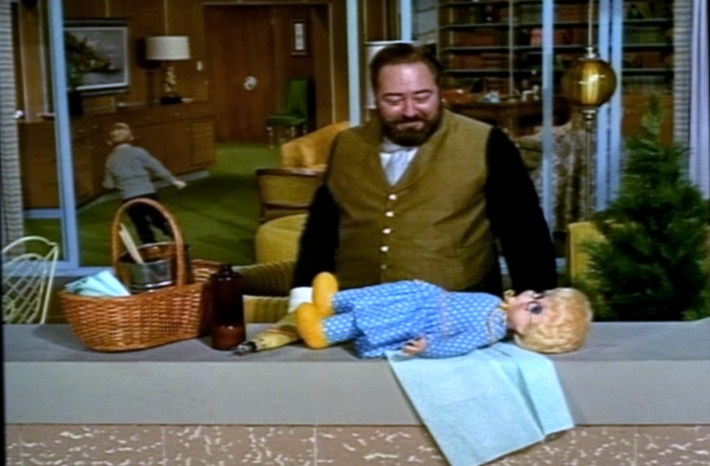
A seeming tragedy occurs when Mr. French accidently knocks Mrs. Beasley off the terrace, and the doll is nowhere to be found below.

What could go wrong here?

Yeah. That.

Meanwhile, a related subplot finds Uncle Bill’s weekend plans to “sleep, play golf and do a little mild socializing” thwarted by conflict with a neighbor–a neighbor whose little girl suddenly owns a doll (Effie Boots) the spitting image of Mrs. Beasley.

Effie Boots’ owner is the spitting image of Pamelyn Ferdin.

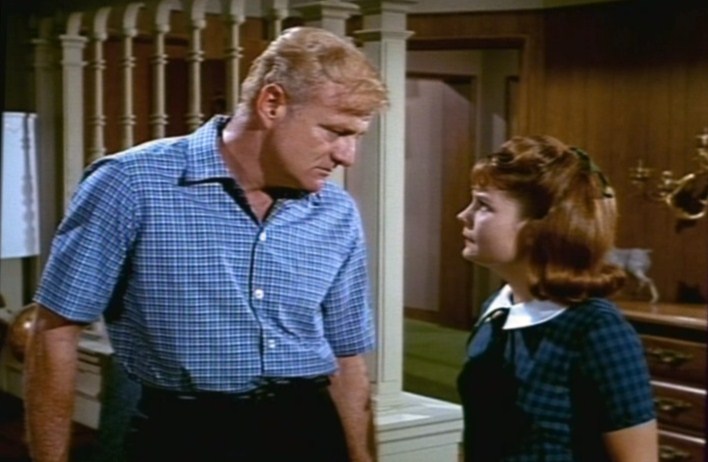
A despondent Buffy, however, testifies that the doll isn’t hers.  The whole Davis family suffers along with Buffy.

See the clothes these two are wearing while Cissy makes the scrunched-face-of-concern at Uncle BIll? Well, keep them in mind. We’ll get back to them later.

Jody offers to let Buffy sleep with his turtle. Awww.
A sweet sisterly moment. Double Awww.

When all seems lost, Uncle Bill and his girlfriend du jour find Buffy’s doll in the apartment building’s garbage cans.

“Competition is the lifeblood of free enterprise,” the ragpicker notes approvingly when he sees Bill and his date rifling through the trash. Aren’t ragpickers amusing?

The happy reunion.

Random Thoughts

It would take a cold heart to remain unmoved by Buffy’s suffering. As a Barbie collector, though, I enjoy the toy store scene the most: drool-worthy Mattel dolls as far as the eye can see. I don’t know if Mattel had released the Mrs. Beasley doll yet, but obviously the show had forged its relationship with the toy company.

The mid-1960s was a golden era in Barbie history. In this scene, you can see several “American Girl” Barbie dolls. These were only made for two years and are highly sought after today. The long-haired doll in the background is Barbie’s cousin Francie. The Barbie clothes of that era were especially glamorous. The doll in the foreground is wearing Fabulous Fashion. You can spot other dolls wearing Fashion Luncheon and Pan American Airways Stewardess. One price guide I own values the latter at $900 if it’s still in the box! The little dolls on the shelf above the saleslady are Barbie’s brother and sister, Tutti and Todd, along with their friend Chris. Mattel made a Buffy and Mrs. Beasley doll in that same size.

Guest Cast: George Nelson: Frank Maxwell. Diane: Joan Vohs. Clara: Ann McCrea. Saleslady: Cathleen Cordell. Melissa: Pamelyn Ferdin. Scotty: Karl Lukas. Ragpicker: Andy Albin. Maid: Pauline Drake. Pamelyn Ferdin is a familiar face, and voice, from the 1960s and ’70s. Among other roles, she played Edna on The Odd Couple and voiced Lucy in A Boy Named Charlie Brown and Fern in Charlotte’s Web. She also appeared (with Johnnie Whitaker) on Sigmund and the Seamonsters and was in the ’70s version of Lassie. On The Brady Bunch, she appeared in the episode where Jan sports a wig. She also played Francie in a 1972 made-for-TV version of A Tree Grows in Brooklyn. She would appear in three more episodes of Family Affair. Joan Vohs appeared in a second-season epidsode as Mrs. Scofield, then appeared in six third-season episodes as Miss Cummings. Andy Albin was a regular performer on Bob Newhart’s short-lived first series in 1961.

Continuity Notes: Cissy explains that after the death of her mother and father and separation from her siblings, Buffy had only Mrs. Beasley left as a friend.

Continuity error–Cissy and Uncle Bill are wearing the same clothes in this scene as they did in the “concerned conversation” scene above, but this scene takes place the next day.

Notable Quotes: “People you love always go away–I know.” Buffy

Well, that quote’s a bummer. So I will close instead with two random Buffy pictures. In Buffy’s happy scenes in this episode, Anissa Jones seems more animated than usual.

Anissa Jones cuteness.

I love that outfit, too. It reminds me of the Gymboree outfits I tried to get my daughter to wear when she was 4 and 5. (No dice.)

Today’s Bonus Feature

An article from Doll World, December 1996, about the small Buffy and Mrs. Beasley doll.

Read my whole Family Affair series!

Spin Again Sunday: Dr. Kildare Game

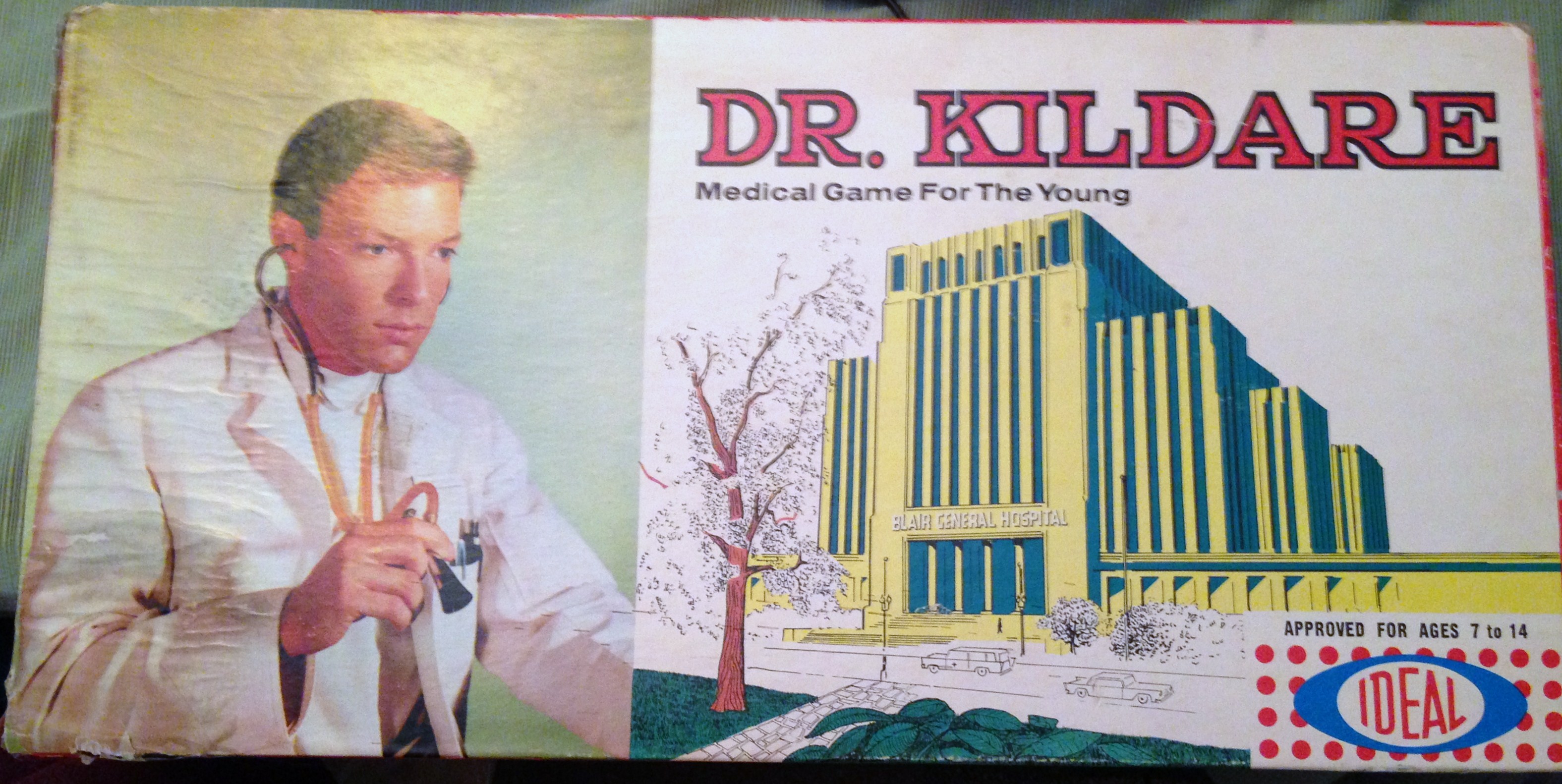
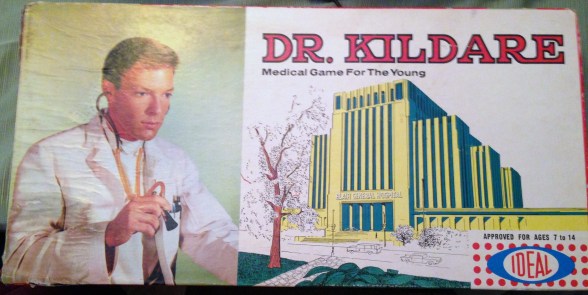
Dr. Kildare Game, Ideal, 1962

It’s time to take two aspirin and enjoy the latest installment in my series about vintage board games.

Today’s Game: Dr. Kildare

Copyright Date: 1962

Mystifying Subtitle: “Medical Game for the Young.” I wonder why they felt the need to specify that it was for the young.

Game Box: I’m sure the draw for potential buyers was the large photo of dreamy Richard Chamberlain as Dr. Kildare, who is staring intently ahead and listening to an invisible person’s heartbeat.

The Analyzer

Recommend Ages: 7 to 14. Actually, it says “Approved for ages 7 to 14.” That’s a strangely officious way to put it.

Game Board: The board offers a cute representation of a hospital, with green corridors, patient rooms, an operating room, and more. The patients all seem happy, even the one traction.

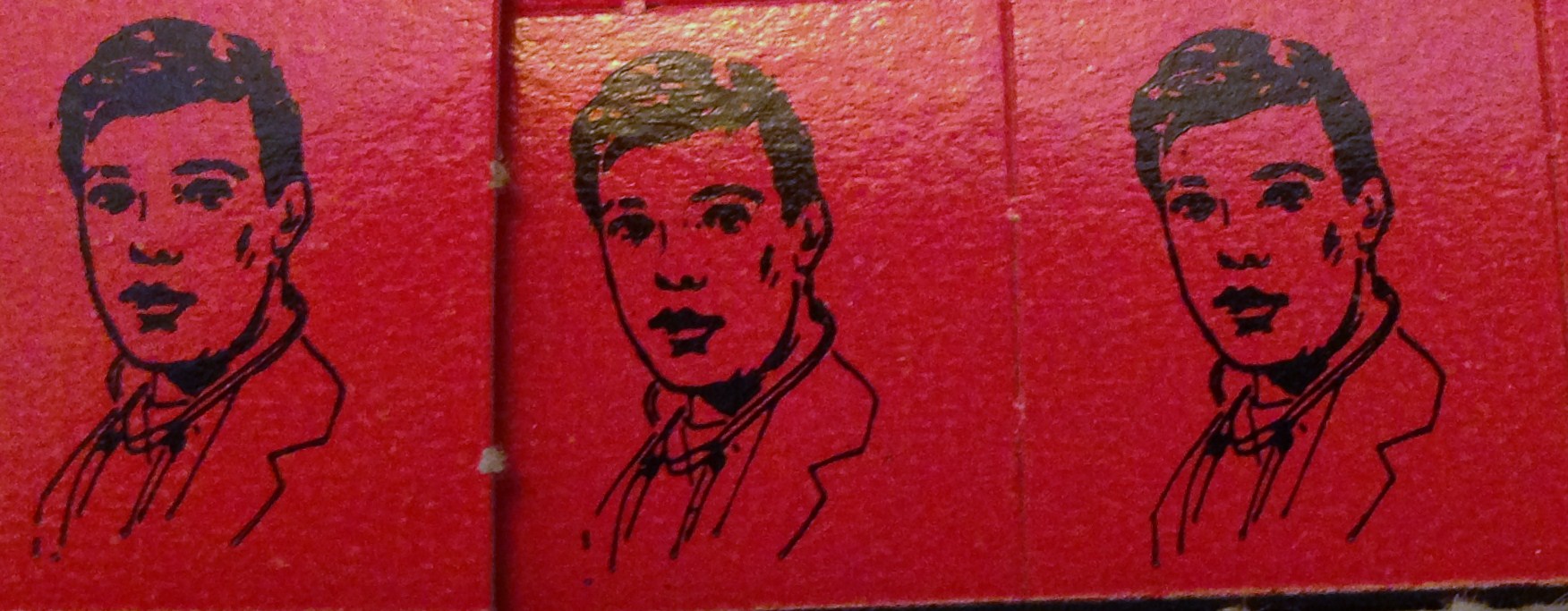
Game Pieces: Dr. Kildare’s dreamy face again.

Game Play: Pretty cool. Players make their “rounds” through the hospital and diagnose their patients with the help of the “Analyzer.”  Patients’ conditions are written in code on diagnosis cards. I decoded two of them just for fun—nose bleed and sprained back.

Nice Touch: The instructions say that you can play the game by yourself.  I used to play board games against myself all the time—my brother was not really a board-game guy.

My Thoughts: I’ve never actually seen an episode of Dr. Kildare. It was a bit before my time. I saw The Thorn Birds at an impressionable age, though, so I can appreciate Richard Chamberlain’s charms. The game looks pretty entertaining—what kid doesn’t love decoding messages?

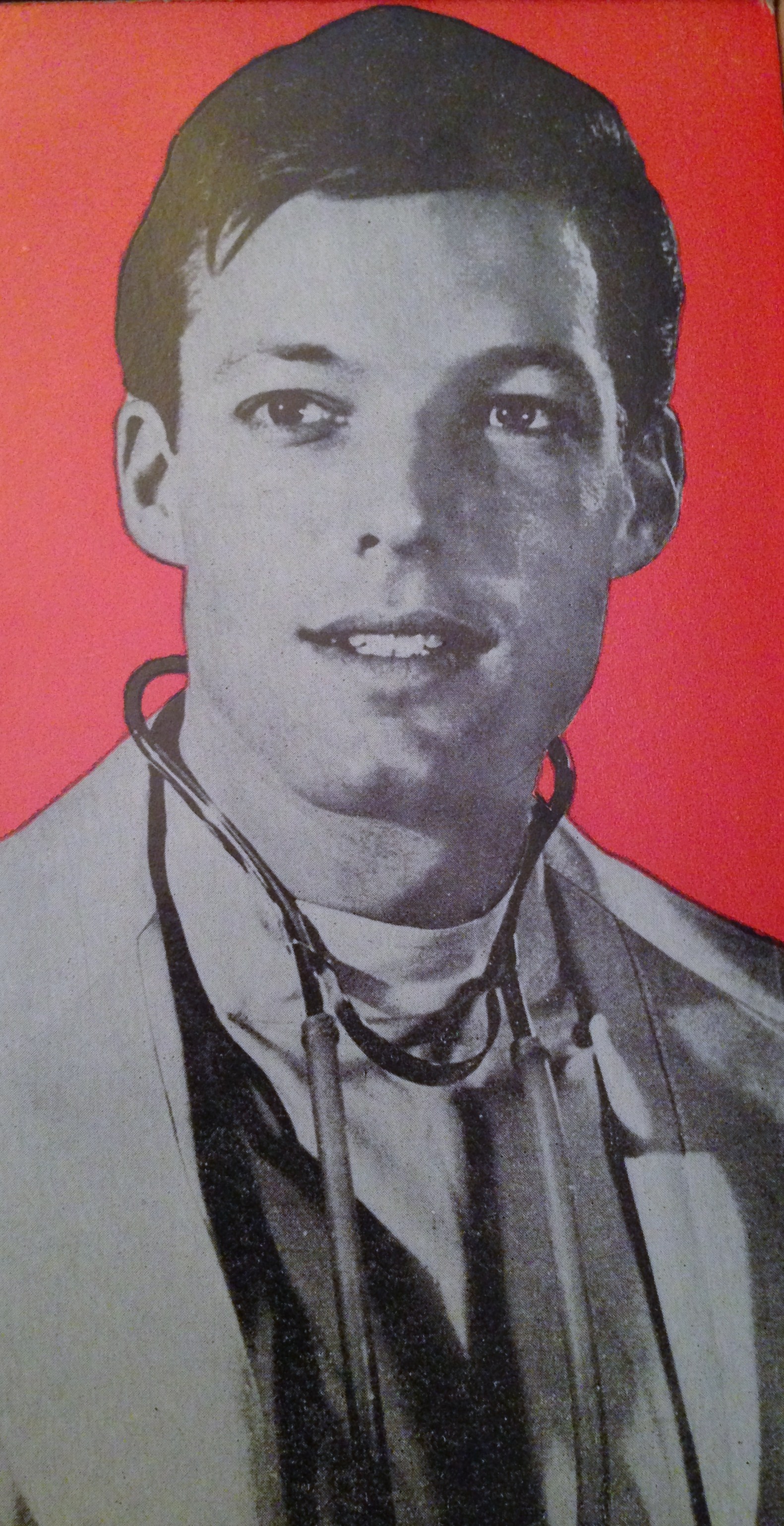
Another photo of Dr. McDreamy from the box insert. Okay, we get it, he’s handsome!

If you enjoyed this post, read the whole Spin Again Sunday series!