I’ve Got a Date with a Couple of Chipmunks

I’m heading to Walt Disney World today to partake in Mickey’s Not So Scary Halloween Party, the Food and Wine Festival at Epcot, and any chance I get for a photo opportunity with my favorite rodents.

I won’t be posting much in the next few days, though I do have a couple entries scheduled to pop up, including an abbreviated version of Family Affair Friday.

When I return on Tuesday, I hope to post some election-themed old-time radio shows.

Because I hate to post empty-handed, I leave you with this vintage Walt Disney World commercial

Weird Words of Wisdom: Attending to Our Bodily Housekeeping Edition

“Many girls feel that it is more delicate to neglect the care of the bowels than to attend to a daily evacuation, but if they would remember that it is just as indelicate to carry effete or dead matter around in the bowels as it would be to carry it upon the person in any other way, they would realize that it was only politeness and refinement to see that this part of their bodily housekeeping was attended to.”

What a Young Woman Ought to Know, 1913
By Mary Wood-Allen

Today, I would love to blog about a book with a Halloween theme. Unfortunately, Vincent Price never wrote an advice book for teens. (He did, however, write a cookbook.) So, the scariest thing that we can do is travel a century into the past to see what the day’s leading authorities were telling girls.

About this Book and Its Author: Born in 1841, Dr. Mary Wood-Allen was a physician and the World Superintendent of the Purity Department of the Women’s Christian Temperance Union (isn’t that an imposing-sounding title?). She was a leading light of the social purity movement in late 19th and early 20th century America, and wrote many books advising girls and women about sexuality and health. Though her views seem far removed from today’s feminist thought, many feminists of her era supported the social purity cause. Social purists believed in giving young women information about sexuality (though they usually did so in an oblique way—they popularized “the birds and the bees” method of explaining reproduction). They also attacked the prevailing double standard that demanded purity from women but found it acceptable for men to visit prostitutes. Their alternative to the double standard was imposing Victorian standards of purity on both sexes.

Wood-Allen was in great demand as a lecturer, as an interesting biographical sketch from 1897 shows:

“At present Dr. Allen has her home in Toledo, Ohio, whence she goes forth into the lecture field. Glorious as has been her work for temperance, that which she has done, and is doing, for social purity is more beautiful. Upon this subject, so difficult to handle, she has spoken Sabbath evenings in many pulpits, and has received the unqualified praise of such noted clergymen as Dr. Heber Newton, Dr. Theodore Cuyler and Dr. Pentecost in the East, and Dr. McLean upon the Pacific coast. She manifests a peculiar fitness for giving wise counsel to girls, and has done acceptable work in this line in schools and colleges. During several winters, by invitation of Miss Grace Dodge, she has spoken to the Working Girl’s Clubs of New York City…Her mission in the work of reform and philanthropy demands a peculiar talent which she possesses in an unusual degree; a scientific education which enables her to speak with authority ; a winning presence ; a musical voice which makes itself heard in the largest building with no apparent effort, and which by its sympathetic quality arrests attention and touches the heart, while her words appeal to the reason, and a gentle womanly manner which converts the most pronounced opposer of woman’s public work. To those who hear her on the platform or in the pulpit, she is a living voice, alluring her hearers to lives of truth and purity, and to those who know her personally she is a sweet womanly presence, the embodiment of those graces which are the power in the home.”

Wood-Allen cites the views of Dr. John Harvey Kellogg several times in this book, and her general views on health seem to accord well with his: Enemas are good, coffee is bad, and “self-abuse” is a dire threat to physical and mental health.

Quotes from What a Young Woman Ought to Know

“The influence of tight clothing upon the pelvic organs is to displace them and create a great many difficulties which we know as ‘Female Diseases.’”

“If you waken unrefreshed (after a night’s sleep), I should want to inquire into your habits of life. Was there opportunity for fresh air to enter your room? Was there in it no uncovered vessel, no old shoes in the closet, no soiled underclothing, nothing that could contaminate the atmosphere? Did you eat a hearty supper late in the evening? Is your system oppressed with a superabundance of sweets?”

“Dancing is a most fascinating amusement, and if it only could be conducted under proper circumstances, it would be very delightful. In itself it is not so objectionable as in its concomitants; the late hours, the improper dressing, the hearty suppers in the middle of the night, the promiscuous association, and the undue familiarity of the attitude of the round dance are what make dancing objectionable.”

“I would like to call your attention to the great evil of romance-reading, both in the production of premature development and in the creation of morbid mental states which will tend to the production of physical evils, such as nervousness, hysteria, and a host of maladies which largely depend on disturbed nerves.”

“The modern play concerns itself principally with a delineation of those phases of life which we condemn when they become reality, and the teaching power of the stage becomes a lesson in wrongdoing which to the young and inexperienced is potent in its suggestiveness.”

On card playing: “The young woman who respects her own intellectual and moral powers will see little charm in manipulating cards in a way to gain a momentary success over another and perhaps arousing unkind feelings, it may be even passions, that may culminate in bloodshed.”

“When girls are so sentimentally fond of each other that they are like silly lovers when together, and weep over each other’s absence in uncontrollable agony, the conditions are serious enough for the consultation of a physician. It is an abnormal state of affairs, and if probed thoroughly, might be found to be a sort of perversion, a sex mania, needing immediate and perhaps severe measures.”

“A young husband exacted of his bride a promise that she would never take a glass of wine except in his company, and when asked the reason, replied that he knew that no woman’s judgment was to be trusted after taking one glass of wine.”

“…the daughter of drunken parents, very often attractive to some men by reason of their excitable, vivacious, neurotic manner, should be carefully avoided by young men in search of wives.”

“Idiocy and inebriety are on the increase among civilized peoples.”

“…while in the human being the procreative act does not kill, it exhausts, and no doubt takes from the vital force of those exercising it. One can feel justified to lose a part of her own life if she is conferring life upon others, but to indulge in such a waste of vital force merely for pleasure is certainly never excusable…”

“A young man may assure you most emphatically that he respects you none the less, although you allow him to hold your hand, or kiss you at parting, but he knows it is not true, and he will admit it to others rather than to the girl herself.”

“…in wedded life, all that is lasting in affection, in tender courtesy, in most intimate companionship, in sweetest demonstration, is possible without the physical union, which in itself is the most transitory of pleasures, but which in unlimited indulgence becomes the most domineering of passions, exhaustive of physical powers and of mental vigor, and absolutely annihilating all true love.”

What a Young Woman Ought to Know is so full of weirdness that you might want to read the whole thing. It’s in the public domain and available for free.

Read the whole Weird Words of Wisdom series.
Old-Time Radio Playlist: Halloween, Part 2

Last week I presented some Halloween “treats” from the world of old-time radio—lighthearted holiday episodes. Today, I’m offering a few “tricks”—spooky Halloween episodes and a few classic horror stories.

Enjoy—and let me hear from you. What are your favorite old-time radio Halloween episodes? What’s your favorite show in the suspense or horror genre?

November 7, 1937
Columbia Workshop, The Horla

By early radio standards, this is a good adaptation of a creepy Guy de Maupassant story.

July 11, 1938
Mercury Theater, Dracula

This is faithful adaptation with a great cast: Martin Gabel (if you’ve seen What’s My Line? re-runs, you may remember him as Mr. Arlene Francis), Agnes Moorehead, and, of course, Orson Welles. The Mercury Theater’s actual Halloween episode, The War of the Worlds, might seem more appropriate for this playlist, but I wanted to choose something slightly less well known.

February 20, 1944
The Weird Circle, Frankenstein

Many radio shows adapted Mary Shelley’s story—I picked this version rather randomly. I’d love to hear opinions about the best radio Frankenstein.

October 27, 1947
Quiet Please, Don’t Tell Me About Halloween

“Marry in haste, repent at leisure” takes on new meaning when your spouse is immortal. This is an entertaining episode of Quiet, Please, a series of psychological horror stories that aired from 1947 to 1949. Wyllis Cooper created the show and wrote every episode—an amazing feat, in my opinion. Not every episode is brilliant, but they are all interesting. This episode has a bonus for me as a Guiding Light fan: Charita Bauer, who played Bert on GL, is the female lead.

January 10, 1948
Favorite Story, Dr. Jeckyll and Mr. Hyde

Ronald Colman hosted this series, which presented a classic story each week, supposedly picked by a celebrity. Colman tells us that Alfred Hitchcock picked this classic Robert Louis Stevenson story. Radio stalwart Bill Conrad gives powerful performance in the dual role.

October 31, 1948
Quiet Please, Calling All Souls

This episode has a good story, but the organ music grates—that’s one aspect of old-time radio I just don’t love.

October 31, 1949
Inner Sanctum Mysteries, A Corpse for Halloween

I’m not a big Inner Sanctum fan, and this story loses me a little. It does have compensations, however: Its Halloween setting, its tiger motif (I like anything cat-related), and its star—Larry Haines. As with Charita Bauer, I know Haines from the world of daytime TV drama; he played Stu on Search for Tomorrow for 35 years. He was also a prolific radio actor, and he gives a good performance here as a guy who’s cracking up.

March 14, 1951
NBC Short Story, The Lottery

Long before there was The Hunger Games, there was this classic Shirley Jackson story. No one faces any monsters here; the horror that unfolds is the horror that human beings can inflict on each other when they cling blindly to destructive traditions. Even when you know what’s coming, the end packs a huge punch. The music is appropriately haunting.

October 30, 1976
CBS Radio Mystery Theater, The Witches’ Sabbath

This story doesn’t reference Halloween, but its subject matter suits the holiday. Once again, we encounter Larry Haines as a man cracking under a strain—his performance is even better here than in the Inner Sanctum Mysteries episode above. The conversations between his character and the bartender amused me.

Enjoy more old-time radio playlists:

Halloween, Part 1

Edgar Allan Poe, Part 1

Edgar Allan Poe, Part 2

Spin Again Sunday: Addams Family Card Game

For this pre-Halloween edition of my series on vintage games, I bring you an altogether ooky diversion.

This Week’s Game: Addams Family Card Game, 1965

Recommended Ages: 7 to 15.

Game Play: While I usually focus on board games, this is a simple card game. Cards show pictures of Addams Family characters. Gomez, Morticia, and the children each appear on 11 cards. Six wild cards show Lurch and Uncle Fester. The game proceeds like the game War. The player who amasses all the cards wins.

As the instruction card puts it, “Each character has the power to TAKE another. Gomez TAKES Morticia…Morticia TAKES the Children…the Children TAKE Gomez. The Lurch and Uncle Fester (Wild) cards are most powerful; they TAKE any of the other cards.”

It’s certainly fitting that Gomez TAKES Morticia. Was there ever a more passionate married couple in the world of classic TV?

Family Affair Friday(ish): Season 1, Episode 8, Who’s Afraid of Nural Shpeni?, 11/7/1966

I apologize for my lateness in bringing you this installment of my weekly Family Affair series.

Season 1, Episode 8, “Who’s Afraid of Nural Shpeni?”

Written by: Cynthia Lindsay. Directed by: William D. Russell.

Synopsis

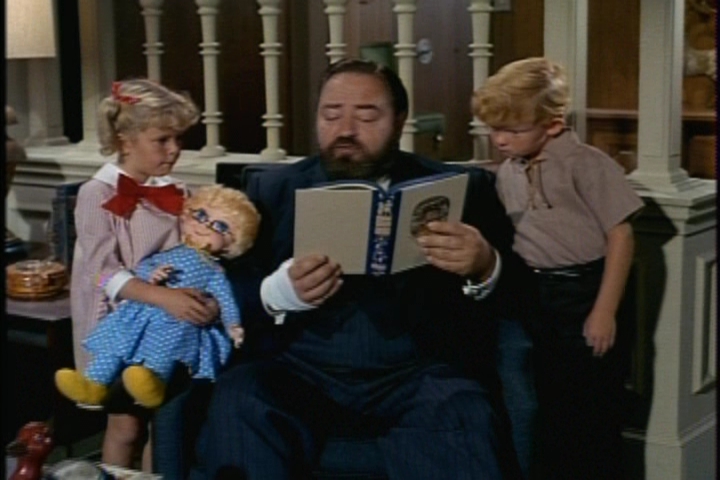
A Middle Eastern theme pervades this episode, which begins with French reading to the twins about Sinbad the Sailor.

Jody seems pretty excited about this story.

With Uncle Bill soon to return from a project in Beirut, French decides to brush up on his Lebanese culinary skills. But a trip to Fuad’s Middle Eastern Delicacies leads to cooking lessons from Nural Shpeni and then to her family’s demands that French marry her.

The prospective bride. French could do a lot worse.

Dr. Sarkis, an associate of Uncle Bill, reminds Nural’s brothers that the traditions they are relying upon to force French into marriage also demand a large dowry from them.

When Buffy and Jody open the door and see this group, they scream and run. It’s kind of funny, if politically incorrect.

French is thrilled when Nural finally announces she’d rather marry Officer Chamas, the local cop on the beat.

Vic Tayback as the cop. Hmm, Mr. French or Mel Sharples? Tough call.

Random Thoughts

This is the episode the Cleveland Amory mocked in his TV Guide review of Family Affair. It is pretty bad, actually. It’s always fun to see Mr. French in a state of extreme discomfort, however. And it has some other compensations.

Compensation 1: French using a hookah!

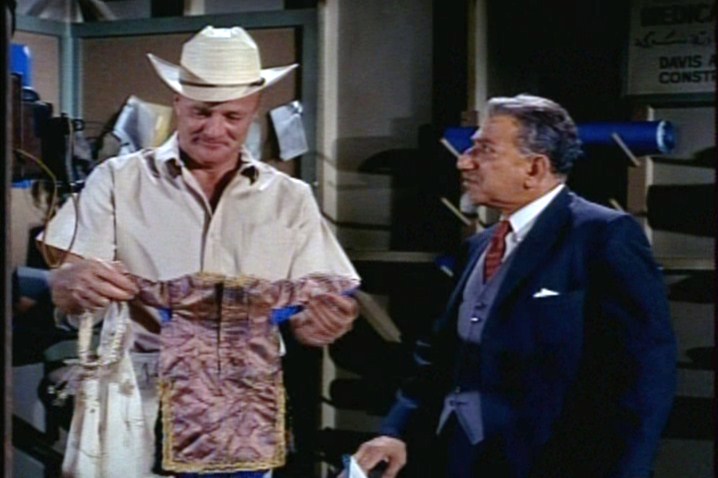
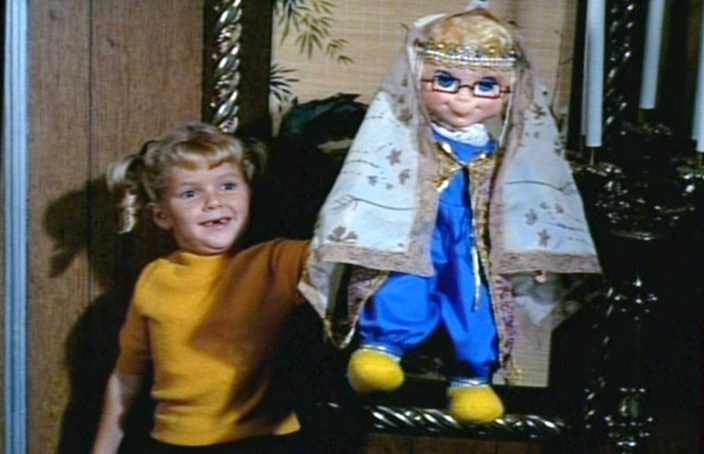
Compensation 2: Uncle Bill buys Mrs. Beasley this cute outfit in Lebanon.

Here she is later wearing the outfit.

Guest Cast

Fuad: Nestor Paiva. Nural: Magda Harout. Alam: Henry Corden. Mohad: Peter Manahos. Policeman Chamas: Vic Tayback. Old woman: Kay Koury. Dr. Sarkis: Abraham Sofaer. Most familiar is Vic Tayback, who played Mel in the 1974 movie Alice Doesn’t Live Here Anymore, as well as the subsequent TV series Alice. Nestor Paiva, who had a long career in movies, died before this episode aired. Magda Harout, on the other hand, is still alive and continued to act as recently as 2010, with an appearance on Fringe. Attention Seinfeld fans: she appeared as Stella in the 1991 episode “The Pen.” Henry Corden voiced many cartoon characters, including Fred Flintstone. He was Marcia’s boss, Mr. Haskell, in the ice cream parlor episode of The Brady Bunch.

Fun Facts

Mr. French speaks Arabic and once worked for the Shah of Morocco. Jody is five minutes older than Buffy.

Read my whole Family Affair series!

Today’s Bonus Feature

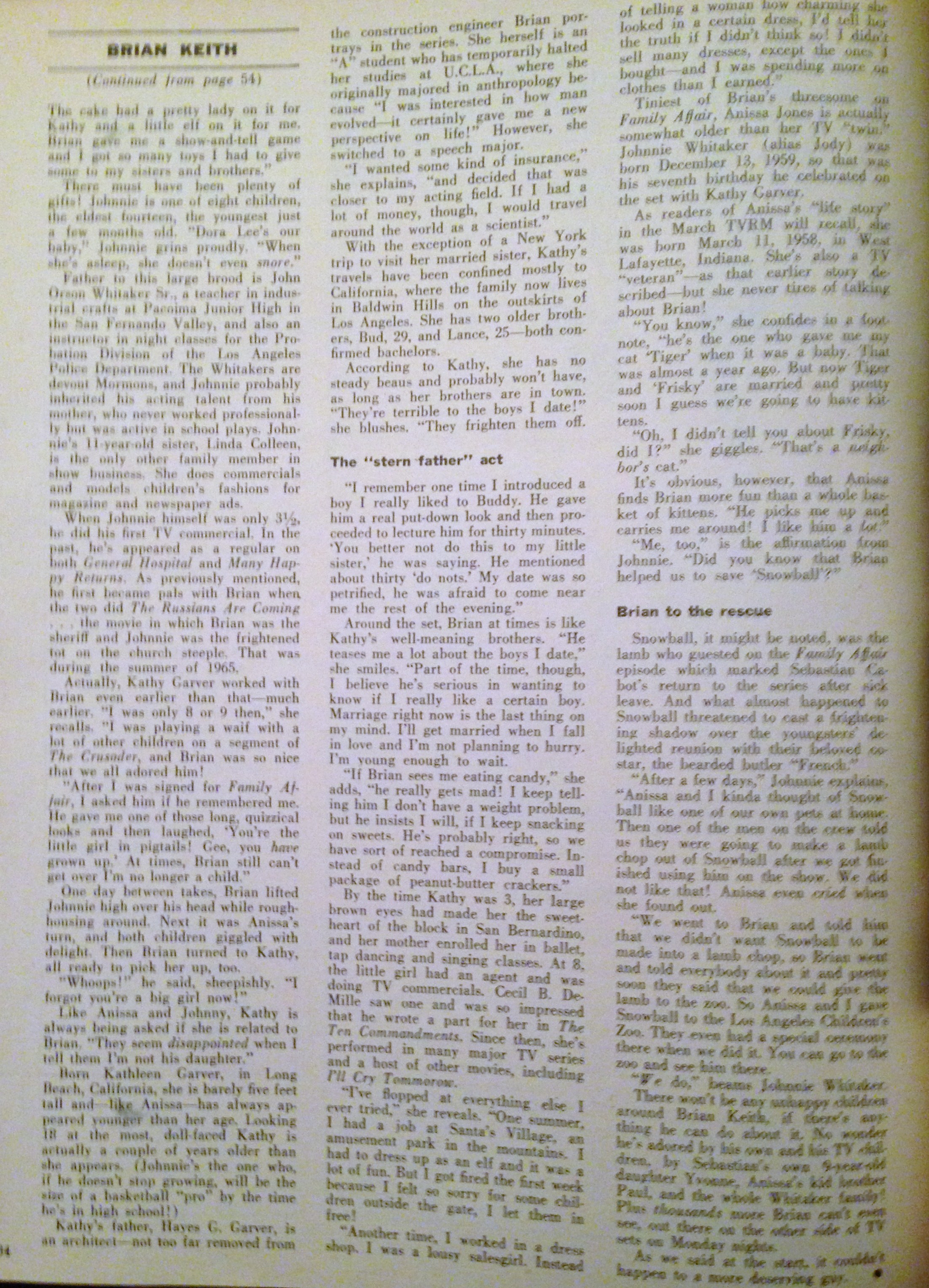
An article from TV Radio Mirror, July 1967. These fan magazine articles are not to be trusted completely, but the photos are nice. Here, you can see Johnny Whitaker’s real family.

Old-Time Radio Playlist: Halloween, Part 1

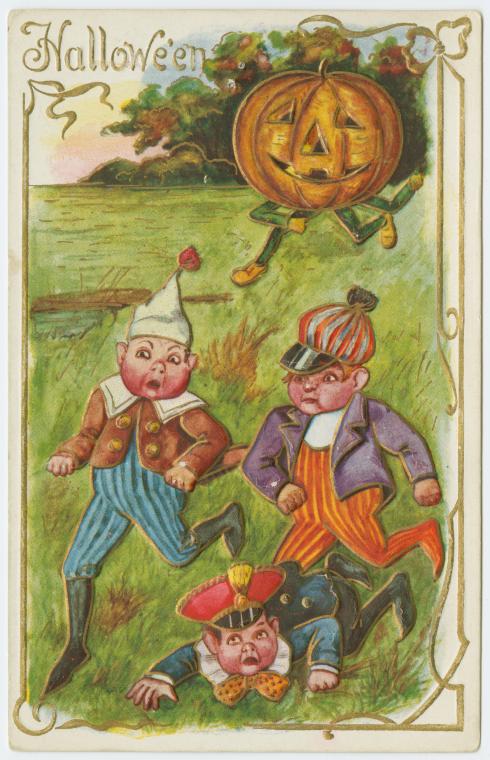
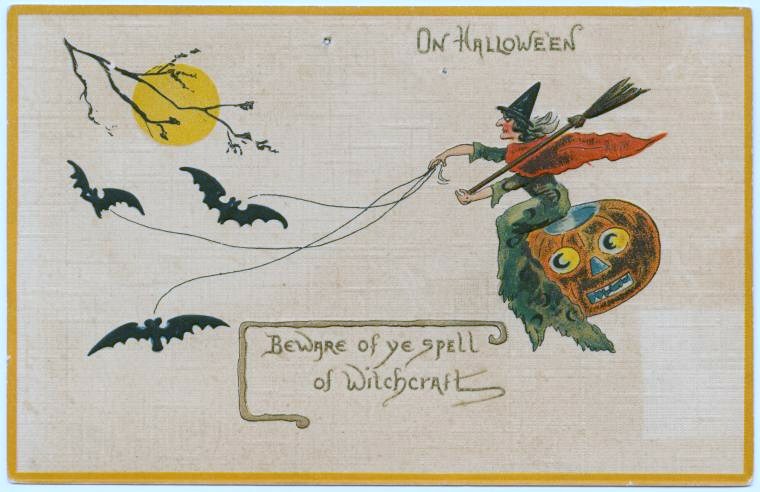
Vintage Halloween Postcard from The Public Domain Review

Today, I present a selection of Halloween treats–some lighthearted old-time radio episodes that capture an interesting period in the history of Halloween.

(On Tuesday, October 30, I’ll post some Halloween”tricks”–spooky holiday offerings and classic horror stories.)

European immigrants to the United States popularized Halloween celebrations in the late 19th century.

By the turn of the century, there was a move to downplay the scarier aspects of the holiday. According to History.com, “Halloween parties for both children and adults became the most common way to celebrate the day. Parties focused on games, foods of the season and festive costumes.”

By the 1920s and 1930s, pranks were a big part of the holiday, “often devolving into vandalism, physical assaults and sporadic acts of violence.”

Most of these radio shows date from the 1940s, when trick-or-treating was just beginning to transition into a community-sanctioned, kid-friendly activity. I’m guessing that’s why so many of the adults in these shows seem ambivalent about Halloween–looking back fondly on their own parties and pranks, but wary of letting their children participate in trick-or-treating.

Unknown Date
Air Castle, Halloween

Air Castle was a children’s show that ran in the late 1920s and early 1930s. It was entirely the work of Baron Keyes, who starred as the “Story Man” and provided voices and sound effects to represent various fanciful characters. This Halloween episode is cute!

October 19, 1933
Martha Meade Society Program, Halloween Parties

This cooking show provides a nice slice of 1930s life. From this and other radio shows, I’ve gleaned that doughnuts were a popular Halloween tradition in the early 20th century.

October 24, 1939
Fibber McGee and Molly, Halloween Party at Gildersleeve’s House

This would be a good starter episode for a new Fibber listener. It’s filled with typical wordplay and punning humor, and most of the classic supporting characters appear.

October 31, 1940
The Aldrich Family, Halloween Prank Backfires

Just about every episode of this family comedy involves a misunderstanding that snowballs out of control. These Halloween hi-jinx are typical.

November 2, 1941
Jack Benny, Halloween with Basil Rathbone

I’m in love with the Jack Benny Program. To really appreciate the series, you need to listen to a long run of consecutive episodes. Characterizations and jokes build from week to week. This is my favorite of several Halloween episodes–Jack annoying his Beverly Hills neighbors is always a win.

October 29, 1944
Edgar Bergen and Charlie McCarthy, Halloween

Guest star Orson Welles is quite amusing, especially when he ad-libs.

October 29, 1944
The Life of Riley, Haunted House   

Near the end, this takes a surprisingly sharp turn into patriotic messaging. You’ll have that sometimes in World-War-II-era programs.

October 31, 1944
Lum and Abner, Discuss Halloween Pranks

Lum and Abner has been growing on me lately, and this episode is a cute one.

November 1, 1946
Baby Snooks, Halloween

Fanny Brice’s mischievous Baby Snooks is a natural for Halloween pranks. This episode has a strong start, but a weak finish, in my opinion.

October 29, 1947
Philco Radio Time, Boris Karloff and Victor Moore

Boris Karloff was the go-to guest for variety-show Halloween episodes. Here, he’s the guest of Bing Crosby, and he and Bing actually sing together (along with comedian Victor Moore)!

October 31, 1948
Adventures of Ozzie and Harriet, The Haunted House       

I always found the TV version of Ozzie and Harriet bland, but the radio episodes I’ve listened to have been surprisingly chuckle-worthy.

October 31, 1948
Adventures of Sam Spade, The Fairly-Bright Caper    

I’m not a huge Sam Spade fan–ditzy Effie gets on my nerves–but this has a nice Halloween flavor.

Oct 31, 1948
Jack Benny, Trick or Treating with the Beavers

This is another good Halloween episode, with an inventive way of bringing the supporting cast into the story.

October 31, 1951
The Great Gildersleeve, Halloween and Gildy Finds a Lost Boy

I’m not the biggest Gildy fan, but this episode has great warmth.

November 7, 1951
The Halls of Ivy, Halloween

I really enjoy this series, which stars Ronald and Benita Colman. Having spent plenty of time in academia, I appreciate the college setting, and the Colmans are just charming.

Oct 29, 1953
Father Knows Best, Halloween Blues

Robert Young’s character is in preachy mode, and the end doesn’t work for me, but this is an interesting look at those changing Halloween customs.

Listen to more old-time radio!

Weird Words of Wisdom: The 5 Types of People Who Go All the Way Edition

“Just how advisable is it for a farm girl to date a city boy? The chief concern here seems to be her ability to handle a date who is more sophisticated than she is. The old story of the traveling salesman and the farmer’s daughter has some basis in the tendency of certain urban males to try to exploit the presumably more naïve country girl.”

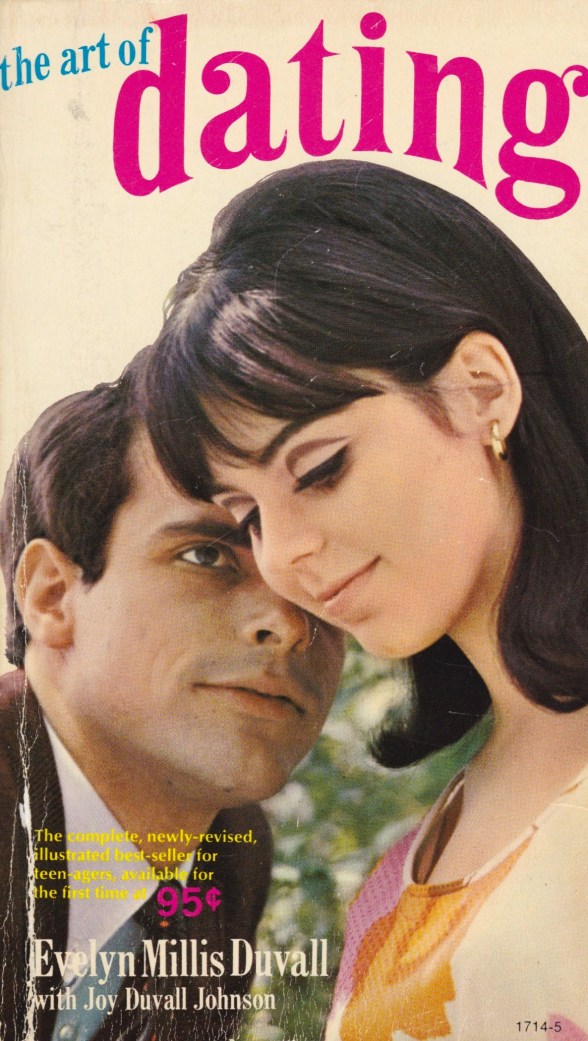
The Art of Dating, 1967 (1969 printing) By Evelyn Millis Duvall with Joy Duvall Johnson

About the Authors: Evelyn Millis Duvall, according to this book’s back cover, was “known nationally and internationally as a top-ranking authority on sex and family life education.” She was no intellectual slouch—she earned a Ph.D. in Human Development from the University of Chicago, and she was a Fellow of the American Sociological Association, which sounds impressive. Her earlier book The Facts of Life and Love for Teenagers went through many printings in the 1950s and 1960s. Her daughter, Joy Duvall Johnson, assisted her in writing this book. She was a University of Chicago graduate, too, with a master’s degree in “social group work.”

About This Book: Having read both this book and The Facts of Life and Love for Teenagers, I’ve found that two qualities distinguish Duvall in the advice-giving game: She has a research-based approach and an obsessive love of detail.

You can see the first quality in the many studies that she cites and statistics that she offers. Here is a fairly typical Duvall passage:

“Professors Kirkpatrick and Caplow found that the most usual course of love is one starting with mutual indifference and moving upward through attraction to love, and either dropping again to indifference, with the broken love affair, or remaining in love at a high level of mutual involvement. One out of every five love affairs studied is irregular in its course, with unpredictable shifts from love to hate to indifference to liking in various combinations throughout the history of the relationship. Somewhat fewer young men and women experience an even more vacillating kind of love that is off-again-on-again, with ups and downs like a roller coaster’s.”

Her love of detail pervades the entire book, which explores dating from every possible angle. Take her guidelines, for instance, about a movie date:

  • Paying for the tickets: “While the fellow buys the tickets, the girl steps aside and looks at the stills outside to avoid the boy any embarrassment he may feel at the ticket window.”
  • Walking in to the theater: “If there is no usher, the boy precedes the girl down the aisle, finds two seats, and steps aside so that the girl may be seated first; he then follows and seats himself behind her.”
  • During the film: “…throwing popcorn or paper, or otherwise behaving like a nuisance, is rude and crude.
  • Getting refreshments: “At (intermission) the boy may ask his date what she would like, then excuse himself while he gets it…If his budget doesn’t call for this extra, a boy should come prepared with some little offering to take the place of purchased refreshments, such as candy from a roll or mints or a stick of gum. The girl accepts the offer graciously without hinting that she would like something else.”
  • Acceptable affection: “The boy may hold the girl’s hand if she has no objection or place his arm over the back of her seat.”
  • Talking: “They may whisper their reactions to the picture or comment to each other about the characters or plot, so long as they neither embarrass each other nor annoy their neighbors.”
  • Leaving the Theater: “…the boy helps the girl into her wraps and waits is the aisle until the girl emerges and precedes him out of the theater. Then, the boy may suggest stopping at a soda fountain, if he wishes, or if it’s early, the girl may invite him to her home for ‘cake and milk’ or whatever she and her family have agreed upon for an evening snack.”

Whew! I was the most socially awkward teenager who ever lived, and even I wouldn’t have needed that much help to get through a simple movie.

Despite her scientific bent, Duvall occasionally lapses into flights of fancy that seem to be inspired by movies rather than real life, circa 1967. In addition to warning about the great urban-rural dating schism, she predicts soap-opera-esque consequences for dating outside one’s social class. She even cites the 1940 movie (or 1939 novel) Kitty Foyle to demonstrate the latter situation’s pitfalls!

Decoding a Previous Owner: A previous owner of my book went crazy underlining passages and scribbling in his or her own, sometimes smug, notes. At first I assumed this mad scribbler was a teenage reader, and it surprised me that any teen was taking this book so seriously in 1969. Then I started to notice that the underlinings included portions aimed at both girls and boys, and I wondered if the reader was a parent, teacher, or some kind of minister. Finally, I hit upon a note that confirmed a church affiliation: Below a passage that described church ladies hosting an after-prom party, my scribbler wrote, “Possibility for our women.” Oh, the fun of reading used books!

More quotes from The Art of Dating

“When the boy on the hill dates the girl from across the tracks, the general public is apt to assume that it’s because she is willing to let him take more liberties with her than would a girl from his own social group.”

Possible dating activity: “An old-fashioned taffy pull lends itself to hilarious, if sticky, informality.”

“Currently some segments of the young adult population try to express their individuality by extremes in hair style and dress. However young people respond to this, most want an attractive date. On one college campus, the men revolted against the trend of certain co-eds to be unkempt. They protested that they wanted girls to look feminine. Most fellows would agree.”

Dating costs: “College men find it often costs close to $5 for a ‘movie and malt’ date.”

Really? Just as responsible?: When you step into a car, you are just as responsible as the driver for what goes on…If (a girl) lets the boy drive too fast, she shares the guilt if an accident occurs.

Warning—writing about illegal drugs may be a gateway to abusing quotation marks: “Some teen groups have ‘parties’ where drugs provide ‘entertainment.’ At these parties teens are often exploited by dope peddlers who ‘contribute’ marijuana. Young people might be tempted to try a ‘reefer.'”

Smart girls: “Boys worry less about dating girls inferior to them in intellect, since it is generally expected that a girl won’t be as intelligent as the boy she dates. Indeed this is emphasized so strongly that a superior girl may find that if she has a reputation as a ‘brain,’ boys are afraid to date her. Such a girl may pretend to be dumber than she is on a date…But there are girls who resent having to ‘put their brains on ice,’ so they only go out with boys who like them as they are, who admire intelligence and are not threatened by a girl’s superior mental ability. A girl who dates a boy who is not her intellectual equal must decide whether she dares to be herself or whether she must put on an act.”

(You would think that two female, University-of-Chicago-educated social scientists might take a firmer stand on which is the right choice, but they let matters rest there.)

The five kinds of people who “go all the way” before marriage:

1. “The Unconventional person with few or no religious roots.”

2. Young people from the lower socioeconomic classes. (“In general, the middle-class girl or boy values chastity more highly.”)

3. People desperate for love and acceptance.

4. Rebellious types.

5. People who are deeply in love but, for some reason, cannot marry.

“The more mature girl knows that she doesn’t need to resort to either slapping or running in order to deal with the too amorous boyfriend. She wards off unwelcome behavior with a firm refusal to cooperate, accompanied by a knowing smile and a suggestion of some alternate activity. She may say, “Not now, Ambrose—let’s go get a hamburger; I’m hungry.”

Read the whole Weird Words of Wisdom series