Carole Lombard was born on this date in 1908. I’ve always felt that, though she certainly had Golden-Age-Hollywood glamor, she also had a strangely modern quality–I can envision her as a 21st century movie star. Dell published this special magazine in 1942 after her death.
“Correct Lyrics by Permission of Copyright Owners.” You certainly wouldn’t want to sing incorrect lyrics to “Abercrombie Had a Zombie,” “Melinda the Mousie,” or “Hey! Stop Kissin’ My Sister.”
When I was about four, I walked with my mom to a nearby store. I can still remember walking home, up a hill, carrying a large box, and bursting with excitement. For no special reason at all, my mom had bought me the Fisher Price Play Family School that day.
Play Family toys were among my favorites. Besides the School, I had the House and the Houseboat. When I was five, Santa brought me the wonderful Play Family Village, which included a firehouse, dental office, theater, post office, police station, barber shop, garage, restaurant, and telephone booth.
I don’t have any of my old Fisher Price toys, but my husband has picked up some vintage structures at flea markets and yard sales. My daughter, who is nine, still enjoys playing with them now and then. Today, she set up a Play Family city around the living room rug.
Another week, another cardboard-and-plastic journey to the past.
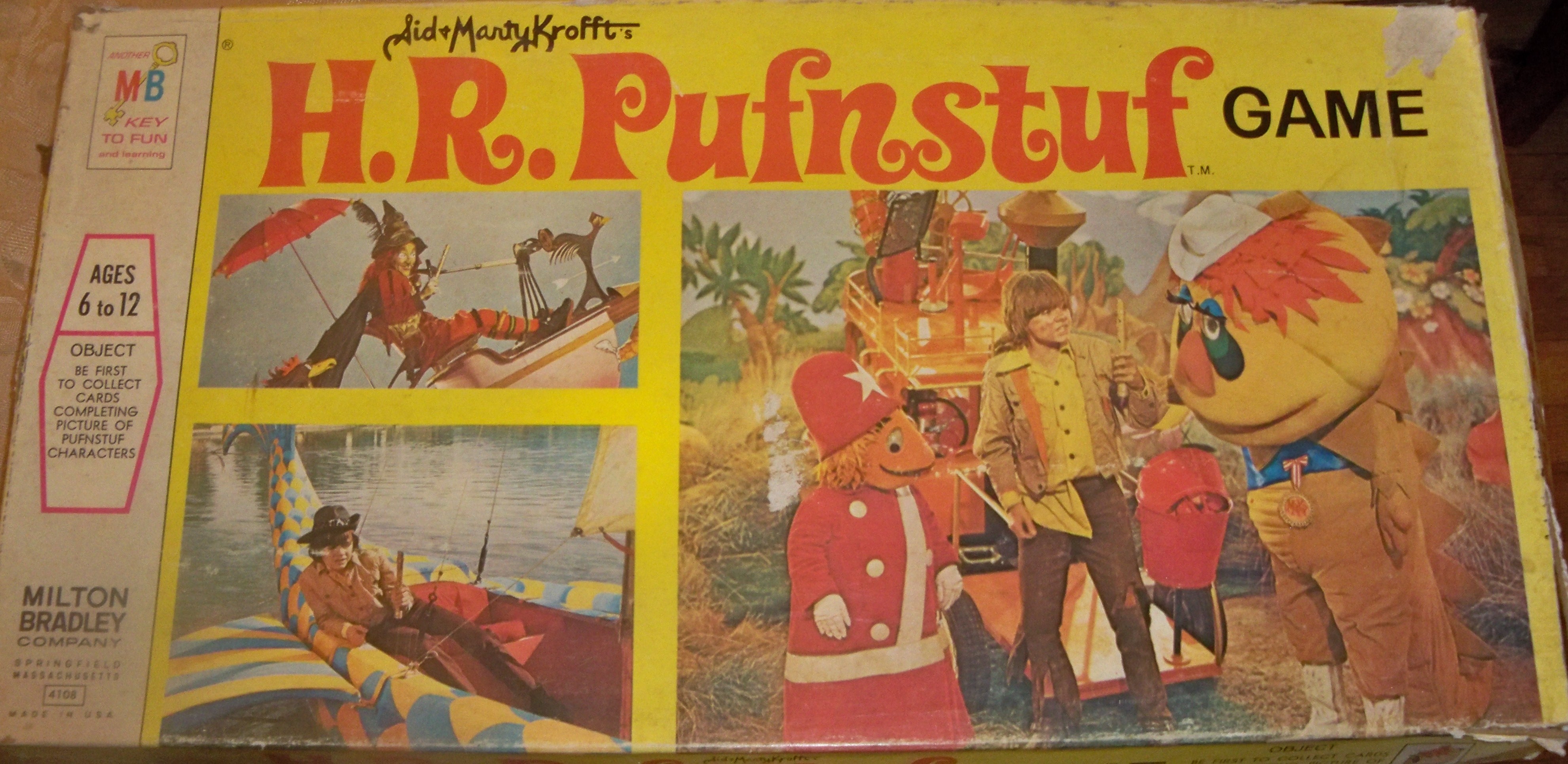
Today’s Game: H.R. Pufnstuf Game
Copyright Date: 1971
Object: Be first to collect cards completing picture of PufnStuf characters.
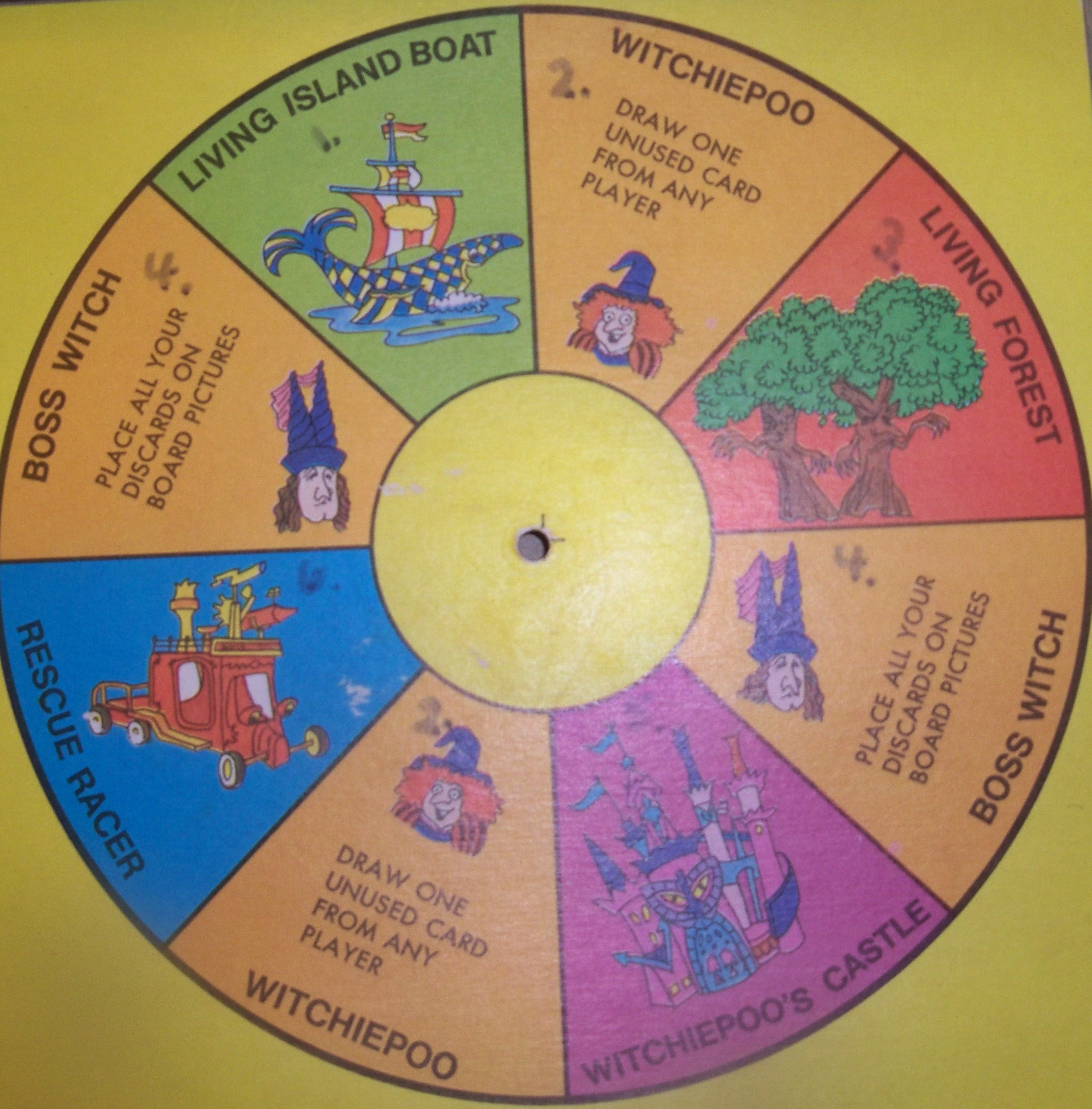
Game Board: Colorful and cartoony, though the cartoon likenesses leave a lot to be desired.
Game Pieces: None. Cards and a spinner are all you need to play this game.
Recommended Ages: 6-12. The game box, with its full-color photos, might have attracted kids throughout that age range, but the graphics inside scream little kid.
Game Play: The board is really superfluous in this game; players don’t move around it. They just spin and collect cards and try to complete a puzzle. (It’s nice that Freddy the Flute gets his own puzzle; on the show, he just squeaked “Jimmy” and got stolen a lot.
Personal Notes: I never had this game as a child—I would’ve been too young to play it in 1971. I did watch H.R. Pufnstuf, though, and still have the disturbing, hallucinatory memories to prove it.
About the Show: H.R. Pufnstuf premiered on September 6, 1969, as part of NBC’s Saturday morning lineup. Popular with kids, it aired for two years on NBC, one year on ABC, and two and a half years in widespread syndication—an amazing feat considering that Sid and Marty Krofft only produced 17 episodes.
Final Fun Fact: Jack Wild, who starred as Jimmy, got to keep one of the original Freddy the Flutes as a souvenir after the show wrapped, according to the book Pufnstuf and Other Stuff.
Let us venture again into the world of vintage board games.
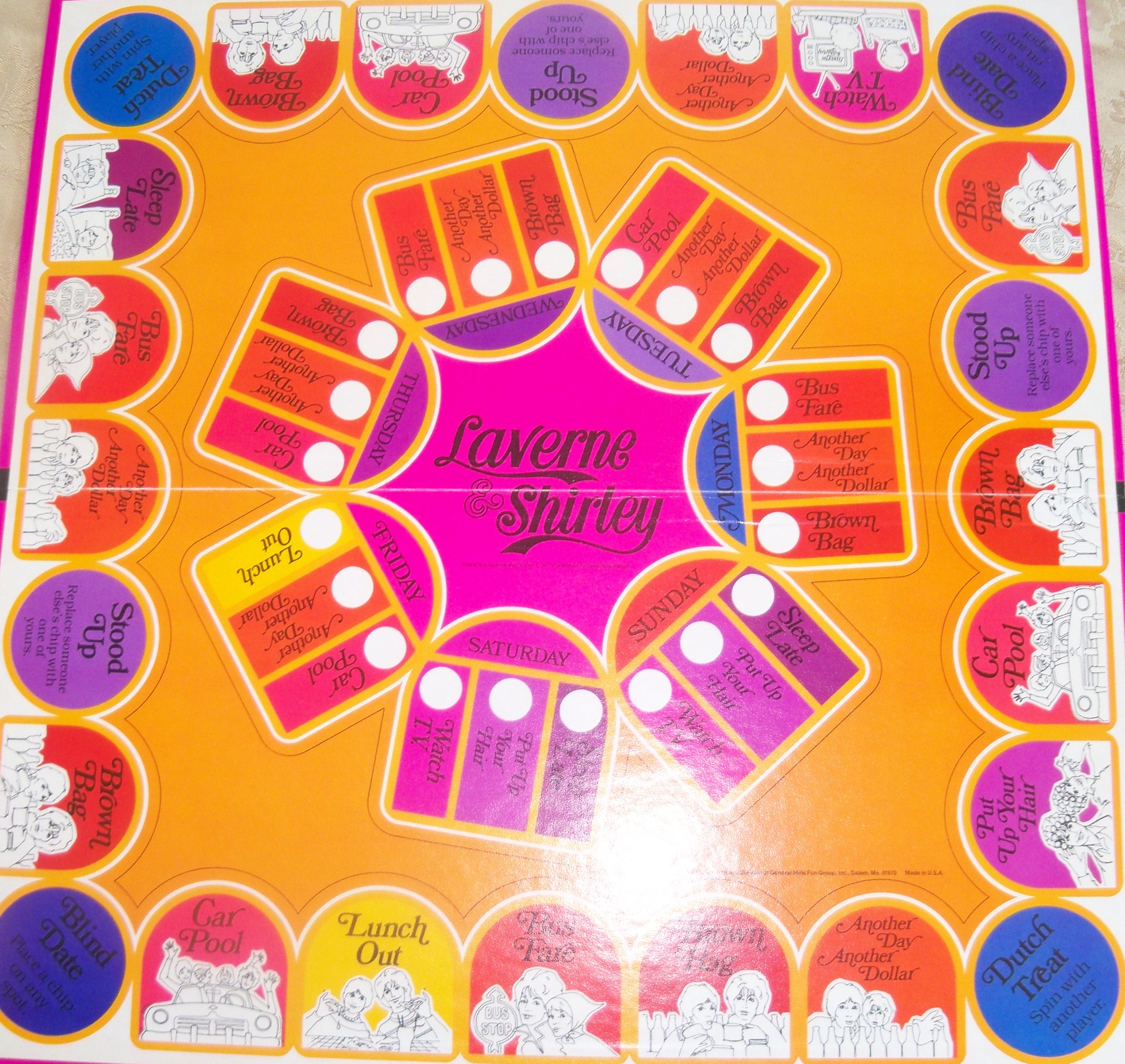
Today’s Game: Laverne & Shirley
Copyright Date: 1977
Object: “Make all your dreams come true.” (In this game, all your dreams must involve dating. She who dates the most, wins.)
Game Board: Colorful, but the Laverne and Shirley caricatures are drab. Perhaps they complement the drab vision of blue collar life this game portrays—an endless round of rent paying, hair washing, TV viewing, bus riding, and brown-bag lunching.
Game Pieces: Standard plastic pegs. The most interesting game element is your “diary,” which you strive to fill up with dating minutes.
Recommended Ages: 8-14. Manufacturers often put an upper age limit of 13 or 14 on these TV show games. I don’t what their reasoning was, but I can imagine parents using it to their advantage: “I’d love to play Laverne & Shirley with you, Lisa, but rules are rules.”
Personal Notes: Did you ever see something and know you’ve seen it before, long ago? That’s how I felt looking at this game board, though I’m pretty sure I never owned the game. I must have played it at a friend’s house.
About the Show: Laverne & Shirley premiered in January 1976. I remember watching the first episode and finding it hilarious. The rest of America agreed, quickly propelling the show to number one. I was 7; I don’t know what the rest of America’s excuse was.
Final Fun Fact: According to The Complete Directory to Prime Time Network and Cable Shows, “Critics called (the show) TV junk food; ABC program chief Fred Silverman responded by comparing it to the classic satire of the 17th century French playwright Moliere.”
Blogging about lunch boxes yesterday got me thinking about school supplies and how they’ve changed through the years. My daughter’s school provides lengthy, specific supply lists to parents each summer. On the first day of school, her backpack contains a spine-disfiguring load of tissues, hand sanitizer, spiral notebooks, folders, loose-leaf paper, and glue sticks.
School-supply shopping was simpler in the 1970s. My teachers rarely required anything specific—as long as you had paper and pencils, you could organize your work any way you wanted. Once, in seventh grade, I tried a complicated system of color-coded folders and spiral notebooks for each class. The more common organizational tool, however, was a binder. (Strangely, this is one supply my daughter’s school bans.)
Many people have fond memories of their Trapper Keepers. You can find tributes to them across the web, and people snap up vintage ones on Ebay. The Trapper Keeper even inspired a South Park episode.
My first and favorite binder, however, was the Trapper Keeper’s forgotten older sibling: The Mead Data Center.
As far as I can tell, Mead introduced the Data Center in 1975, three years before they released the Trapper Keeper. Like that later binder, the Data Center came with a detailed measurement conversion chart. Other features, according to an Etsy listing for vintage 1975 one, were a planner, a place to record your class schedule, a telephone directory, a three-year calendar, a notepad that clipped onto the binder, and a pencil holder.
Now, when I had this model in third grade, almost all these features were useless to me. But I loved the idea of having them. These extras, and the name Data Center itself, suggested a grown-up, businesslike level of organization—a level of organization I’ve never been able to reach as an actual grown up.
This second part of this commercial shows that Data Center lasted into the 1980s.
Final Fun Facts: Mead corporate history is a complicated series of acquisitions and sales. Some trivia:
In 1968, Mead spent $6 million to buy an information technology company; this company went on to develop the Lexis Nexis electronic research system, which Mead sold in 1994 for $1.5 billion.
In the 1960s, Mead also acquired Westab, the company that invented the spiral notebook and produced Big Chief tablets, a back-to-school staple for mid-century kids.
In 1992, Mead sold American Pad and Paper—Ampad—to Bain Capital. Ampad’s subsequent bankruptcy is controversial. But this transaction does allow you to connect Mitt Romney to a Trapper Keeper with only two degrees of separation.
As an adult, you have many ways to express your tastes—you do it with the clothes you wear, the cars you drive, the home décor you choose, and the statements you spew across social media platforms.
But as child anticipating the first day of school and wanting to make a strong impression, your options were limited. Your mom was still buying your clothes. School supplies were mostly bland. Only one back-to-school purchase was both an expression of your individuality and a totem connecting you to your peers: The lunch box.
The National Museum of American History is hosting a small exhibit of vintage lunchboxes. (To celebrate the exhibit’s opening, the Museum enticed ancient celebrities to pose with their younger, immortalized-in-tin representations.)
The Lunch Box Museum in Columbus, Georgia, displays a much larger selection (and has now earned a spot on my bucket list). Lunch box collecting is a bustling business online, and many web sites offer photo galleries of the best and worst lunch box specimens. (I’m pretty sure one of my schoolmates had that Exciting World of Metrics box.)
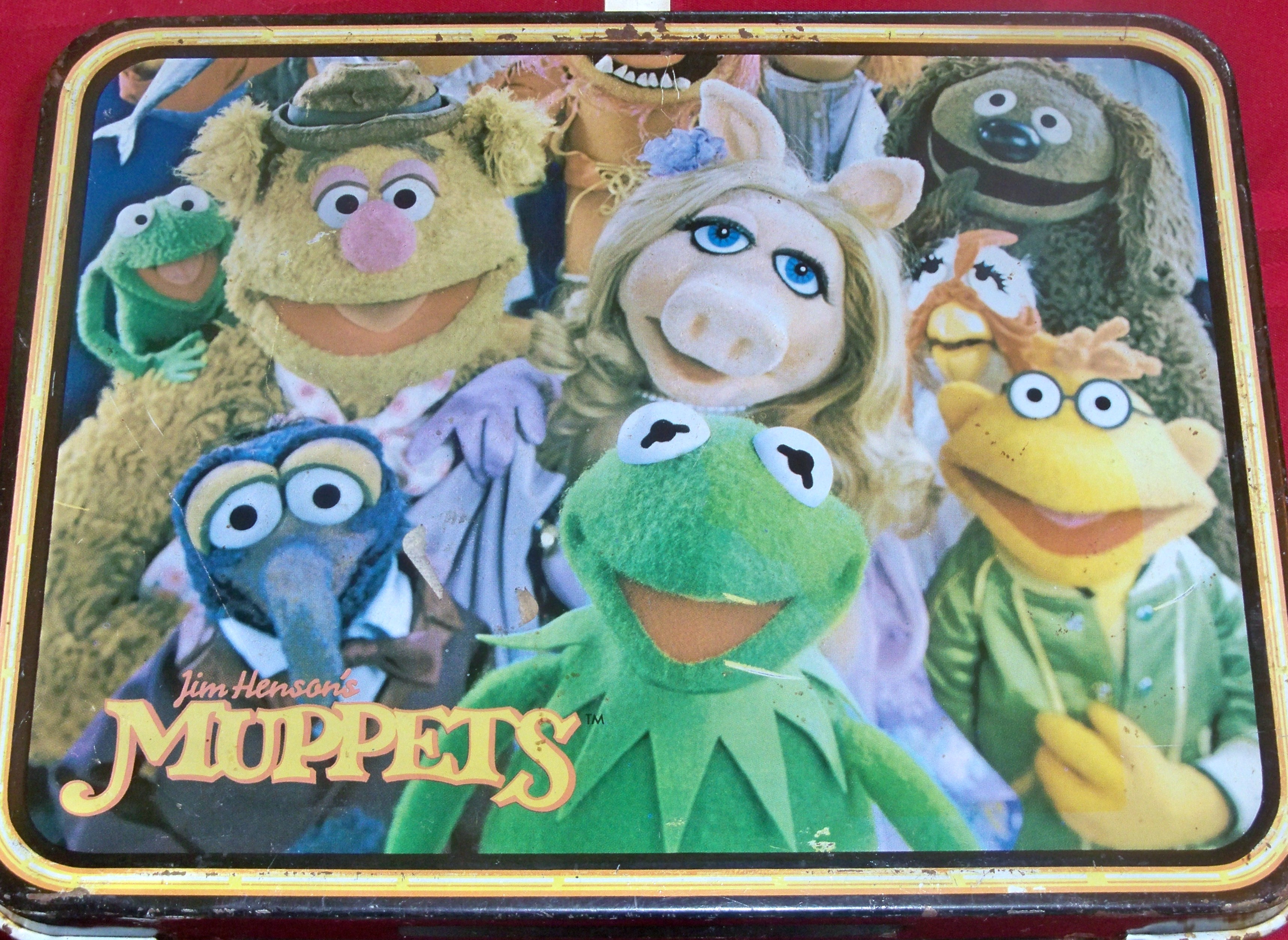
I grew up in the 1970s, the pinnacle of lunch box history. I remember my male classmates toting NFL, superhero, Six Million Dollar Man, and Star Wars boxes. Girls’ boxes offered the full gamut of 1970s female images, from Holly Hobbie to Charlie’s Angels. Disney, the Muppets, and Peanuts were always popular. All these boxes were metal, of course, with lithographed designs on every side. (This interview with a graphic designer who collects vintage lunch boxes provides some interesting insights on the design process.)
Though I remember other people’s lunchboxes, I can’t remember having one of my own in either first or second grade. I must have eaten hot lunch every day.
I do remember my third grade lunchbox—a yellow plastic dome-shaped Snoopy box. To my best friend and me, this box seemed innovative and different. Plastic! Domed, with a Thermos that fit in the top! We both bought them; I think hers was red.
That innovative plastic, sadly, signaled the beginning of the end for the lunch box heyday. Today, my daughter takes a cloth Vera Bradley lunch bag to school. It’s pretty and easy to carry, but I don’t think it will ever grace the Smithsonian.







 Embarrassing Treasures