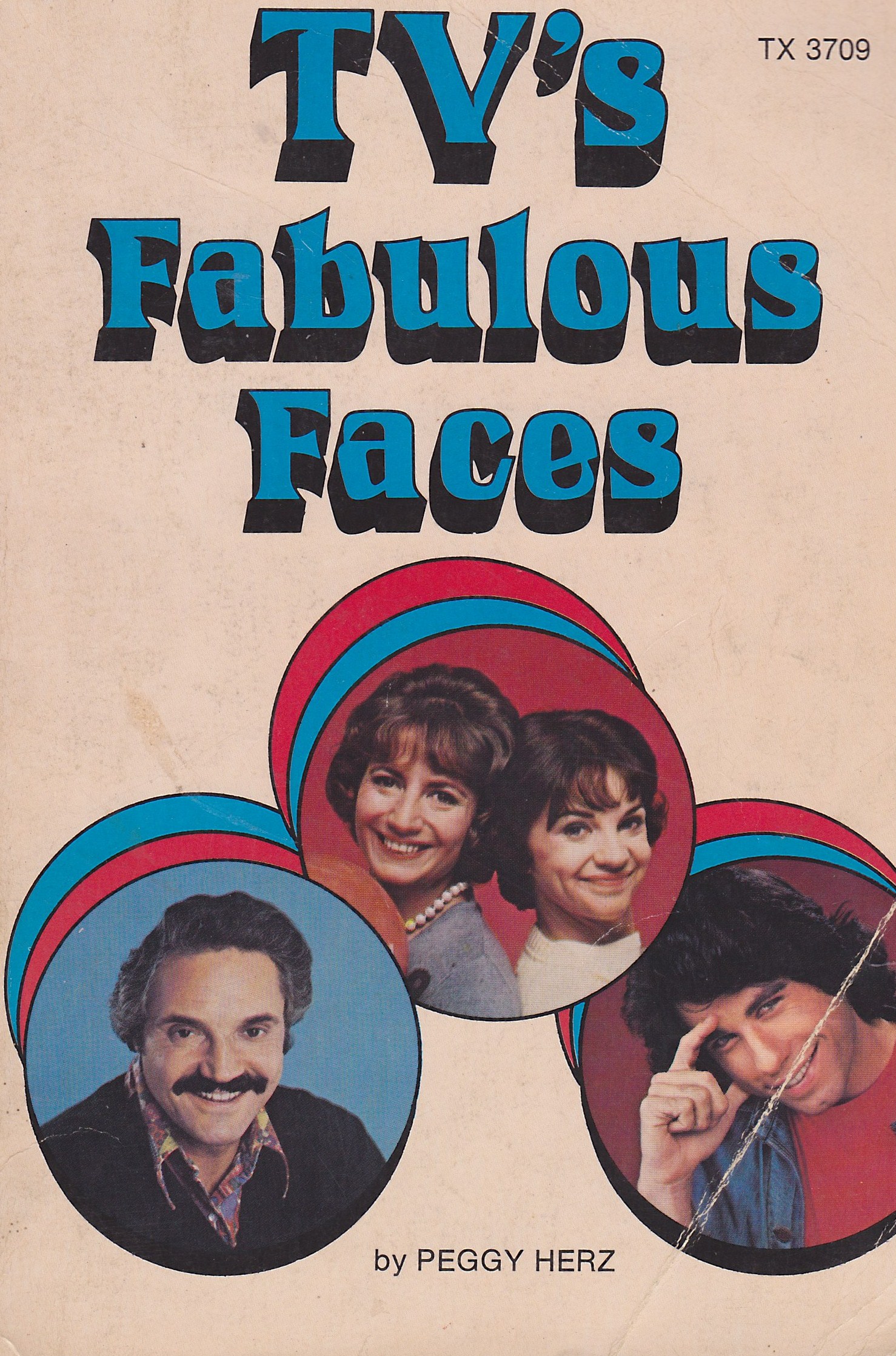
I wonder who decided to put Hal Linden on the cover of a kids’ book called TV’s Fabulous Faces. I mean, Donny and Marie have a chapter in here!
In tribute to Ron Palillo, who passed away August 14, I present this excerpt from TV’s Fabulous Faces, a 1977 Scholastic Book Club title:
“When the show first came on the air, some viewers thought Horshack was retarded. ‘That made me very angry,’ Ron said. ‘People pinned that label on Horshack because he is young. If you act that way when you’re older, they just say you’re a little slow.’
“Ron Shook his head in disgust. ‘At first, Horshack would only talk when Barbarino said, ‘You may talk now.’ That’s going on in schools today. It always has! Retarded? Go to schools and see the kids! Many of them are crying out for attention and that’s not because they are retarded! They are asking for help!’
“Kissing for fun is like playing with a beautiful candle in a room full of dynamite!”
‘Twixt Twelve and Twenty by Pat Boone, 1958
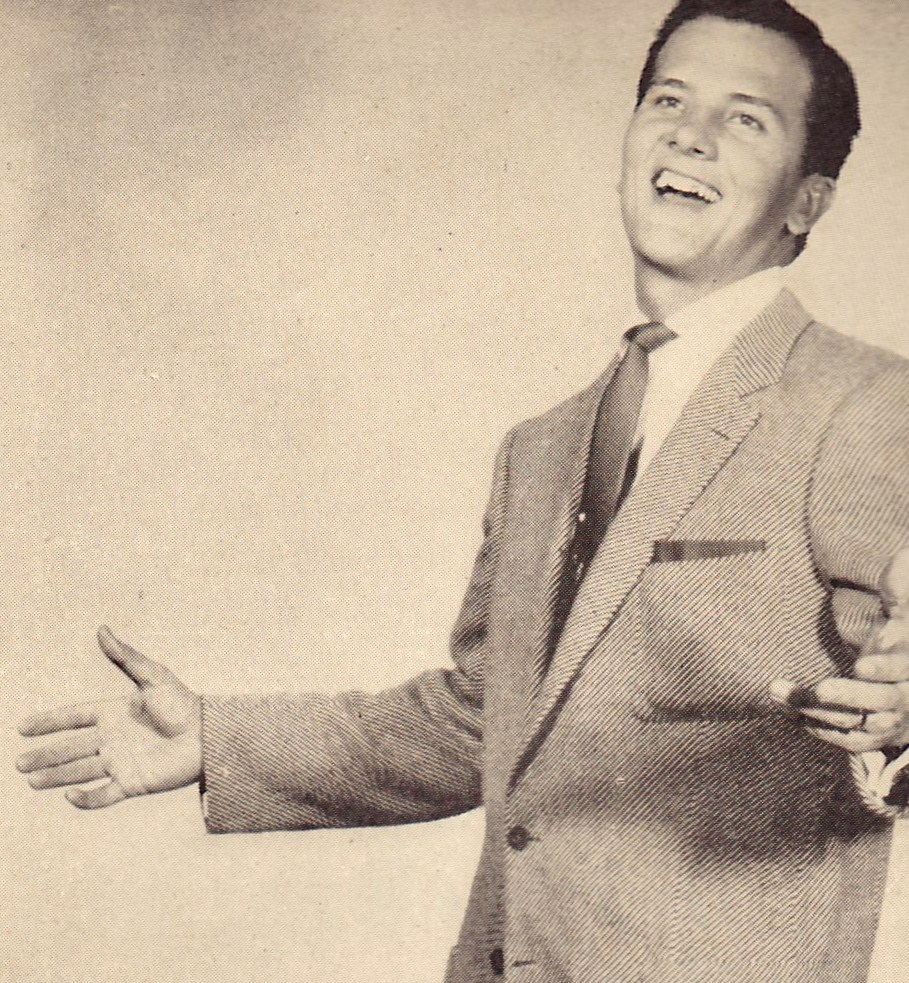
Would you let your teenage daughter take advice from this man?
About the Author: If you’re like me, and you know little about Pat Boone besides the fact that he’s Debby’s father, you may be surprised to learn just how popular he was in the 1950s. With 38 Top 40 hits, he was second only to Elvis in chart dominance. He also had his own TV show, The Pat Boone-Chevy Showroom, and starred in 15 feature films.
Boone has put his conservative Christian beliefs into practice throughout his career, avoiding sponsors and material that he considered offensive. His most controversial career move came in 1997, with his tongue-in-cheek foray into heavy metal.
Considering his conservative background, one shouldn’t find it surprising that Boone is a Republican political activist today—but it is disappointing to see he is a birther.
When ‘Twixt Twelve and Twenty was published, Boone and his wife Shirley had been married for five years and were raising four daughters.
About the Book: If it seems strange today that teens would turn to a young married celebrity for advice on surviving adolescence, the phenomenon was common in the 1950s. ‘Twixt Twelve and Twenty was one of the most popular books of its kind—in fact, according to the Washington Post, it was 1958’s second-highest selling nonfiction book.
While a ghostwriter probably contributed to this book, it displays a convincingly folksy Booneishness. Words and phrases like “chillun,” “’taint true,” and “lil ol’ teenager” appear frequently. Boone’s evangelical Christian beliefs pervade the book, which according to Time, he promoted at Church of Christ congregations nationwide. Parents who share his beliefs would probably find much to like in this book, even today.
While he avoids details on sex, Boone urges teens to stick to innocent “April love,” until they are truly ready for “May” (a serious, steady relationship) and “June” (marriage). He doesn’t go the full Duggar by condemning teen dating and kissing entirely.
Basically, Boone recommends being yourself, developing good habits, practicing the Golden Rule, and resisting the urge to grow up too fast—things that even a secular-minded, liberal parent like myself can get behind.
The Boone Family Spanking Situation: The book hits its one really weird note on the issue of corporal punishment:
“And of course there are spankings—and spankings. There is the delayed spanking that sets in when you’re too old to go across Mama’s knee and have to wait until you get home and lean over the bathtub. There is the angry spanking and the loving spanking. My mother never gave ‘loving’ spankings. I wouldn’t know what they were. But hers weren’t angry either; they were intelligent and they were just.”
Boone informs readers that his mother delivered these spankings with a sewing machine belt, and didn’t stop her “lean over the bathtub” spankings until he was seventeen (and only then, apparently, because her inability to make him cry frustrated her).
Now, I don’t believe in spanking at all, but surely even most spanking advocates would find that a bit excessive. Even more shocking is the way this carried over into the next generation, as the Washington Post described in a 1978 Debby Boone profile:
Perhaps the man she is still closest to is her father. Both say that their stormy battles during Debby’s teens have made them even closer now. For Debby the turning point was in Japan; for Pat it was in Columbus, Ohio, two years ago when the family appeared at the state fair. They all thought it was going to be their last show together.
“We all were in an emotional state,” he recalls. “Debby (who was 19 then) had left the room to go and get candy; and was gone for a half-hour. I was worried about her and went to find her. She was in the lobby talking to some musicians, but was upset that I embarrassed her in front of them. It was a trivial matter really, but when we got back to the room I thought she was pretty sassy. One thing led to another and suddenly I threw her over on the bed and spanked her in front of her mother and her sisters.”
Afterwards, feeling chagrined and guilty, the father apologized to his family and led them all in prayer. “But there were no hugs and kisses that night,” he remembers. The next day on the plane, he heard Debby laughingly tell the girls about the black and blue marks on her bottom. “I found there were tears in my eyes,” he says, “for I realize Debby had let me off the hook. Overnight, she had forgiven me for being out of line.”
Spanking your 19-year-old daughter? At the risk of Pat Boone considering me unladylike: WTF?
Original Owner: My copy belonged to a girl named Carol Sue, whose parents inscribed it to her and gave it to her as a 12th birthday gift.
Final Fun Fact: Twixt Twelve and Twenty is also the name of a 1959 Pat Boone hit.
Other Quotes from ‘Twixt Twelve and Twenty:
“Popularity—‘manifest approval of the people in general’—can be a good, sound thing, but it can also be a personality freak or a snow job. Adolf Hitler was the most popular man in Germany for quite a spell.”
“It doesn’t make sense to me that girls who want to be as pretty as possible, who intend to be feeding and caring for a whole family day after tomorrow, don’t know how to feed and care for themselves today. Yet magazine articles, dietitians, beauticians, high school principals, all sigh over the high percentage of poor physical care and poor nutrition among teenagers, even in top economic areas.”
“Take my first steady…She was a very pretty girl, a wonderful singer, much in demand. But she put too much strain on young love. She let me see her in her curlers.”
“(Shirley) has the kind of beauty I admire. A neatness, a freshness and cleanness, as well as pretty features. Her physical attractiveness is the quiet, decent kind that a man looks for in a wife.”
“Sometimes, girls, if you let your husband boss the project a little, he’ll wind up doing the work quite efficiently. Because, you see, it’s his corporation.”
“Bad language is a dead giveaway that the user is covering up ignorance (he doesn’t know what he’s talking about) or is pretty lazy (he knows, but he won’t take the trouble to say it). Or, worst of all, that he thinks it’s smart!”
Also on swearing—“We’ll assume ladies never develop the above mentioned habit—I hope—I hope!!”
“We all say marriage is a partnership and, for the most part, we mean it in the sense of sharing the fun, the joys, the responsibilities, the highs and lows of any family’s life. But just as there can be only one skipper to a boat, one driver to a car, or one president of a company, so there can be only one head of a happy house—and that is, by law, by taxes, by census, and by woman’s intuition, the husband. It’s a pleasant thought to remember that if a man’s home is his castle, he must be the lord and master; and you, therefore, are the chatelaine, the mistress of the castle and keeper of the keys to a very happy existence as a wedded wife.”
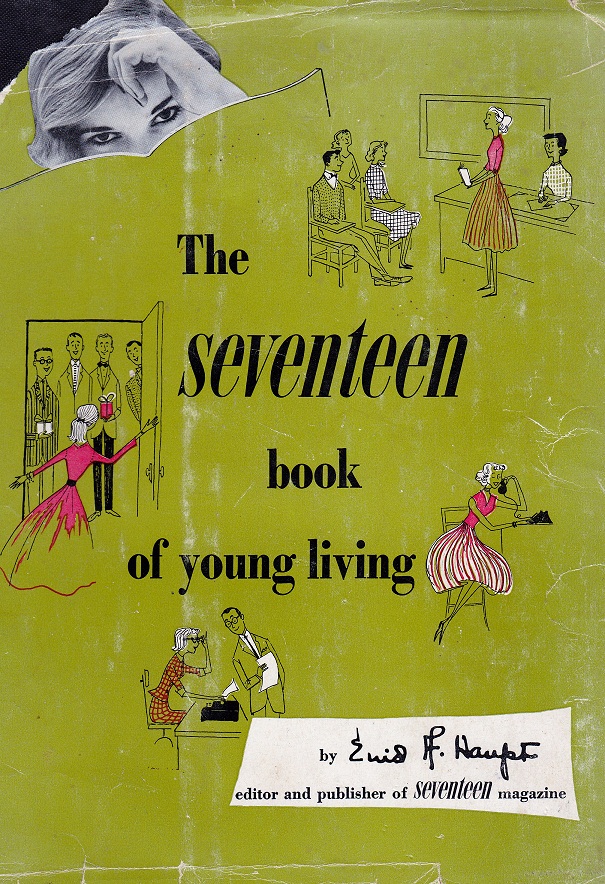
The Seventeen Book of Young Living by Enid Haupt, 1959
About the Book: This book, purchased at a library book sale two decades ago, started me collecting advice manuals aimed at teenagers. I wasn’t so far past my own teenage years then, and the book’s quaint advice on dating, friendship, fashion, and school amused and sometimes charmed me. As I added more advice books to my collection, I became fascinated by what the books reveal about the past. Reading what a given era’s adults felt young people should know tells you a lot what a society valued.
(Reading what previous owners wrote or left in these books can be interesting, too. The previous owner of my book recorded her first name as “Twinkle.” This suggests she was a careful student, indeed, of The Seventeen Book of Young Living.)
This book strives to introduce budding Betty Drapers to gracious living, mid-century style, from party planning to the art of conversation (“Books, plays, and movies are always welcome subjects”); from bedroom decorating to managing men (she recommends that a girl develop “a very feminine ability to look prettily bewildered and helpless while plotting and achieving a goal she thinks is really important.”)
More than many such books, this one encourages girls to develop their minds as well as their manners. The author recommends exploring the arts and expresses unusual ardor when the subject turns to books.
Haupt, who edited and published Seventeen for 15 years beginning in 1955, strove for an elevating tone. She accepted the editorship from her brother, legendary publisher Walter H. Annenberg. “I knew nothing about running a magazine,” she told the New York Times in 1992, “but my brother said, ‘You can bring culture to the average working person who has not had your advantages.’ ”
I used to laugh at the back-cover photo of Haupt, all prim and pearled—and her Times obit’s revelation that she led Seventeen “from a pink swiveled throne in a large office dominated by pink curtains and pink flowers” supports my initial impression of her.
Actually, Haupt exuded true graciousness. She donated much of her publishing-dynasty fortune to worthwhile causes, including Memorial Sloan-Kettering Cancer Center, the New York Public Library, and the Metropolitan Museum of Art. Her love of gardening inspired her largest philanthropic gifts, including $34 million to the New York Botanical Garden in the Bronx.
(“Nature is my religion” was apparently one of her favorite sayings—and to that I say, “Amen!”)
“I suppose I have an exaggerated sense of the beauty of the world, rather than the ugliness,” Haupt told the Times.
In The Seventeen Book of Young Living, Haupt does avoid most controversial subjects. Even for the era, her treatment of sex is vague: “The major responsibility for any romance disintegrating into an affair—that can only lead to reproaches—is the girl’s. Your chances of causing the boy you love, or yourself, anything but unhappiness are fairly slim if you fail to conform to the generally approved standards of behavior.”
On at least one issue, however, she takes a firm stand—she spends an entire chapter trying to squelch prejudice in her young readers.
Final Fun Fact: Haupt, who died at age 99 in 2005, lived for many years in a penthouse at 740 Park Avenue. Author Michael Gross wrote an entire book about that address, home to what he calls the “world’s richest apartment building.” Haupt’s penthouse, which she bought for $350,000 in 1967, sold for $27.5 million in 2006, according to the Times.
Other Quotes from The Seventeen Book of Young Living:
“In dealing with any male, the art of saving face is essential. Traditionally, he is the head of the family, the dominant partner, the man in the situation. Even on those occasions when you both know his decision is wrong, more often than not you will be wise to go along with his decision—temporarily—until you can find a face-saving solution.”
“If you’ve ever watched your brother’s grimaces when he’s been haunted by telephone calls from a love-smitten young lady, you would better understand the embarrassment the boy suffers and the blow you are dealing your relationship by being aggressive.”
“Flirting is probably inevitable at youth, because at this age it’s almost second nature for a bright pretty girl to sparkle at the men and boys she meets.”
“If you are going out with one boy on an exclusive basis, the temptation to offer to share expenses for movies, tennis balls, and so on will be very great. Resist it…trying to pay your way can only be awkward and damaging to you both.”
“Prejudice shows up in many ways, all indicating flaws in the structure of a personality. It indicates ignorance, fear of new things, inability to meet the challenge of the unknown.”
“You, the young in spirit and in years, have no place in your hearts for prejudice against anybody or anything. It’s a big world you’re going out into, and you need an open mind and an open heart to take advantage of the all the friendships, knowledge, and beauty that await you.”
“The better born and bred a person is, the less prejudiced he is.”
 Embarrassing Treasures